
How Brand Mentions and Source Authority Influence AI Visibility
A practical, architecture-first guide for marketing and SEO leaders on how brand mentions, source authority, and entity architecture affect visibility in Google, AI Overviews, and other answer surfaces.
1. Framing: definitions and where this matters
Start with shared definitions. A precise vocabulary keeps technical, product and marketing teams aligned when they design systems for AI visibility.
What AEO, GEO and entities mean here
AEO (Answer Engine Optimization) focuses on optimizing content and signals so answer engines and answer features (like direct answers, snippets, or AI Overviews) can use your content. GEO (Generative Engine Optimization) is the broader practice of making content retrievable and useful to generative models and answer surfaces that synthesize across sources. In both cases ‘entities’ are the discrete people, organisations, products, places, concepts or events that systems recognise and link across content.
- AEO/GEO are optimization disciplines, not guaranteed placements.
- Entities are identity nodes used by knowledge graphs and retrieval systems to tie mentions, facts and documents together.
Retrieval, citations, structured data and knowledge graphs — quick map
Retrieval systems decide which documents or passages to consider for an answer. Citations are how a system attributes that answer to a particular source. Structured data (schema) helps machines map page content to entity properties. Knowledge graphs store canonical entities and their relationships — they’re the connective fabric that helps engines resolve ambiguous mentions.
- Retrieval selects candidate content; ranking and citation logic decide what’s shown and attributed.
- Structured data reduces ambiguity; knowledge graphs provide canonical identity and relationships.
2. What search engines document versus what practitioners infer
Separate documented guidance from inference and experiment. That distinction affects both what you can rely on and how you design controls.
Documented guidance (what Google publishes)
Google publicly documents principles about helpful content, structured data, and AI features. For example, Google encourages people-first, reliable content and explains how structured data helps machine understanding. Google’s AI features guidance explains how content may be used in AI-powered surfaces and how high-quality sources are preferred, but it does not promise placements or automatic citations.
- Follow Google’s helpful content guidance for people-first content.
- Implement structured data where it applies; it helps machines understand page elements and entities.
- AI features documentation clarifies how content may be used but stops short of specific ranking factors or guarantees.
Practitioner inferences and observed signals
Practitioners observe that brand mentions, co-occurrence patterns, link graphs, and distribution affect entity salience and retrieval likelihood. These are inferences built from empirical testing, log analysis and information retrieval research — useful for designing systems, but not guaranteed by search providers.
- Co-occurrence: repeated thematic mentions across reputable sources strengthen an entity’s topical footprint.
- Brand mentions without context have less value than mentions linked to entity facts and content.
- Link authority still correlates with discoverability; mention density and quality of contexts also matter.
3. How brand mentions feed entity identity and authority
Mechanically, brand mentions influence two things: entity recognition (does the system know you exist and which entity you are?) and source authority (how trustworthy or relevant you appear).
Entity recognition and canonical identity
Brand mentions provide surface signals that link text to an entity. Systems resolve identity through a combination of co-reference (sameAs links, canonical URLs), structured data (schema.org properties), and distribution across authoritative publishers. Tell the same entity story consistently across your web properties and partner channels so retrieval systems can canonicalise mentions.
- Use consistent naming, canonical URLs, and sameAs statements where appropriate.
- Structured entity pages (about pages, product schemas) help build a canonical identity.
Source authority as a retrieval signal
Authority is multi-dimensional: editorial standards, expertise, link profile, user engagement, and historical reliability all feed how retrieval systems weight sources. Brand mentions on low-quality pages add little; mentions on recognized authoritative sites (and within authoritative contexts) have greater impact — empirically, not guaranteed.
- Prioritise mentions on pages with clear editorial context and topical relevance.
- Earn mentions that include descriptive context (quotes, fact-statements) rather than simple name drops.
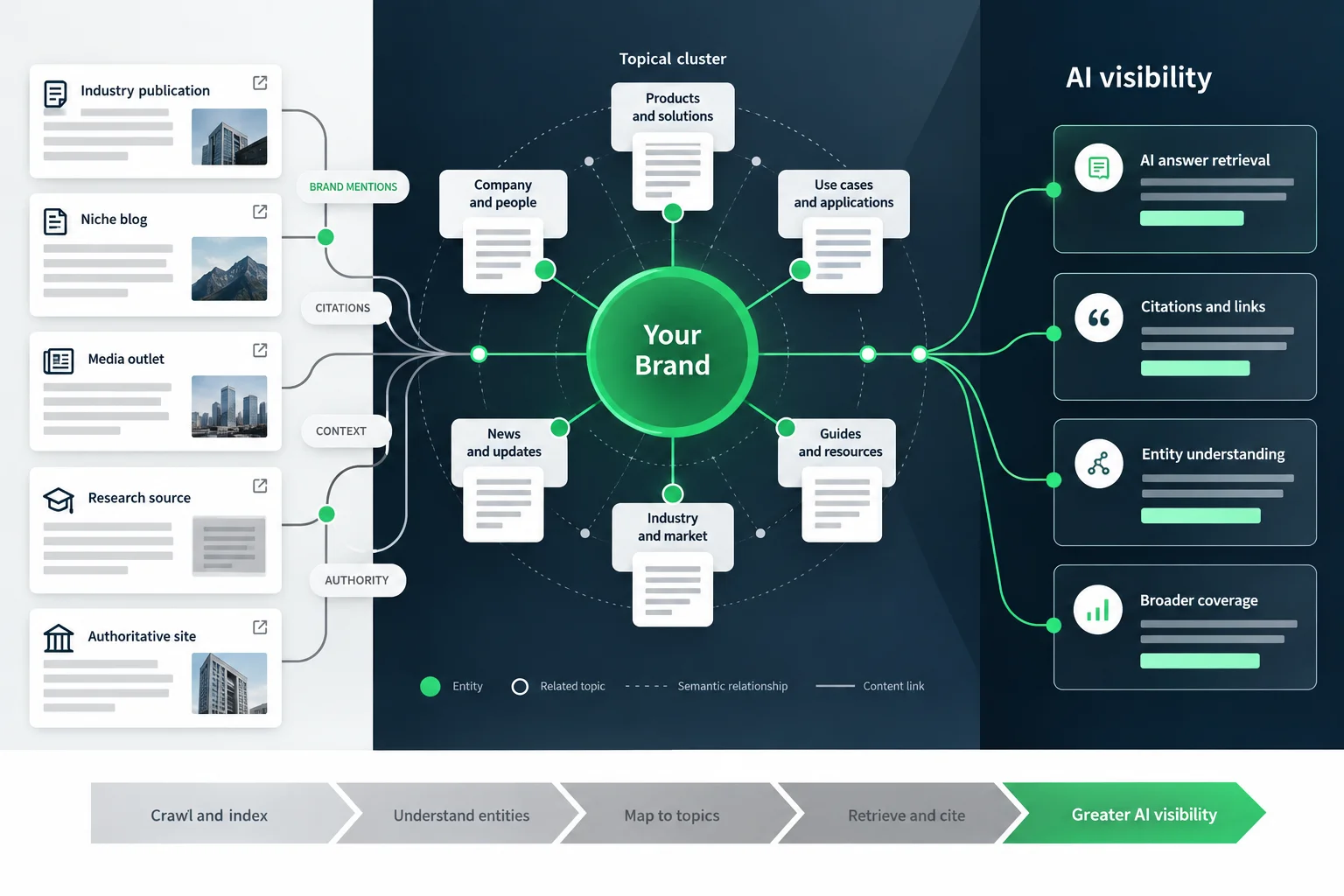
4. Architecting visibility: data contracts, identity, and APIs
Treat visibility as a system integration problem with clear contracts between research, content, structured-data output, distribution channels, and retrieval adapters. This section explains the architecture and operating model you should run.
System architecture: from entity model to retrieval adapters
Design a pipeline: Research & entity model → topic & page graph → authoritative content → structured data & internal linking → distribution & brand signals → retrieval and citation surfaces → measurement and iteration. Each step requires explicit data contracts and canonical identifiers (entity IDs, canonical URLs, schema mappings).
- Entity model: canonical IDs, types, relationships, and synonyms.
- Page graph: map pages to entity IDs and topic nodes with content intent.
- Retrieval adapters: APIs or connectors that expose content indexes, metadata and canonical IDs to retrieval systems or internal LLMs.
APIs, data contracts and controlled adapters
Don’t rely solely on public crawling. Provide controlled, authenticated endpoints and content bundles for partners or owned retrieval systems: sitemap manifests, JSON-LD feeds, or discovery APIs. Data contracts should include canonical URL, entity ID, schema type, structured-data payload, last-modified, and content-immediacy flags for freshness-sensitive answers.
- Use authenticated feeds for high-value content to ensure reliability and freshness.
- Document schema versions and field-level contracts so retrieval engineers can depend on stable inputs.
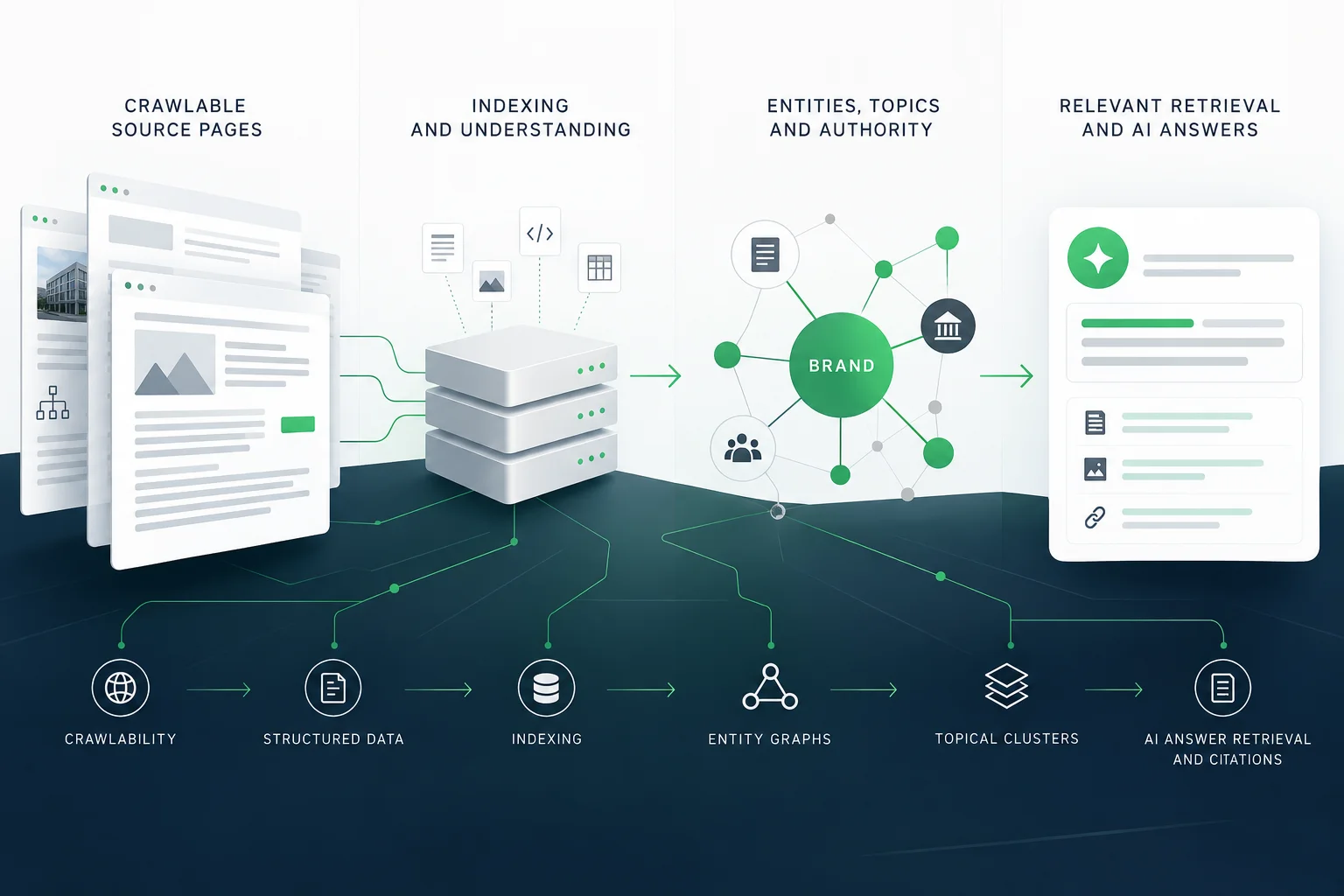
5. Content and technical controls that improve being cited
What practical content and technical controls move the needle in a controlled, repeatable way? Focus on canonical entity pages, structured facts, internal linking, and distribution.
Authoritative entity pages and structured facts
Build canonical entity pages—clearly titled, semantically structured, and populated with verifiable facts. Use schema.org types appropriate to the entity (Organization, Product, Person, Event) and include sameAs links for official social and knowledge-graph mirrors. Facts should be concise and citable (dates, specifications, primary quotes).
- Include JSON-LD with canonical property values and stable identifiers.
- Surface verifiable facts near the top of the page so retrieval extracts useful passages.
Internal linking and topical page graphs
Internal linking builds a topical graph that helps retrieval select representative pages. Link entity pages to supporting content (how-to, guides, reports) and use consistent anchor text that reflects entity properties and relationships.
- Map internal links to the entity & topic graph; prioritize depth for high-value topics.
- Use breadcrumbs and hub pages to create concise authoritative entry points.
Distribution and brand signal orchestration
Coordinate PR, partnerships, developer docs, and syndication to produce high-quality mentions that include context and links back to canonical pages. Where syndicated mentions are unavoidable, ensure syndication includes canonical URLs or structured meta tags pointing to your canonical content.
- Prefer mentions with context and linking; quantify mentions by authority and relevance.
- Provide ready-to-use data bundles for partners (press kits with canonical links and structured metadata).

6. Measurement, experiments and observability for AI visibility
Measurement is an engineering discipline. You need experiments, logs, and metrics that tie changes in entity architecture and distribution to observable retrieval outcomes.
What to measure and how
Track both upstream signals and downstream outcomes. Upstream: mentions (contexted), inbound links with context, structured-data coverage, and feed ingestion health. Downstream: presence in answer surfaces (as observed by SERP/feature scrapes), referral traffic from features, and citation frequency in controlled partners or commercial APIs.
- Instrument mention collection with source authority metadata (domain rating, editorial context).
- Measure structured-data coverage and validation error rates.
- Track retrieval outcome signals: feature impressions, snippet captures, and click-through where available.
Experimentation and causal inference
Use A/B tests or staggered rollouts when possible. For brand mentions, test controlled placements (same content on different-authority hosts) and measure retrieval changes. For structured-data and canonicalization fixes, run before/after tests while controlling for temporal confounders.
- Design short-term and long-term measurement windows — knowledge graph effects can be gradual.
- Use reliable baselines, and avoid attributing short-term noise to strategic changes.
Privacy, data residency and compliance considerations
Be cautious when creating feeds or exposing user data. Decide hosting and backup regions, subprocessors, and access controls. For regulated content (health, finance), document boundaries and consult legal teams; guidance varies by jurisdiction and use-case.
- Identify hosting region, backup region, and subprocessors for any shared API or feed.
- Record and manage consent for user-generated content, and limit PII exposure in public feeds.
- Consult qualified legal professionals for jurisdiction-specific obligations.
Related Peak Demand resources
Industry and AI sources reviewed
- Creating helpful, reliable, people-first contentGoogle Search Central
- Understand how structured data worksGoogle Search Central
- Schema.org DocumentationSchema.org
- AI features and your websiteGoogle Search Central
- SEO Starter GuideGoogle Search Central
Search-engine and AI-answer behavior changes over time. Google documentation can establish published requirements and guidance, but inclusion in rankings, AI Overviews, citations, or LLM answers is never guaranteed. Practitioner observations should be labelled as inference or testing rather than official ranking factors. This article is operational guidance, not legal advice; organizations should confirm applicable requirements with qualified professionals.
Frequently asked questions
SEO improves visibility in traditional search results. AEO focuses on making content easy for answer systems to extract and use. GEO focuses on visibility in generative search and AI answer experiences. In practice, the strongest strategy combines technical accessibility, useful content, clear entities, strong internal relationships, structured data, and credible source authority rather than treating them as isolated channels.
Official reference: SEO Starter Guide
No. Structured data can make page entities and relationships more explicit and can support eligible search features, but it does not guarantee rankings, AI Overview inclusion, citations, or mentions in generative answers. It should reinforce accurate visible content rather than replace it.
Official reference: Understand how structured data works
Search and answer systems need to understand what a brand, person, product, service, or concept is and how it relates to other entities. Consistent naming, authoritative pages, structured relationships, internal linking, and corroborating references can reduce ambiguity and make a site easier to interpret and retrieve.
Official reference: Schema.org Documentation
Track traditional search visibility alongside query coverage, indexed pages, non-brand discovery, AI referral traffic where available, observed citations or mentions, entity consistency, content-cluster coverage, internal-link depth, and lead quality. Treat AI-surface monitoring as directional because answer composition can vary by model, query, user, and time.
Official reference: AI features and your website
Build a search and AI visibility system that compounds
Peak Demand connects technical SEO, entity architecture, knowledge graphs, structured data, topical authority, internal linking, distribution, and measurement into a managed SEO/AEO/GEO operating system.
Explore Peak Demand AI SEO, AEO & GEO


