
Governance & Orchestration Framework for Predictive, Accessible Transit Voice AI
A practical governance and orchestration framework that separates scheduled knowledge from real‑time alerts, defines validation and human‑handoff boundaries, and delivers predictable operational controls for accessible transit Voice AI.
1. Operating premise and scope
This framework applies to enterprise Voice AI used by public transit and municipal mobility organizations for rider information, accessibility support, and operational assistance. It intentionally excludes safety‑critical incident handling (e.g., active emergency response) which must remain with trained staff.
Purpose and boundaries
Define the service envelope before procurement or pilots. Typical Voice AI responsibilities include schedule lookups, fare and station information, trip planning assistance, accessible routing and service‑alert summaries. Do not assign clinical, legal, or emergency decisioning to the Voice AI. Map every dialog outcome to one of four outcomes: authoritative response, validated response requiring confirmation, case submission (service request), or human handoff.
- Outcomes: answer, validate, submit, escalate.
- Exclude emergency incident triage and safety‑critical commands from automation.
- Record and surface uncertainty levels to riders when data confidence is low.
Audience and measurable outcomes
When you measure success, prefer operational metrics that tie to rider experience and agency risk: first‑contact accurate answers for scheduled items, mean time to human handoff for escalations, case submission validity rates, and false‑positive escalation rate. Define acceptable thresholds in SLAs and day‑one runbooks.
- Accuracy for scheduled timetable queries (target per SLA).
- Handoff latency (seconds/minutes) and staffing rules for peaks.
- Validation failure rate and duplicate submission rate.
2. Architecture: clear separation of knowledge and alerts
Design the data plane and orchestration so scheduled knowledge and real‑time service alerts live behind different adapters and governance paths. This separation reduces risk of stale or conflicting answers.
Controlled knowledge base for scheduled information
Maintain an authoritative scheduled knowledge base (timetables, stops, fares, accessibility features). This dataset is curated, versioned, and published on a cadence with change control. Voice AI should read scheduled answers from this controlled source and tag responses as ‘scheduled’ with a timestamp.
- Versioned canonical schedules with roll‑forward timestamps.
- Change control and audit trails for schedule edits.
- Staleness checks: if scheduled authoritativeness is older than threshold, require human confirmation.
Real‑time alerts and predictive inputs via approved APIs
Detours, delays, vehicle positions, and operator alerts must come through explicitly approved APIs or feeds. Treat these feeds as event sources with their own SLAs and validation rules. Predictive features (e.g., estimated arrival) are permitted only when fed by low‑latency, high‑quality real‑time vehicle position or approved prediction services.
- Classify feeds: service_alerts (disruptions), vehicle_positions (telemetry), predictions (optional).
- Require feed SLAs and error budgets; instrument latency and update frequency.
- If real‑time feed quality drops below threshold, disable predictive outputs and fall back to scheduled messaging.
Orchestration pattern (rider → Voice AI → adapters → validation → outcome)
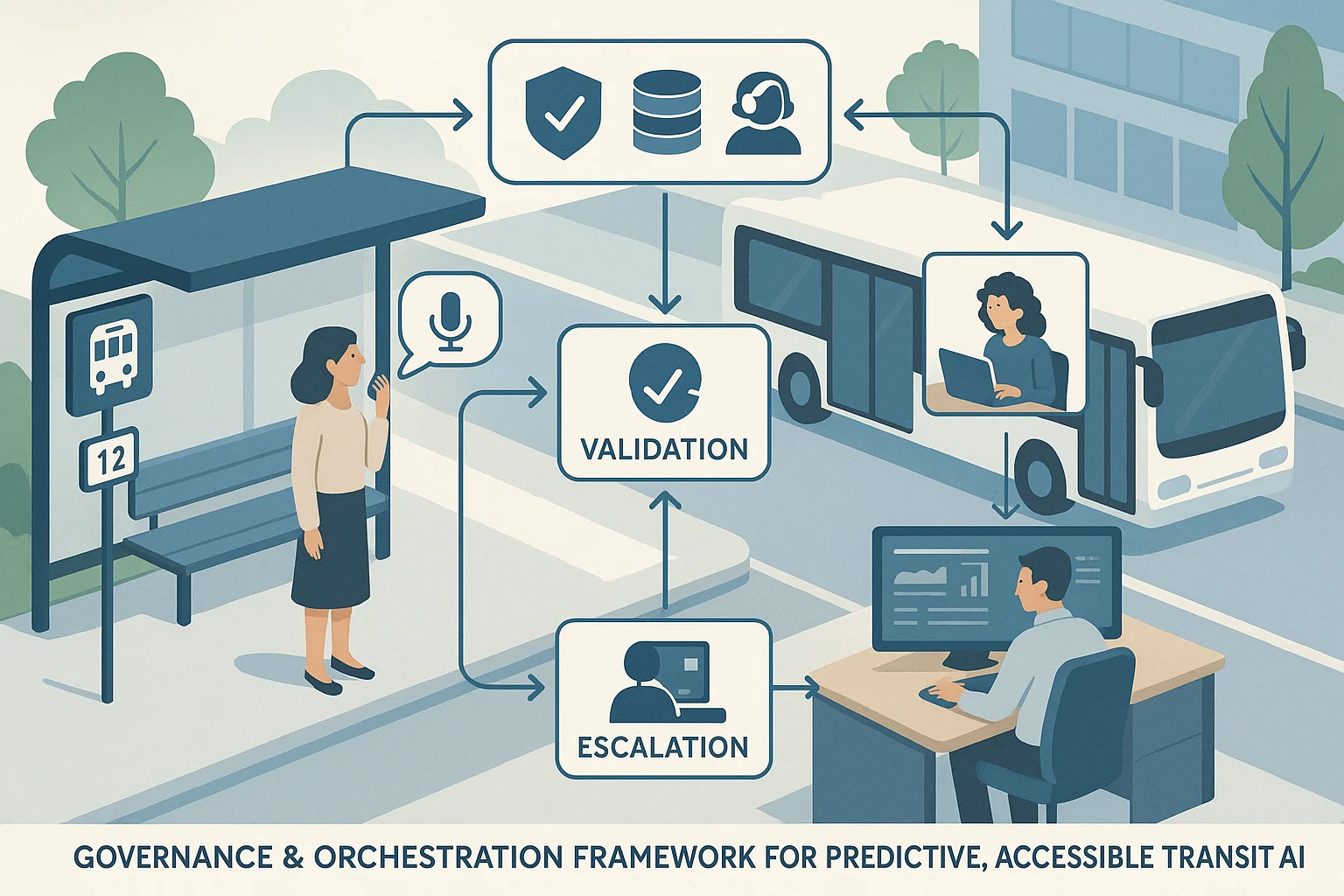
Adopt a linear orchestration: Rider interacts with Voice AI; the system consults either the controlled knowledge base (for scheduled queries) or the approved APIs (for alerts/predictions); responses are validated; then the flow either returns an answer, generates a case (with structured form), or routes to a human. Each adapter must surface provenance, confidence, and timestamps.
- Always include provenance: source type and last updated time in backend logs.
- Visibility: record adapter responses for QA and audit.
- Decision gates: confidence thresholds that determine whether to answer or escalate.
3. Governance, risk controls, and oversight
Formalize governance in policy and operational artifacts: risk register, change control board (CCB), audit logs, and human oversight rules. Tie AI risk management to existing agency governance structures.
AI risk management and principle alignment
Use established risk frameworks and principles as the foundation for governance: identify AI system purpose, enumerate harms, set tolerances, and embed monitoring. Align policies to internationally recognized principles for trustworthy AI and risk management.
- Catalog potential harms (misleading arrival times, accessibility failures, privacy leakage).
- Define acceptable risk thresholds and remediation playbooks.
- Include human oversight rules and staff training requirements in policies.
Operational controls and change control
Adopt strict change control for knowledge updates, model/voice changes, and feed adapter changes. Every change must have prelaunch tests (regression and safety checks), a rollback plan, and postlaunch monitoring windows.
- Prelaunch: deterministic test suites using canonical scenarios.
- Postlaunch: hourly checks during first 72 hours, with defined rollback triggers.
- Maintain an auditable change log accessible to compliance teams.
Security and infrastructure resilience
Protect integration points and real‑time feeds; maintain backups with known recovery RTO/RPO. Coordinate with transportation cyber resilience programs to ensure continuity under feed outages or attacks.
- Secure API credentials and use mutual TLS where possible.
- Plan for feed degradation: predefined fallbacks to scheduled content.
- Include the Voice AI in agency incident response playbooks.
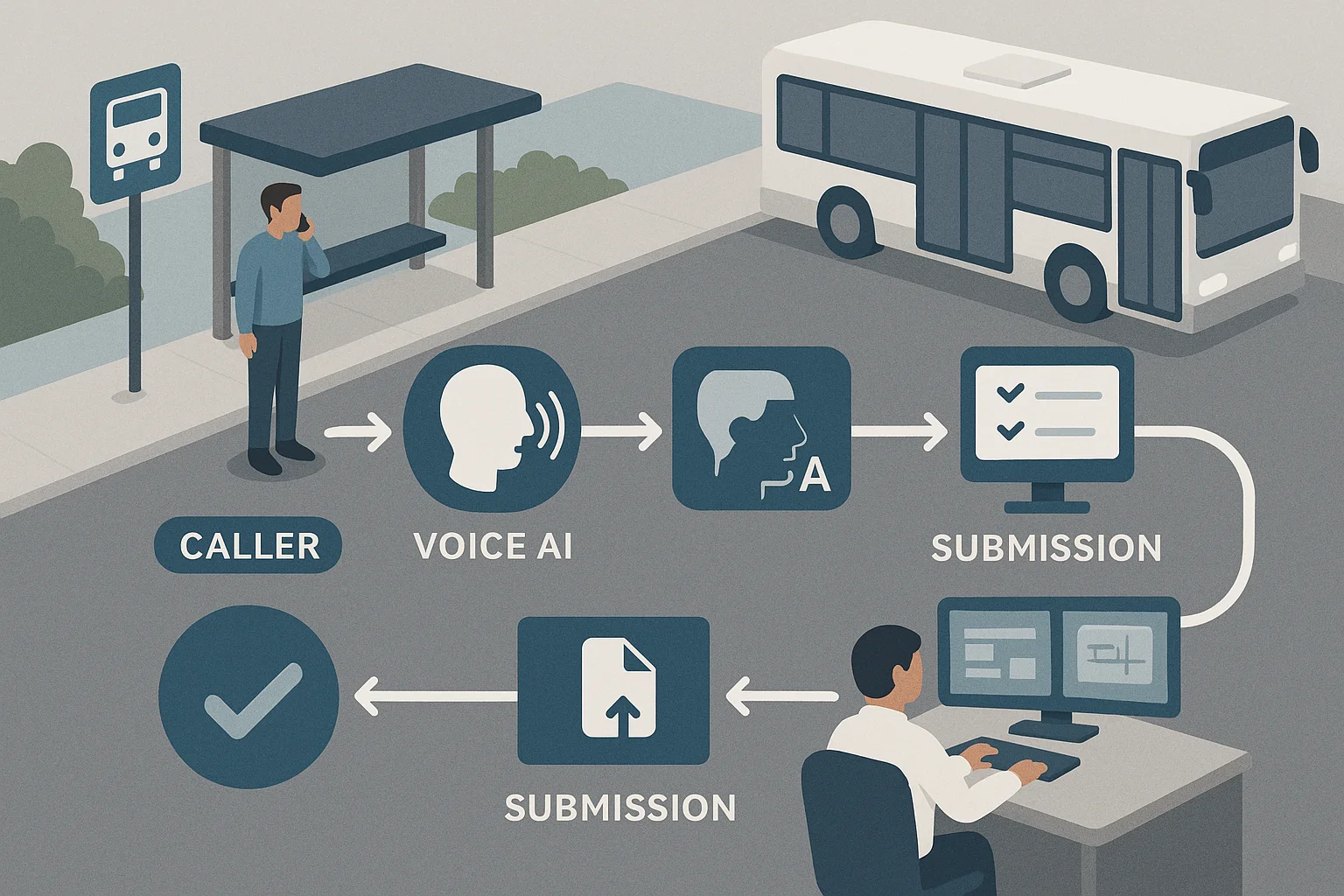
4. Orchestration workflows: validation, submission, and human handoff
Define concrete workflows for the four outcomes. Each workflow must include trigger conditions, validation steps, timers, and handoff protocols.
Authoritative response and confidence labels
When the query maps to scheduled knowledge and the controlled KB is up‑to‑date, the system returns an authoritative answer. Always include internal confidence metadata and, where appropriate, a succinct rider‑facing qualifier (e.g., “According to today’s published schedule”).
- Tag responses as scheduled vs. real‑time in logs and transcripts.
- Surface short qualifiers to riders when confidence is below threshold.
- Log provenance for auditability.
Validation paths and safe submission
For service requests or situations where the system must capture details (missed stops, lost property, accessibility complaints), require structured validation: confirm identity where necessary, read back critical fields, deduplicate, and present a safe submission summary before creating a case. Provide a confirmation identifier and an accessible receipt method (SMS/email/voice).
- Structured intake forms with required fields and validation rules.
- Duplicate detection before submission and merge rules for follow‑ups.
- Provide unique confirmation numbers and an opt‑in record of the exchange.
Human handoff and escalation controls
Escalation must be timed and conditional: immediate for recognized critical words (e.g., emergency), conditional for low confidence or failed validation, or scheduled for high‑complexity requests. Route to staff with a prepopulated context card including transcript, provenance, and validation results.
- Define immediate vs. queued escalations with SLA targets.
- Prepopulate context, transcript, and timestamps for receiving staff.
- Monitor and measure human handoff satisfaction and rework rates.

5. Procurement, contracts, and vendor controls
Procurement must reflect operational reality: vendors should be measured on observability, integration SLAs, subprocessors, and documented fallback behavior.
Contract requirements and evidence
Specify feed SLAs (latency, accuracy), observability access (logs, metrics), and responsibilities for adapter maintenance. Require vendors to document subprocessors, hosting regions, backup regions, and onward transfer policies. Insist on breach notification timelines compatible with the agency’s incident response plan.
- Feed and adapter SLAs with clear error budgets.
- Access to raw adapter logs and provenance traces for audits.
- Subprocessor list, hosting and backup regions, and data transfer mechanisms.
Procure for graceful degradation and failback
Contracts should require defined behaviors for feed degradation: what is the fallback text, when are predictive features disabled, and how are riders informed? Require synthetic‑traffic tests and periodic outage drills.
- Defined fallback messaging and disabling of predictions under poor feed health.
- Synthetic load and outage drills with postmortem reporting.
- Service credits or remediation tied to missed SLA thresholds.
Vendor observability and QA access
Vendors must provide dashboarding for feed health, confidence distributions, and QA sampling. Ensure access to anonymized transcripts and the ability to run delegated test suites against staging adapters.
- Real‑time health dashboards and historical trend retention.
- Controlled access to anonymized transcripts for QA.
- Integrated test harness for prelaunch validations.
6. Operational maturity: QA, monitoring, and records
Scale Voice AI from pilot to enterprise with staged quality controls, auditability, and public‑records handling that reflect municipal transparency obligations.
QA sampling, observability, and metrics
Operate continuous QA with stratified sampling: scheduled queries, real‑time alerts, low‑confidence responses, and escalations. Track false positives, false negatives, handoff latency, case validity, and duplicate rates. Tie these metrics to runbooks and automated alerts.
- Stratified QA sampling and periodic blind audits.
- SLOs: accuracy, handoff latency, case submission validity.
- Automated alerts for confidence distribution shifts or sudden feed errors.
Records, retention, and public disclosure
Establish retention policies aligned to jurisdictional obligations. Distinguish transcripts used for QA from public records; document retention, disclosure, redaction, and access processes. Provide clear notices to callers about recording and retention and capture explicit consent where required.
- Retention schedule tied to record type and jurisdictional policy.
- Redaction and disclosure procedures for public records requests.
- Caller notification and consent recording for retention and recording.
Continuous improvement and governance cadence
Run regular governance cycles: weekly operational reviews, monthly risk and QA reviews, and quarterly CCB meetings for significant changes. Feed lessons learned back into training data, validation suites, and procurement templates.
- Weekly ops dashboards and incident reviews.
- Monthly QA trend and root cause analysis.
- Quarterly policy and CCB reviews with documented approvals.
7. Accessibility, privacy, and deployment constraints
Accessibility and privacy are operational imperatives for public transit Voice AI. Treat them as functional requirements rather than optional features.
Accessible design and testing
Design dialogs for diverse sensory and cognitive needs. Provide multi‑modal fallbacks (DTMF/SMS/email), plain‑language prompts, and repeat/clarify affordances. Validate accessibility with representative users and include accessibility acceptance criteria in test suites.
- Multi‑modal outputs and tactile fallbacks where practical.
- Testing with representative users and measurable accessibility acceptance criteria.
- Accessible receipts (SMS/email) and easy escalation to human agents trained in accommodation.
Privacy, consent, and data residency considerations
Document data flows: what is stored, where, for how long, and which subprocessors have access. Make retention, recording consent, and breach notification explicit in procurement and privacy notices. Confirm legal obligations with qualified counsel because residency and disclosure rules vary by jurisdiction.
- Map: collection point, hosting region, backup region, subprocessors, and retention.
- Obtain explicit consent where required for recording and retention.
- Define breach notification timelines consistent with agency incident response.
Related Peak Demand resources
Industry and AI sources reviewed
- Transportation Systems SectorCybersecurity and Infrastructure Security Agency (CISA)
- Artificial Intelligence Risk Management Framework (AI RMF 1.0)National Institute of Standards and Technology (NIST)
- OECD AI PrinciplesOrganisation for Economic Co-operation and Development
Transit safety, accessibility, privacy, cybersecurity, records, and service-information obligations vary by jurisdiction and operating authority. This article is operational guidance, not legal advice; organizations should confirm applicable requirements with qualified professionals.
Frequently asked questions
Good starting points include lost property, complaints and feedback, stop or shelter issues, fare-machine faults, non-emergency accessibility service requests, schedule information from approved sources, and structured routing to customer service or field teams.
Official reference: Artificial Intelligence Risk Management Framework (AI RMF 1.0)
Use GTFS Realtime only when the agency exposes suitable feeds and the workflow genuinely needs service alerts, trip updates, or vehicle positions. The integration should validate freshness and availability, and the agent should avoid presenting stale feed data as a guaranteed arrival prediction.
Emergency, security, injury, crime, and safety-critical reports should follow approved transfer or emergency-routing procedures. Voice AI may detect and route the call, but it should not make operational safety decisions or replace trained personnel.
Official reference: Transportation Systems Sector
Request realistic call testing, feed and system failure handling, service-request integration, transfer context, audit logs, accessibility channels, monitoring, change control, and evidence that the agent distinguishes scheduled information from dynamic service alerts.
Official reference: Artificial Intelligence Risk Management Framework (AI RMF 1.0)
Design the transit service workflow before automating it
Peak Demand helps transit teams connect Voice AI to rider information, service requests, approved live-data sources, escalation, confirmation, and analytics.
Schedule a discovery call


