
Field‑Embedded Voice AI for Utilities: Secure Offline Operations & Telemetry
A pragmatic operational framework for deploying field-embedded, offline-capable Voice AI in electric, water, gas and municipal utilities. Covers validated intake, outage communications, telemetry, integration safeguards, and governance for regulated operations.
1. Operating Model and Core Call Flow
Establish a single, auditable operating model that drives every field Voice AI interaction. Keep the call flow simple and deterministic to reduce operational risk and support regulatory review.
Canonical architecture
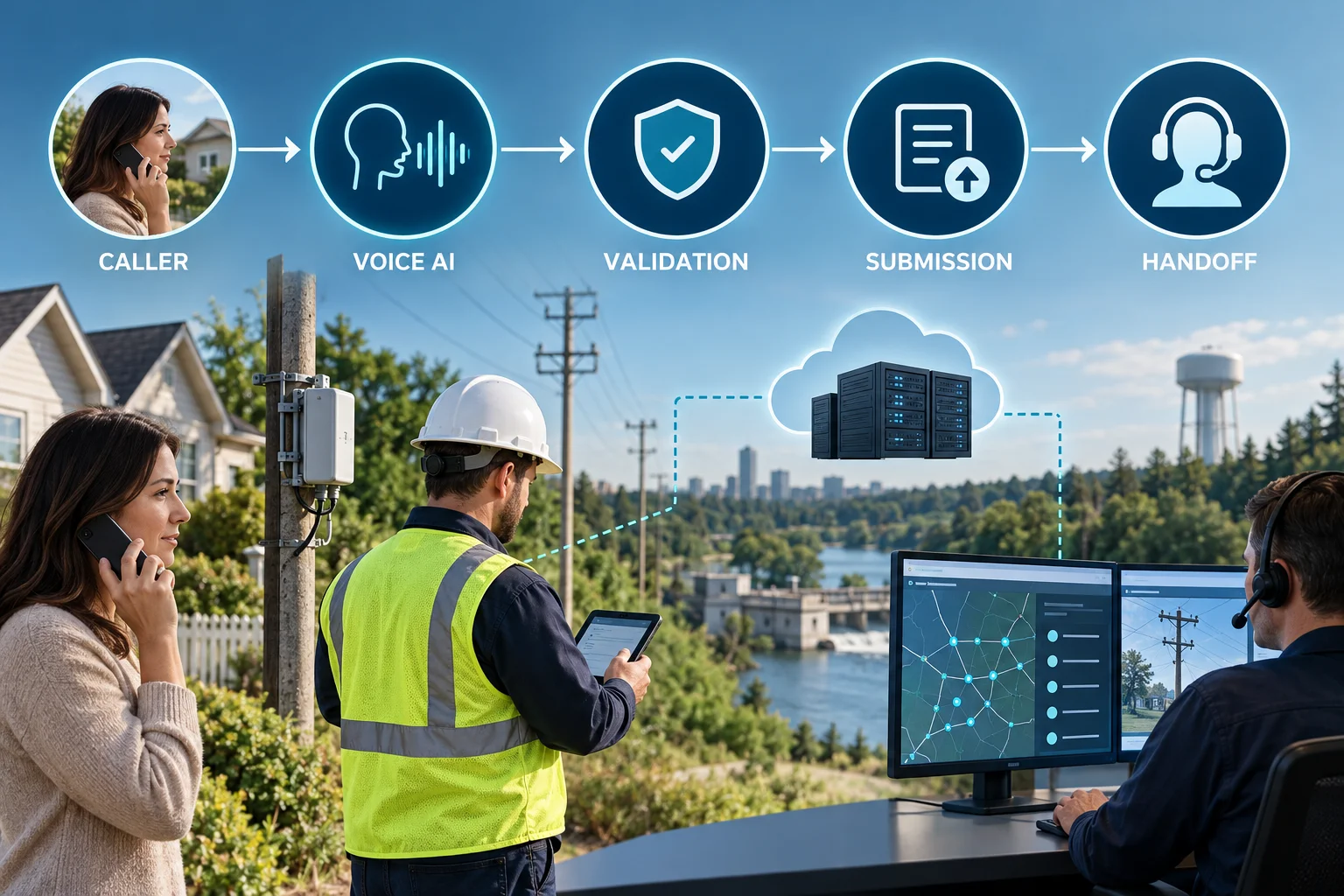
Use a repeatable architecture: Customer call → Voice AI → account or location validation → approved utility API or knowledge source → action (service request, status response, or human escalation). Make the gating explicit: validation must succeed before any action that changes account or field schedules. Treat the Voice AI as an intake and routing layer rather than an execution engine.
- Front door: telephony, SMS fallback, or push notification that surfaces premise identifiers.
- Voice AI: always logs intent and confidence; supports deterministic prompts for re-verification.
- Validation: query CIS/CRM or an identity service through an approved API adapter before accepting requests.
- Action: where permitted, submit only standardized service-request payloads; otherwise queue for human agent.
Roles and responsibilities
Define clear operational ownership across customer service, field operations, IT, and legal/compliance. Determine which teams own: validation rules, fallback scripts, telemetry schemas, escalation thresholds, and incident response. Keep operators responsible for safety-critical escalation decisions.
- Customer service: script approvals, SLA targets for human takeover.
- Field operations: confirmation of job payloads, safe routing and scheduling.
- IT/integration: API adapters, audit logging, and observability.
- Compliance/legal: data residency, retention, and disclosure requirements.
2. Deployment Patterns for Offline and Edge Voice AI
Design choices for field-embedded or offline Voice AI determine telemetry strategy, failure behavior, and procurement boundaries. Choose the pattern that maps to operational priorities.
Edge-first (field-embedded) pattern
Deploy models and decisioning logic on field devices or local gateways when connectivity is intermittent or latency intolerable. Edge-first designs reduce dependence on real-time cloud connectivity but increase the need for strict local controls, periodic syncs, and tightly scoped telemetry.
- Local model inference with a lightweight orchestration agent.
- Periodic encrypted synchronization of approved datasets and policy bundles from a central authority.
- Local audit log maintained with secure buffering and periodic upload when connectivity returns.
- Minimum viable offline scope: intake, validation against locally cached identifiers, and safe escalation to queued human workflows.
Hybrid (intermittent connectivity) pattern
Combine local inference with opportunistic cloud checks: operate in offline mode for routine, low-risk interactions and defer higher-risk actions until connectivity is re-established. Ensure the hybrid agent can enforce read-only local actions and consistently flag deferred items for human review.
- Policy: define which operations are allowed offline (e.g., outage status queries) and which must be deferred (e.g., remote switch orders).
- Telemetry: separate critical event logs (require immediate upload) from routine logs (buffered).
- Security: local secrets rotated and sealed; stored telemetry encrypted with key management.
- Operational control: explicit queueing for deferred items with time-to-review SLAs.
3. Integration, Validation, and Account-Safe Controls
Integrations to CIS, OMS, CRM, and field-scheduling systems are the operational heart of utility Voice AI. Protect account integrity with deterministic validation and minimal-privilege APIs.
Approved API gating and adapter patterns
Integrate through approved APIs or controlled adapters. Ensure adapters enforce authorization, input validation, rate limits, and context binding (call-ID, agent-ID, device-ID). Maintain a catalogue of allowed endpoints and a test harness that verifies adapter behavior under high volume.
- Adapter responsibilities: map Voice AI intent to a canonical service-request model, sanitize inputs, and record audit metadata.
- Enforce least privilege: create service accounts that can only perform specified actions.
- Test harness: automated tests that simulate concurrent calls, validation failures, and delayed downstream responses.
Account and premise validation
Use multi-factor validation for any account change or sensitive request. Validation should be deterministic and auditable: known contact data, premise identifiers, recent transaction or meter history, or a one-time code delivered by the utility.
- Validation tiers: low-sensitivity (outage status) requires matching premise; higher-sensitivity (move-in, billing change) requires multi-factor confirmation.
- Re-verification: require reconfirmation when confidence scores fall below a calibrated threshold.
- Audit trail: store the exact prompts, responses, confidence scores and the API responses used for validation.
4. Outage Communications, Surge Capacity, and Telemetry
Outage events are high-volume, time-sensitive, and sensitive to misinformation. Design Voice AI flows that prioritize accurate status, minimize erroneous actions, and provide measurable telemetry for post-event analysis.
Outage-first scripting and content strategy
Scripts should default to read-only outage status and expected restoration windows drawn from the outage management system (OMS). Avoid acceptance of field commands or remote operations through Voice AI during an outage and encourage verified callbacks or technician dispatch.
- Status prioritization: emphasize confirmed information from OMS, not crowd-sourced reports.
- Message templates: clear confirmations, estimated restoration time ranges, and instructions for safety.
- Information refresh: implement brief polling windows for changing outage data and provide a reference timestamp.
Surge handling and graceful degradation
Implement queueing strategies, progressive disclosure, and prioritized callbacks. During extreme volume, switch to a condensed interaction path: confirm premise, provide known status, and offer callback or SMS updates. Preserve the ability to capture structured intakes for critical safety reports.
- Progressive disclosure: move from free-form dialogue to structured prompts during surges.
- Callback prioritization: triage based on safety flags and critical customers (hospitals, large accounts).
- Capacity planning: test with burst simulations and define operational thresholds for rerouting to contingency contact centers.
Telemetry that supports decisions
Collect event-level telemetry: intent labels, confidence, validation outcomes, hold-times, escalation latencies, and reconciliation status. Design telemetry schemas to support both near-real-time dashboards for operations and forensic analysis after an incident.
- Operational KPIs: intake completion rate, validated-account pass rate, safe-escalation latency, callback fulfillment rate.
- Event-level logs: include raw prompts/responses, timestamps, confidence scores, and API response snapshots.
- Privacy considerations: redact or encrypt PII in telemetry; define retention for operational and forensic needs.

5. Governance, Security, and Incident Response
Embed governance that treats Voice AI as critical infrastructure-adjacent technology. Maintain documented risk assessments, security controls, and an incident-response plan aligned with recognized frameworks.
Risk and security controls
Adopt cross-sector cybersecurity goals: identify, protect, detect, respond and recover. Controls should include least-privilege API credentials, encrypted telemetry in transit and at rest, role-based access to logs, and authenticated remote support channels. Regularly test controls through threat modeling and red-team exercises.
- Access control: segmented accounts for voice adapters, telemetry storage, and orchestration.
- Encryption and key management: separate keys for device-level and cloud-level storage.
- Monitoring: anomaly detection on request volumes, unexpected API calls, or unusual validation failures.
Incident response and business continuity
Define incident response runbooks for integration failures, incorrect actions, or security events. Include steps for isolation, triage, customer notification, and evidence preservation. Plan business continuity for controller or cloud outages and ensure a documented fallback to human-only channels.
- Runbooks: precise steps to pause outbound actions, switch to read-only, and preserve logs.
- Continuity: tested fallback procedures for telephony overflow and manual intake.
- Post-incident: root-cause analysis, remediation plan, and stakeholder reporting.
Auditability and regulatory posture
Maintain immutable audit trails for each intake and decision point. Ensure logs are discoverable for regulatory review and that data residency, remote-support access, subprocessors, and retention policies are documented. Confirm obligations with qualified advisors in the applicable jurisdiction.
- Audit elements: call metadata, transcripts/recordings, validation evidence, API responses, and agent overrides.
- Vendor subprocessors: maintain a registry and contractual controls for onward transfers and breach notification.
- Data residency: document hosting region, backup region, and cross-border transfer mechanisms.

6. Procurement, Vendor Evaluation, and Measurable Outcomes
Procure Voice AI capability with operational guarantees and testable acceptance criteria. Require deterministic failure modes and measurable outcomes tied to operational priorities.
Contract requirements and testable SLAs
Request SLAs and acceptance tests that reflect operational realities: validation accuracy targets, escalation latency, telemetry delivery guarantees, and failure-mode behavior. Require vendors to document how offline models are updated, how telemetry is buffered and transferred, and who can access remote-support channels.
- SLA candidates: telemetry delivery latency, human-handoff latency under surge, and validated-account pass-rate thresholds.
- Acceptance tests: scripted outage scenarios, adapter failure injection, and surge load tests.
- Operational clauses: obligations for security incidents, subprocessors, and data-retention commitments.
Vendor evaluation checklist
Assess vendors for enterprise-grade observability, integration artifacts, and operational support. Look for deterministic routing of service requests, event-level analytics, and clear boundaries for what the Voice AI will not do (for example, it will not execute remote switch gear commands).
- Evidence of high-volume delivery: test results from burst-load simulations and integration test harnesses.
- Integration maturity: adapter libraries for common OMS/CIS/CRM suites and documented mapping logic.
- Operational support: runbooks, emergency contact procedures, and forensic log export.
Measurable operating outcomes
Define metrics with explicit calculation rules and reporting cadence. Use these metrics to govern operations and to trigger contract remediation if targets are missed.
- Common metrics: intake completion rate (per 1,000 calls), validated-account pass rate, average escalation latency, callback fulfillment time, and percentage of deferred actions.
- Reporting cadence: daily for outage events, weekly for operational KPIs, and quarterly for governance reviews.
- Continuous improvement: require joint post-incident reviews and prioritized remediation backlogs.
Related Peak Demand resources
Industry and AI sources reviewed
- Cross-Sector Cybersecurity Performance GoalsCybersecurity and Infrastructure Security Agency (CISA)
- AI Risk Management Framework — Critical Infrastructure ProfileNational Institute of Standards and Technology (NIST)
- Cybersecurity Capability Maturity Model (C2M2)U.S. Department of Energy
Utility cybersecurity, critical-infrastructure, records, customer-protection, and emergency-communications obligations vary by jurisdiction and service type. This article is operational guidance, not legal advice; organizations should confirm applicable requirements with qualified professionals.
Frequently asked questions
Good starting points include billing and account questions, move-in or move-out intake, appointment scheduling, service-request capture, outage-status messaging from approved systems, payment-routing assistance, and structured escalation. Safety-critical and infrastructure-control decisions should remain with qualified utility teams.
Official reference: Cross-Sector Cybersecurity Performance Goals
Use the minimum approved identifiers needed for the workflow, validate them against the utility's system of record, limit data exposure, and provide a human-assisted path when verification fails. The Voice AI should not guess account, premise, or outage information.
Official reference: Cross-Sector Cybersecurity Performance Goals
Use controlled adapters, strict schemas, timeouts, retries, audit logs, safe failure states, and human escalation. The system should distinguish approved utility data from model-generated language and should never present stale or unverified operational information as fact.
Official reference: Cybersecurity Capability Maturity Model (C2M2)
Track containment by request type, successful validations, transfers, abandoned calls, integration errors, incorrect or stale responses, time to resolution, customer follow-up, and the percentage of cases completed safely without manual rework.
Official reference: Cybersecurity Capability Maturity Model (C2M2)
Build resilient utility customer-service automation
Peak Demand helps utilities connect Voice AI to approved customer-information, outage-communication, service-request, dispatch, escalation, and analytics workflows.
Schedule a discovery call


