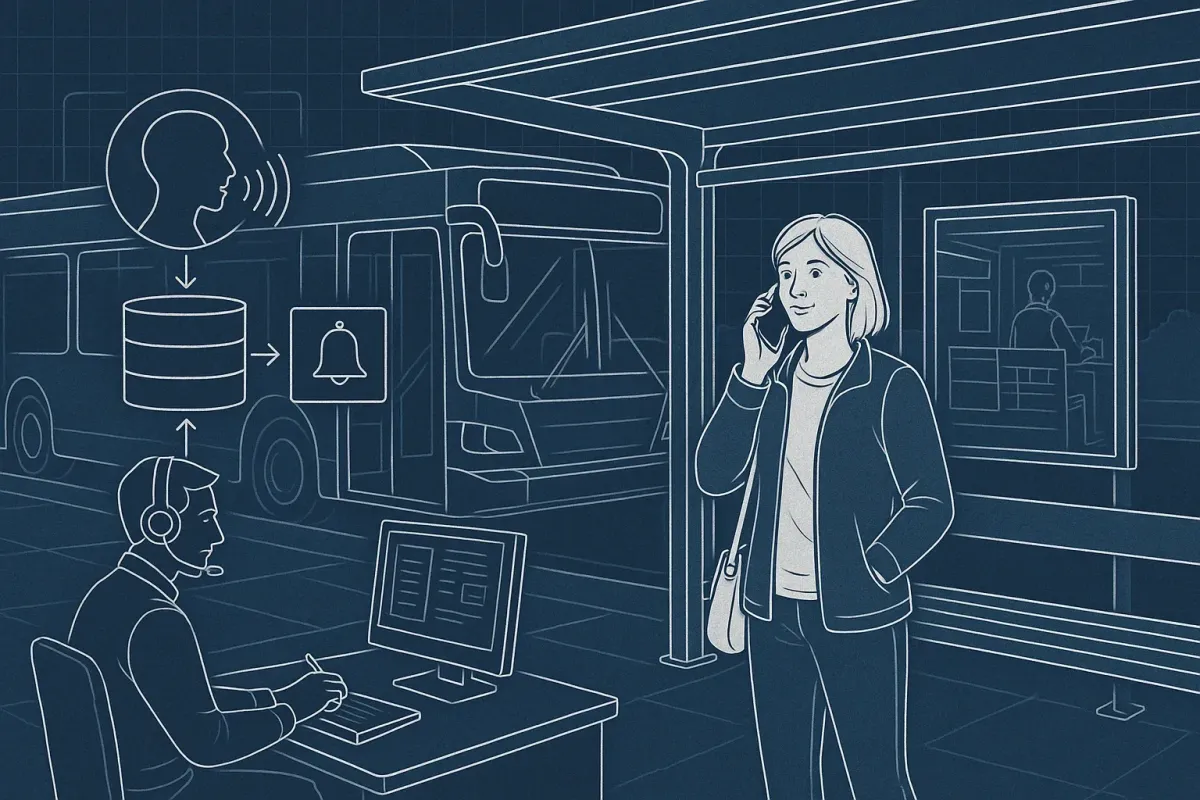
Enterprise Operating Model for Predictive Voice AI in Municipal Transit
Practical operating model for municipal transit leaders adopting predictive Voice AI: architecture, data boundaries, validation, human handoff, procurement controls and measurable outcomes.
1. Model overview: clear separation of knowledge and alerts
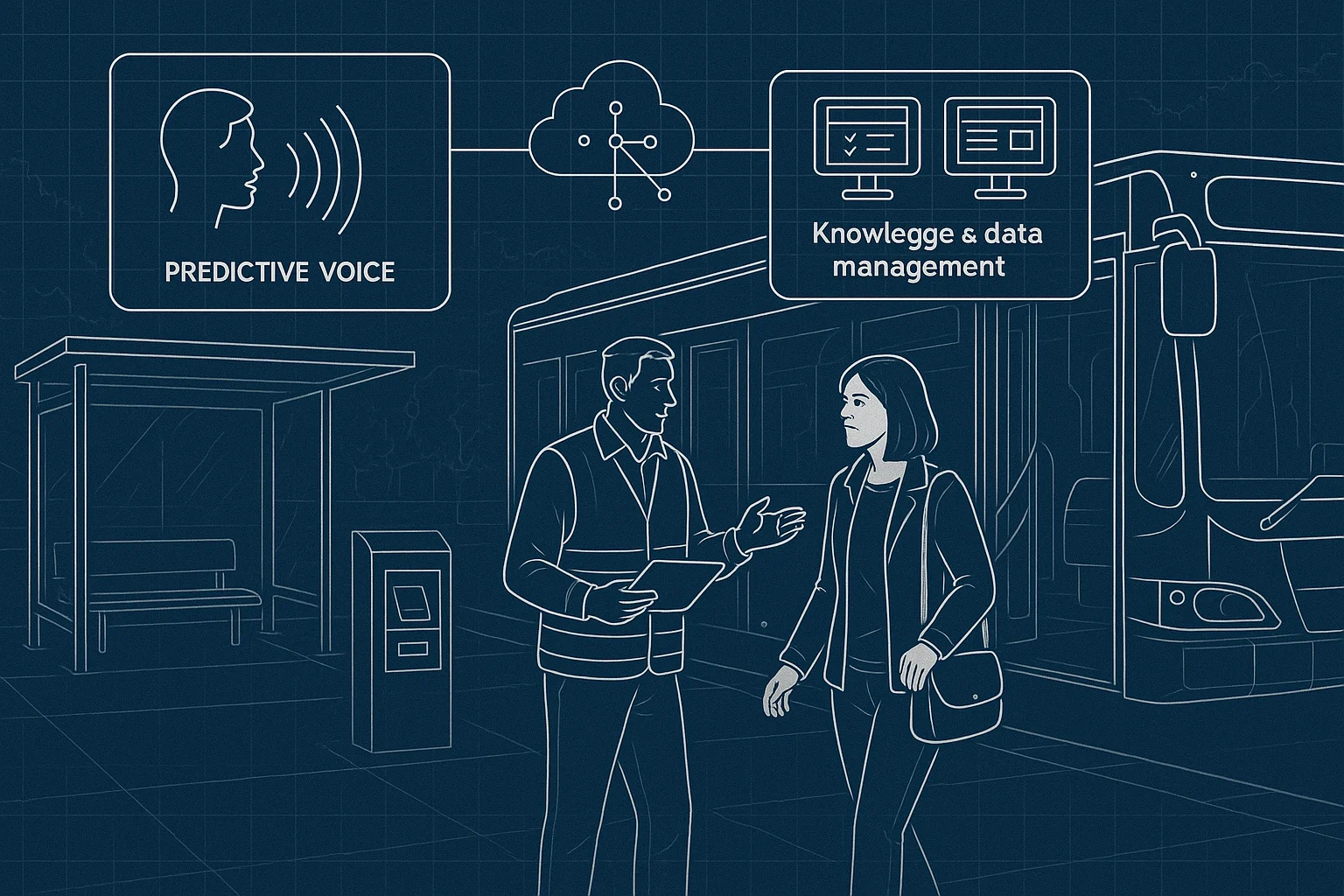
An operationally safe, enterprise Voice AI for transit starts with a mandatory separation: scheduled knowledge (timetables, route patterns, fare rules) must be surfaced from a controlled knowledge base; detours, delays, and real‑time alerts must be requested from approved, authenticated service‑alert APIs. Predictive features must be treated as derived outputs that require explicit validation and human‑handoff policies.
Why separation matters
Scheduled knowledge is relatively stable and can be curated, verified, versioned, and signed. Real‑time events (delays, detours, vehicle incidents) originate from operational systems and third‑party feeds that change rapidly. Treating them the same creates safety and accuracy risks because the last confirmed static schedule may not reflect current operations. The operating model mitigates this by forcing a verification step whenever the assistant produces a prediction that depends on real‑time data.
- Controlled Knowledge Base: curated schedules, fare policies, stop names, route descriptions.
- Service‑Alert APIs: agency feeds for delays, detours, vehicle incidents, stored and queried via adapters.
- Derived Predictions: outputs that combine the two must include provenance and confidence metadata.
Canonical architecture
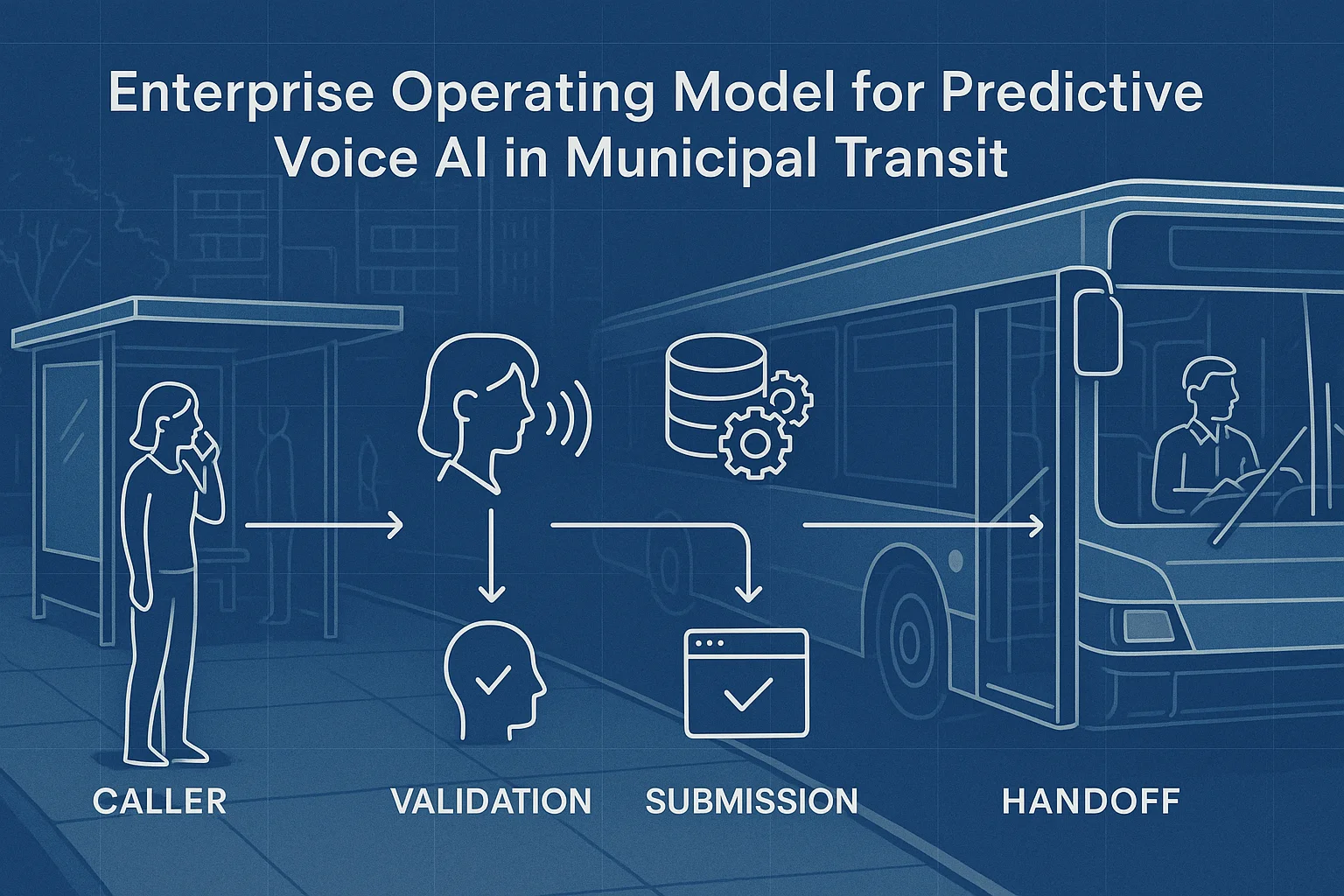
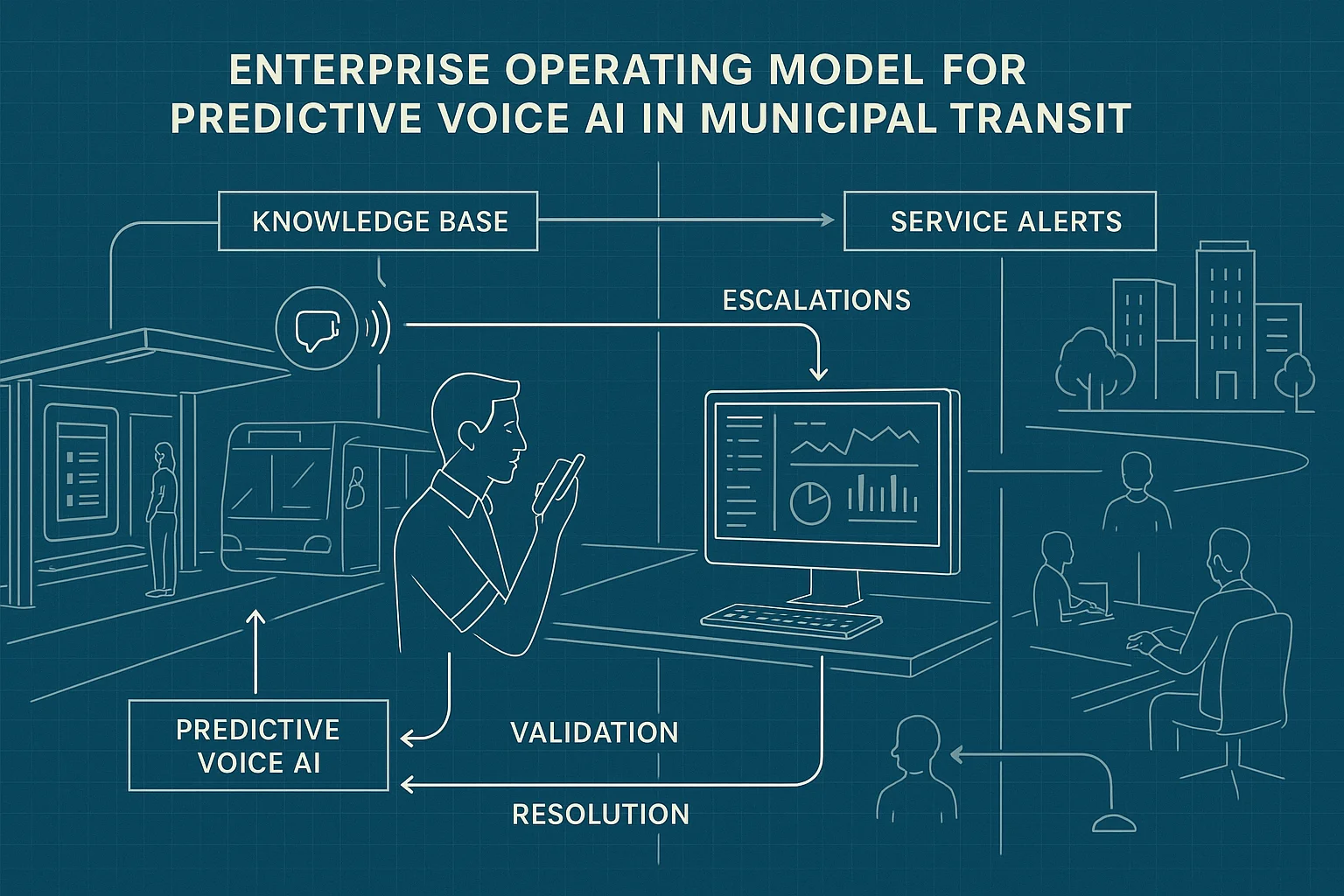
Rider → Voice AI → Controlled Knowledge Base (scheduled info) OR Service‑Alert/API adapter (alerts, detours) → Validation & Confidence Engine → Response (informational), Dynamic Service Request (case), or Human Handoff. This flow makes provenance explicit at every turn and supports audit trails and post‑interaction QA.
- Provenance tagged on every statement and prediction.
- Confidence thresholds determine whether the assistant answers, asks for clarification, or escalates.
- Audit log entries include the data source, timestamp, and validation outcome.
2. Implementation choices and integration patterns
Choose integration patterns that fit agency scale, existing systems, and regulatory boundaries: adapter‑based API orchestration, synchronous pass‑through to operational feeds, or hybrid cached knowledge stores with short TTLs for stable fields.
Approved API adapters versus cached knowledge
Adapters provide the most accurate real‑time view but require high availability and authenticated access. Cached knowledge stores reduce latency and cost for scheduled content but must include strict TTLs and automatic revalidation when an alert feed indicates a service change.
- Use adapters for alerts, incident reports, and vehicle telemetry; use cached KB for schedules and fare rules.
- Implement TTLs and change‑notification hooks so cached entries are invalidated when an alert triggers.
- Log adapter latencies and error rates; treat adapter failures as an explicit failure boundary.
Telephony and channel integration
Support multi‑channel orchestration (voice, SMS, chat, mobile app) with shared session state. For telephony, use SIP or cloud telephony providers with secure audio streams and real‑time transcription. Ensure session identifiers map to the same interaction in the case record for consistent handoffs.
- One session identifier across channels for cross‑channel continuity.
- Shared case records and conversation transcripts preserved with retention and consent metadata.
- Fallback to human agent with audio handoff where transcription confidence is low or safety rules fire.
Language and accessibility support
Support multiple languages and accessible dialogues, with lightweight fallback to human interpreters where automated intent detection fails. Refer to Peak Demand guidance on accessible municipal voice AI for design considerations and alternatives.
- Language fallback chains and human interpreter integration.
- Voice prompts and dynamic forms optimized for cognitive load and clarity.
- Separate accessibility testing from functional QA.
3. Operational workflows: validation, dynamic forms and safe submission
Operational workflows turn conversations into accountable action. Use dynamic forms to collect minimal required data, validate inputs against authoritative records where necessary, and protect safe submission with confirmation and routing rules.
Dynamic service‑request flows
When a rider reports an issue or asks for service support, generate a dynamic form during the call: capture only required fields, validate against agency directories (e.g., vehicle IDs or stop names), and present a readback for confirmation before case creation.
- Minimize PII collection: request what’s needed and explain why.
- Input validation against canonical lists (stop IDs, route IDs) to prevent misrouting.
- Provide the option to remain anonymous with limited routing and service choices.
Validation and confidence rules
Every predictive statement must include a confidence score and a provenance tag. Define thresholds for automatic answering, re‑asking (clarification), or human escalation. Low confidence in predictions or mismatch between scheduled knowledge and alert feeds should route the interaction to a trained agent.
- Confidence threshold table: auto‑answer, clarification, escalate.
- Provenance displayed in admin logs and available to riders on request.
- Automated retries of adapters within bounded backoff windows; human routing upon repeated failures.
Safe submission and human handoff
Case submission is an auditable event. Build a safe‑submission pattern where the assistant reads back the human‑facing summary before submission, enumerates expected next steps, and creates a ticket with timestamps, sources, and channel metadata. Handoffs should include the last N utterances, confidence signals, and relevant attachments.
- Readback and explicit consent before ticket creation.
- Ticket payload includes source IDs, validation outcomes, and transcript snapshot.
- SLA for agent pickup and an automated escalation path for safety incidents.
4. Data strategy, residency, and privacy boundaries
Transit agencies must decide where data lives, who can access it, and how long it is retained. Document data residency, backup geography, subprocessors, cross‑border transfer mechanisms, and recording consent as part of the procurement baseline.
Data residency and subprocessors
Specify hosting region, backup region, permitted subprocessors, and mechanisms for onward transfer in the contract. Identify remote support access, maintenance windows, and circumstances that allow access from outside the hosting region. Agencies should validate these controls against local obligations with qualified counsel.
- Define primary hosting region and secondary (backup) region.
- List subprocessors and their roles; require notification and approval for changes.
- Specify remote‑access controls, MFA, and privileged access logging.
Recording, consent and retention
Capture call recording consent early in the interaction and log consent metadata. Apply least‑privilege access to transcripts and case attachments. Define retention schedules for transient transcripts, operational tickets, and analytic datasets separately and include deletion and export procedures in the contract.
- Explicit recording consent and easy revocation procedures.
- Retention buckets: transient (24–90 days), operational tickets (per records schedule), analytics (anonymized and time‑boxed).
- Export and deletion APIs with certified proof of deletion where required.
Privacy and compliance caution
This article is jurisdiction‑neutral. Agencies must confirm obligations for data residency, cross‑border transfer, and recording consent with qualified legal and privacy professionals. Do not assume certification or geography eliminates obligations.
- Treat privacy and data residency as procurement requirements, not vendor marketing claims.
- Require evidence of subprocessors' controls and contractual guarantees.
- Attach breach notification timelines and responsibilities to the SOW.
5. Governance, security and reliability controls
Enterprise deployments require formal governance: risk management, model lifecycle controls, and transportation‑sector cyber resilience. Adopt structured risk management, continuous monitoring, and clear failure boundaries.
AI risk management and governance
Embed AI risk management into lifecycle governance: model documentation, testing for distributional shifts, transparency of provenance and confidence, and periodic audits. Align model governance with internationally recognized risk principles to show due diligence.
- Model documentation, decision logs, and test benches for new releases.
- Regular bias, robustness, and safety testing as part of deployment pipelines.
- Human oversight policies for safety‑critical and low‑confidence outputs.
Transportation cybersecurity and resilience
Treat adapter and API security as critical infrastructure. Apply network segmentation, strong auth for adapters, rate limits to protect operational systems, and incident response aligned with transportation‑sector guidance.
- Segment voice AI infrastructure from operational control systems.
- Use strong authentication and rotational keys for adapters to service‑alert APIs.
- Document incident response and recovery playbooks, and test them in tabletop exercises.
Observability and SRE controls
Operational observability must include service‑level indicators (SLIs) for adapter availability, end‑to‑end latency, containment rate (interactions resolved without human handoff), and handoff time. Define alerting and runbooks for degradations and adapter failures.
- SLIs: adapter availability, response latency, confidence distribution, containment rate, human pickup time.
- Automated alerting when adapter error rate or latencies cross thresholds.
- Runbooks that specify degraded modes: read‑only schedule KB, clear rider disclaimers, and expedited human handoff.
6. Procurement and vendor boundaries
Procurement should translate the operating model into contracts: precise scope, SLOs, observability obligations, security attestations, subprocessors, and clear liability for data loss or unauthorized access. Avoid over‑broad managed‑service claims without measurable commitments.
Define vendor scope and deliverables
Differentiate managed‑service offerings: voice channel operations, model hosting, adapter maintenance, and data stewardship. Specify which party owns integrations, who will maintain adapters to source systems, and who is responsible for changes to schema or API contracts.
- Clear ownership of adapters and change management procedures.
- Maintenance windows, escalation contacts, and SLA commitments for adapter uptime.
- Deliverables include runbooks, audit logs, and model documentation.
Observable SLAs and proof points
Require machine‑readable SLIs, periodic SLA reports, and the right to audit. Include acceptance criteria and phased rollouts that mandate performance and safety gates before broad deployment.
- Machine‑readable SLI reports and monthly SLO reviews.
- Phased rollouts with canary groups and safety gates.
- Right to audit security and data handling practices.
When to choose managed service versus in‑house
Decide based on internal skills, risk appetite, and control needs. Agencies that require tight data residency, direct adapter control, and deep integration with operations may prefer a hybrid or in‑house approach; others may accept managed services with strict contractual controls.
- Hybrid deployments for agencies that need adapter control and vendor model hosting.
- Managed service accepted when vendor meets detailed SLAs, subprocessors' transparency, and audit rights.
- Plan for exit: data export, deletion, and transition support.
Related Peak Demand resources
Industry and AI sources reviewed
- Artificial Intelligence Risk Management Framework (AI RMF 1.0)National Institute of Standards and Technology (NIST)
- OECD AI PrinciplesOrganisation for Economic Co-operation and Development
- Transportation Systems SectorCybersecurity and Infrastructure Security Agency (CISA)
Transit safety, accessibility, privacy, cybersecurity, records, and service-information obligations vary by jurisdiction and operating authority. This article is operational guidance, not legal advice; organizations should confirm applicable requirements with qualified professionals.
Frequently asked questions
Good starting points include lost property, complaints and feedback, stop or shelter issues, fare-machine faults, non-emergency accessibility service requests, schedule information from approved sources, and structured routing to customer service or field teams.
Official reference: Artificial Intelligence Risk Management Framework (AI RMF 1.0)
Use GTFS Realtime only when the agency exposes suitable feeds and the workflow genuinely needs service alerts, trip updates, or vehicle positions. The integration should validate freshness and availability, and the agent should avoid presenting stale feed data as a guaranteed arrival prediction.
Emergency, security, injury, crime, and safety-critical reports should follow approved transfer or emergency-routing procedures. Voice AI may detect and route the call, but it should not make operational safety decisions or replace trained personnel.
Official reference: Transportation Systems Sector
Request realistic call testing, feed and system failure handling, service-request integration, transfer context, audit logs, accessibility channels, monitoring, change control, and evidence that the agent distinguishes scheduled information from dynamic service alerts.
Official reference: Artificial Intelligence Risk Management Framework (AI RMF 1.0)
Design the transit service workflow before automating it
Peak Demand helps transit teams connect Voice AI to rider information, service requests, approved live-data sources, escalation, confirmation, and analytics.
Schedule a discovery call


