
Designing Accessible Municipal Voice AI Services
A jurisdiction-neutral operational framework for municipal leaders to design, validate and operate accessible Voice AI for resident intake, routing, escalation and audit-ready case submission.
1. Where Voice AI Belongs in Municipal Service Operations
Voice AI delivers continuous intake and help to residents, but its role must be clearly scoped. This section explains the right use cases, what to avoid, and the operational limits that protect public accountability.
Appropriate use cases and scope
Voice AI is best used for structured resident requests: service complaints, bookings, status lookups, basic bylaw guidance, and scheduling. Use it to collect validated fields, guide callers through dynamic forms, and return confirmation numbers. Avoid placing enforcement, emergency response, legal advice, eligibility determinations, or discretionary decisions fully under automated control — these require trained staff.
- Good fits: missed pick-up reports, permit status check, facility bookings, basic bylaw explanations.
- Bad fits: emergency dispatch, enforcement notices, eligibility or legal judgment calls.
Operational limits and safety boundaries
Define hard boundaries in the design phase. Any interaction that could create liability, trigger enforcement action, or has legal effect must route to human staff. Implement a clear fallback: if confidence thresholds or data validation fail, offer a human handoff or a scheduled callback. Preserve recordings and transcripts for audit and quality assurance, subject to local data protection obligations.
- Set conservative confidence thresholds for intent and slot-fill before automated submission.
- Automatically escalate when callers indicate immediate danger or use keywords tied to emergencies.
- Record metadata (not necessarily full recordings) for audit trails and QA sampling.
2. Reference Architecture and Context Management
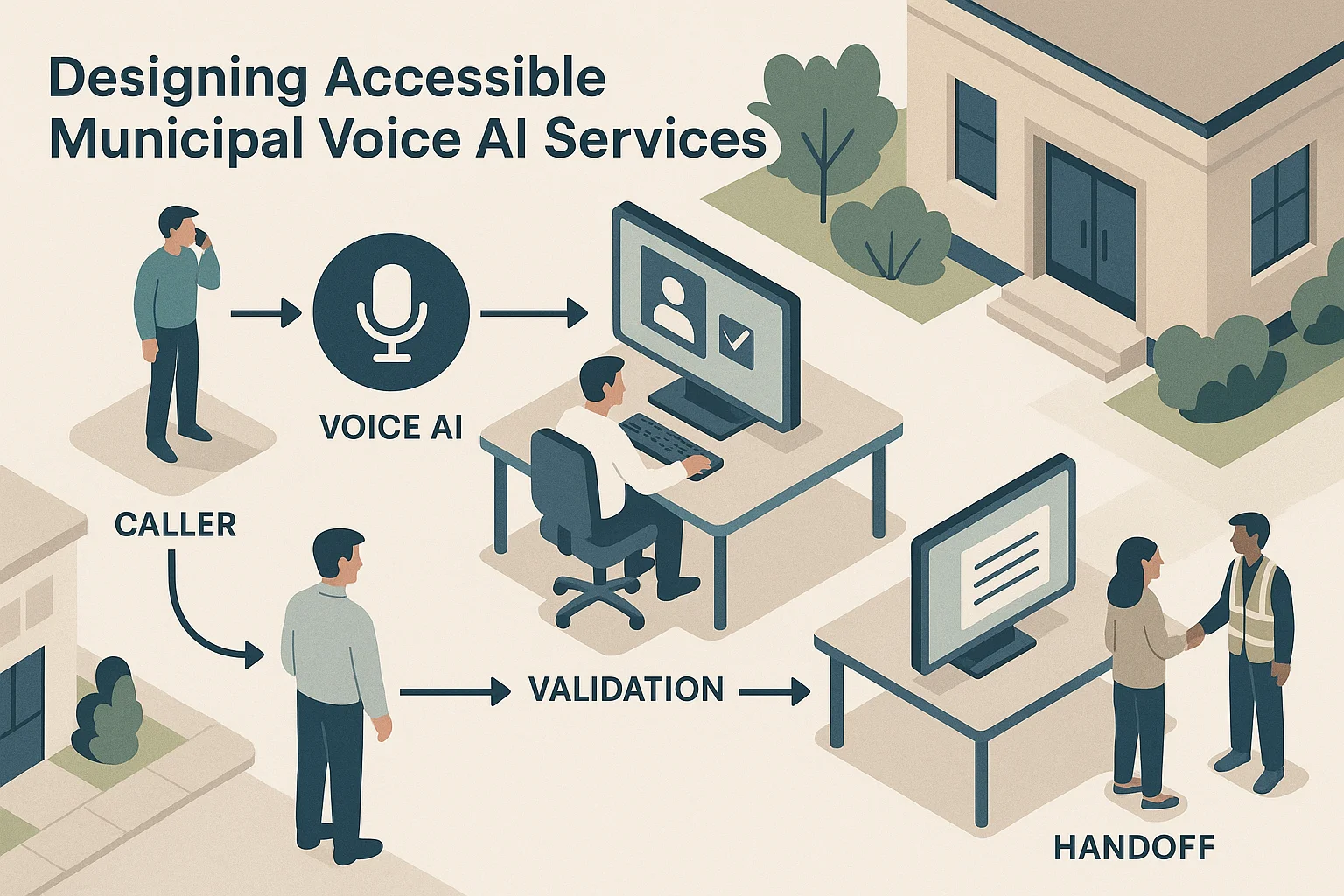
A reliable operating model follows a clear data flow: Resident → Voice AI → logic bridge → form & field retrieval → validation → municipal case system → confirmation or human handoff. This section explains each component and the role of context.
Core components and data flow
Implement a modular architecture where the Voice AI handles speech/NLU and session-level interactions, and a separate logic bridge (middleware) enforces business rules and retrieves dynamic form schemas. The logic bridge queries a form-and-field repository (or MCP) to determine required fields, validation rules, duplicate detection rules, and destination case types. Once fields are validated, the bridge submits a standardized payload to the municipal case system (CRM/CS/311) via API, then returns a confirmation number to the resident.
- Voice AI: speech recognition, NLU, TTS, session management.
- Logic bridge: enforces business rules, validation, duplicate checks, routing decisions.
- Form repository / MCP: authoritative field definitions, prompts, accessibility hints.
- Municipal case system: case creation, status tracking, attachments, audit fields.
Model Context Protocol (MCP) for consistent context
Use a Model Context Protocol (MCP) to store and transport the session context and form schema between components. The MCP contains active form version, required fields and allowable values, confidence scores, prior interactions, and routing hints. Maintaining an explicit MCP reduces drift between the Voice AI’s conversational model and the municipal backend, supports repeatable validation, and makes handoffs auditable.
- MCP packet should include form ID, version, filled fields, confidence per field, and last-update timestamp.
- Persist MCP snapshots at key transitions (end of call, handoff) to support audits and dispute resolution.
- Do not allow the Voice AI to modify authoritative form schema — the logic bridge should reconcile any suggested changes.
3. Intake, Validation and Case Submission Workflows
Concrete workflows and controls are where municipal operations either succeed or create risk. Design field‑level validation, duplicate detection, and explicit confirmation flows before a case is created.
Dynamic forms and field-level validation
Serve dynamic forms that surface only the fields needed for the caller's request. Validate each field at capture — e.g., address normalization, permit number format, date windows — using authoritative APIs where possible. When validation fails, offer a clarifying prompt and one retry; after two failures, route to human staff. Store field-level confidence scores in the MCP so downstream systems can interpret the reliability of submitted values.
- Use address cleansing APIs for geographic fields and return canonical addresses with geocodes.
- Validate business IDs or permit numbers against municipal registries in real time when available.
- Record confidence and validation flags for every field in the case payload.
Duplicate controls and confirmation numbers
Before submission, run duplicate checks against recent cases using normalized keys (address + request type, account number, phone). If a probable duplicate exists, present the resident with the existing case number and status or allow creation of a new case with a linked reference. Always return a confirmation number and estimated response time for new cases; confirmation numbers must be immutable and included in audit logs.
- Define duplicate-match thresholds and allow configurable business rules per service type.
- Provide residents with existing case details or a new confirmation number and optional follow-up options.
- Log duplicate checks and user choices for appeals and transparency.
4. Routing, Escalation and Human-in-the-loop
Design explicit routing rules and escalation paths that blend automated triage with human judgment. This section details thresholds, routing logic and handoff patterns.
Automated routing and destination selection
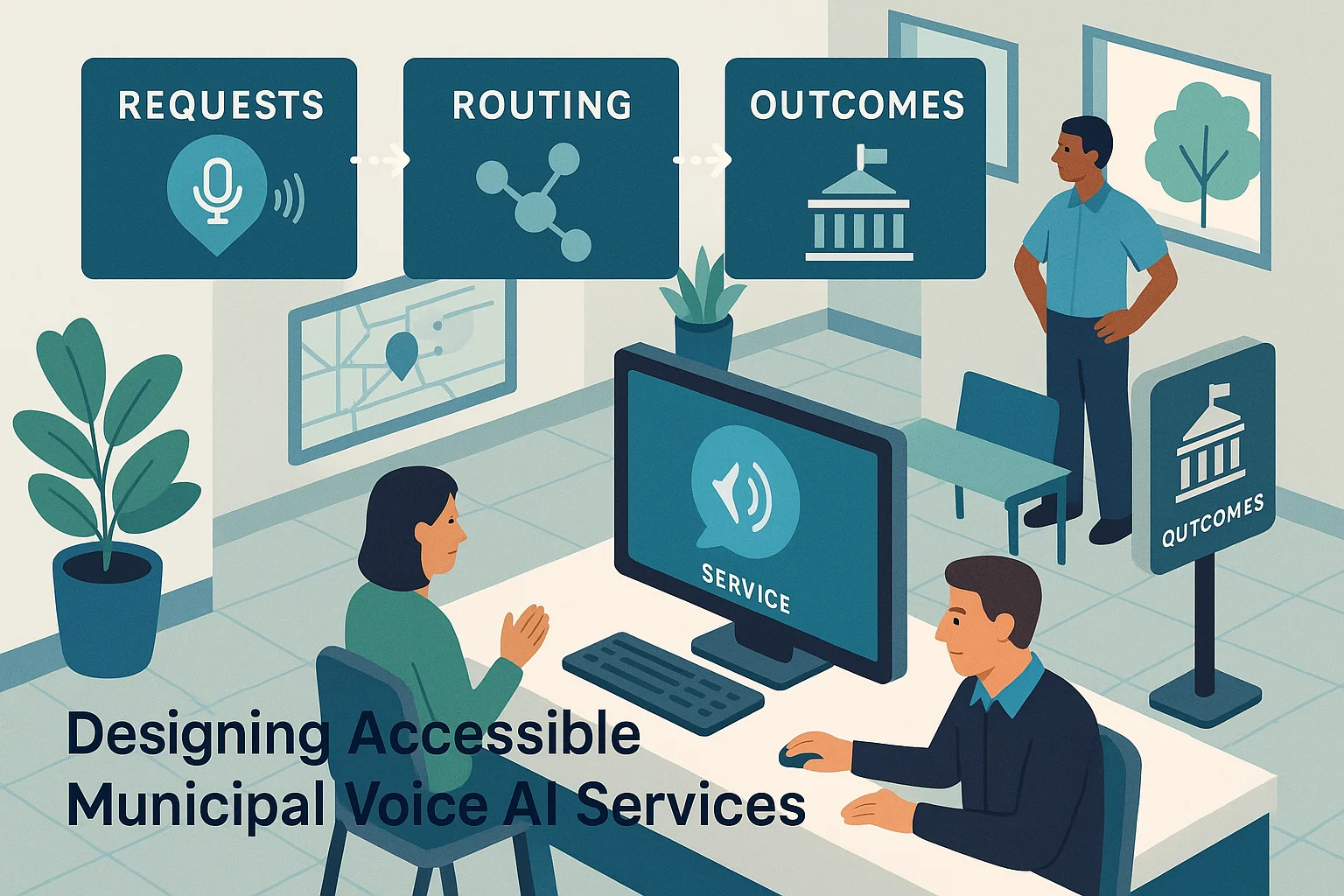
Route by case type, geography, required response SLA, and workload balancing. The logic bridge should attach routing metadata to the case payload — priority, estimated handling time, attachments — and enforce pre-defined SLAs. Use a queueing layer with priority tiers and automated reassignment when staff are unavailable or SLAs are at risk.
- Include routing signals such as language, accessibility needs, and preferred contact method.
- Attach MCP context so receiving staff have the full session transcript, field-level confidence and validation flags.
- Integrate with workforce management to surface live capacity and avoid misrouting.
Escalation, handoff and exception handling
Handoffs must preserve context and be predictable. When confidence is low, or when a resident requests escalation, create a warm transfer with the MCP snapshot and a brief agent script that summarizes the interaction and unresolved fields. Define exception types (e.g., incomplete address, enforcement request, safety issue) and map each to a predefined human queue. Record the reason for escalation and the chosen path in the audit log.
- Warm transfer: push MCP plus transcript snippet and validation flags to the agent interface.
- Cold transfer: create a routed case with callback scheduling and explicit skip-notes for agents.
- Always log the escalation trigger, agent acceptance time, and outcome for QA.

5. Operations, Governance and Quality Assurance
Operational ownership, monitoring and ongoing QA are critical. This section defines roles, QA processes, and AI-specific governance measures for municipal leaders.
Operational ownership and RACI
Assign clear ownership: an operations lead (311/Customer Service) should own day-to-day outcomes; IT owns integrations, security and platform uptime; an AI governance sponsor or legal officer owns policy and public accountability. Define a RACI for incident response, model updates, form schema changes, and procurement.
- Operations: SLA monitoring, QA sampling, workforce interaction.
- IT: integration APIs, backups, hosting region and remote support access.
- Governance/legal: algorithmic impact assessments, public transparency and appeals.
Monitoring, QA sampling and model validation
Continuously monitor intent accuracy, slot-fill completion, escalation rates, false positives for duplicates, and user satisfaction. Maintain periodic model validation and drift detection processes; keep human review samples for every major request type. Where risk is higher (e.g., complex bylaw advice), increase human sampling and shorten retraining cycles.
- Measure per-intent precision and recall; sample low-confidence interactions for human review.
- Track SLA adherence from call start to case closure and measure time-to-human-resolution for escalations.
- Version and timestamp models, MCP schemas and logic bridge rules for traceability.
6. Security, Privacy and Procurement Considerations
Municipal deployments operate under data protection, cybersecurity and procurement constraints. This section gives practical controls and vendor-selection guidance.
Cybersecurity and data residency basics
Adopt baseline controls consistent with cross-sector cybersecurity goals: restrict administrative access, encrypt data at rest and in transit, and maintain segmented environments for test and production. Define hosting and backup geography explicitly: decide primary region, backup/DR region, and whether remote-support or subprocessors will access live data. Confirm data residency and cross-border transfer obligations with legal counsel — obligations vary by jurisdiction.
- Document hosting region, backup region, and subprocessors during procurement.
- Establish remote-support controls and logging for any vendor-assisted troubleshooting.
- Implement least-privilege access for staff and vendors; require MFA and session logging.
Procurement, vendor responsibilities and integration ownership
Spec the vendor's scope: who owns the Voice AI model, who manages the MCP and logic bridge, who maintains connectors to municipal systems, and who is responsible for logs and audit exports. Require audit logs, retention policies, subprocessors list, and RFP-ready security/consent documentation. Where you outsource managed operations, ensure clear SLAs for incident response and change windows.
- Ask vendors for API contracts, audit log formats, and export tooling in the RFP.
- Clarify ownership of dynamic forms and the authority to change schemas in production.
- Demand documented processes for emergency off-ramps, data deletion and breach notifications.
Related Peak Demand resources
Industry and AI sources reviewed
- Artificial Intelligence Risk Management Framework (AI RMF 1.0)National Institute of Standards and Technology (NIST)
- Cross-Sector Cybersecurity Performance GoalsCybersecurity and Infrastructure Security Agency (CISA)
- Algorithmic Impact AssessmentGovernment of Canada
Privacy, telecommunications, recording-consent, cybersecurity, consumer-protection, employment, and records obligations vary by jurisdiction and use case. This article is operational guidance, not legal advice; organizations should confirm applicable requirements with qualified professionals.
Frequently asked questions
Suitable workflows include structured resident inquiries, service-request intake, permit or program information, appointment scheduling, department routing, status updates from approved systems, and after-hours overflow. Adjudication, enforcement discretion, emergency response, and binding eligibility decisions should remain with authorized staff.
Official reference: Artificial Intelligence Risk Management Framework (AI RMF 1.0)
Use a controlled service catalogue, required fields, department ownership rules, validation, duplicate checks, confirmation numbers, and documented handoff paths. The system should create an auditable record and avoid silently dropping requests when a downstream system is unavailable.
Official reference: Algorithmic Impact Assessment
Municipal deployments should document purpose, affected services, data use, human oversight, complaint and appeal paths, accessibility channels, records handling, monitoring, and the process for approving material changes.
Official reference: Algorithmic Impact Assessment
Require workflow demonstrations, integration and security architecture, testing evidence, auditability, data-location and subcontractor details, incident response, accessibility support, human escalation, exit planning, and clear ownership of ongoing updates.
Official reference: Artificial Intelligence Risk Management Framework (AI RMF 1.0)
Turn Voice AI infrastructure into a managed enterprise operation
Peak Demand designs, integrates, deploys, monitors, and improves Voice AI systems across customer service, enterprise systems, governance, escalation, and reporting.
Schedule a discovery call


