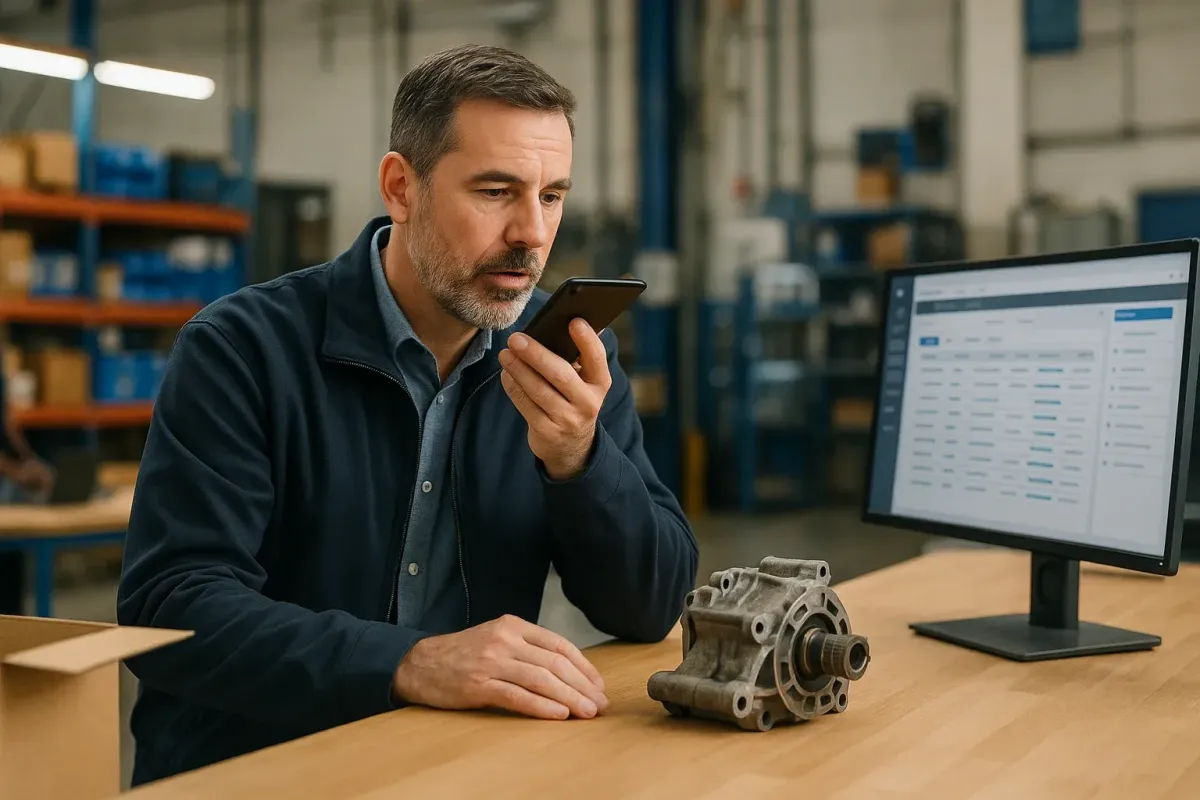
Designing Voice AI Workflows for Service, Warranty, and Parts Intake
Practical guidance for manufacturers, dealers, and distributors on architecting Voice AI intake for parts, warranty, and service — workflows, integrations, controls, failure boundaries, and procurement considerations.
1. Why Voice AI Matters — Problems It Solves and Limits You Should Respect
Voice AI can address chronic intake friction across dealers, distributors, field service, and plant service desks. But value depends on precise scope, integration quality, and conservative safety controls.
Buyer problems and expected first wins
Manufacturers and dealers typically see high friction in three intake paths: parts orders with unclear SKU or serial numbers, warranty triage requiring eligibility checks, and service intake that needs rapid routing to a specialist or field technician. Voice AI's first, practical wins are reducing time-to-case-creation by capturing structured details (product model, serial, symptom, location), validating them against a backend, and either creating a case or routing to a human. Start with one high-volume workflow per contact channel (phone or callback) and instrument it for measurable KPIs such as call containment, time-to-fill, and first-touch accuracy.
- Typical first workflows: parts lookups and order initiation, warranty eligibility triage, service request creation and scheduling.
Operational boundaries — what Voice AI should not decide
Voice AI should not be authorized to approve warranty claim settlements, safety interlocks, or engineering changes. These activities require human judgment, contractual review, and evidence aggregation. In operational design, the Voice AI's role is evidence collection, rule-based eligibility checks, and recommendation. Any approval, crediting, or physical safety action must route to a designated human actor within the manufacturer's governance model.
- Collect and present evidence; do not finalize warranty disposition.
- Use human-in-the-loop gates for financial or safety decisions.
- Log all inputs and system decisions for audit and dispute resolution.
2. Core Architecture: A Deterministic, Audit‑Ready Flow
Design a simple, testable architecture that separates conversational intelligence from authoritative business systems and explicitly defines handoff points.
Recommended call flow
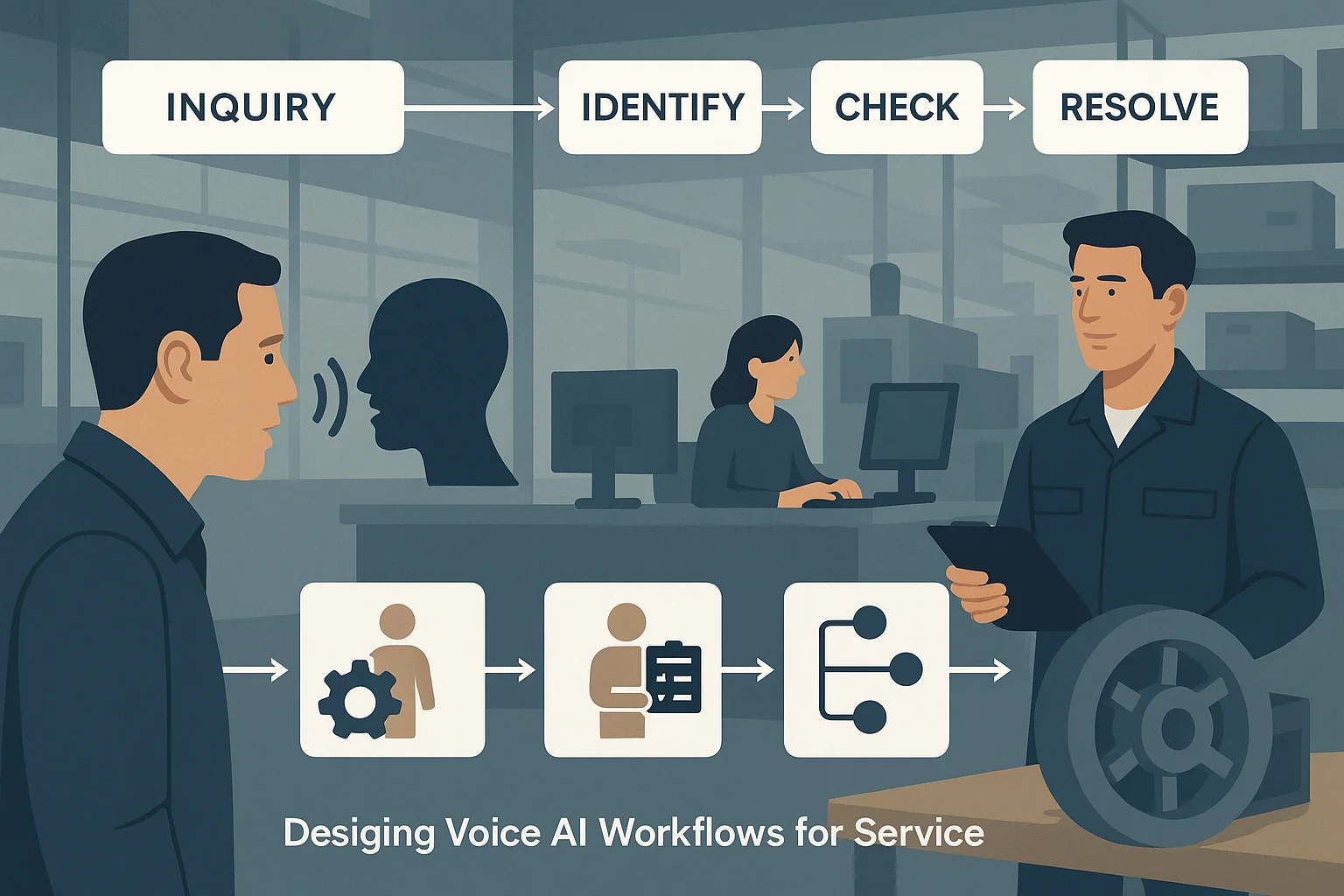
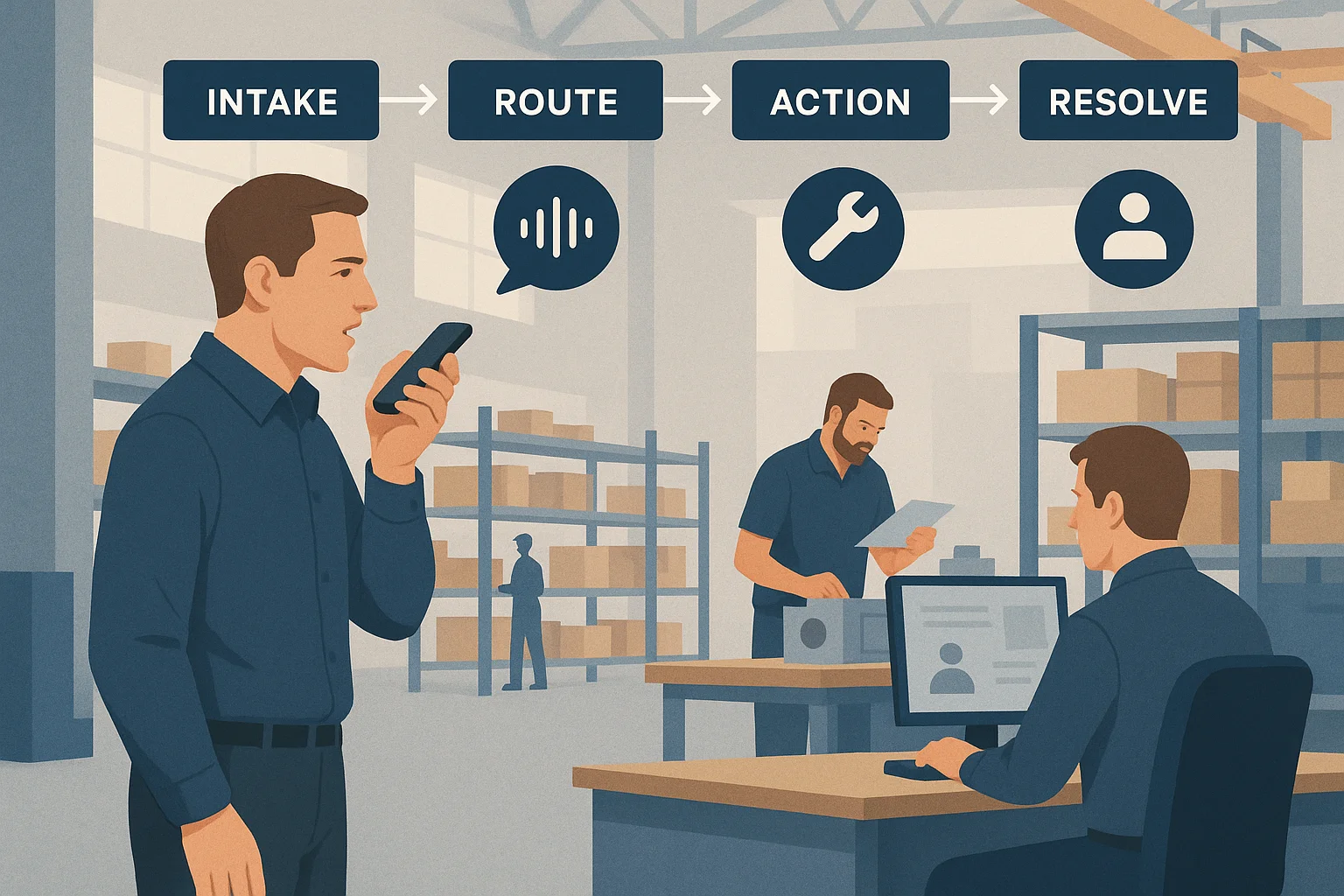
Keep the topology minimal and deterministic: Caller → Voice AI (ASR + NLU + dialog manager) → intent and product validation layer → ERP/CRM/warranty/service APIs → create case / book part order / hand off to human specialist. The validation layer is a controlled adapter that runs lookups (SKU, serial number, warranty status), applies business rules, and returns structured findings to the Voice AI. If checks pass, Voice AI completes routine tasks; if checks fail or conditions hit safety/financial thresholds, the system prompts for human escalation.
- Separation of concerns: conversational logic vs. business truth in ERP/CRM.
- Adapters encapsulate authentication, request throttling, and logging.
- Human escalation is a first-class outcome, not a fallback after failure.
Observability and audit trails
Instrument every step: call metadata, transcript, detected intent confidence, adapter request/response, and routing decision. Maintain immutable records (or tamper-evident logs) of actions taken and the human approvals associated with them. Observability enables acceptance testing during procurement and is essential when disputes or warranty investigations arise.
- Capture transcripts and structured fields for each intake.
- Store adapter responses with timestamps and actor IDs.
- Expose metrics for accuracy, containment rate, and escalation latency.
3. First Workflows to Deploy — Concrete Intake Patterns
Implement workflows that deliver operational value quickly and keep complexity low. Each workflow below is practical for a first-phase deployment.
Parts identification and order initiation
Design a flow that captures either SKU or serial number, validates it against the ERP/parts catalog, confirms pricing and availability, and can either create a sales order or hand the caller off to a human for payment and shipping particulars. Use structured prompts (spell digits, confirm characters) and offer alternatives (photo upload link or SMS) when the speech capture confidence is below threshold.
- Prompt for SKU or serial in a constrained format (e.g., 'Please spell the part number one character at a time').
- Run real-time ERP lookup via secure adapter; present availability and lead time.
- If payment or complex fulfillment is required, queue to a specialist with pre-populated data.
Warranty triage and evidence collection
Collect claimant identity, product identifiers, date of purchase, symptom description, and any supporting details (photos, invoice number). Use business rules to check registration, warranty period, and prior incidents. The Voice AI should return a disposition recommendation (e.g., 'send part under return authorization' or 'escalate to warranty adjudication') but not execute credits or settlements without human sign-off.
- Capture standardized symptom codes where possible to aid downstream adjudication.
- Attach transcript and any uploaded media to the warranty case.
- Always require a human approval step for financial outcomes.
4. Integration, Security, and OT/ICS Boundaries
Voice AI projects often stumble on integration and cybersecurity. Treat OT/ICS environments and manufacturing data as constrained domains and design adapters and controls accordingly.
Integration patterns and adapters
Implement thin, authenticated adapters between the Voice AI orchestration and business systems (ERP, CRM, warranty platform, field-service management). Adapters should encapsulate API credentials, enforce rate limits, and normalize responses to a common schema. Avoid direct, unmanaged access to production databases; prefer read-only queries or controlled service endpoints for intake validation.
- Adapters map Voice AI fields to business system fields and return structured validation results.
- Use role-based service accounts and short-lived credentials for adapter access.
- Document APIs, error codes, and fallbacks in the SOW and acceptance tests.
OT/ICS boundaries and manufacturing cybersecurity
Keep Voice AI out of operational control loops. If intake requires any OT context (asset state, production line status), retrieve that information via a secure, read-only interface maintained by OT teams. Hard separation and least-privilege principles reduce risk. Follow recognized guidance for OT security and cross-sector performance goals when defining network segmentation, access controls, and monitoring for adapters that query manufacturing systems.
- Voice AI should not issue commands to PLCs, control systems, or safety interlocks.
- Use DMZs or data diodes where required to enforce unidirectional data flows.
- Coordinate with OT and security teams on logging, access reviews, and incident response.

5. Failure Modes, Human‑In‑Loop Controls, and Safety
Design for the things Voice AI cannot do well yet: low-confidence recognition, ambiguous intent, safety incidents, and contractual warranty disputes. Failure boundaries must be explicit and tested.
Defining failure boundaries
Set confidence thresholds for speech recognition and intent classification; below threshold, offer alternatives (repeat, SMS/photo, or immediate transfer to human). Define a specific set of trigger conditions that force escalation: missing product identifiers, conflicting warranty information, symptom descriptors that indicate safety risk, or caller insistence on human interaction.
- Use confidence thresholds per field (e.g., serial capture vs. symptom description).
- Provide callers a clear path to a human at any time.
- Log reasons for escalation to enable continuous improvement.
Human-in-loop design and auditability
Clearly delineate which operations require human approval (warranty settlement, credits, emergency dispatch). Integrate a simple review UI for humans that displays the collected evidence, confidence scores, and recommended disposition. Require human sign-off with identity logging for any financial or safety outcome.
- Record approver identity and timestamp for all non-routine dispositions.
- Provide playback of the relevant call segment alongside structured evidence.
- Design agent workflows that minimize duplicate data entry by pre-populating fields.
6. Procurement, KPIs, and Operationalizing at Scale
Procurement and operations must align on acceptance tests, SLAs, and continuous improvement processes. Treat initial deployments as experiments with defined success criteria.
Procurement checklist and acceptance tests
Include a technical SOW that specifies call flows, APIs, data residency, audit logging, support windows, and escalation SLAs. Acceptance tests should include sample calls for SKU capture, warranty triage, and a failure-case where escalation is required. Require vendor-provided observability dashboards and raw logs for post-acceptance verification.
- SOW items: supported channels, language/localization, hosting region, subprocessors, retention, and audit logs.
- Acceptance tests: scripted calls that validate SKU recognition, correct ERP lookup, and proper human escalation.
- Require playbooks for incident response and OT coordination.
Operational metrics to track
Measure containment rate (percentage of contacts resolved by Voice AI), accuracy of structured field capture (SKU/serial), time-to-case-creation, escalation latency, and human review overturn rates. Use these metrics to prioritize model and dialog improvements and to quantify ROI internally without promising external guarantees.
- Primary KPIs: containment rate, SKU/serial capture accuracy, average handling time for escalations.
- Quality metrics: human override rate and median time to resolution for escalated cases.
- Operationalize continuous improvement with regular QA cycles and model updates.
Managed services and vendor scope
Decide whether to run a managed service (vendor operates call flows and monitoring) or host and operate in-house with vendor support. For enterprise buyers, require clarity on what the vendor manages: voice models, call orchestration, adapters, QA, and observability. Peak Demand’s approach is to build custom call flows and adapters, integrate ERP/CRM/warranty systems, and provide managed optimization—this model reduces in-house operational burden while preserving integration ownership and escalation pathways.
- Define who owns model tuning, adapter maintenance, and incident response.
- Require runbooks for failover, human takeover, and patching schedule.
- Include a transition plan and IP rights for call flows and dialog designs.
Related Peak Demand resources
Industry and AI sources reviewed
- Guide to Operational Technology SecurityNational Institute of Standards and Technology (NIST)
- Cross-Sector Cybersecurity Performance GoalsCybersecurity and Infrastructure Security Agency (CISA)
- Cybersecurity Resources for ManufacturersNIST Manufacturing Extension Partnership
Privacy, telecommunications, recording-consent, cybersecurity, consumer-protection, employment, and records obligations vary by jurisdiction and use case. This article is operational guidance, not legal advice; organizations should confirm applicable requirements with qualified professionals.
Frequently asked questions
Strong starting points include parts and order-status requests, distributor or dealer support, warranty and service intake, appointment scheduling, case creation, basic product information, and routing to technical specialists. Keep engineering judgment, safety decisions, and operational-technology control outside the conversational layer.
Official reference: Cybersecurity Resources for Manufacturers
The workflow should collect structured identifiers such as model, serial number, part number, customer account, asset location, and symptoms, then validate them against ERP, CRM, catalogue, warranty, or service systems. The agent should escalate rather than invent a match when confidence is low.
Official reference: Cybersecurity Resources for Manufacturers
Not by default. Customer-service automation should normally use controlled business-system integrations and tightly governed adapters. Any connection near operational technology requires explicit security architecture, least privilege, monitoring, and separation from safety-critical control functions.
Official reference: Guide to Operational Technology Security
Require workflow mapping, integration ownership, test evidence, fallback behavior, auditability, security boundaries, change control, monitoring, human escalation, and a plan for maintaining product, parts, warranty, and service knowledge after launch.
Official reference: Cybersecurity Resources for Manufacturers
Turn Voice AI infrastructure into a managed enterprise operation
Peak Demand designs, integrates, deploys, monitors, and improves Voice AI systems across customer service, enterprise systems, governance, escalation, and reporting.
Schedule a discovery call


