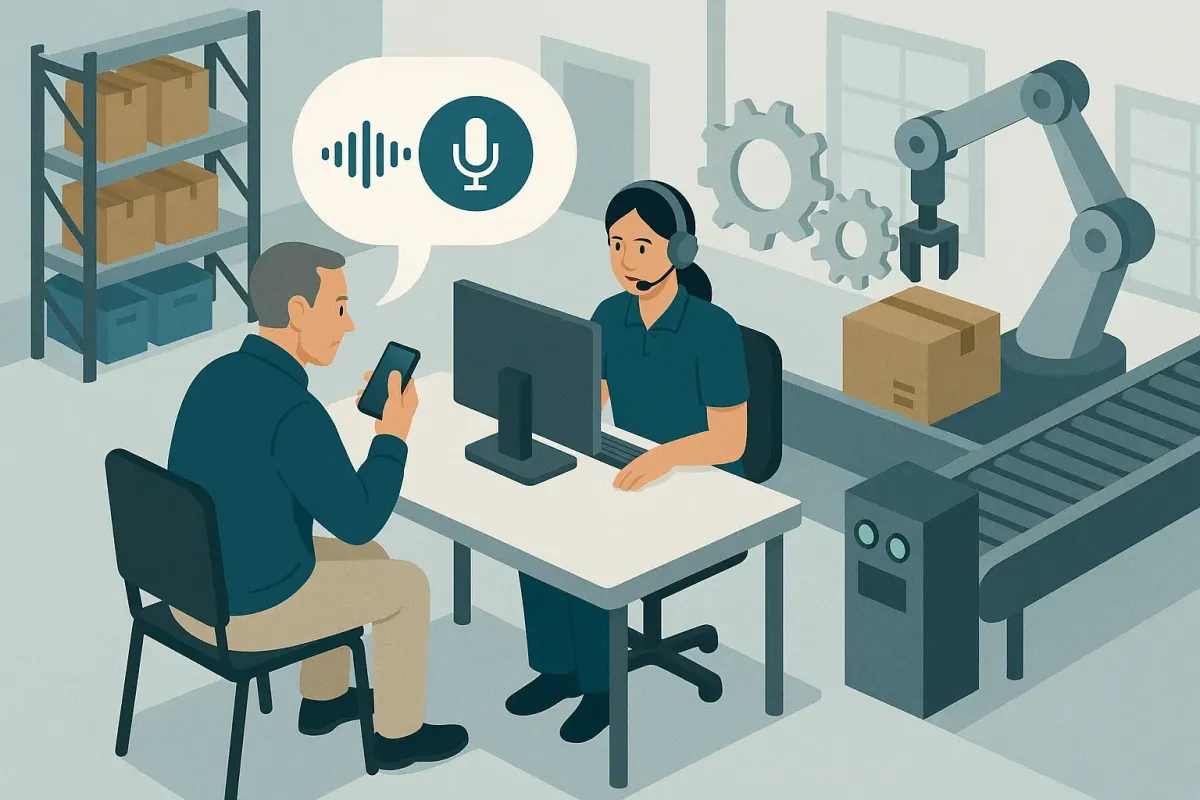
Voice AI for Manufacturing Customer Service and Parts Requests
A practical operational guide for deploying Voice AI in manufacturing customer service, parts intake, and field service—covering validation, integrations, safety boundaries, accessibility, and Peak Demand’s differentiated approach.
1. Why Voice AI Matters for Manufacturing Support
Manufacturing and industrial dealers handle high volumes of inbound calls about failed equipment, urgent parts, warranty questions, and service scheduling. Voice AI—when designed to respect operational and safety boundaries—reduces manual triage, accelerates parts identification, and routes cases to the right specialist faster.
Faster triage without removing human judgement
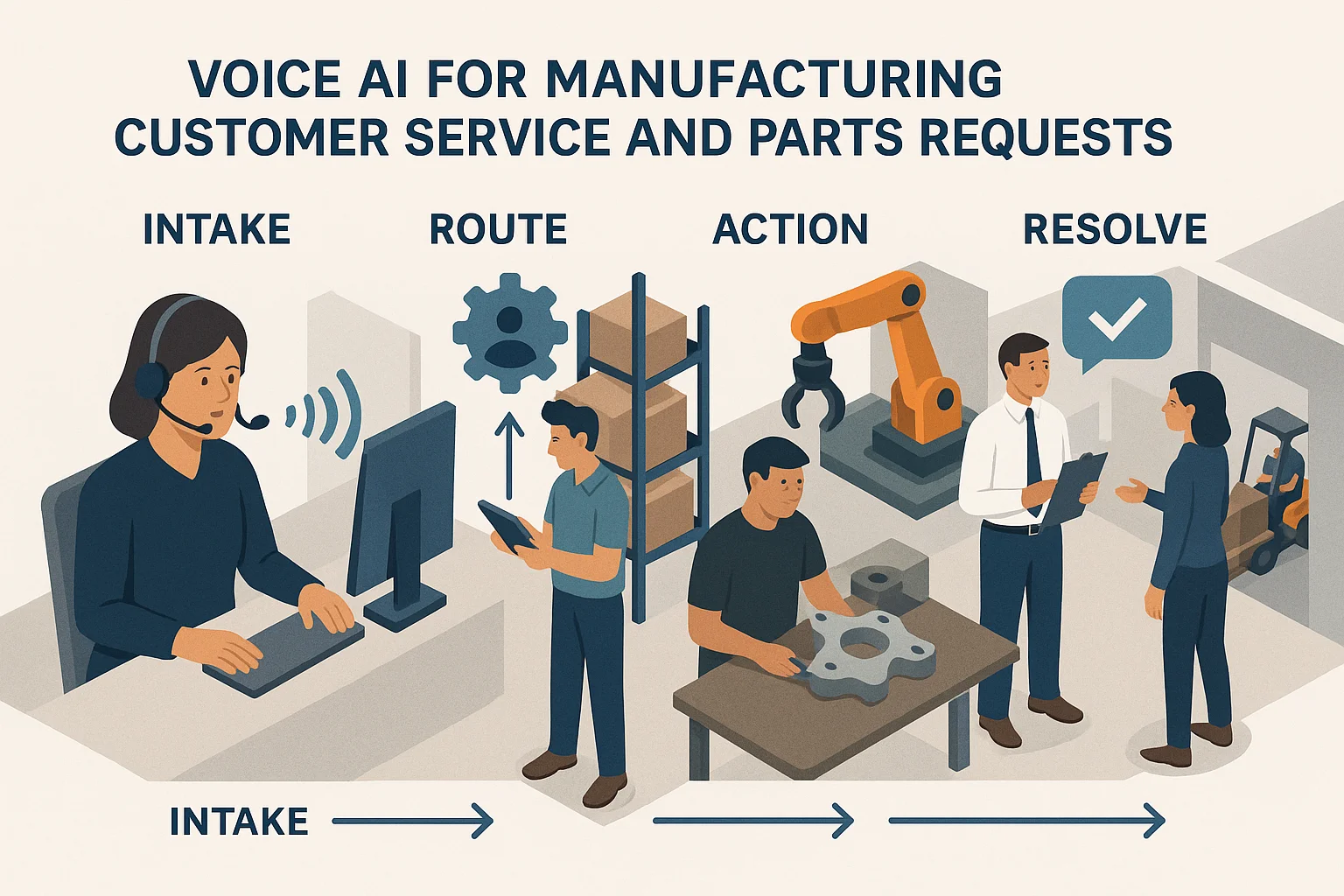
The immediate operational win is consistent triage. A voice agent collects structured intake—product identifiers (serial number, model), symptom descriptors, site location, and urgency—and validates those entries against ERP/CRM records before opening a case. That shifts time from data entry and verification to resolution. Importantly, never enable autonomous approvals for warranty eligibility, safety remediation, or engineering acceptance; those must remain human-controlled and auditable.
- Structured intake reduces back-and-forth and transcription errors.
- Validated context (SKU, serial, PO) enables deterministic routing.
- Human sign-off remains required for warranty and safety actions.
Operational outcomes you can expect
Expect measurable reductions in average handle time for common requests (status checks, parts availability) and faster specialist response for complex failures because call handlers arrive with validated context. Avoid promises of fixed savings; outcomes depend on integration quality, product complexity, multilingual coverage, and the human escalation model.
- Quicker parts identification through SKU/serial lookup.
- Reduced repeat contacts due to front-loaded validation.
- Smarter routing to field service, parts desk, or engineering.
2. Core architecture and operating model
A clear architecture governs responsibilities and limits of automation. Keep the conversational layer focused on intent capture and validation, then delegate authoritative decisions to enterprise systems or humans.
Recommended request flow
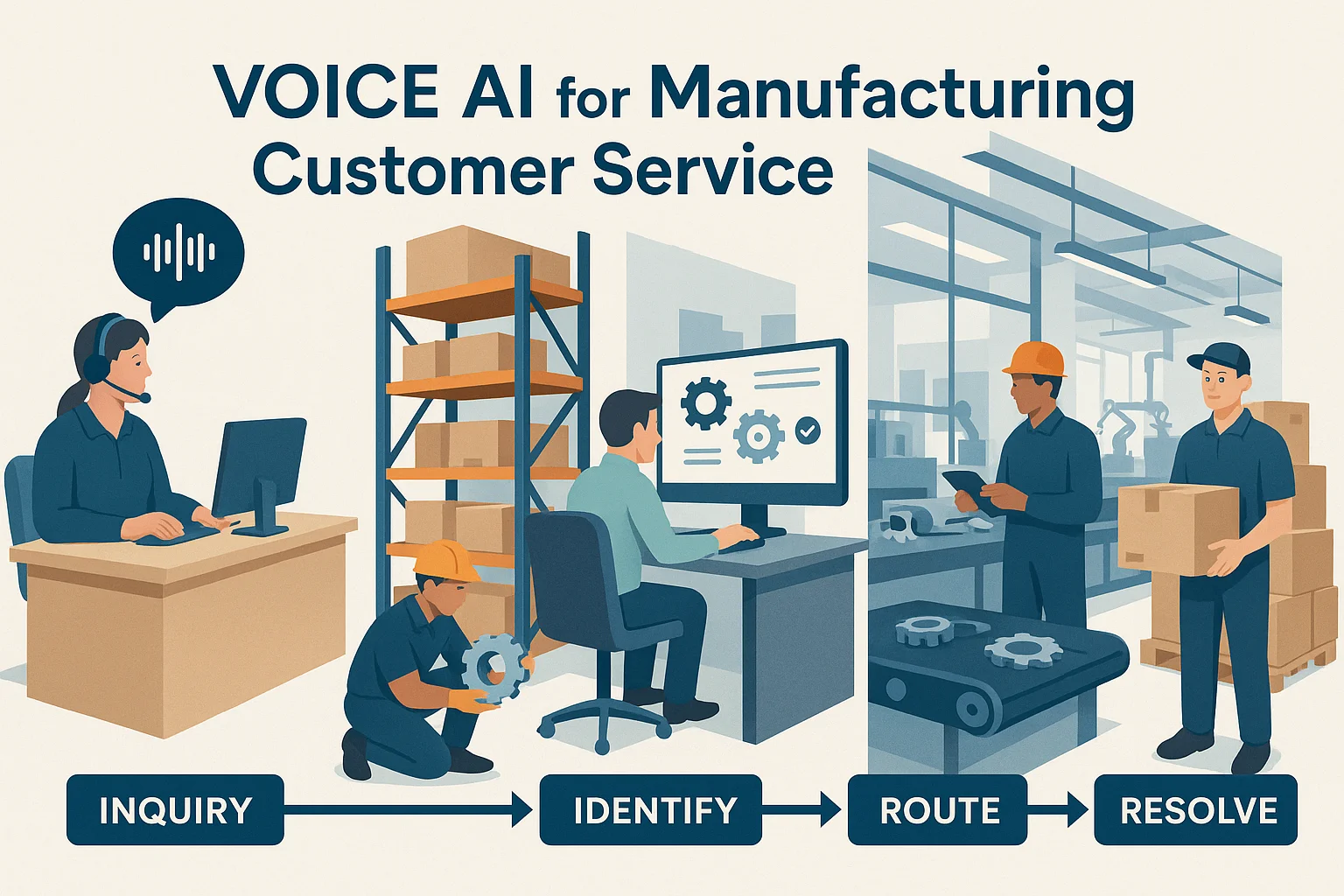
A reliable pattern is: Caller → Voice AI → intent & product validation → ERP/CRM/Warranty/Service API → case creation, order check, or specialist handoff. Voice AI should return a confidence score for each intent and record every step in an auditable transaction log. Use deterministic business rules to decide when to escalate to a human agent, for example low confidence, warranty edge cases, or safety-critical symptoms.
- Capture identifiers early (serial, model, PO, site).
- Validate against authoritative systems before action.
- Expose confidence thresholds to supervisors for tuning.
Integration touchpoints
Key integrations typically include: ERP (parts inventory, order history), CRM (customer records, contacts), warranty system (coverage windows, approvals), OSS/BSS or dispatch platform (field technician schedules), and ticketing or case-management tools. Architect integrations with idempotent APIs and compensating transactions to avoid duplicate parts orders if a call drops or is retried.
- Prefer read-then-write patterns with pre-checks to avoid duplicate orders.
- Maintain transactional logs and reconciliation for billing and warranty.
- Support multilingual lookups and locale-aware SKU formats.
3. Designing call flows for parts and warranty intake
Parts and warranty requests are routine but sensitive: they require accuracy (correct SKU), traceability (who requested what, when), and policy-aware escalation (warranty exclusions). Voice AI should orchestrate the interaction and enforce business rules.
Parts identification and availability check
Begin with deterministic prompts: request serial number or part number, confirm model, and clarify symptom or failure mode. Use dual-channel validation: spoken entry followed by an SMS or email transcription and a confirmation number for high-value parts. The Voice AI should query the ERP inventory API to confirm on-hand quantity, lead times, and fulfillment location before creating an order or reservation.
- Ask for one identifier at a time to reduce recognition errors.
- Confirm results back verbally and via an optional push-notification.
- Reserve stock in ERP only after human confirmation for high-cost items.
Warranty intake and human-in-loop controls
Collect warranty-relevant fields (purchase date, site, serial, prior repairs) and surface any policy triggers (age, non-covered damage, previous claims). Voice AI can flag probable coverage outcomes but must route any approvals or denials to trained warranty agents. Keep a secure, auditable handover workflow: the voice session creates a case with all captured metadata and a suggested disposition; a human reviews and applies the final decision.
- Do not automate warranty approvals—provide suggested dispositions only.
- Log captured evidence (audio, transcript, identifiers) in the CRM.
- Apply role-based access for warranty reviewers to prevent unauthorized changes.
4. Field service, dispatch, and real-time coordination
Field service workflows are time-sensitive and benefit from integrating Voice AI with real-time dispatch and telemetry. Keep conversational flows separate from telemetry feeds for reliability and security.
Dispatch integration and real-time availability
After validating the problem and confirming parts needs, the Voice AI can create a dispatch request and check technician availability via the service platform’s API. For operational patterns, follow mature realtime-feed design principles: exchange concise event payloads for vehicle or technician status and avoid embedding bulk telemetry inside conversational messages. The goal is rapid yes/no decisions (is a tech available within the SLA?) rather than streaming raw telemetry through the voice channel.
- Use lightweight events for availability checks and ETA updates.
- Keep telemetry out of the voice path; use separate secure channels.
- Provide technicians with a contextual job brief generated from the voice intake.
Technician handoffs and onsite validation
When a technician accepts a job, the system should deliver the intake packet (symptoms, parts, site notes) to the field app and confirm acceptance back to the caller. Onsite verification should be a human task: technicians confirm serials and failure codes and record any warranty-relevant observations. These human confirmations should feed back into the CRM and trigger order fulfillment or further engineering escalation if needed.
- Deliver structured intake to field apps—avoid free-text dumps.
- Require technician confirmation for final part issuance or warranty remediation.
- Use event acknowledgments to close the loop between call intake and field execution.

5. Accessibility, privacy, and compliance considerations
Voice AI systems must be accessible and respect rights and privacy. Build voice interactions with inclusive design and offer alternatives for callers who cannot use or prefer not to use voice channels.
Accessible voice UIs and reasonable accommodations
Design voice interactions consistent with accessibility principles: allow slower speech input, repeated prompts, DTMF fallback for sensitive identifiers, and alternative channels (SMS/email/web) for confirmations or forms. These practices align with the obligation to provide accessible services; organizations should consider the UN CRPD principles for non-discrimination and reasonable accommodation when offering automated voice services. Make alternative pathways explicit during prompts (e.g., “If you prefer, press 1 to receive a secure link to complete this form.”).
- Offer DTMF and web fallbacks for callers with speech or hearing limitations.
- Avoid forcing voice-only interactions for critical or lengthy procedures.
- Document accommodations offered and any caller preferences in the CRM.
Privacy, security, and jurisdictional limits
Treat audio, transcripts, and collected identifiers as sensitive. Apply encryption in transit and at rest, role-based access controls, and data retention policies aligned with local laws. Be cautious about cross-border data transfer and ensure that call recordings, transcripts, and warranty evidence are stored where allowed. For legal, accessibility, or privacy compliance questions, confirm obligations with qualified counsel and local officers because laws vary by jurisdiction.
- Encrypt audio and metadata; minimize storage where feasible.
- Use consent prompts for recording and offer opt-outs.
- Check local rules before transferring recordings across borders.
6. Implementation roadmap and Peak Demand approach
Deploying Voice AI in manufacturing requires phased delivery: discovery and data readiness, pilot with limited SKUs and languages, scale, and continuous tuning. Peak Demand’s approach emphasizes operational controls, integrations, and managed operations.
Phased rollout plan
Start with a two- to three-month discovery that inventories SKUs, warranty rules, CRM/ERP APIs, and common call patterns. Pilot the voice agent on a focused product line (high-volume parts or common fault codes), validate end-to-end routing, and measure triage accuracy and escalation rates. Expand languages and SKUs after stabilizing integrations and confidence thresholds.
- Discovery: map data sources, policies, and escalation rules.
- Pilot: limited SKUs, 1–2 languages, defined SLA checks.
- Scale: broaden catalogue, add languages and dispatch integrations.
Peak Demand differentiation and services
Peak Demand builds custom call flows and integrates directly with ERP, CRM, warranty, and dispatch APIs to validate identifiers and apply deterministic routing. Our offerings include custom voice agents, enterprise deployments, and managed voice AI operations for 24/7 availability. We design for multilingual support, secure data handling, deterministic parts reservations, and human escalation controls—delivering production-grade reliability rather than a vendor proof-of-concept. For specific capabilities, see our managed and custom services.
- Custom call flows built for parts validation and warranty intake.
- ERP and CRM integrations with idempotent order and reservation flows.
- Managed operations to tune thresholds, monitor logs, and handle escalations.
Where to start and governance tips
Assign a cross-functional steering team: operations, service, quality, field service, IT, and legal. Define measurable acceptance criteria (intent accuracy at validation, routing accuracy, case completeness) and maintain a change-control process for voice script updates. Log every intake for auditability and require final human sign-off for warranty and safety outcomes.
- Create a steering committee with service and field representation.
- Set intent-confidence thresholds and escalation SLAs.
- Retain auditable logs for all handoffs and decisions.
Related Peak Demand resources
Industry and AI sources reviewed
- Cybersecurity Resources for ManufacturersNIST Manufacturing Extension Partnership
- Cross-Sector Cybersecurity Performance GoalsCybersecurity and Infrastructure Security Agency (CISA)
- Guide to Operational Technology SecurityNational Institute of Standards and Technology (NIST)
Manufacturing cybersecurity, operational-technology, product, warranty, records, and workplace obligations vary by jurisdiction and operating environment. This article is operational guidance, not legal advice; organizations should confirm applicable requirements with qualified professionals.
Frequently asked questions
Strong starting points include parts and order-status requests, distributor or dealer support, warranty and service intake, appointment scheduling, case creation, basic product information, and routing to technical specialists. Keep engineering judgment, safety decisions, and operational-technology control outside the conversational layer.
Official reference: Cybersecurity Resources for Manufacturers
The workflow should collect structured identifiers such as model, serial number, part number, customer account, asset location, and symptoms, then validate them against ERP, CRM, catalogue, warranty, or service systems. The agent should escalate rather than invent a match when confidence is low.
Official reference: Cybersecurity Resources for Manufacturers
Not by default. Customer-service automation should normally use controlled business-system integrations and tightly governed adapters. Any connection near operational technology requires explicit security architecture, least privilege, monitoring, and separation from safety-critical control functions.
Official reference: Guide to Operational Technology Security
Require workflow mapping, integration ownership, test evidence, fallback behavior, auditability, security boundaries, change control, monitoring, human escalation, and a plan for maintaining product, parts, warranty, and service knowledge after launch.
Official reference: Cybersecurity Resources for Manufacturers
Connect Voice AI to real manufacturing service operations
Peak Demand helps manufacturers automate parts, order, warranty, dealer, distributor, and service requests through controlled integrations, validation, escalation, and reporting.
Schedule a discovery call


