
Demand‑Responsive Transit Orchestration with Voice AI: SLOs & Data Contracts
Operational framework for transit leaders building voice‑first demand‑responsive services: define SLOs, formalize data contracts for schedule vs service‑alert sources, design safe failure boundaries and procurement evidence.
1. Scope, operating principle, and scope limits
This section sets operational boundaries: what a voice‑orchestrated demand‑responsive transit (DRT) system should guarantee, and what it must not attempt without approved data or staff.
1.1 What we mean by voice‑orchestrated DRT
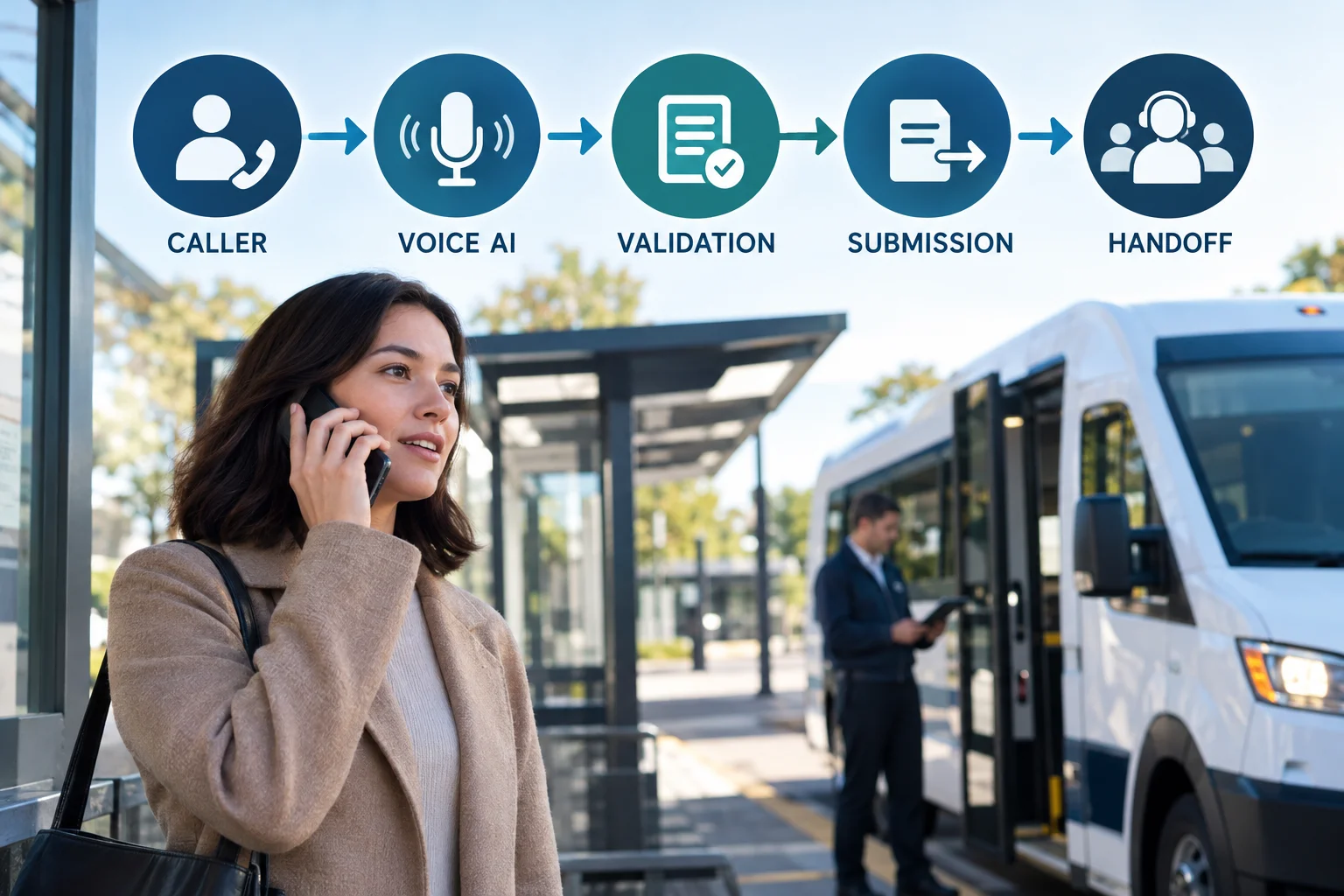
Voice orchestration for demand‑responsive transit connects riders to service information and actions (booking, enquiries, case submission) using a voice channel as the primary interaction surface. In production, the pipeline should follow a single, auditable flow: Rider → Voice AI → controlled schedule knowledge for published timetables OR service‑alert APIs for detours/delays/real‑time events → validation → response, case submission, or human handoff. This structure keeps scheduled knowledge and event data separate, preventing conflicting answers and improving traceability.
- Primary authoritativeness: scheduled knowledge (static timetables, stop names) versus event sources (detours, delays, cancellations).
- Actionable outcomes: voice responses, dynamic service‑request forms, or validated case submissions to operations.
- Human handoff: defined when automated confidence is insufficient or when safety/complexity demands human decision.
1.2 Scope limits and safety boundaries
Do not treat voice AI as the final authority for safety‑critical or emergency incidents. If a rider reports a medical emergency, security incident, or anything requiring trained responders, the system must escalate to human staff immediately and must not attempt automated diagnosis or instructions. Similarly, avoid claiming reliable next‑bus prediction unless the agency has a verified low‑latency vehicle‑position feed and the procurement contract allows use of that source for predictions.
- Safety‑critical incidents: immediate human escalation only.
- Next‑bus prediction: only when backed by an approved, rapid vehicle‑position feed and explicit SLOs.
- Accessibility and privacy: deploy accessibility testing and consent flows but confirm legal obligations with counsel in each jurisdiction.
2. Service Level Objectives (SLOs) for voice orchestration
SLOs translate business expectations into measurable targets. For DRT voice orchestration, SLOs must cover availability, responsiveness, intent accuracy, actionable resolution, and human‑handoff performance.
2.1 Availability, latency and observability SLOs
Availability and latency SLOs apply to the whole call path: ingestion, intent resolution, knowledge lookup, API calls, and response synthesis. Define SLOs per component and as end‑to‑end commitments so incident triage maps directly to owners.
- End‑to‑end availability SLO (e.g., percentage uptime of the orchestration service) with agreed‑upon measurement windows and monitoring sources.
- Action latency SLOs for common operations: schedule lookup, service‑alert query, and form submission.
- Observability requirements: structured logs, correlation IDs, trace sampling, and exportable metrics for SLO reporting.
2.2 Intent accuracy, actionable resolution, and error budgets
Intent accuracy SLOs should be framed in terms of actionable resolution: did the interaction end in a correct answer, a safe decline, a validated case, or a human handoff? Track false‑positive escalations (unnecessary human handoff) and false negatives (failed to escalate when needed) as distinct metrics in your error budget.
- Define intent resolution SLOs as percent of queries that result in a valid, auditable outcome (answer, validated form, or handoff).
- Separate measurement for scheduled knowledge lookups versus live event responses (alerts, detours).
- Error budgets and remediation playbooks: specify thresholds that trigger rollback, model freeze, or increased human review.
3. Data contracts: schedule knowledge versus service‑alert APIs
Data contracts are the backbone of verifiable voice automation. They specify schema, provenance, update cadence, and validation rules for each data type the Voice AI relies upon.
3.1 Controlled schedule knowledge contract
Static schedule data (published timetables, stop names, service patterns) should be modelled as a controlled knowledge base with clear ownership, versioning, and an approval workflow for updates. Treat the controlled knowledge base as the canonical source for static answers like 'first/last trip' and 'route name' but not for momentary events.
- Schema versioning and immutable snapshot IDs for each published timetable.
- Publication metadata: publisher ID, publish timestamp, effective window, and human approver.
- Fallback rules: when schedule data is older than its freshness window, require a service‑alert check before answering.
3.2 Service‑alert API contract for detours, delays and events
Event data (detours, cancellations, short‑notice changes) must be delivered via a signed, time‑stamped service‑alert API that includes uncertainty bands and source provenance. Keep the schema deliberately explicit so downstream orchestration can determine whether to answer immediately, verify with a human, or create a case.
- Minimal fields: event_id, affected_entities (route/stop IDs), event_type, start_time, end_time (optional), certainty/confidence, issuer_id, signature, and ingest_timestamp.
- Versioning and backward compatibility rules to avoid silent schema breaks.
- Provenance: cryptographic origin metadata or an auditable publisher registry so voice responses include an internal reference ID.
4. Orchestration workflows and failure boundaries
Design workflows that are deterministic and auditable across regular and degraded conditions. Failure boundaries should prioritise safety, transparency, and recoverability.
4.1 Normal orchestration flow
A typical successful transaction follows these ordered steps: voice intent capture, canonicalisation and identity validation (as required), route to appropriate knowledge source (controlled schedule knowledge OR service‑alert API), response composition, and delivery. If the rider requests an action (booking, complaint), present a dynamic service‑request form in voice or send a secure shortlink, validate required fields, and submit for processing with an audit trail.
- Correlation ID tracked from voice capture through to any case or ticket submission.
- Dynamic forms: minimal required fields, progressive disclosure, and audible confirmation before submission.
- Auditable outcome: response transcript, referenced data sources, and any submission ID recorded for follow‑up.
4.2 Degraded and degraded‑plus modes
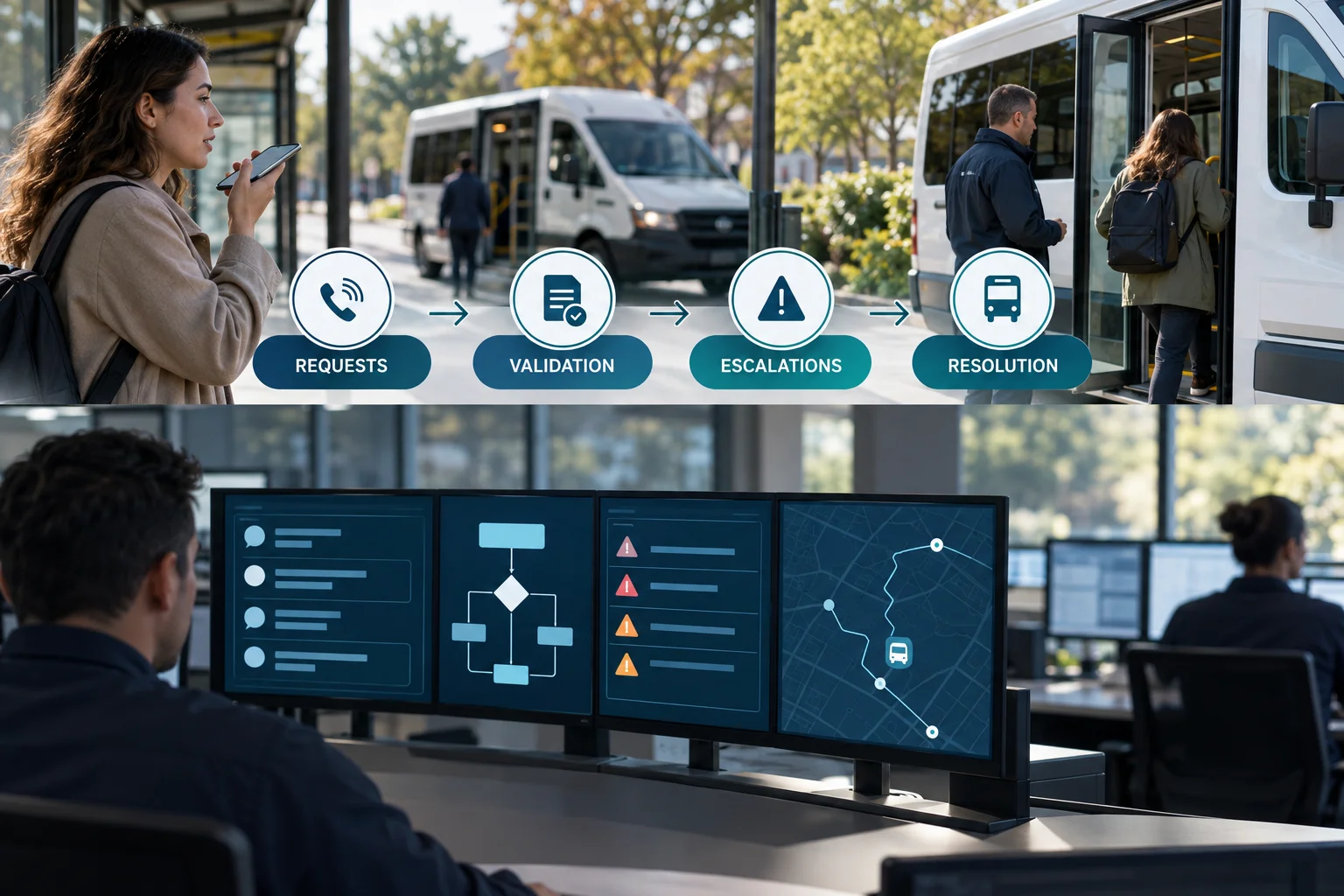
When a data source is stale, unavailable, or contradicts other sources, the system must follow a predetermined degraded mode: inform the rider of uncertainty, avoid speculative predictions, offer to submit a validated case, and route to a human if required by SLO thresholds.
- Stale schedule: check service‑alert API before answering; if both unavailable, inform rider and offer case submission.
- Missing provenance: decline to assert an authoritative event and offer handoff with recorded context.
- High‑uncertainty events: reduce automation scope (e.g., disallow automated booking) and require human verification.

5. Procurement, evidence and vendor evaluation
Procurement documents must embed SLOs, the data contract schema, observability requirements, human handoff responsibilities, and acceptance tests. Treat the Voice AI vendor as a subsystem — not a black box.
5.1 Contract clauses and SLO enforcement
Include clear clauses for uptime, API response latency, intent resolution SLOs, error budgets, and remediation steps. Require full access to observability data for the life of the contract (logs, traces, metric exports) to support audits and incident postmortems.
- Service credits, remediation windows, and termination rights tied to SLO breaches.
- Access scope: read access to production metrics, log replay within bounded windows, and exportable SLO reports.
- Change control: versioned schema rollouts with preproduction compatibility testing.
5.2 Acceptance testing and operational evidence
Acceptance should be based on deterministic tests: schema conformity checks, synthetic call tests across scenarios, human‑review audits of transcripts, and privacy/retention validation. Maintain a test corpus that mirrors real interactions, including low‑incidence accessibility scenarios.
- Synthetic and live‑shadow testing to validate routing, handoff, and case creation.
- QA samples and human review quotas for initial months after rollout.
- Privacy and retention verification: confirmation of delete flows, transcript access logs, and subprocessors.
6. Measurement, QA and continuous improvement
Operational maturity relies on measurement and feedback loops. Use SLOs and data contract telemetry to drive continuous improvement cycles.
6.1 Observability, reporting and dashboards
Instrument the system to expose SLO‑linked metrics: success rates per intent, case submission counts, handoff latency, and top failure reasons. Dashboards should tie metrics to data‑contract quality (e.g., stale alerts) and provide drilldown into sample transcripts for each anomaly.
- Key dashboards: SLO health, error budget burn rate, data‑contract validation failures, and human‑handoff queue metrics.
- Data export: scheduled SLO reports for governance and procurement reviews.
- Retention of evidence: store representative transcript samples for QA and audits, subject to retention policy.
6.2 Continuous QA and governance loops
Establish a cadence for model and rule reviews, schema evolution, and governance meetings. Use representative production samples for periodic retraining or rule updates but maintain an approval gate to prevent silent regressions.
- Monthly governance review for SLOs, error budgets, and schema changes.
- Change control board for any update that affects user outcomes.
- Human‑in‑loop sampling and red‑team tests for adversarial or edge cases.
6.3 Search and discoverability for voice answers
Ensuring consistent public information requires coordination with web and search teams. Use structured data and answer‑ready content where appropriate so downstream surfaces and voice systems draw from the same authoritative content. Peak Demand’s schema and AEO services can support structured, answer‑ready pages that complement voice orchestration.
- Align voice knowledge with published, structured content to reduce discrepancies.
- Use schema markup for service pages and FAQs to improve discoverability for both web and voice channels.
- Coordinate update windows between content publishers and the controlled knowledge base.
Related Peak Demand resources
Industry and AI sources reviewed
- Artificial Intelligence Risk Management Framework (AI RMF 1.0)National Institute of Standards and Technology (NIST)
- ISO/IEC 42001 Artificial Intelligence Management SystemInternational Organization for Standardization
- Transportation Systems SectorCybersecurity and Infrastructure Security Agency (CISA)
Transit safety, accessibility, privacy, cybersecurity, records, and service-information obligations vary by jurisdiction and operating authority. This article is operational guidance, not legal advice; organizations should confirm applicable requirements with qualified professionals.
Frequently asked questions
Good starting points include lost property, complaints and feedback, stop or shelter issues, fare-machine faults, non-emergency accessibility service requests, schedule information from approved sources, and structured routing to customer service or field teams.
Official reference: Artificial Intelligence Risk Management Framework (AI RMF 1.0)
Use GTFS Realtime only when the agency exposes suitable feeds and the workflow genuinely needs service alerts, trip updates, or vehicle positions. The integration should validate freshness and availability, and the agent should avoid presenting stale feed data as a guaranteed arrival prediction.
Emergency, security, injury, crime, and safety-critical reports should follow approved transfer or emergency-routing procedures. Voice AI may detect and route the call, but it should not make operational safety decisions or replace trained personnel.
Official reference: Transportation Systems Sector
Request realistic call testing, feed and system failure handling, service-request integration, transfer context, audit logs, accessibility channels, monitoring, change control, and evidence that the agent distinguishes scheduled information from dynamic service alerts.
Official reference: Artificial Intelligence Risk Management Framework (AI RMF 1.0)
Design the transit service workflow before automating it
Peak Demand helps transit teams connect Voice AI to rider information, service requests, approved live-data sources, escalation, confirmation, and analytics.
Schedule a discovery call


