
Customer Identity, Consent & Access Controls for Utilities Voice AI
A practical operating framework for utilities deploying high‑volume Voice AI: account-safe validation, consent capture, integration safeguards, human escalation and measurable controls for outage and service-request operations.
1. Why identity, consent and access controls matter for utilities
Utilities run high-volume voice operations during normal load and significant peaks during storms, leaks, or gas events. Identity, consent, and access controls are the foundation that keeps customer-service, outage communication, and field-service workflows auditable, safe, and legally defensible.
Operational risks and boundaries
Voice AI changes how customers interact with utility systems, but it does not change operational boundaries. Treat Voice AI as a customer‑facing orchestrator: it may collect information, present status, or create service requests but must not initiate safety‑critical control actions or replace emergency response. Define explicit failure boundaries for every capability: what the Voice AI can do autonomously, what requires automated API approval, and what must be confirmed by a human agent.
- Do not permit Voice AI to open/close valves, switch feeders, or issue crew safety directives.
- Mark any action that alters billing, service entitlement, or field safety as requiring multi-step validation and human approval.
- Log all decisions and triggers with immutable metadata for post-event audit and continuous QA.
Operational outcomes to measure
Choose measures that reflect safety, reliability and customer impact rather than abstract AI metrics. Useful outcomes include accurate outage-status responses, percent of calls resolved without human handoff, time-to-create service request during peak events, false-acceptance rate for identity checks, and audit latency (time between event and record availability).
- Track the false-acceptance rate for account validation (fraud/false-positive controls).
- Measure field-work correctness after Voice AI-scheduled visits (routing accuracy).
- Monitor mean time-to-escalate for calls that require human oversight.
2. Core call architecture and approved integration pattern
Standardize a deterministic architecture so teams can reason about identity and consent across channels and events.
Canonical call flow (decision-useful pattern)
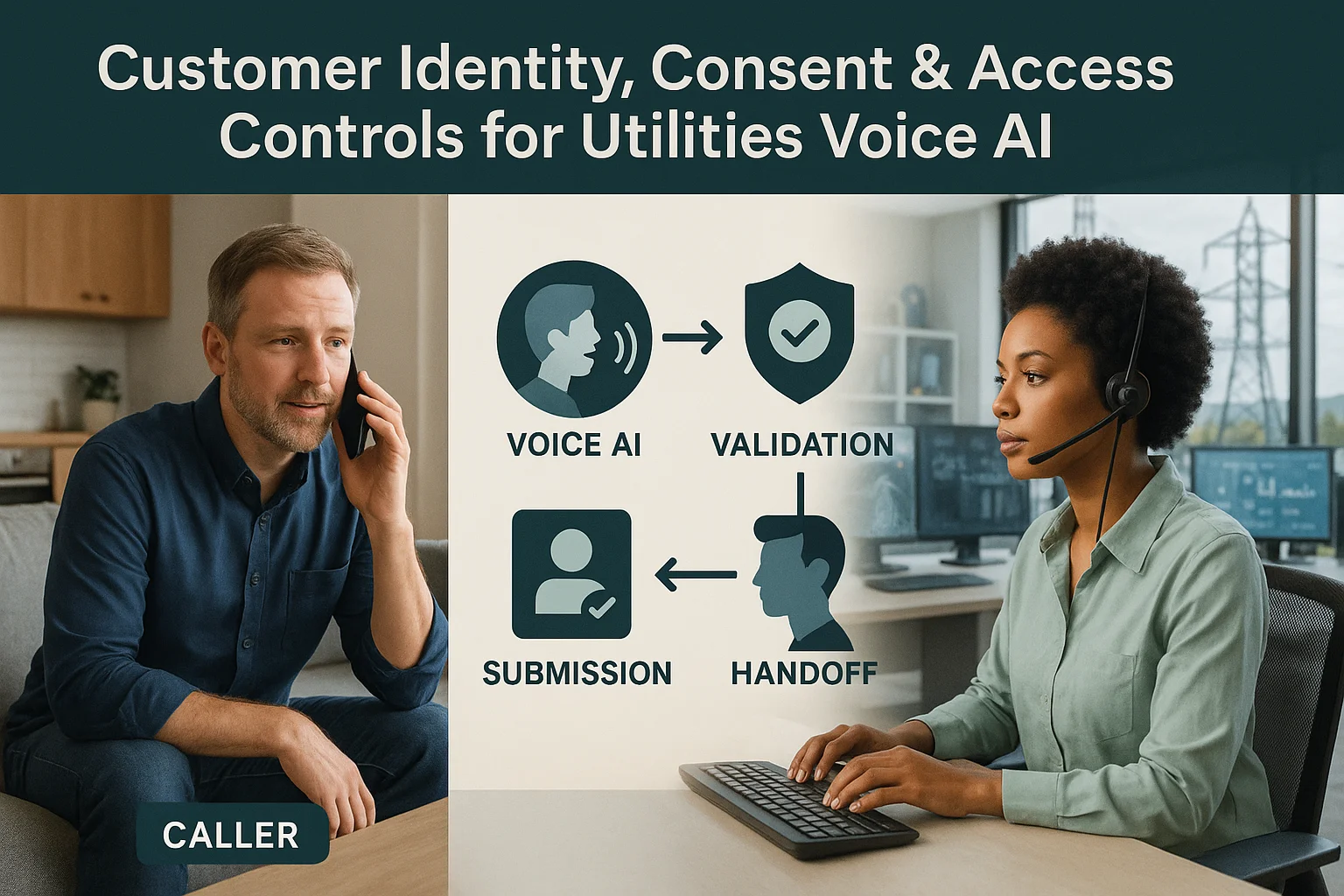
Adopt this minimal, auditable flow for every customer call: Customer call → Voice AI front end → account or location validation → approved utility API or knowledge source → service request, status response, or human escalation. Keep each handoff explicit and time‑boxed; persist the verification result and the data sources used in the call record.
- Voice AI collects minimal identifiers (phone number, premise address, meter ID) and transforms them into a normalized lookup key.
- Validation step queries approved APIs (CIS, OMS, outage maps) via controlled adapters — never direct database queries from the Voice AI runtime.
- If an API denies access or returns high risk, route to human triage or an elevated verification flow.
Approved API and knowledge-source rules
Treat approved APIs and knowledge sources as the policy ground truth. Maintain a registry of approved endpoints, their allowed call types, expected rate limits, and data-use agreements. Use an orchestration layer to enforce policy (fields allowed, redaction rules, scopes) and to mediate calls from Voice AI to back-end systems.
- Map each API to permitted intents (status check, create ticket, update contact) and the required authorization scope.
- Implement field-level minimization and masking within the adapter so Voice AI receives only permitted data.
- Record adapter decisions and the identity of the calling service in the audit log for compliance review.
3. Consent, recording and retention controls
Recording and consent are operational necessities. Capture consent with consistent wording, persist consent metadata, and make retention and access auditable.
Consent capture and recording statements
Require an early, clear consent statement that states the call will be recorded, why the recording is required, and how it will be used. Store the consent transcript or flag as metadata tied to the call record. For callers who refuse recording, provide a documented alternative (e.g., callback to a human agent or text/email follow-up) and log that alternative path.
- Use consistent, plain-language consent scripts across IVR and Voice AI to reduce disputes.
- Persist a consent token with time, call identifier, script version, and the voice print or DTMF confirmation where available.
- If a caller withdraws consent mid-call, transition to an unrecorded human agent flow or the pre-defined alternative and record the withdrawal event in the.
Retention, access controls and cross-border considerations
Define retention periods by data class (recordings, transcripts, verification tokens, audit logs) and implement role-based access to each class. Identify hosting region for primary data, backup/DR geography, subprocessors, and mechanisms for lawful cross-border transfers. Make retention and transfer policies explicit in procurement contracts and privacy assessments.
- Separate raw recordings from anonymized transcripts; apply stricter retention to raw audio.
- Use role-based access controls and just-in-time elevation for account-sensitive record access.
- Document subprocessors, backup region, and the transfer mechanism (standard contractual clauses, adequacy decisions) in the data processing agreement.
4. Tiered identity and verification strategies
Verification must be proportional to risk and the requested action. Use a tiered model that balances customer friction with fraud and safety mitigation.
Tier 1 — low-friction checks for outage status and information
For high-volume outage calls, prioritize rapid verification that requires minimal friction. Use CLI (calling number inference), premise matching (address/meter ID), and outage-map correlation. If the customer provides minimal identifiers that match an affected premise, the Voice AI may provide read-only outage status and estimated restoration windows without elevated authentication.
- Accept CLI and premise lookup for read-only responses (outage status, estimated restoration).
- Log verification confidence and the sources used to produce the status message.
- If confidence falls below a threshold, automatically offer to route to a human agent for confirmation.
Tier 2 — elevated checks for service changes and privileged requests
When a caller requests changes (move-in/out, payment arrangements, meter access, or new service), require stronger verification: multi-factor authentication, knowledge-based confirmation, or callback to a known account contact. Record the verification steps and require human approval where policy dictates.
- Require MFA, SMS/email OTP, or callback validation for account changes and billing requests.
- Treat any request that could affect safety or entitlement as requiring human review and signed consent where applicable.
- Store the verification artifacts (OTP success, callback transcript) with the service request ticket.

5. Integration safeguards, failure modes and surge handling
Safeguards should assume integrations will fail under stress. Define graceful degradation, surge controls, and observability so operations and field teams remain effective during events.
Controlled adapters, policy enforcement and observability
Place an adapter/orchestration layer between Voice AI and back-end systems. This layer enforces field-level policies, rate limits, allowed intents, and data redaction before any back-end call. Implement end-to-end observability: request/response tracing, SLA dashboards, and event‑level analytics that link call volumes to API latency and error rates.
- Adapters should provide tokenized identities for the Voice AI to prevent direct credential exposure.
- Log request ID, adapter decision, API response, and time-to-response for every back-end interaction.
- Use event-level analytics to detect anomalous patterns (sudden rise in failed verifications or surge‑driven throttles).
Failure boundaries and fallbacks
Define explicit fallback behaviors for adapter or API failures: present a short status message, offer to queue for a callback, or immediately route to human agents. Never allow the Voice AI to make irreversible changes when a required back-end verification failed or returned a timeout.
- Classify failures as transient (retry), partial (limited read-only), or critical (route to human).
- Prioritize calls based on safety flags and account criticality when capacity is limited.
- Expose failure-mode telemetry to operations in real time for manual override during events.
Surge capacity, throttling and SLA alignment
Design throttles to protect critical systems: OMS and CIS must not be overwhelmed by automated retries or mass Voice AI queries during large events. Coordinate with backend owners to set reasonable rate limits and provide event-specific exemptions when staff can monitor and accept risk.
- Implement token bucket throttling and circuit breakers per API endpoint.
- Use prioritized routing so safety-flagged or critical accounts bypass non-essential queues.
- Align incident runbooks and SLAs between contact centre, Voice AI, and field operations for event response.
6. Human escalation, governance and continuous QA
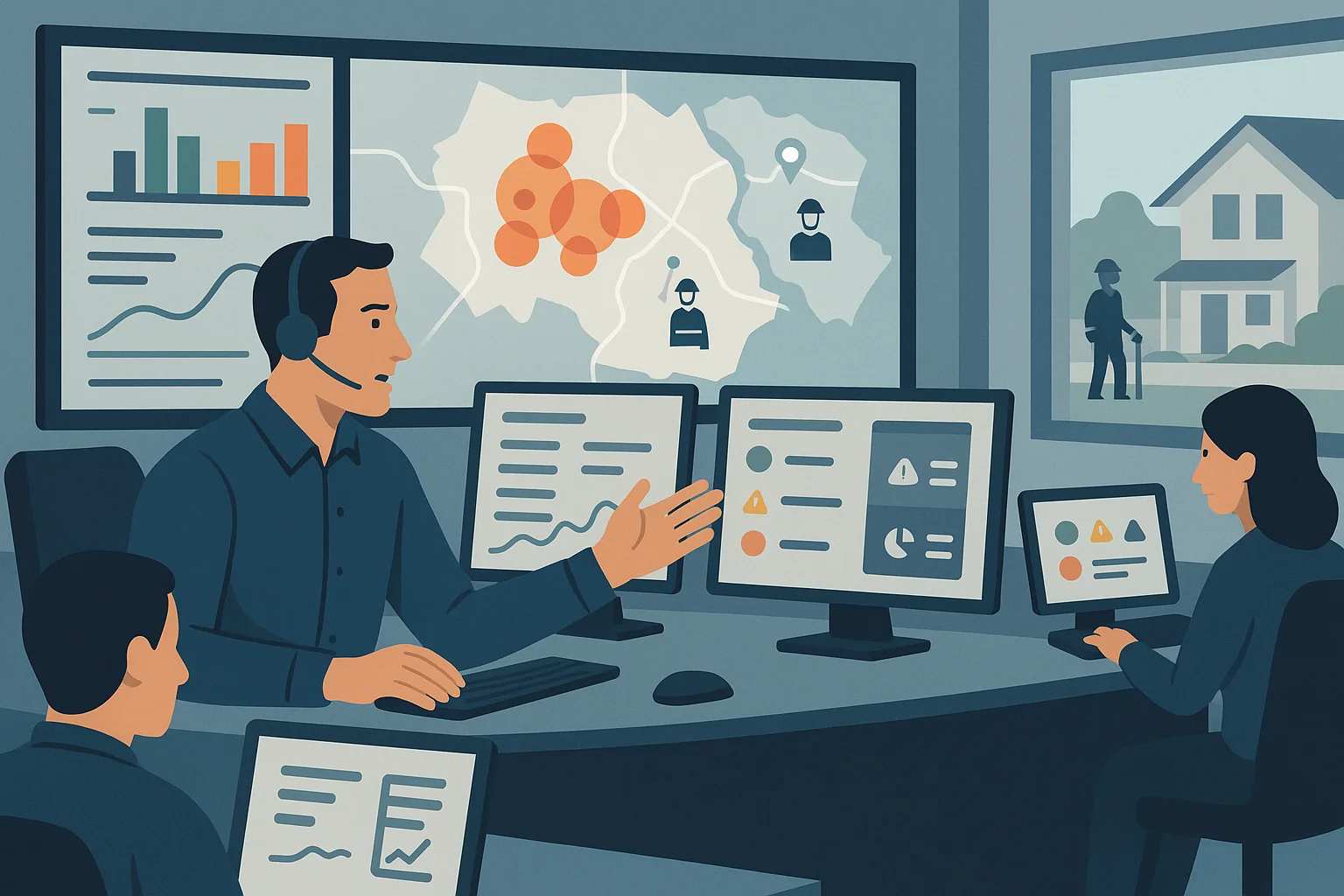
Human oversight is the safety valve. Define explicit escalation triggers, governance roles, and QA cycles that make Voice AI auditable and improvable.
Escalation rules and human-in-loop design
Create deterministic rules for when a call escalates: verification confidence thresholds, detection of safety keywords (gas smell, carbon-monoxide symptoms), or failed backend verification. Escalation should include a structured hand-off: summary, verification artifacts, and an action checklist for the agent.
- Always pass verification artifacts and consent metadata to the human agent at handoff.
- Use structured hand-off cards that list what was attempted automatically and recommended next steps.
- Allow human agents to mark calls for QA retraining and to flag edge cases into governance reviews.
Governance, audit trails and QA cycles
Establish a governance board for Voice AI that includes operations, legal, privacy, field, and IT representatives. Maintain auditable trails: call recording or transcript IDs, verification tokens, API adapter logs, and human actions. Schedule QA cycles to review escalations, false acceptances, and transcript accuracy to tune models and policies.
- Retain a searchable audit index for regulatory or internal review with access controls.
- Run periodic tabletop exercises that simulate outages and test verification and escalation rules.
- Feed QA findings back into policy changes and retraining pipelines with measurable KPIs.
Related Peak Demand resources
Industry and AI sources reviewed
- AI Risk Management Framework — Critical Infrastructure ProfileNational Institute of Standards and Technology (NIST)
- ISO/IEC 27001 Information Security Management SystemsInternational Organization for Standardization
- Cybersecurity Capability Maturity Model (C2M2)U.S. Department of Energy
- Cross-Sector Cybersecurity Performance GoalsCybersecurity and Infrastructure Security Agency (CISA)
Utility cybersecurity, critical-infrastructure, records, customer-protection, and emergency-communications obligations vary by jurisdiction and service type. This article is operational guidance, not legal advice; organizations should confirm applicable requirements with qualified professionals.
Frequently asked questions
Good starting points include billing and account questions, move-in or move-out intake, appointment scheduling, service-request capture, outage-status messaging from approved systems, payment-routing assistance, and structured escalation. Safety-critical and infrastructure-control decisions should remain with qualified utility teams.
Official reference: Cross-Sector Cybersecurity Performance Goals
Use the minimum approved identifiers needed for the workflow, validate them against the utility's system of record, limit data exposure, and provide a human-assisted path when verification fails. The Voice AI should not guess account, premise, or outage information.
Official reference: Cross-Sector Cybersecurity Performance Goals
Use controlled adapters, strict schemas, timeouts, retries, audit logs, safe failure states, and human escalation. The system should distinguish approved utility data from model-generated language and should never present stale or unverified operational information as fact.
Official reference: Cybersecurity Capability Maturity Model (C2M2)
Track containment by request type, successful validations, transfers, abandoned calls, integration errors, incorrect or stale responses, time to resolution, customer follow-up, and the percentage of cases completed safely without manual rework.
Official reference: Cybersecurity Capability Maturity Model (C2M2)
Build resilient utility customer-service automation
Peak Demand helps utilities connect Voice AI to approved customer-information, outage-communication, service-request, dispatch, escalation, and analytics workflows.
Schedule a discovery call


