
Consent Orchestration and Patient Identity for Enterprise Voice AI Access
Practical guidance for implementing Voice AI in patient access with consent orchestration, identity proofing, safe escalation, integrations, and governance for regulated healthcare environments.
1. Why identity and consent orchestration matter for Voice AI
Voice AI is now capable of replacing large volumes of routine calls in patient access — appointment booking, rescheduling, basic administrative questions. But for enterprise, the crucial control plane is identity and consent. Without reliable identity proofing and explicit consent trails, automated actions can create privacy, safety, and liability exposures.
The operational problem
Patient-access teams face a practical trade-off: reduce unnecessary human calls while avoiding incorrect releases of protected information, scheduling errors, or unsafe automation of clinically sensitive items. Identity ambiguity is the single most common reason automated workflows must hand off to people. Designing identity and consent controls upstream reduces those handoffs and keeps automation within safe boundaries.
- Automate administrative tasks only after an identity confidence gate.
- Capture consent for recording, data use, and action authorization explicitly and audibly.
- Treat consent as a workflow state that can be revoked or re-validated.
Commercial value without overreach
Enterprise buyers should aim for predictable operational benefits (reduced wait time, better scheduling accuracy, extended after‑hours coverage) but avoid claims that automation replaces clinical judgment. Portfolio decisions should balance containment (what Voice AI resolves end-to-end) against safe escalation for ambiguous or high-risk interactions.
- Define which transactions are in-scope (e.g., appointment booking, insurance eligibility checks) and explicitly exclude clinical triage.
- Measure containment rate and escalation accuracy rather than headline savings alone.
- Use phased rollouts to validate identity and consent flows in live conditions.
2. A practical operating model: Patient→Voice AI→Validation→Action
Keep the architecture simple and gate critical actions behind validation. The operating flow should be deterministic and auditable.
Canonical workflow
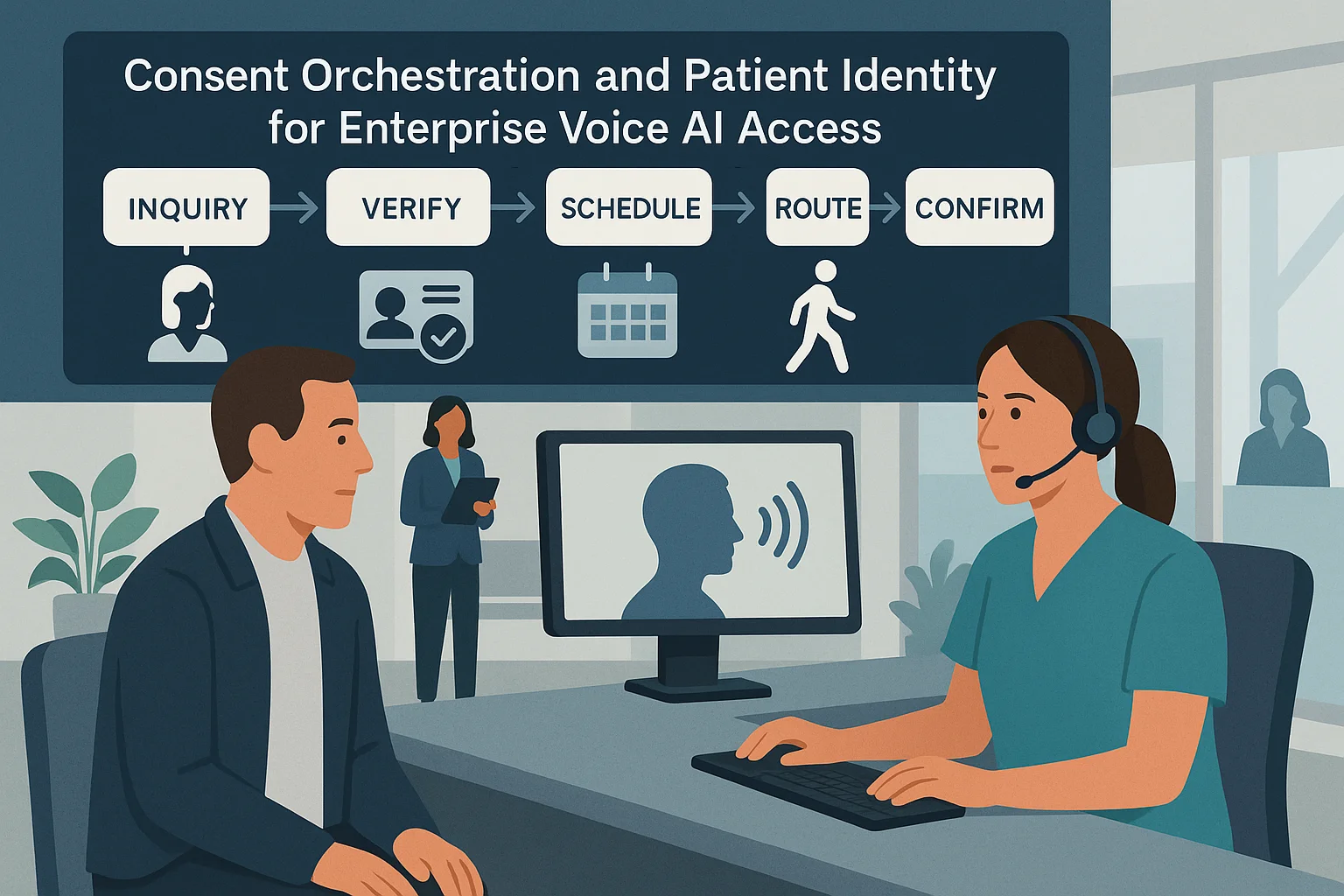
Design each call as a state machine: caller arrives → Voice AI greets → capture identity inputs → run identity checks → capture consent → execute approved action (scheduling API, leave message, transfer to agent) → confirm and log. The decision to act is a discrete, auditable event that requires passing both identity and consent gates.
- Patient or caller → Voice AI (IVR/ASR/NLU) → Validation and identity controls → Approved scheduling/service API or human handoff → Confirmation and audit log.
- Every automated write operation to scheduling or EHR systems must be tokenized and logged with caller identity confidence and consent metadata.
- Store a compact interaction record (who, when, what action, identity confidence, consent flags) for audit and QA.
Where Peak Demand typically adds value
Peak Demand builds custom Voice AI with scheduling and intake integrations, field validation, safe escalation, audit trails, and human review mechanisms. Our approach uses controlled adapters to EHR/PM systems and orchestration layers that centralize identity and consent state so downstream systems receive only approved, logged requests.
- Custom adapters for scheduling systems (including Epic) encapsulate business rules and reduce direct EHR writes from the voice layer.
- Field validation routines check slot-level constraints (clinic hours, provider availability, prep requirements) before action.
- Human review queues surface low-confidence or high-risk interactions with full playback and metadata.
3. Identity proofing and consent controls — design choices
There is no one-size-fits-all identity solution. Design identity proofing to match transaction risk and local privacy expectations. Consent capture should be auditable and reversible.
Layered identity: confidence thresholds and methods
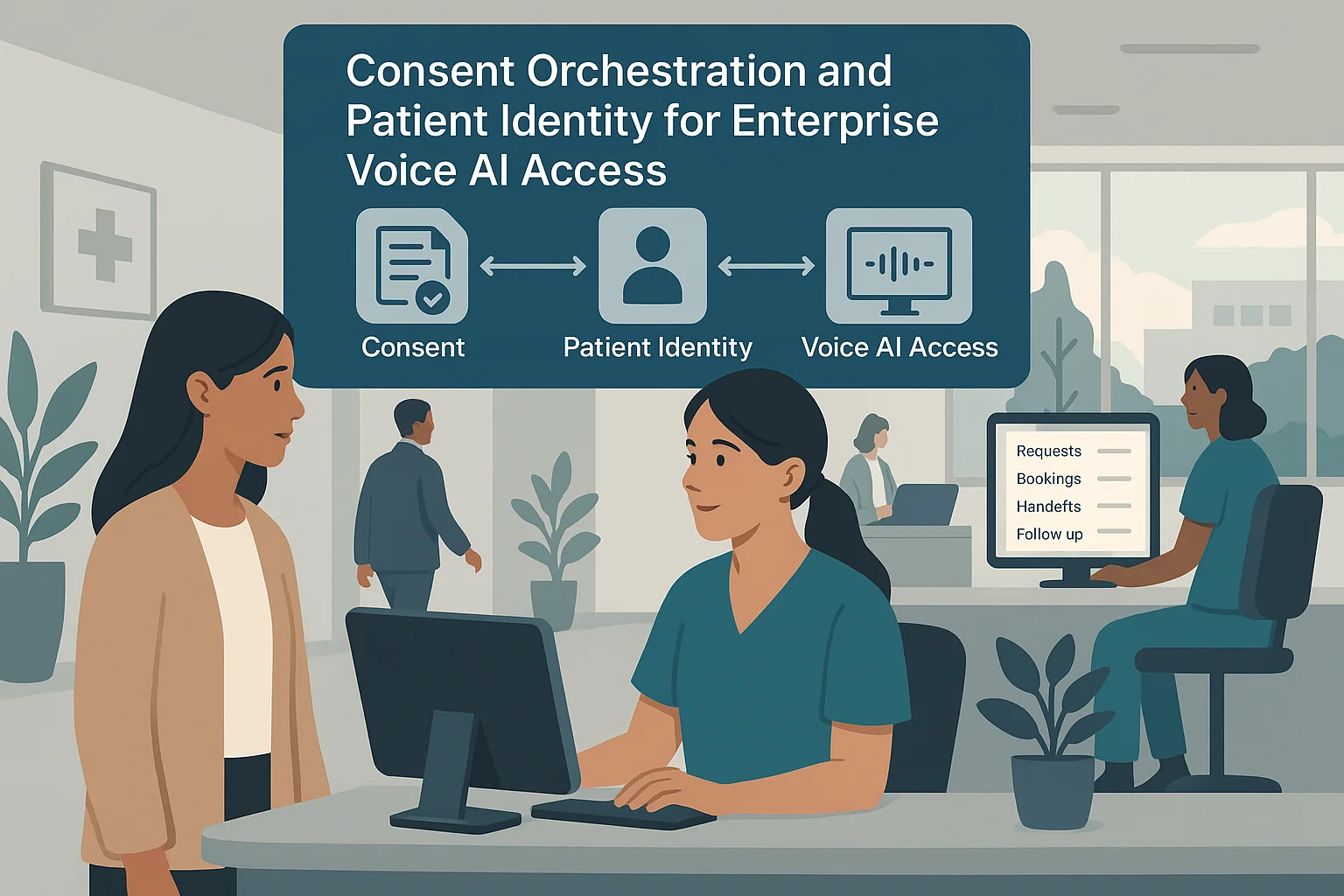
Match identity method to risk. Low-risk tasks (office hours info) may need only name and DOB. Higher-risk actions (release of PHI, scheduling sensitive procedures, third-party rescheduling) require stronger proofing: multi-factor voiceprint match, call-back to on‑record phone, one-time passcode (OTP), or integration with patient portals for SSO confirmation.
- Define confidence bands (low, medium, high) and map them to permitted actions.
- Use multiple orthogonal checks for high-risk workflows (voiceprint + OTP + matching demographic fields).
- Fail closed: if confidence is insufficient, route to a verified human agent rather than defaulting to weaker actions.
Consent orchestration and audit trails
Capture explicit consent for recording, data use, and transaction authorization. Make the consent statement brief, audibly recorded, and stored as structured metadata. Consent must include the purpose, retention period for recordings, and options for revocation. Logging should connect the consent record with the action’s audit trail.
- Record that consent was given (time-stamped), by whom, and for what purposes.
- Store a consent token in the orchestration layer that downstream services check before executing actions.
- Design retention and deletion processes for recordings that align with local regulations and your retention policy.
4. Safety boundaries, human oversight, and clinical limits
Voice AI must operate inside clearly signposted safety boundaries. It is not a clinical tool and must escalate clinical ambiguity and emergencies immediately to trained staff.
Explicit clinical exclusions
Never use Voice AI to diagnose, prescribe, triage emergencies, or make clinical decisions. Scripts and NLU models should include explicit detection for verbs or phrases implying clinical urgency (chest pain, shortness of breath) and treat them as immediate handoffs.
- Block workflows that request clinical advice; provide clear escalation actions and hold music while transferring.
- Log every clinical escalation with the trigger phrase, confidence score, and timestamp for QA and clinical governance.
- Test the handoff path regularly with clinical staff and incident drills.
Human-in-the-loop thresholds and review
Define measurable thresholds (identity confidence, NLU confidence, transaction criticality) that force human review. Implement audit queues where agents see call recordings, reason codes, and suggested actions. Make human-in-the-loop review a standard part of change control for model updates.
- Use patterned sampling for post-resolution QA and targeted review for low-confidence cases.
- Track human override rates and root-cause classify overrides (identity failure, NLU error, incorrect field mapping).
- Ensure supervisors have playback, redaction controls, and a clear remediation workflow.

5. Integration, data flows, and regulatory-aware deployment
Integration ownership, data residency, subprocessors, and remote-support access are procurement and deployment decisions. Make them explicit and test end-to-end.
Integration ownership and orchestration adapters
Decide who owns adapters between Voice AI and scheduling/EHR systems. Best practice: a shared-responsibility model where the vendor provides a certified adapter and the healthcare organization controls API credentials and production governance. Adapters should observe business rules (no double booking, appointment prep verification) and expose observability for each action.
- Contractual clarity on change control: who updates adapters when EHR schemas change?
- Use transaction tokens and idempotency keys for scheduling writes to avoid duplication.
- Monitor adapter success/failure rates and define clear escalation paths.
Data residency, subprocessors, and cross-border considerations
Document hosting region, backup region, subprocessors, remote-support access, and data egress paths before go-live. Note: jurisdictional obligations vary. Organizations must confirm obligations with qualified counsel and privacy experts. From an operational perspective, ensure you can answer these questions for every deployment and that retention and recording consent policies are enforced by configuration.
- Identify primary hosting region, backup/DR region, and where recordings or transcripts may be stored.
- List subprocessors used for speech-to-text, analytics, and storage; require subprocessors to comply with contractual security and privacy obligations.
- Define remote-support controls (jump-hosts, jump boxes, logging of remote sessions) and retention of support logs.
6. Procurement, governance, and measurable controls
Procurement should move beyond features to responsibility mapping: who provides what, with what evidence, and how outcomes are measured.
RFP and vendor checklist
When procuring Voice AI, require: clear delineation of adapter ownership; sample audit logs; identity proofing options; consent recording features; SLA for handoffs; QA sampling methods; and a documented incident and breach-notification process. Ask for evidence of controlled testing in healthcare environments and an approach to red-team NLU failures.
- Request runnable QA scripts and metrics for containment, escalation accuracy, and false-acceptance rates for identity checks.
- Require documentation for subprocessors, data localization options, and remote-support access.
- Include a change-control clause for model updates and a rollback process.
Governance, risk, and continuous QA
Operationalize governance with a cross-functional steering committee (patient access, privacy, legal, clinical safety, IT). Use the AI Risk Management Framework to structure risk assessment, mapping model performance to business impact and controls. The committee should own tolerances for identity confidence, escalation thresholds, and acceptable error paths.
- Create a quarterly report with hit rates on key gates: identity failures, consent revocations, and clinical escalations.
- Operationalize incident post-mortems with clear remediation timelines and tracking.
- Run periodic model validation and adversarial tests that simulate real-world call variability.
7. Implementation roadmap, testing, and failure boundaries
Use a phased rollout that validates identity and consent gates early and keeps clinical risk contained.
Phased rollout and gating
Start with a narrow scope: limited clinic locations, non-clinical transactions, and daytime hours. Validate identity proofing and consent capture in production with live supervision. Expand scope only after meeting pre-agreed KPIs and lowering manual intervention rates.
- Phase 1: after-hours and information calls with basic ID checks.
- Phase 2: appointment booking and confirmation with medium confidence checks and human fallback.
- Phase 3: schedule changes and registration updates with high-confidence proofing and operationalized audit review.
Failure modes and containment
Define and rehearse failure modes: identity false-acceptance, transcription errors, adapter write failures, and clinical phrase detection misses. For each failure mode, define a containment action: immediate human transfer, temporary suspension of automated writes, or selective rollback of recent transactions.
- Instrument rapid rollback for scheduling writes (e.g., idempotency, reversible confirmations).
- Monitor for correlated failures (spikes in human overrides) that may indicate model drift or integration faults.
- Schedule periodic full-stack tests (voice → NLU → orchestration → adapter → EHR) as part of release gates.
Related Peak Demand resources
Industry and AI sources reviewed
- Ethics and governance of artificial intelligence for healthWorld Health Organization
- Regulatory considerations on artificial intelligence for healthWorld Health Organization
- Artificial Intelligence Risk Management Framework (AI RMF 1.0)National Institute of Standards and Technology (NIST)
- OECD AI PrinciplesOrganisation for Economic Co-operation and Development
Healthcare privacy, security, clinical-safety, records, and professional obligations vary by jurisdiction and workflow. This article is operational guidance, not legal advice; organizations should confirm applicable requirements with qualified professionals.
Frequently asked questions
Administrative workflows such as appointment booking, changes and cancellations, referral-status intake, approved follow-up, patient-access questions, after-hours overflow, and structured routing are common starting points. Clinical judgment, diagnosis, emergency triage, and prescribing decisions must remain with qualified professionals.
Use the minimum identifiers approved by the organization, validate them against the system of record, avoid exposing unnecessary information, and provide a human-assisted path when verification fails. The system should not infer identity from conversational context alone.
The agent should follow the organization's approved escalation and emergency-routing rules, avoid clinical advice, and transfer or direct the caller to the appropriate human or emergency channel. Those rules must be tested with realistic language and failure cases.
Request identity and privacy controls, scheduling or EHR integration behavior, audit logs, escalation rules, downtime handling, testing evidence, change control, monitoring, and clear separation between administrative automation and clinical decision-making.
Design a safe patient-service workflow before automating it
Peak Demand helps healthcare organizations connect Voice AI to scheduling, intake, patient communication, identity checks, escalation, and reporting with clear operational boundaries.
Schedule a discovery call


