
Clinic-Scale Voice AI: QA, Containment, Escalation, Cost-to-Serve
Operational guidance for deploying voice AI in clinic patient-access: measurement, QA, containment, safe escalation, cost-to-serve, multilingual scale, and continuous optimisation.
1. Use case and operating model
A clinic-scale Voice AI should automate clearly defined administrative patient-access tasks while providing deterministic handoffs for clinical or ambiguous requests. Below is an operational model and the safety boundaries required for regulated healthcare contexts.
Operational architecture (caller to confirmation)
Use a linear, auditable flow: Patient or caller → Voice AI (speech-to-intent) → validation and identity controls → approved scheduling or service API → confirmation or human handoff. Keep system responsibilities discrete. The Voice AI's role is to collect required intake fields, confirm identity and consent, validate fields against authoritative systems (EHR/PM), and either execute a permitted API action (book, cancel, reschedule, request refill routing) or queue a human handoff.
- Input capture: NLU + slot-filling for name, DOB, MRN, appointment type, preferred times.
- Identity & consent: OTP, knowledge-based questions, or EHR-matched fields before permit.
- Action layer: Only pre-approved API calls (scheduling, messaging) initiated after validation.
- Handoff: Structured handoff packet, priority flags, and recorded audit trail.
Safety boundaries — clinical vs administrative
Define and encode a strict clinical boundary: Voice AI must not triage, diagnose, recommend treatment, interpret clinical test results, or decide urgent care. Any utterance touching symptoms, medication advice, or acute complaints must trigger an immediate escalation to trained staff and be labeled for clinical review. Operationally codify these boundaries as deterministic triggers in the model context (MCP — Model Context Protocol) so the model never attempts out-of-scope actions.
- Hard-stop triggers: words/phrases mapping to 'urgent', 'shortness of breath', 'chest pain', 'severe bleeding', etc., route to human immediately.
- Soft-warning triggers: potential clinical terms that require confirmation from caller and immediate escalation if present.
- Audit requirement: every escalation includes raw audio/text, derived intent, and reason-code for compliance.
2. QA and measurement framework
Operational QA is not a one-off test; it's a lifecycle of synthetic tests, live sampling, annotation, and metrics that directly feed product and clinical governance decisions.
Test plan: synthetic, shadow, and live
Structure QA into three phases. 1) Synthetic regression suites — scripted audio and text probes for every intent, slot, language, and failure mode. 2) Shadow mode — live calls processed by Voice AI in parallel with human agents; no action taken, but full telemetry logged. 3) Gradual rollouts — percentage-based routing with escalation monitoring and rollback criteria.
- Scripted probes: edge cases, non-native accents, filler words, background noise, and degraded audio.
- Shadow logging: compare Voice AI decisions to agent outcomes for drift and false negatives.
- Rollback gating: defined thresholds for escalation accuracy and containment change the rollout percentage or pause deployment.
Key metrics and dashboards
Control panels must expose both operational KPIs and safety KPIs. Operational KPIs tell you efficiency and cost; safety KPIs tell you whether patient risk is rising.
- Containment rate: percent of calls completed by Voice AI without human handoff.
- Escalation accuracy: percent of escalations that were appropriate (true positives) and percent of missed escalations (false negatives).
- Handoff quality score: completeness of the structured packet (required fields populated) and time-to-accept by human agent.
- Cost-to-serve per call: break down by automated handling time, human escalation time, post-call human review, and periodic retraining costs.
- Model performance: intent accuracy, slot-filling F1, ASR word-error-rate by language/channel.
3. Containment quality: keeping automated actions correct
Containment is necessary but not sufficient. High containment with poor accuracy or unsafe decisions is unacceptable. Design containment to be conservative and verifiable.
Confidence thresholds and rejection pathways
Use multi-stage confidence logic: ASR confidence + intent confidence + field validation. Only when all gates pass should the system execute an action. Otherwise, it rejects to a human. Explicitly log the reasons for rejection so QA can trace and improve.
- Dual-threshold logic: require both intent and slot confidence to exceed configured thresholds.
- Fallbacks: offer retries (repeat, rephrase) up to a bounded count before handoff.
- Rejection taxonomy: low ASR quality, ambiguous intent, identity mismatch, API validation failure.
Field validation and identity verification
Before permitting scheduling or release of PHI, validate captured fields against the patient record. Identity verification options include One-Time Passcode (OTP) to the patient’s phone, knowledge-based questions based on EHR data, or integration-based session tokens from patient portals. Field-validation reduces erroneous bookings and reduces exposure of protected data.
- EHR/PM API checks: match name + DOB + phone or MRN before any scheduling action.
- OTP for sensitive actions: require OTP to confirm appointment changes and send confirmation.
- Logging and retention: record what identity method was used and store as part of audit trail per retention policy.
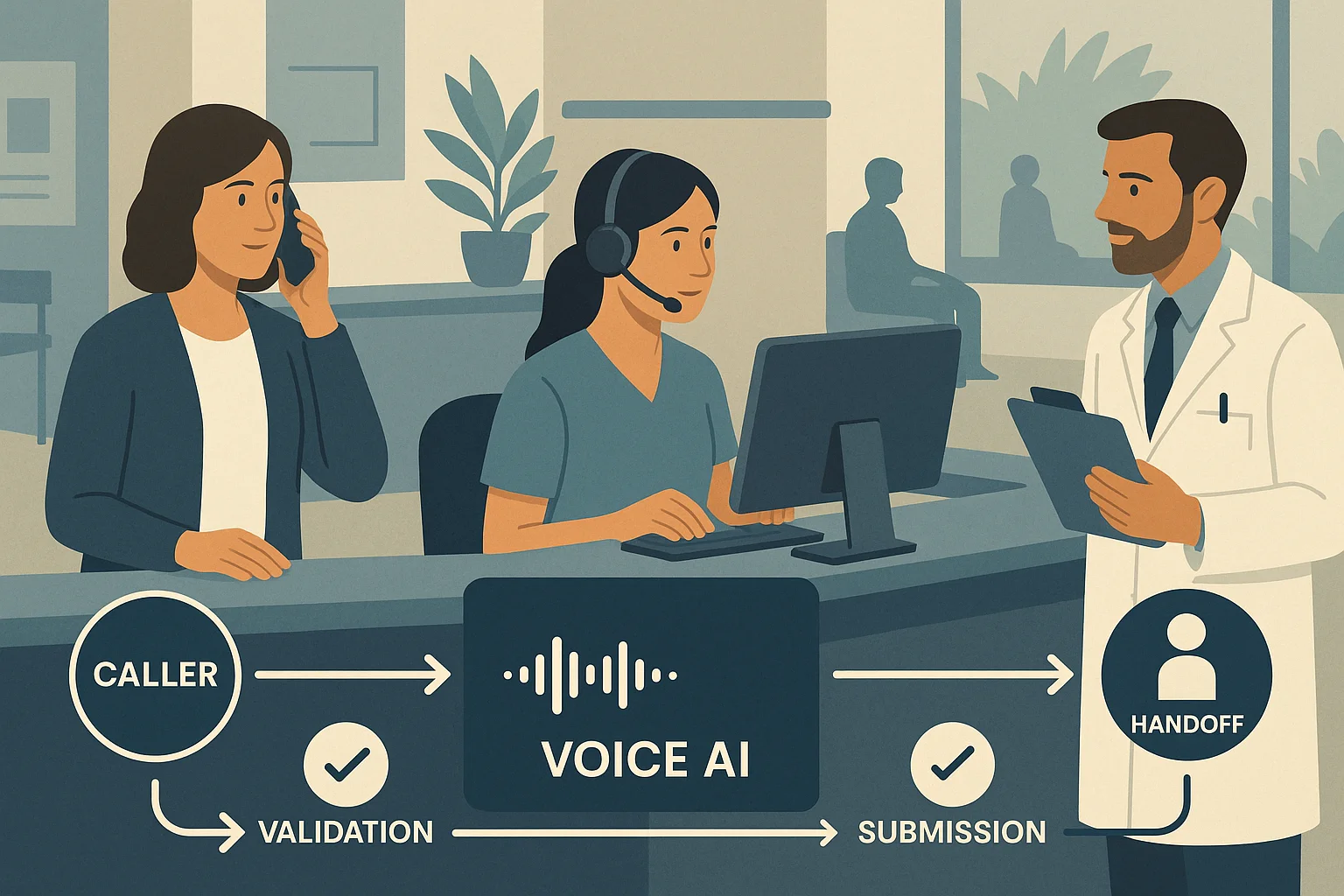
4. Escalation quality and human-in-the-loop design
Escalation is where safety and patient experience are decided. Treat the handoff as a product feature that must be measured and optimised.
Escalation triggers and routing
Design triggers with both deterministic rules and model-driven signals. Deterministic triggers handle clear safety concerns; model signals can detect fuzzier cases (uncertain intent, conflicting slots). Route escalations to the right team — scheduling, clinical triage, or security/privacy — using structured tags.
- Priority tags: 'urgent-clinical', 'ambiguous-intent', 'identity-failed', 'system-error'.
- Skill-based routing: route urgent clinical to nurses/triage; scheduling to access teams with EHR privileges.
- SLA windows: define expected human response times by tag and monitor adherence.
Handoff quality and audit trails
A good handoff packet reduces resolution time and limits repeated questioning. Include raw audio/text, structured intent, slot values, confidence scores, identity verification result, and recommended next action. Every handoff must be logged with a reason-code and time-to-accept metric.
- Standardized handoff format: JSON packet with schema for all required fields to integrate with contact centre or EHR workflows.
- Human review sampling: sample escalations for clinical and compliance review, and track corrective actions.
- Immutable audit logs: store handoff packets and acceptance timestamps in an access-controlled ledger for investigations.
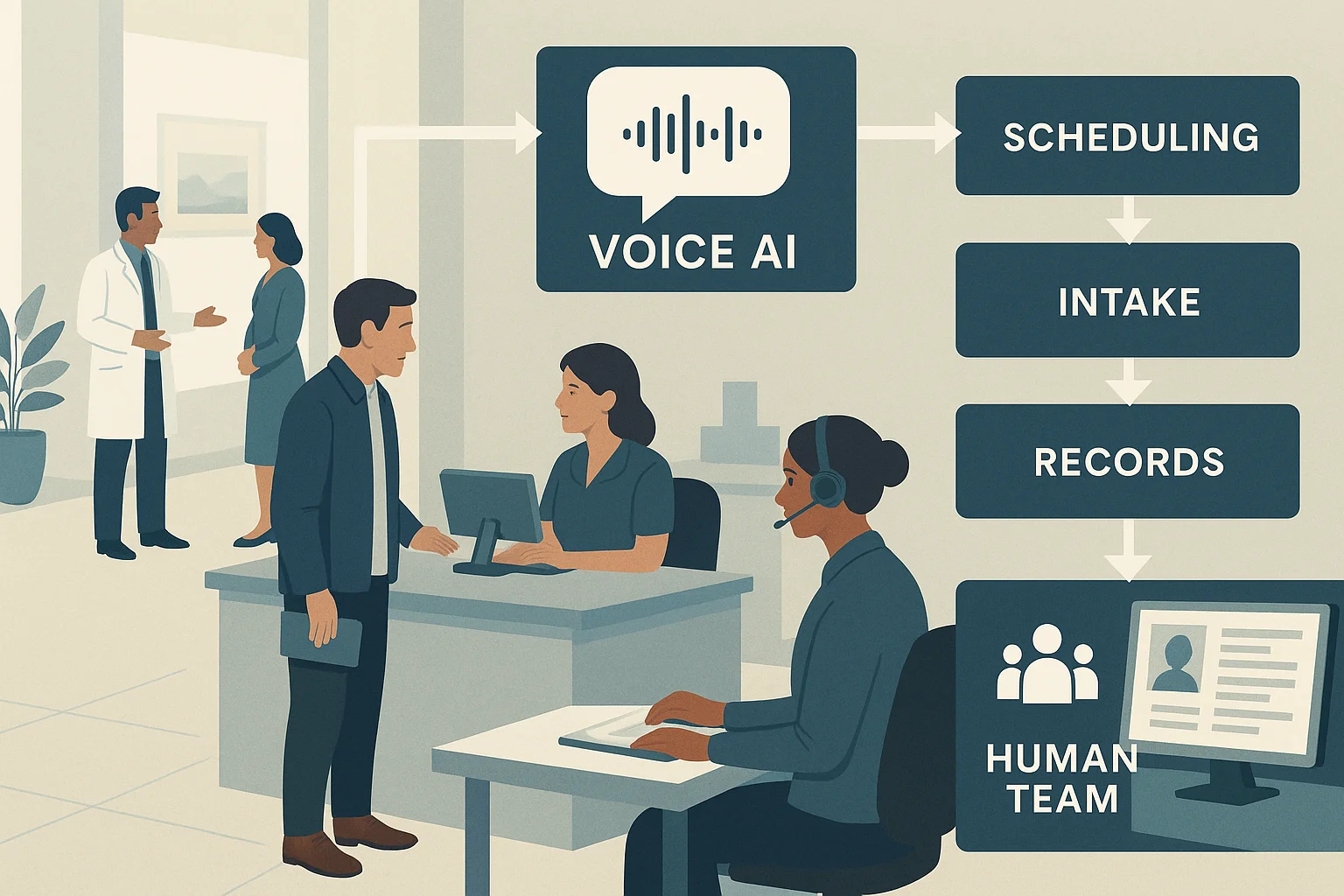
5. Cost-to-serve and commercial levers
Measure cost-to-serve as a unit economic that informs pricing, capacity planning, and ROI sensitivity. It is driven by automation share, average handling times, and human review needs.
Cost components and measurement
Break down cost-to-serve into discrete components and measure them continuously. Use these levers in budgeting and vendor negotiations.
- Automation runtimes: cloud compute and ASR/NLU costs per minute or per call.
- Integration calls: API usage costs and any transaction fees with scheduling or messaging providers.
- Human handling: agent-resolved time for escalations, including transfer and wrap-up.
- Quality overhead: annotation, human review, retraining, and governance staff time.
- Fixed ops: deployment, integration, and initial tuning.
Commercial levers and scale effects
As containment rises and false escalations fall, variable human costs decline. However, rising annotation and model maintenance costs can offset gains unless optimised. Negotiate vendor contracts around measurable SLAs: intent accuracy, ASR WER by language, and uptime for integrations. Consider managed services for shrink-wrapped operations, but retain control over identity and scheduling integrations.
- Pricing models: per-minute ASR, per-transaction scheduling, or outcome-based tiers with clear metric definitions.
- Managed vs in-house: managed services reduce ops burden (link to managed service offering) but confirm data flows and subprocessor lists.
- Integration ownership: keep ownership of scheduling/EHR integration to retain data control and faster troubleshooting.

6. Multilingual and multi-site scale
Scaling across sites and languages introduces variability in ASR, local phrasing, and operating rules. Treat localization as a controlled release with its own QA pipeline.
Language model strategy and voice UX
Select ASR and NLU models per language and channel; do not assume parity across languages. Run language-specific synthetic tests and recruit representative voice talent for prompts and utterance collection. Maintain voice UX consistency: predictable turn-taking, clear confirmations, and additional repeats for low-confidence segments.
- Separate thresholds by language and channel (IVR vs mobile app).
- Localization of prompts and slot formats (dates, address formats, honorifics).
- Accessibility considerations: support DTMF fallback and simple menu-based options for critical actions.
Deployment topology and data residency
Define hosting regions, backup geography, and subprocessors during procurement. For multi-site deployments, use regional endpoints that minimize latency and comply with local policies. Document remote-support access methods, cross-border transfer mechanisms, retention periods for recordings and transcripts, and subprocessors handling voice data. Organizations must validate these against local legal and regulatory obligations with qualified counsel.
- Hosting and backups: specify primary hosting region and backup region for disaster recovery.
- Subprocessor transparency: require vendor disclosure of all subprocessors and transfer mechanisms.
- Retention policy: set retention for raw audio, transcripts, and annotation artifacts based on clinical, legal, and operational needs.
7. Continuous optimisation, procurement, and governance
Clinical-grade Voice AI requires continuous improvement and clear governance. Procurement should be evidence-based, and governance should map to risk-management frameworks.
Cycle of measurement, annotation, and model updates
Run a continuous feedback loop: monitor metrics, sample failures, annotate, retrain/tune with version control, and redeploy behind feature flags. Maintain a retraining cadence based on drift signals rather than fixed intervals and instrument canaries in production for any model change.
- Versioned models with MCP: use Model Context Protocol (MCP) to freeze allowed inputs and intended outputs per release and to record context used for.
- Canary deployments and shadow tests before full rollout.
- Annotation management: keep labeled datasets segregated by language, site, and channel to avoid cross-contamination.
Procurement checklist and governance controls
Procurement should verify vendor evidence, SLAs, observability, and governance maturity. Require clear responsibilities for data flows, subprocessors, incident response, and access controls. Align governance with international guidance on AI in health where relevant.
- Require documentation: model taxonomy, allowed actions, escalation rules, and audit logging practices.
- Operational evidence: synthetic test suites, shadow-run reports, and live-sampling results.
- Governance artefacts: risk assessments, human oversight policy, incident response plan, and clinician sign-off for boundaries.
Related Peak Demand resources
Industry and AI sources reviewed
- Ethics and governance of artificial intelligence for healthWorld Health Organization
- Artificial Intelligence Risk Management Framework (AI RMF 1.0)National Institute of Standards and Technology (NIST)
- Regulatory considerations on artificial intelligence for healthWorld Health Organization
- OECD AI PrinciplesOrganisation for Economic Co-operation and Development
Privacy, telecommunications, recording-consent, cybersecurity, consumer-protection, employment, and records obligations vary by jurisdiction and use case. This article is operational guidance, not legal advice; organizations should confirm applicable requirements with qualified professionals.
Frequently asked questions
Administrative workflows such as appointment booking, changes and cancellations, referral-status intake, approved follow-up, patient-access questions, after-hours overflow, and structured routing are common starting points. Clinical judgment, diagnosis, emergency triage, and prescribing decisions must remain with qualified professionals.
Use the minimum identifiers approved by the organization, validate them against the system of record, avoid exposing unnecessary information, and provide a human-assisted path when verification fails. The system should not infer identity from conversational context alone.
The agent should follow the organization's approved escalation and emergency-routing rules, avoid clinical advice, and transfer or direct the caller to the appropriate human or emergency channel. Those rules must be tested with realistic language and failure cases.
Request identity and privacy controls, scheduling or EHR integration behavior, audit logs, escalation rules, downtime handling, testing evidence, change control, monitoring, and clear separation between administrative automation and clinical decision-making.
Turn Voice AI infrastructure into a managed enterprise operation
Peak Demand designs, integrates, deploys, monitors, and improves Voice AI systems across customer service, enterprise systems, governance, escalation, and reporting.
Schedule a discovery call


