
Evaluating Voice AI Vendors and Phased Rollout for Patient Access
Practical buyer guidance for selecting Voice AI vendors, scoping identity and scheduling integrations, and running a phased rollout that enforces safety, auditability, and human escalation for patient access.
1. Realistic use case and operating model
Start by grounding the project in a narrowly scoped, auditable administrative workflow. This reduces clinical risk, limits data scope, and makes procurement and testing practical.
Use case: intake, scheduling, and follow-up confirmations
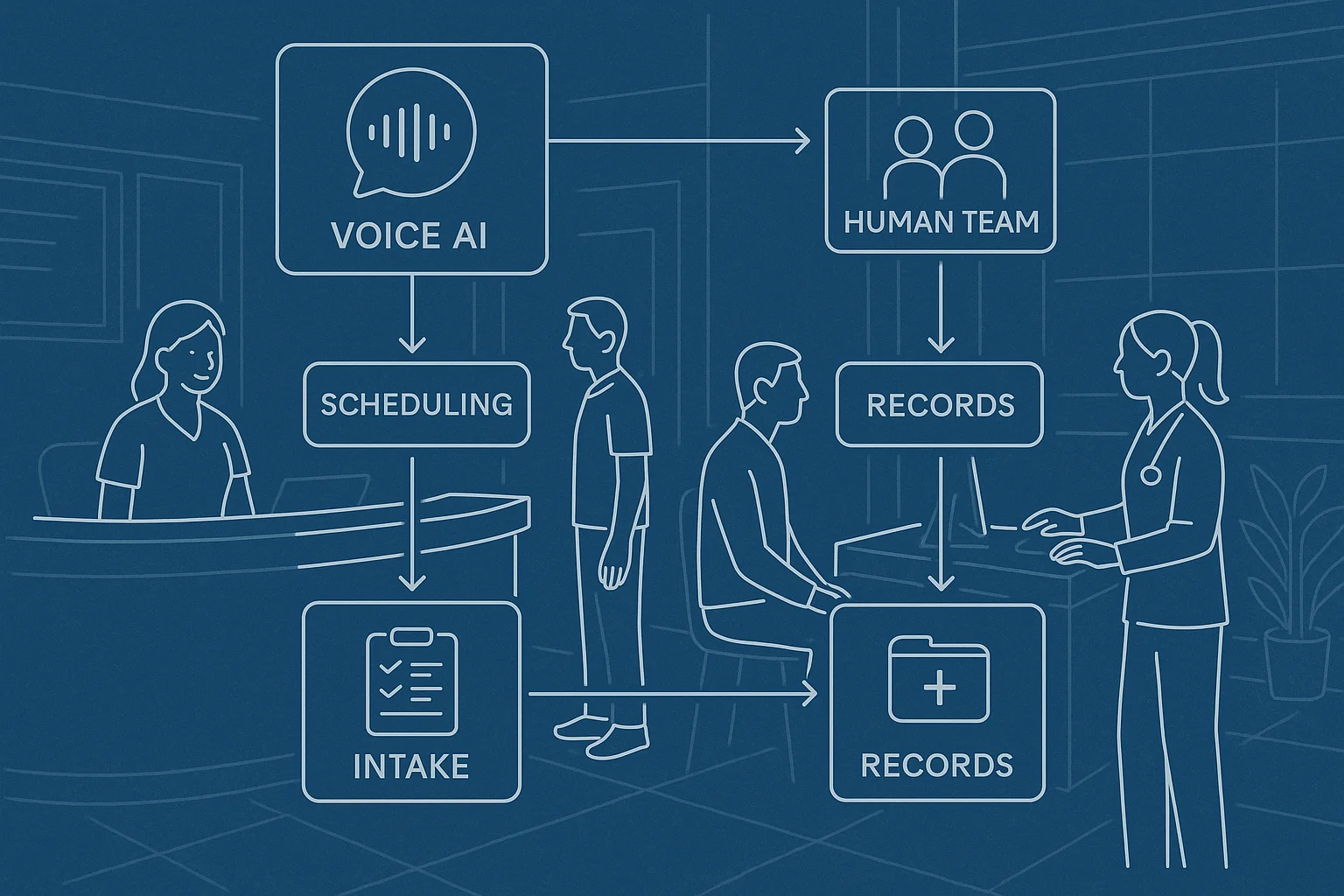
Focus the initial Voice AI scope on administrative patient-access tasks: identity and appointment verification, scheduling and rescheduling via approved scheduling APIs, pre-visit instructions (administrative only), and outbound confirmations. These tasks are high-volume, repetitive, and commonly integrated with practice management (PM) or EHR scheduling modules. Architect the flow so clinical judgment is never requested or returned by the Voice AI.
- Caller intent detection limited to administrative intents (new appointment, reschedule, cancel, collect pre-registration details).
- No clinical symptom triage, diagnosis, or medication advice handled by the Voice AI.
- All changes that affect care (e.g., urgent cancellations) are flagged for human review.
Recommended architecture
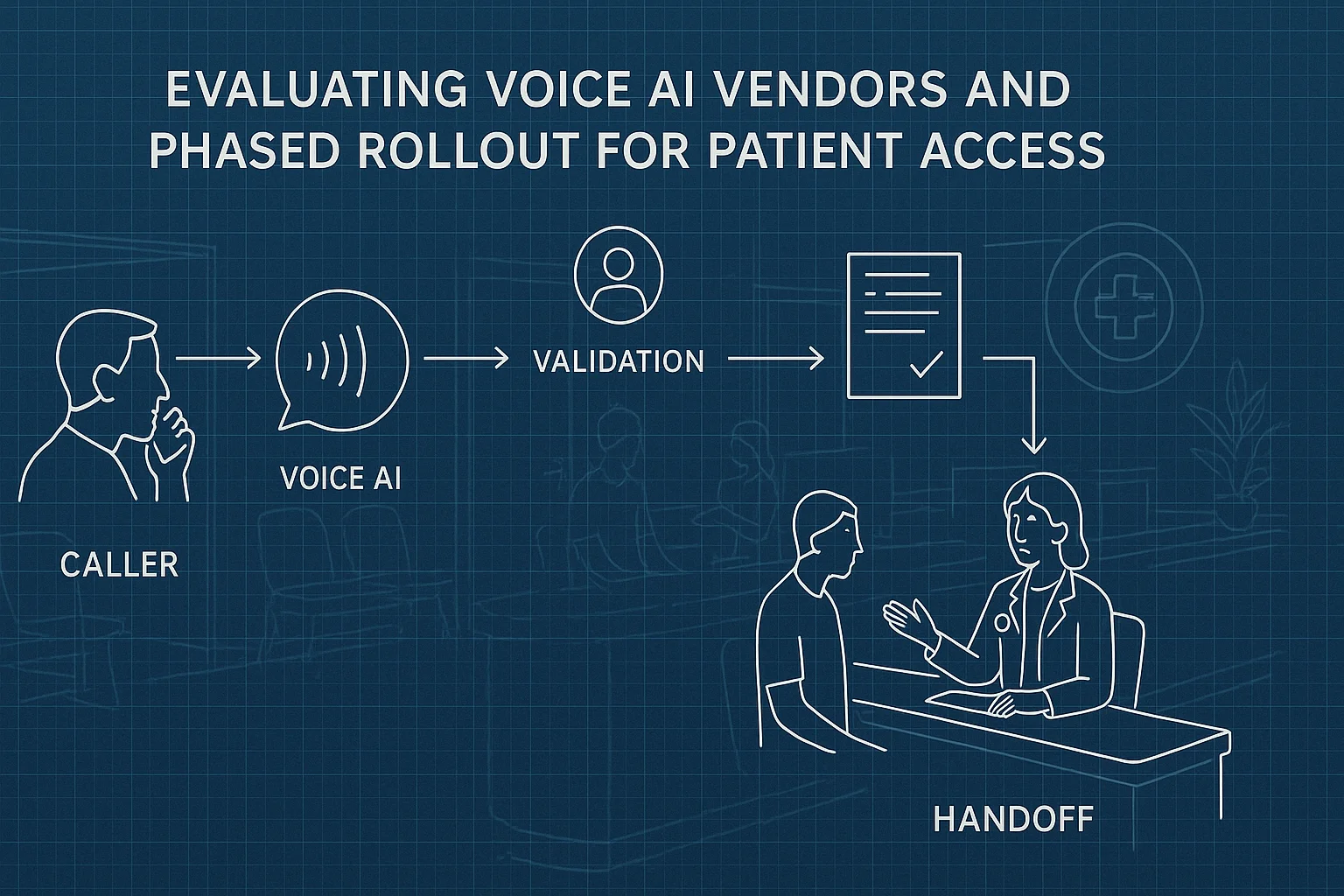
A simple, auditable architecture reduces risk and simplifies vendor responsibilities. A recommended path is: Patient/caller → Voice AI (NLP and dialog manager) → validation and identity controls → approved scheduling/service API (EHR/PM adapter) → confirmation or human handoff. The Voice AI should call only governed APIs and produce a clear transaction record for each interaction.
- Segregate the dialog logic from scheduling/clinical data via controlled API adapters.
- Implement an identity verification step (see identity subsection) before any PII is retrieved or changed.
- Persist an immutable interaction record and produce human-readable logs for audit and QA.
2. Vendor evaluation criteria that matter
Ask for evidence and operational ownership. Vendors often conflate model capability with production readiness. In healthcare, the integration and controls are equally — if not more — important.
Integration and operational scope
Require clarity about who owns each integration piece. Does the vendor provide pre-built adapters to your PM/EHR, or will your IT team build and maintain middleware? Confirm API versions supported, error handling semantics, and ownership for retries, idempotency, and transactional integrity.
- Prove adapters exist for your vendor’s PM/EHR or provide a plan and timeline for building one.
- Define error handling: when the scheduling API returns a conflict or timeout, what automatic and manual recovery steps occur?
- Confirm whether the vendor will operate the runtime (managed service) or only provide software.
Identity, validation, and auditability
Identity verification is central to safe automation. Require vendors to support multi-step identity validation (caller-provided identifiers + knowledge-based or token validation) and to generate immutable logs that link voice transcripts, decisions, API calls, and operator overrides.
- Ask for a clear identity flow: what attributes are used (e.g., DOB, MRN, phone on file), how failures are handled, and when calls are.
- Ensure logs are tamper-evident, timestamped, and include both machine and human review dispositions.
- Request documentation on redaction capabilities and retention controls for PII/PHI.
Safety boundary and supervision
Vendors must define operational boundaries and a Model Context Protocol (MCP) that constrains model behavior within approved contexts. Demand explicit rules for clinical-sounding utterances, escalation triggers, and an auditable supervision loop that allows human staff to review and correct decisions.
- Require an MCP that specifies allowed intents, forbidden topics (clinical triage), and the system’s fallbacks.
- Confirm escalation triggers (ambiguous answers, verification failures, expressions of distress) and expected human response SLAs.
- Insist on red-team testing results and a process for rapid update and redeployment.
3. Procurement checklist and contract must-haves
Translate technical requirements into contractual terms that allocate risk and ensure operational continuity.
Technical and service-level commitments
Specify availability, response times, observability, and maintenance windows. For managed services, include runbook access and a supported escalation path. For software-only deliveries, require comprehensive deployment and test documentation.
- Availability SLAs for the Voice AI runtime and middleware (if vendor-managed).
- Error and retry behaviours for scheduling API failures, with clear responsibilities for data reconciliation.
- Access to logs and transparency for incident post-mortems.
Privacy, security, and data handling
Demand documented compliance controls: encryption in transit and at rest, role-based access, SOC or equivalent audits if available, and explicit data retention and deletion policies. Require vendors to support your jurisdictional obligations and to cooperate with audits.
- Specify encryption standards, key management ownership, and access controls.
- Mandate breach notification timelines and a joint incident response plan.
- Include contractual language on data residency or subprocessors if required by local laws.
Operational governance and change control
Control how updates to dialog models, prompts, or the MCP are approved and deployed. Require a change control board (vendor + buyer reps) with defined testing gates for production changes.
- All model or dialog changes affecting patient interaction require documented QA, red-team review, and sign-off.
- Define emergency rollback procedures and who executes them.
- Schedule periodic governance reviews to reassess scope and boundaries.
4. Phased rollout: test readiness and acceptance criteria
A controlled, metrics-driven rollout prevents harm and builds operational confidence. Use discrete acceptance criteria for each phase.
Phase A — Discovery and closed pilot
Run a small, closed pilot (limited clinics, low-risk appointment types) to validate the full end-to-end flow: identity verification, scheduling API integration, handoff, and logging. Use live traffic only after consent and clearly signposted caller experience.
- Acceptance gates: successful identity verification rate, percentage of calls requiring human transfer, and correct API transaction completion rate.
- Operational readiness: trained staff to handle escalations, monitored dashboards, and daily QA sampling.
- Duration: long enough to capture representative traffic variability (minimum 2–4 weeks is typical, but adapt to local call volumes).
Phase B — Controlled expansion
Increase coverage by adding more call types and sites after pilot gates close. Tighten monitoring and reduce manual oversight incrementally as confidence grows.
- Introduce more complex scheduling scenarios (multiple providers, referral constraints), but keep clinical topics excluded.
- Measure and cap transfer rate and unrecognized-intent rate; if thresholds exceed agreed limits, pause expansion.
- Begin sampling for quality by reviewing full-call transcripts and outcomes.
Phase C — Scale and continuous assurance
At scale, establish continuous monitoring, periodic audit, and a lifecycle process for model and dialog updates tied to the MCP. Shift from reactive to proactive QA driven by agreed KPIs.
- Operational KPIs to track: verification success, transfer/escalation rate, scheduling API error rate, average handle time, and post-call satisfaction.
- Automate anomaly detection for unexpected dialog paths or sudden rises in escalation.
- Maintain a regular cadence for governance, red-team testing, and compliance audits.
5. Testing, QA, and readiness controls
Rigorous testing prevents drift and ensures the system adheres to safety boundaries in production.
Test types and examples
Combine scripted tests, fuzz testing, and field validation. Scripted tests confirm expected dialogs; fuzz tests probe model behaviour with unusual or adversarial inputs; field validation checks real-world performance against human-reviewed ground truth.
- Scripted acceptance tests for every approved intent and API transaction path.
- Fuzz tests that introduce ambiguous language, emotional distress cues, or attempts to illicit clinical advice.
- Field validation: periodic human review of randomly sampled interactions to measure accuracy and safety.
Runbooks, incident response, and human-in-the-loop
Create runbooks for common failure modes (bad audio, API timeouts, verification failures) and define who intervenes. Human-in-the-loop review must be rapid and auditable.
- Define clear thresholds for when staff must take the call (e.g., verification failure, caller distress, system unavailability).
- Establish incident RACI for telecom outages, data breaches, and model misbehavior.
- Preserve speaker audio and transcripts for investigation, following retention and privacy rules.
6. Accountability, roles, and measurable outcomes
Assign operational ownership and metrics to ensure sustainability and compliance.
RACI for production operations
Create a RACI matrix that assigns responsibility across vendor, IT, patient access, compliance, and executive sponsors. Key responsibilities: runtime ops, adapter maintenance, QA sampling, incident response, and governance approvals.
- Vendor: maintain runtime (if managed), apply security patches, and provide logs and incident reports.
- IT: integration ownership for EHR/PM adapters, network, and authentication services when vendor is not hosting adapters.
- Patient access/contact centre: first-line escalation, QA sampling, and training materials.
Measurable operating outcomes (no guarantees)
Require a baseline and continuous measurement plan rather than promising fixed benefits. Track outcomes that directly tie to safety and operational value so leadership can make informed scale decisions.
- Verification success rate (percent of calls where identity validation completes without human help).
- Transfer/escalation rate (percent of calls handed to human staff).
- Scheduling transaction success and reconciliation rate (no manual corrections required).
- Quality defect rate from QA sampling (percentage of interactions requiring correction).
Related Peak Demand resources
Industry and AI sources reviewed
- HIPAA Security Rule Guidance MaterialU.S. Department of Health and Human Services
- Ethics and governance of artificial intelligence for healthWorld Health Organization
- Regulatory considerations on artificial intelligence for healthWorld Health Organization
Privacy, telecommunications, recording-consent, cybersecurity, consumer-protection, employment, and records obligations vary by jurisdiction and use case. This article is operational guidance, not legal advice; organizations should confirm applicable requirements with qualified professionals.
Frequently asked questions
Administrative workflows such as appointment booking, changes and cancellations, referral-status intake, approved follow-up, patient-access questions, after-hours overflow, and structured routing are common starting points. Clinical judgment, diagnosis, emergency triage, and prescribing decisions must remain with qualified professionals.
Official reference: HIPAA Security Rule Guidance Material
Use the minimum identifiers approved by the organization, validate them against the system of record, avoid exposing unnecessary information, and provide a human-assisted path when verification fails. The system should not infer identity from conversational context alone.
Official reference: HIPAA Security Rule Guidance Material
The agent should follow the organization's approved escalation and emergency-routing rules, avoid clinical advice, and transfer or direct the caller to the appropriate human or emergency channel. Those rules must be tested with realistic language and failure cases.
Request identity and privacy controls, scheduling or EHR integration behavior, audit logs, escalation rules, downtime handling, testing evidence, change control, monitoring, and clear separation between administrative automation and clinical decision-making.
Official reference: HIPAA Security Rule Guidance Material
Turn Voice AI infrastructure into a managed enterprise operation
Peak Demand designs, integrates, deploys, monitors, and improves Voice AI systems across customer service, enterprise systems, governance, escalation, and reporting.
Schedule a discovery call


