How to Build an Internal Linking Graph for AI and Search Retrieval
A practical, system-level guide for marketing and SEO leaders to design, implement, and measure an internal linking graph that improves entity retrieval, structured data utility, and AI/answer-engine visibility—covering architecture, APIs, identity, reliability, and observability.
1 — Why an internal linking graph matters for AI, retrieval, and topical authority
Search engines and AI-driven answer surfaces increasingly treat sites as graphs of entities and pages. An internal linking graph is the operational pattern that turns editorial coverage into retrievable signals—useful to rankers, retrieval systems, and LLM-based answer generation.
What retrieval systems look for
Retrieval systems (vector stores, sparse retrievers, and search indices) prioritise content that is identifiable, topically concentrated, and evidential. Internal links provide navigation for users and give retrieval systems context: tightly connected, well-labeled pages make it easier to surface the right passage or entity.
- Entity identity (canonical name, IDs) helps disambiguate content during retrieval.
- Topical hubs (cluster pages) focus signals and reduce dilution across many thin pages.
- Citation and evidence links (source-to-source internal references) help build evidence chains for answers.
Why editorial structure and technical signals must align
Editorial topic maps without machine-readable identity (schema, canonical tags, stable URLs) are hard for automated retrieval to use. Conversely, perfect schema with scattered content yields weak topical authority. The graph is an integration point: content, links, schema, and APIs must be designed to produce reliable retrievability.
- Align page roles: entity, topic hub, detail/asset, and canonical.
- Use internal links to show semantic relationships: parent/child, related, compare/contrast.
- Expose identity in both HTML and machine-readable formats to aid automated systems.
2 — Define the model: entities, topics, and page roles
Start by defining what counts as an entity for your organisation (brand, product, person, place, concept) and how topics map to those entities. This model drives the graph topology and the data contracts developers will implement.
Entity model — canonical identity and attributes
An entity model lists each canonical entity, its unique ID, canonical URL, name variants, key attributes (type, category, SKU, location), and trusted content sources. A stable canonical ID and URL are the single source of truth for identity in links, structured data, and APIs.
- Record canonical URL + internal persistent ID for each entity.
- Capture aliases and common queries to handle surface-level variations.
- Define allowed attribute schema (what fields each entity type must expose).
Page roles — hubs, entities, and supporting assets
Classify pages by role: hub/overview pages that aggregate topic clusters, canonical entity pages that declare identity and authoritative attributes, supporting pages (blog posts, docs, specs), and evidence assets (whitepapers, datasets). Each role has a linking policy and schema contract.
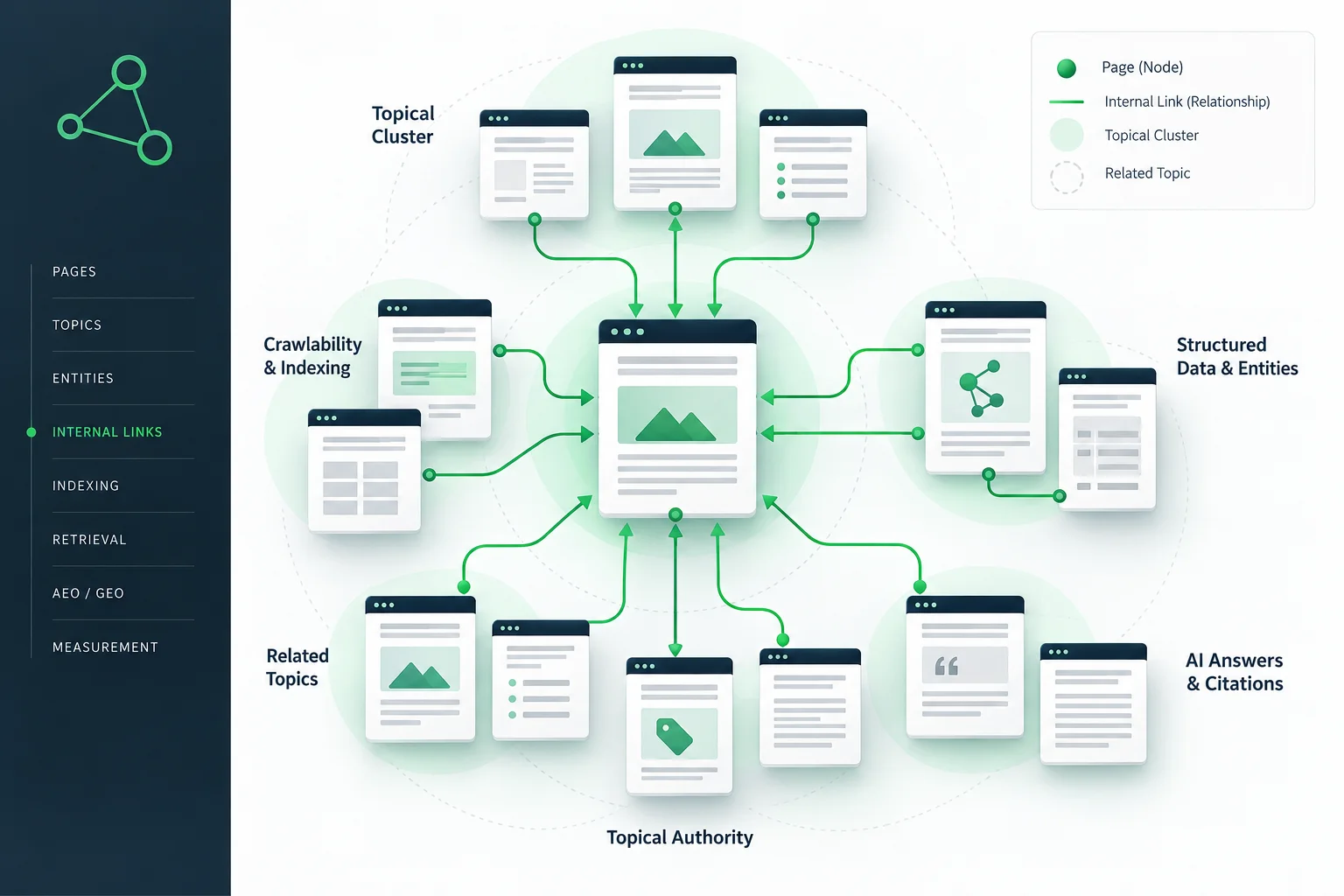
- Hub pages should link to canonical entities and canonical entities should link back to hubs.
- Supporting pages should include an evidence block linking to canonical entities and relevant hubs.
- Define link directionality rules to avoid circular or unhelpful navigation patterns.
3 — Editorial design: topical authority through intentional linking
Editorial design translates the model into content and links. This is where topical authority is built: cluster coverage, purposeful anchor text, and evidence chains that document relationships and source provenance.
Cluster strategy and anchor-text policy
Use a hub-and-spoke approach: hubs summarize and link to canonical pages, and canonical pages link to supporting resources. Anchor text should be descriptive and consistent with the entity model; avoid vague anchors that hinder automated understanding.
- Hubs: overview, definitions, grouped links to entity pages and major subtopics.
- Canonical entity pages: definitive descriptions, attributes, official identifiers, and links to supporting evidence.
- Use controlled vocabularies for anchor text on core links to help automated parsers group relationships.
Evidence chains and internal citations
Treat internal linking like citations: supporting pages should cite the canonical entity and link to the hub where synthesis occurs. This creates evidence chains retrieval systems can follow to rank or present supporting passages to users or LLMs.
- Add explicit 'source' blocks on supporting pages that link to canonical pages and to the hub.
- Where appropriate, use inline links near factual claims to point to authoritative internal sources.
- Keep link density sensible—quality over quantity; avoid weak, implicit cross-linking.
4 — Machine-readable layers: schema, canonical signals, and data contracts
Machine-readable metadata is required for scalable retrieval. Use structured data, consistent canonical tags, and developer-facing data contracts or APIs so both search engines and internal retrieval systems can rely on authoritative identity and relationships.
Structured data and schema design
Implement structured data that reflects your entity model: itemtype, stable identifiers (e.g., sku, productID), canonical URL, and relational properties (sameAs, isPartOf, relatedLink). Structured data does not guarantee special features but helps automated systems parse entity attributes and relationships.
- Surface the same canonical ID in HTML meta, JSON-LD, and API responses.
- Prefer JSON-LD for ease of maintenance and to match modern search guidance.
- Validate schemas against schema.org types and Google’s structured data rules.
APIs and data contracts for retrieval
Expose a read-oriented API (or internal data feed) that returns canonical entities, relationships, and a link map. Define versioned contracts (field names, types, required attributes, error semantics) so search infra (internal crawlers, vector builders, or third-party tools) can produce consistent indices.
- Provide stable endpoints for: entities, topic hubs, supporting assets, and link edges.
- Include changefeed or last-modified timestamps for incremental indexing.
- Define error handling and fallback behaviours (404 vs soft-removed content).
5 — System architecture: identity, reliability, and failure recovery
Treat the linking graph like a data product. Provide identity resolution, SLA-backed indexing pipelines, observability, and tested recovery plans so retrieval systems always see a consistent graph despite deployments or site errors.
Identity and single source of truth
Centralise canonical IDs in a master registry (it can be a database, headless CMS, or a dedicated entity service). All pages, APIs, and structured data should reference that registry. When identity diverges (moved pages, merges, splits), record mappings and redirects to preserve historical references.
- Maintain ID immutability where possible; if IDs must change, provide mapping tables and redirects.
- Record provenance metadata (created_by, created_at, last_verified) to support trust decisions.
- Expose stable 'source of truth' endpoints for other services and build verification checks into deployment pipelines.
Indexing pipelines, SLAs and observability
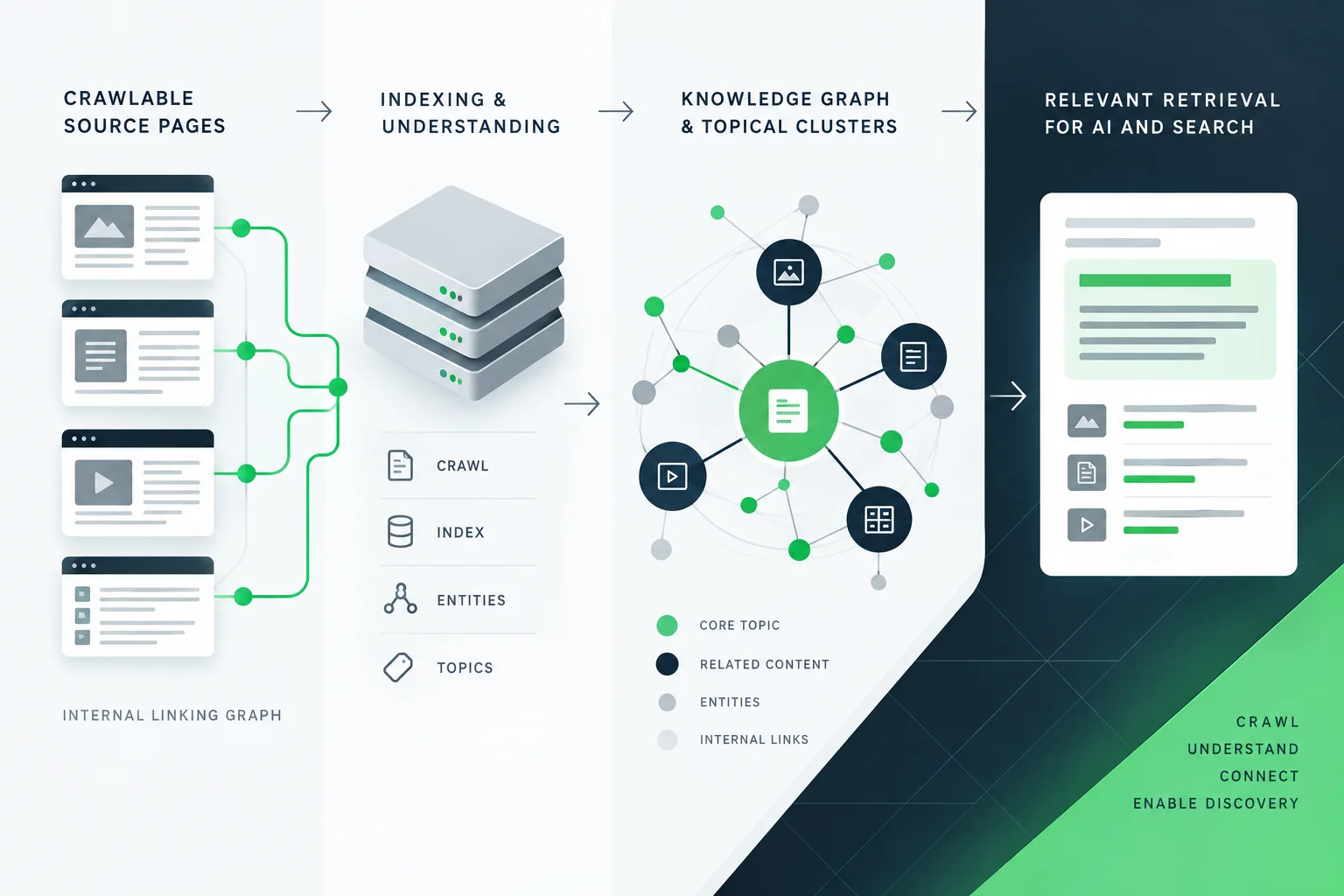
Indexing and vectorization pipelines should be decoupled from publishing flows and operated with clear SLAs (e.g., latency for new/updated entities to appear in retrieval indices). Add health checks, completeness metrics (document counts, link-edge counts), and alerting for schema validation failures.
- Track indexing lag: publish → crawl → index → vectorise times.
- Monitor link-graph metrics: average degree, hub centrality, orphaned nodes.
- Fail-safe: if structured data validation fails, serve readable HTML with human-review flagging.
Failure recovery and graceful degradation
Define recovery playbooks: partial index rebuilds, cache-busting strategies, and safe rollbacks for schema changes. Ensure that automated retrieval failures do not expose sensitive data and that stale-but-verified content remains available rather than returning errors.
- Test incremental and full rebuilds regularly in staging.
- Keep read-only caches for critical entity endpoints to provide resilience.
- Log and audit schema deployments with quick rollback paths.

6 — Observability, measurement, and experiments
Measure whether the graph improves retrievability and evidence quality. Use a combination of search telemetry, retrieval tests, and synthetic prompts to validate that the graph surfaces the intended content.
Key operational and AEO/GEO metrics
Combine traditional SEO metrics with retrieval-focused signals: impressions and clicks remain valuable, but also measure retrieval recall/precision, evidence coverage, node centrality, and snippet/answer quality where available.
- SEO: impressions, clicks, CTR, and organic pages by role (hub/entity/support).
- Retrieval: recall for test queries, precision of top-k results, and passage-level evidence coverage.
- Graph: node degree distribution, hub clustering coefficient, and orphan node counts.
Synthetic and production tests
Run synthetic prompt suites against your retrieval stack (search and vector + LLM chain) to verify that canonical pages are surfaced and that evidence links are returned. Complement synthetic tests with sampled production prompts (privacy-safe) and A/B experiments on hub layouts and link placement.
- Maintain a test suite of representative queries tied to expected canonical IDs.
- Use blind evaluation for generated answers: does the output cite correct internal sources and passages?
- Track regressions after schema or link policy changes.
Visibility diagnostics and continuous improvement
Combine crawl reports, structured data validation, and retrieval audit logs into a dashboard. Prioritise fixes that increase coverage of high-value entities and reduce noise (duplicate or low-quality nodes).
- Automate structured-data linting and surface failures in release pipelines.
- Prioritise reconciling orphan pages and consolidating duplicate entities.
- Iterate link policies using measured uplift in retrieval precision and business KPIs.
Related Peak Demand resources
Industry and AI sources reviewed
- Understand how structured data worksGoogle Search Central
- Schema.org DocumentationSchema.org
- Creating helpful, reliable, people-first contentGoogle Search Central
- SEO Starter GuideGoogle Search Central
- AI features and your websiteGoogle Search Central
Search-engine and AI-answer behavior changes over time. Google documentation can establish published requirements and guidance, but inclusion in rankings, AI Overviews, citations, or LLM answers is never guaranteed. Practitioner observations should be labelled as inference or testing rather than official ranking factors. This article is operational guidance, not legal advice; organizations should confirm applicable requirements with qualified professionals.
Frequently asked questions
SEO improves visibility in traditional search results. AEO focuses on making content easy for answer systems to extract and use. GEO focuses on visibility in generative search and AI answer experiences. In practice, the strongest strategy combines technical accessibility, useful content, clear entities, strong internal relationships, structured data, and credible source authority rather than treating them as isolated channels.
Official reference: SEO Starter Guide
No. Structured data can make page entities and relationships more explicit and can support eligible search features, but it does not guarantee rankings, AI Overview inclusion, citations, or mentions in generative answers. It should reinforce accurate visible content rather than replace it.
Official reference: Understand how structured data works
Search and answer systems need to understand what a brand, person, product, service, or concept is and how it relates to other entities. Consistent naming, authoritative pages, structured relationships, internal linking, and corroborating references can reduce ambiguity and make a site easier to interpret and retrieve.
Official reference: Schema.org Documentation
Track traditional search visibility alongside query coverage, indexed pages, non-brand discovery, AI referral traffic where available, observed citations or mentions, entity consistency, content-cluster coverage, internal-link depth, and lead quality. Treat AI-surface monitoring as directional because answer composition can vary by model, query, user, and time.
Official reference: AI features and your website
Build a search and AI visibility system that compounds
Peak Demand connects technical SEO, entity architecture, knowledge graphs, structured data, topical authority, internal linking, distribution, and measurement into a managed SEO/AEO/GEO operating system.
Explore Peak Demand AI SEO, AEO & GEO


