
Auditable Voice AI Trails for Utilities: Verifiable Outage & Dispatch Records
A practical operating framework for utility leaders to design auditable, account-safe Voice AI trails that produce verifiable outage, service-request, and dispatch records while preserving human oversight, cybersecurity controls, and regulatory readiness.
1. Why auditable Voice AI trails matter for utilities
Utilities operate under accountability pressure for outage cause, response times, crew dispatch, and customer records. Voice AI can scale high-volume customer contact but only becomes operationally trustworthy when each interaction produces a verifiable trail that operators, regulators, and auditors can inspect.
Operational risk and recordability
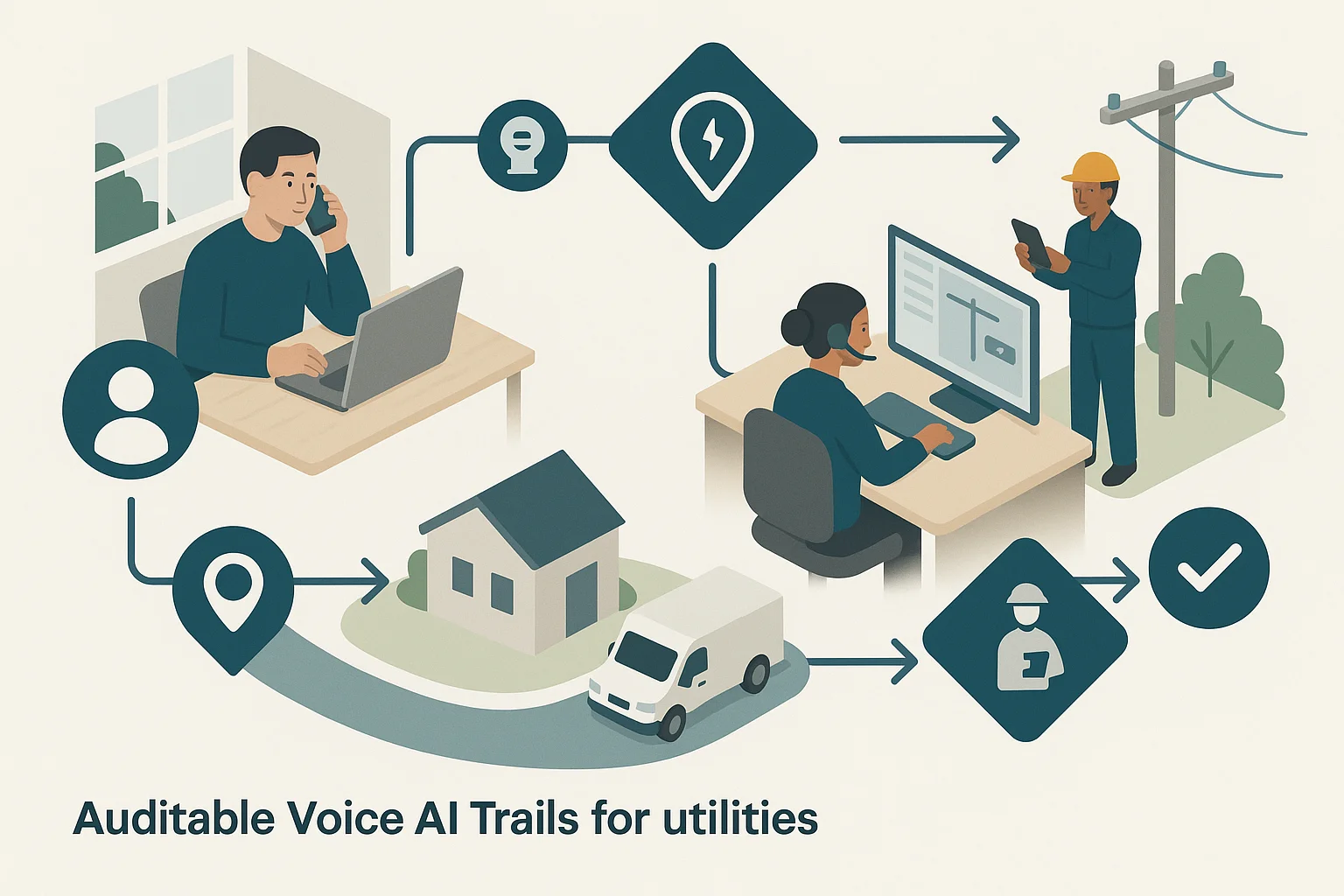
An auditable trail reduces ambiguity after incidents: who reported an issue, how the system validated the account or premise, which authoritative source provided the outage status, whether a field crew was dispatched, and when a human intervened. For utilities, records support post-incident reviews, regulatory reporting, customer dispute resolution, and coordinated field operations. Design trails to align to the utility’s existing evidence model (e.g., CIS/OMS ticket IDs, job numbers, timestamps, and operator IDs).
- Map voice events to existing ticket and job identifiers (CIS/OMS job ID, dispatch number).
- Capture verification artifact (masked account ID, validated location token, or callback number).
- Record the authoritative source used for status or decision (approved API or knowledge base).
What auditability enables — and what it does not
Auditability enables traceability and post-event accountability: it documents decisions, timing, and human overrides. It does not — and must not — imply that Voice AI is authorized to operate infrastructure, isolate circuits, or replace emergency response. Define and publish clear safety boundaries where Voice AI provides information or opens a service ticket, and require human authorization for any action affecting physical systems.
- Voice AI provides status, creates tickets, or routes requests; it must not execute physical-control commands.
- Human authorization gates are mandatory for safety-critical or ambiguous inputs.
- Define measurable SLAs for escalation time and human response.
2. Canonical call flow and data capture
Operational clarity comes from a single canonical flow that every implementation follows. Keep it simple and deterministic to guarantee consistent records.
Canonical flow (minimal viable audit path)
Design each inbound contact to follow this sequence: Customer call → Voice AI front end → account or location validation → authoritative backend lookup via an approved API or knowledge source → decision node that results in (A) one-way status response, (B) service-request/ticket creation with recorded linkage, or (C) human escalation. For each node record the input, decision, API path, response, and actor (machine or person).
- Record voice transcript or structured intent tokens, with redaction/consent metadata where required.
- Log validation outcome: validated, partially validated, or not validated, and the method used (caller-provided info, callback verification, two-factor, pre-auth token).
- Capture the authoritative system and API endpoint used (e.g., OMS query v2.1) and response payload summary.
Account-safe validation patterns
Avoid authorizing service-affecting actions on voice alone unless strict validation is met. Use graduated validation: low-sensitivity interactions (status queries) require minimal validation; medium-sensitivity (service requests creating a non-safety work order) require stronger matching (masked account number, DOB, service address match); high-sensitivity requests (access, disconnects, safety-critical reports) require human confirmation or callback on a pre-registered number. Log which pattern was used and why a request was escalated.
- One-way status responses: provide outage information without exposing account-sensitive data.
- Partial-match workflows: if the system cannot conclusively validate, create a provisional ticket marked 'validation-required' and route to a human.
- Document accepted validation tokens and their allowable actions in a validation matrix.
3. Audit record design — required fields and tamper-evidence
An audit record is useful only when it consistently contains key fields and is stored so it can be relied upon in reviews. Define the minimum event model and protect its integrity.
Minimum event model
Require these fields for every Voice AI event: unique event ID, timestamp (UTC), call identifier, call routing node, validated account/location token (masked), validation method, intent classification and confidence, backend API endpoints called and response codes, action taken (status, ticket ID, escalation), human agent ID if applicable, and a hash or signature for integrity verification. Keep the model lightweight so it is populated for every call at scale.
- Event ID and immutable timestamp to correlate to other system logs.
- Masked identifiers to preserve privacy while enabling reconciliation.
- Action outcome plus authoritative reference (e.g., job number, operator ID).
Tamper-evidence and log controls
Protect audit records with write-once or append-only storage and cryptographic hashing. Maintain a separate verification index or digest store for cross-system reconciliation. Define retention and archival policies that account for data residency, subprocessors, and cross-border transfer; document these in procurement and privacy notices. Confirm local legal obligations with counsel — retention and breach duties vary by jurisdiction.
- Store primary logs in append-only storage; use hashed digests to detect alteration.
- Retain a copy of any voice recording only where consent and policy permit; store its metadata in the event model.
- Document hosting region, backup region, and subprocessors in SOW and privacy attachments.
4. Integrations, orchestration, and dispatch
Auditability is only as strong as the integrations that create and consume records. Define approved adapters and orchestration rules for each back-end system used for outage data, service requests, and dispatch.
Approved API and adapter pattern
Only integrate through approved APIs or controlled adapters that produce consistent request/response metadata. The Voice AI layer must record the exact API endpoint, version, and response code used when making or reading a ticket. Where direct API access is impossible, use a controlled middleware or adapter layer that exposes a consistent contract and logs its own interactions; audit trails must include middleware transaction IDs.
- Require API versioning and response schema compliance for each adapter.
- Capture adapter transaction IDs and map them to event IDs for reconciliation.
- Avoid screen-scraping or manual backend emulation in production systems.
Dispatch and field-service routing
For field dispatch, ensure the Voice AI records the dispatch rule used (territory, technician skill, urgency), the dispatched job ID, and the time the job was accepted by the scheduling system. Peak Demand capabilities such as Voice AI Dispatch Support for Field Service Teams (https://homeservices.peakdemand.ca/ai-dispatch-support-home-services/) and Custom Voice AI Dispatch for Home Services (https://homeservices.peakdemand.ca/custom-ai-dispatch-home-services/) demonstrate pattern implementations where routing decisions are recorded and tied to technician, territory, and job-type rules. Keep the field-system as the authoritative job source and never allow Voice AI to alter an accepted job without logged human approval.
- Record dispatch rule metadata and the authoritative dispatch job ID.
- Log any change requests to routing and require human operator confirmation when changes affect crew safety or availability.
- Use the field-system acceptance timestamp as a checkpoint in post-incident timelines.

5. Governance, cybersecurity, and maturity controls
Auditability sits inside governance and cybersecurity. Adopt recognized frameworks and operationalize them into configuration, QA, and procurement requirements.
Aligning to critical-infrastructure AI risk management
Utilities should ensure Voice AI risk management aligns to critical infrastructure guidance that emphasizes accountability, risk assessment, and sector-specific safeguards. Use risk-tiering for AI-enabled functions and document where Voice AI is informational only versus where it influences operational decisions. Regularly update risk assessments as models, data sources, or integrations change.
- Maintain a current risk register for Voice AI functions with mitigations mapped to each risk.
- Document human oversight points and escalation gates in the risk register.
- Schedule periodic re-evaluation after model updates or new integrations.
Cybersecurity and performance goals
Operational protections must reflect cross-sector cybersecurity performance goals and energy-sector maturity expectations. Require role-based access to audit logs, multi-factor authentication for administrative functions, and monitored remote support. Use a maturity roadmap that stages logging, observability, and response capabilities and ties them to procurement milestones.
- Define controls for privileged access to Voice AI logs and for change management to adapters.
- Mandate monitored remote-support sessions with explicit audit trails for vendor access.
- Map maturity milestones (logging, alerting, forensic readiness) to contract milestones.
6. Operational playbooks, QA, and failure boundaries
Translate the architecture into day-to-day operational playbooks that contact-centre, field, and IT teams can execute under normal and degraded conditions.
Human escalation and ambiguity handling
Define clear rules for when Voice AI must escalate to an agent: failed validation, low intent confidence, safety-critical words (e.g., gas leak indicators), or when a caller requests immediate human contact. Escalation should carry the event context, validation artifacts, and an action history so the human agent receives a complete, auditable handoff.
- Escalation includes event ID, validation summary, and last four interaction steps.
- Agents see suggested routing or safety notes derived from the Voice AI transcript.
- Log human acceptance/rejection of Voice AI suggestions for QA and training.
Surge capacity, observability, and incident response
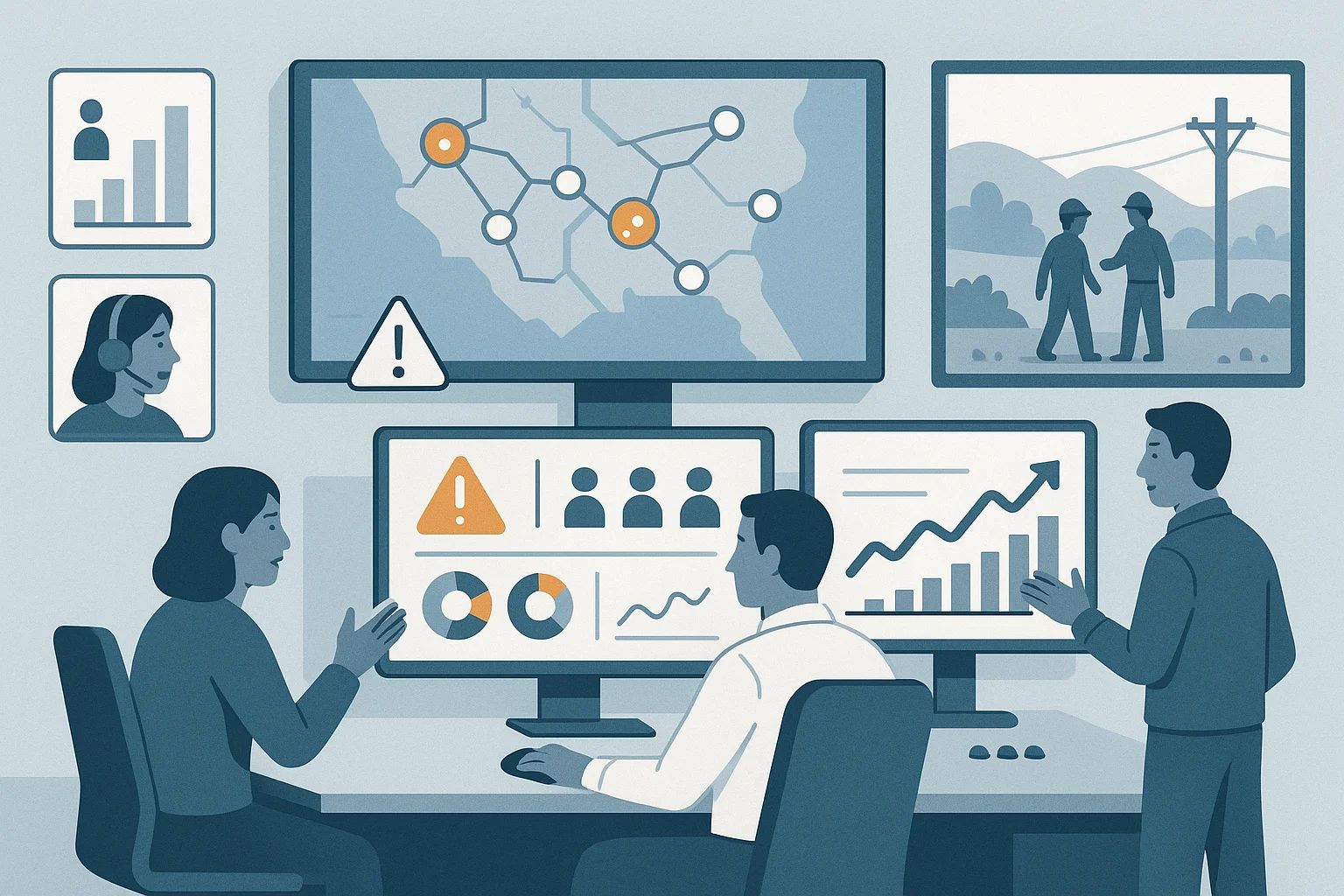
Outages generate call surges. Design the Voice AI and its orchestration to degrade gracefully: prioritize status responses, limit secondary prompts, and redirect high-sensitivity interactions to humans. Instrument metrics for call volume, validation success rate, escalation rate, ticket creation rate, and mean time to human handoff. Tie these metrics to incident-response playbooks and scheduled QA reviews. See Peak Demand guidance on resilient architecture and incident response: Architecting Resilient Voice AI for Utilities (https://blog.peakdemand.ca/post/architecting-resilient-voice-ai-utilities-apis-identity-observability) and Voice AI Incident Response and Business Continuity (https://peakdemand.ca/voice-ai-incident-response-business-continuity).
- Prioritize critical metrics: validation pass rate, escalation latency, and event-model completeness.
- Define automatic flow changes during surge (e.g., limit prompts, offer call-back) and record the mode change.
- Incorporate replayable logs to support post-incident forensics.
Related Peak Demand resources
Industry and AI sources reviewed
- AI Risk Management Framework — Critical Infrastructure ProfileNational Institute of Standards and Technology (NIST)
- Cross-Sector Cybersecurity Performance GoalsCybersecurity and Infrastructure Security Agency (CISA)
- Cybersecurity Capability Maturity Model (C2M2)U.S. Department of Energy
Utility cybersecurity, critical-infrastructure, records, customer-protection, and emergency-communications obligations vary by jurisdiction and service type. This article is operational guidance, not legal advice; organizations should confirm applicable requirements with qualified professionals.
Frequently asked questions
Use Voice AI to absorb high call volumes, provide approved outage and restoration messaging, validate the caller's account or service location, capture non-emergency service details, and route exceptions to trained staff. It should not estimate restoration times unless those estimates come from an approved utility system of record.
Official reference: Cross-Sector Cybersecurity Performance Goals
The integration design typically depends on the use case, but common systems include the customer information system, outage management system, CRM, knowledge base, notification platform, scheduling tools, and service-request or work-order systems. The Voice AI layer should receive only the data and actions required for the approved workflow.
Official reference: Cybersecurity Capability Maturity Model (C2M2)
No. Voice AI should remain a customer-communication, intake, validation, routing, and escalation layer. Infrastructure control, switching, dispatch authority, emergency response, and safety-critical decisions must remain within approved operational systems and qualified human teams.
Official reference: Cross-Sector Cybersecurity Performance Goals
Ask for evidence of surge and latency testing, account and premise validation, integration failure handling, auditable logs, data minimization, human escalation, change control, incident response, monitoring, and a clear operating model for updates after launch.
Official reference: Cross-Sector Cybersecurity Performance Goals
Build resilient utility customer-service automation
Peak Demand helps utilities connect Voice AI to approved customer-information, outage-communication, service-request, dispatch, escalation, and analytics workflows.
Schedule a discovery call


