Aligning Voice AI Portfolio, Regulatory Risk & Capital Planning for Utilities
A decisive operational framework that ties Voice AI portfolio choices to regulatory risk, capital planning, and reliable customer operations—focused on outage communications, service requests, validation, and human escalation.
1) Portfolio-first approach: prioritize use cases by risk and value
Build your Voice AI investment and operating plan from an explicit portfolio map. Organize automation initiatives by the customer journey, required integrations, and regulatory or safety exposure.
Map use cases to integration tiers
Classify Voice AI automations into three practical tiers so procurement and capital planning are aligned to technical scope and operational risk. Tier 1: informational interactions with no account writes (status, outage ETA from public source). Tier 2: authenticated account queries that read approved back-end sources (billing status, scheduled outage details). Tier 3: transactions and service requests that create or modify records in CIS/OMS/work-order systems (outage tickets, scheduling, dispatch directives). This tiering drives budget, staging, and acceptance criteria.
- Tier 1 requires little to no back-end integration but still needs accuracy controls and change monitoring.
- Tier 2 requires secure, read-only API adapters, strict identity/validation, and audit trails.
- Tier 3 requires orchestration, transactional guarantees, rollback patterns, and human-approval gates for safety-sensitive actions.
Prioritize by regulatory exposure and customer impact
Overlay regulatory risk and customer-impact scoring on each use case. For outage communications and safety-adjacent service requests, adopt more conservative rollouts and higher testing thresholds. Use these scores to sequence pilots and justify capital allocation, increasing investment where operational resilience and customer satisfaction metrics return the highest risk-adjusted value.
- Score factors: regulatory oversight, safety adjacency, data sensitivity, frequency, and downstream operational cost of errors.
- Use scores to assign pilot QA intensity, monitoring SLAs, and escalation staffing.
2) Governance & regulatory risk: controls, accountability, and AI risk management
Utilities operate under public-safety, customer-protection, and privacy regimes. Governance must connect AI risk-management practices to enterprise cyber and compliance functions.
Governance model and accountability
Create a governance charter that assigns decision rights for use-case approval, vendor selection, change control, and incident response. Embed business owners (customer service, operations, field leadership) and technical owners (IT, security, integration teams) in formal gating. Require documented acceptance criteria for each use case: expected outcomes, failure modes, handoff thresholds, and rollback procedures.
- Establish an AI product owner in customer service and a technical steward in IT for each portfolio item.
- Formalize quarterly reviews that examine event-level analytics, human escalations, and post-incident corrective actions.
AI risk-management and critical-infrastructure alignment
Adopt an AI risk-management profile that aligns to critical-infrastructure guidance: identify high-consequence scenarios, test model behavior under edge cases, and require human oversight where outcomes could materially affect safety or service continuity. This approach should be coordinated with enterprise risk, legal, and compliance to ensure regulatory obligations are understood and operationalized.
- Define high-consequence scenarios (false negatives on hazard-related calls, incorrect account identity leading to inappropriate access).
- Require stress testing and scenario simulations as part of acceptance for Tier 2 and Tier 3 automations.
3) Operational architecture: clear flows, approved integrations, and validation
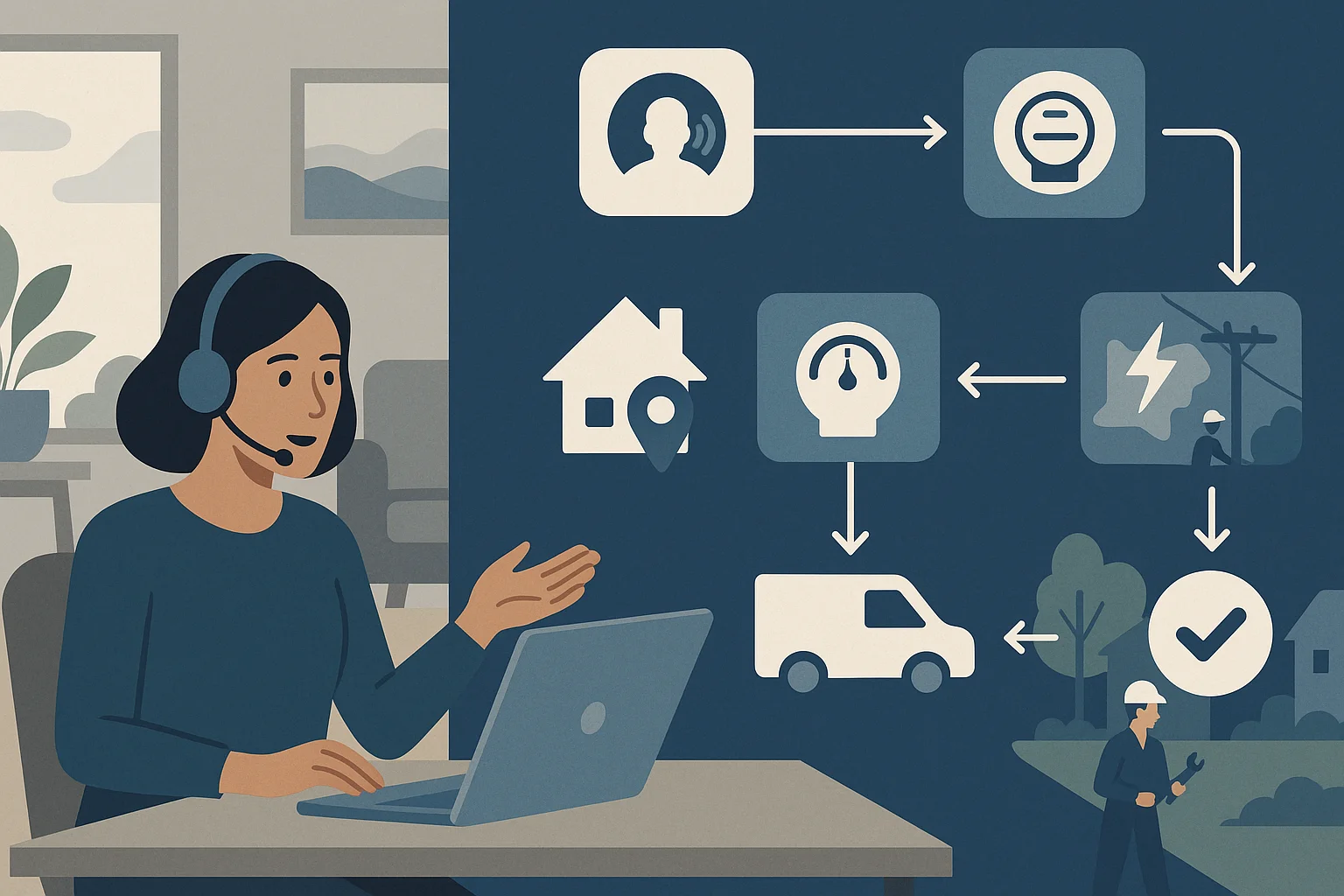
Design each automated call route as an explicit orchestration: Customer call → Voice AI → account/premise validation → approved API or knowledge source → outcome (service request, status response, or human escalation). Make integration patterns repeatable and auditable.
Account and premise validation pattern
Prevent unauthorized actions by standardizing multi-factor or multi-attribute validation for any transaction that reads or writes customer records. Prefer read-only validation calls to an authoritative identity/CRM adapter before proceeding. Maintain a configurable policy that defines when to proceed automatically and when to escalate to a human agent.
- Use at least two independent attributes for validation (account number + address, phone+security PIN) before allowing a Tier 2 or Tier 3 path.
- Log validation attempts and outcomes to an immutable event store for audit and dispute resolution.
Approved adapters and orchestration
Integrate through approved, versioned adapters that convert Voice AI intents into canonical events and then call back-end APIs (CIS, OMS, WFM). Avoid embedding direct database connections in voice workflows. Include compensating actions and idempotency keys for service requests so retries do not create duplicate work orders.
- Define data contracts for each adapter: permitted fields, error semantics, retry behavior, and latency SLAs.
- Implement idempotency and clear rollback or manual-reconciliation steps for failed transactions.
Event-level observability and analytics
Instrument every call with event IDs that carry through validation, adapter calls, and final disposition. Event-level analytics should feed dashboards that show failure rates by adapter, average time-to-escalation, and percent of calls that result in human intervention. Use these metrics for continuous improvement and capital prioritization.
- Capture key telemetry: call start/end, intent classification confidence, validation outcome, API latency, transaction result, escalation reason.
- Use event analytics to identify systemic adapter failures and to quantify cost-avoidance versus manual handling.
4) Outage communications & service-request workflows: safety boundaries and human-in-the-loop
Outage communications and service requests are core utility interactions. Make reliability, clarity, and safety the primary design constraints.
Designing outage call flows
Separate inbound outage reports from status queries. For inbound reports, capture the minimum viable event data quickly (location, nature of outage, life-safety concerns) and then create a ticket for confirmation by the OMS. For status queries, use read-only back-end calls to provide ETA and restore-status derived from OMS or SCADA-synthesized feeds. Avoid letting automated voice flows authorize field actions.
- Prioritize short confirmation dialogs for outage reports; defer extended troubleshooting to field teams.
- Label any automated status as 'best available information' and provide clear human contact options.
Service-request routing and field scheduling
When a Voice AI flow results in a service-request or scheduling action, treat the outcome as an orchestration: push a work-order into OMS/WFM with a provisional flag until a human validator or dispatch rule confirms assignment. For safety-adjacent requests (gas odor, downed wires), require immediate human escalation and field-dispatch confirmation.
- Use provisional flags to prevent premature work-order dispatch without manual verification for critical events.
- Record the human escalation transcript and link to the incident event for auditability.
5) Procurement, vendor evidence, and contract design
Procurement should demand operational evidence, not just capability statements. Structure contracts to make vendor responsibilities explicit across availability, surge capacity, integration ownership, and observability.
Minimum procurement evidence
Require vendors to provide documented runbooks for surge handling, API SLAs, adapter error semantics, audit logs, and third-party subprocessors. Ask for sample event logs (sanitized) that show end-to-end call traces through validation and escalations. Include acceptance testing scenarios that simulate high-consequence failures.
- Test vendor surge handling with scheduled stress tests that mirror peak outage conditions.
- Require transparent subprocessors list and a mechanism to review and approve new subprocessors.
Contract levers and operational SLAs
Negotiate SLAs tied to observable metrics: adapter availability, mean time to human escalation, false-positive rate for urgent escalations, and time-to-repair for adapter failures. Include audit rights, forensic log access, and a change-notice process for model or pipeline updates that could affect customer interactions.
- Include remediation milestones and a governance escalation ladder in contracts.
- Specify log retention windows, data residency expectations, and breach notification timelines consistent with enterprise legal guidance.
Vendor evaluation resources
Frame vendor evaluation around integration risk, not just conversational capability. Use vendor-provided acceptance scenarios that exercise your OMS/CIS/CRM adapters, surge tests, and failover handoffs.
- Rely on operational artifacts: runbooks, incident reports, adapter specs, and event traces to compare vendors.
- Prioritize vendors with documented experience in high-volume utility scenarios and robust escalation controls.

6) Reliability, incident response, and capital planning for scale
Plan capacity and resilience as a joint exercise between capital planning and operations. Voice AI becomes an enterprise interaction tier that must scale predictably under outage-driven surges.
Surge capacity and business continuity
Define surge profiles based on historical outage windows and escalate capacity plans to the capital team. Include warm-failover architectures, regional hosting diversity, and manual-override modes so live agents can assume calls when automated capacity is saturated. Document recovery time objectives (RTOs) for adapters and the Voice AI control plane.
- Identify the maximum acceptable queue time before forced escalation to human agents.
- Plan hosting with primary and backup regions, and make remote-support access and subprocessors explicit in procurement.
Incident response and forensic readiness
Integrate Voice AI into enterprise incident response. Maintain runbooks for common failure modes: model drift producing incorrect intents, adapter outages, validation failures, and security events. Ensure forensics capabilities: end-to-end event logs, conversation transcripts, adapter request/response captures, and configuration change histories.
- Conduct tabletop exercises that include Voice AI failure scenarios and regulatory notification steps.
- Keep a playbook that defines when to pause automation, notify regulators, and move to manual handling.
Capital planning and staged investments
Use staged releases and measurable KPIs to inform capital decisions. Move from pilot (validated customer segments, low-risk use cases) to scale once false-positive/negative thresholds and escalation metrics stabilize. Capital should be allocated for integration adapters, observability tooling, and redundancy rather than for unproven conversational features.
- Tie capital disbursement to operational milestones (e.g., sustained adapter availability, low human-intervention rate, pass of stress tests).
- Prioritize investments in adapters, event stores, and human escalation capacity over cosmetic UX improvements.
Related Peak Demand resources
Industry and AI sources reviewed
- AI Risk Management Framework — Critical Infrastructure ProfileNational Institute of Standards and Technology (NIST)
- Cybersecurity Capability Maturity Model (C2M2)U.S. Department of Energy
- Cross-Sector Cybersecurity Performance GoalsCybersecurity and Infrastructure Security Agency (CISA)
Utility cybersecurity, critical-infrastructure, records, customer-protection, and emergency-communications obligations vary by jurisdiction and service type. This article is operational guidance, not legal advice; organizations should confirm applicable requirements with qualified professionals.
Frequently asked questions
Good starting points include billing and account questions, move-in or move-out intake, appointment scheduling, service-request capture, outage-status messaging from approved systems, payment-routing assistance, and structured escalation. Safety-critical and infrastructure-control decisions should remain with qualified utility teams.
Official reference: Cross-Sector Cybersecurity Performance Goals
Use the minimum approved identifiers needed for the workflow, validate them against the utility's system of record, limit data exposure, and provide a human-assisted path when verification fails. The Voice AI should not guess account, premise, or outage information.
Official reference: Cross-Sector Cybersecurity Performance Goals
Use controlled adapters, strict schemas, timeouts, retries, audit logs, safe failure states, and human escalation. The system should distinguish approved utility data from model-generated language and should never present stale or unverified operational information as fact.
Official reference: Cybersecurity Capability Maturity Model (C2M2)
Track containment by request type, successful validations, transfers, abandoned calls, integration errors, incorrect or stale responses, time to resolution, customer follow-up, and the percentage of cases completed safely without manual rework.
Official reference: Cybersecurity Capability Maturity Model (C2M2)
Build resilient utility customer-service automation
Peak Demand helps utilities connect Voice AI to approved customer-information, outage-communication, service-request, dispatch, escalation, and analytics workflows.
Schedule a discovery call


