
Accessibility‑First Operating Model for Transit Voice AI: SLOs, Audits & Appeals
A practical operating model for transit leaders to deploy Voice AI that prioritizes accessibility, separates scheduled knowledge from service-alert APIs, and embeds SLOs, auditable controls, and appeal workflows with accountable human oversight.
1. Why accessibility‑first matters operationally
This section explains the operational reason to prioritize accessibility when deploying Voice AI for transit customer service and outlines the separation of knowledge domains you must enforce.
Accessibility as an operational SLO
Accessibility is not an add‑on; it is a primary service objective that should appear in the same tier as availability and safety. Define explicit accessibility SLOs that reflect outcomes (for example, successful completion of common tasks using a screen‑reader or text transcript, completion rates for callers using alternate languages, and acceptable handoff times for callers who require human assistance). Make these SLOs measurable, instrumented, and reported alongside uptime and incident metrics. Tying accessibility to SLOs ensures engineering, operations, and procurement prioritize assistive UX in feature backlogs.
- Example SLO types: task completion by channel and assistive-technology; mean time to human handoff for accessibility requests; accessibility regression thresholds on releases
- Instrument SLOs via synthetic and real interaction sampling to capture both automated and assisted flows
Separate scheduled knowledge vs detours/delays (service‑alert APIs)
Operational clarity requires a strict separation: scheduled timetable and route knowledge should be provided from a controlled knowledge base (official schedules, published service patterns), while detours, delays, and urgent service alerts must come from designated service‑alert APIs (the same authoritative feeds operations uses). This separation reduces risk: scheduled answers are stable and auditable; alerts are transient and require different validation, retention and escalation.
- Controlled knowledge: authoritative schedule repository, published timetables, fare rules, ADA accessibility details
- Service‑alert APIs: live detours, delay notices, crowding or emergency advisories must be pulled at time of request and treated as an alert channel
- Implement adapter logic so the Voice AI chooses the information source by query intent and freshness requirements
2. Architecture and flow: Rider → Voice AI → Controlled Sources → Outcomes
A concise operating architecture clarifies responsibility, observability and failure modes. The flow below is prescriptive and minimizes dangerous inference.
Canonical flow and responsibilities
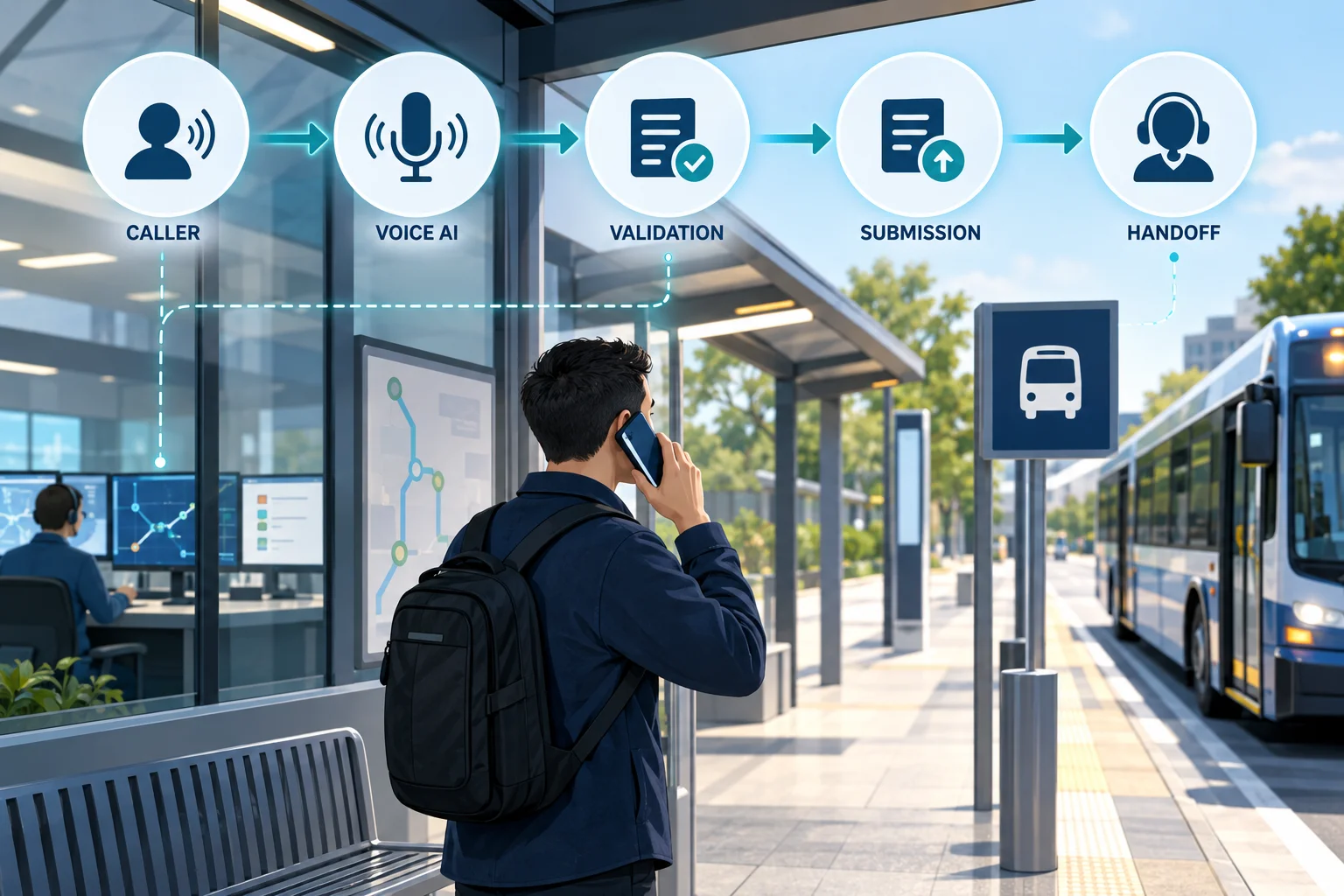
Design the interaction pipeline with clear handoff points: Rider → Voice AI front end (ASR/NLU) → Source selector (controlled schedule knowledge OR approved service‑alert API/form adapter) → Validation → Outcome (automated response, case submission, or human handoff). Each component must log decisions, confidence scores, selected source, and user consent markers. Keep the rule that only approved APIs or the controlled knowledge base may deliver schedule or alert data; the model must not 'hallucinate' timetable changes or predict next‑bus arrivals unless backed by a validated, low‑latency data source.
- Log the source of truth for each factual claim returned to the rider
- Record confidence and validation status; surface these to human reviewers and appeals panels
- Keep emergency/safety escalations on a separate, monitored path that routes immediately to trained staff
Validation and safe submission
Before creating a case or taking a binding action, require validation: verify identity or location where necessary, confirm the rider's intent, and confirm that critical fields are non‑ambiguous. For service‑request forms expose dynamic fields that reflect the chosen source (for example, pre‑populating route and trip identifiers from the schedule store or alert feed). For accessibility requests, collect minimum viable data to enable rapid human action without creating undue barriers.
- Use dynamic forms that adapt to the request type and automate duplicate detection
- Implement safe‑submit gates: if confidence or validation fails, show a concise confirmation script and route to a human
3. SLOs, metrics and observability
Operationalize SLOs so they drive staffing, procurement, and QA. This section lists measurable SLOs and how to instrument them.
Practical SLOs for accessibility and safety
Choose SLOs that map directly to rider experience and operational cost. Examples include: accessibility task completion rate, mean time to human handoff for vulnerable callers, percent of interactions with verified source provenance, false‑positive escalation rate (cases routed to humans incorrectly), and audit‑finding remediation time. Tie each SLO to a monitoring query and an escalation path when thresholds degrade.
- Accessibility task completion (channel+assistive tech) — target and alert thresholds
- Human handoff latency for accessibility or safety requests — maximum acceptable time
- Source provenance rate — percent of responses that include an auditable source tag
Observability, logging and retention
Logs must contain interaction metadata, intent classification, selected knowledge source, confidence, validation steps, and whether audio was recorded (with consent). Define retention and access controls by function: short retention for ephemeral analytics, longer retention for appeals or legal obligations. Where recordings are retained, clearly record consent and provide ways to redact or export transcripts for appeals.
- Split logs by purpose: operational analytics, QA sampling, and legally preserved records
- Specify retention periods and access roles; distinguish backup geography, remote‑support access and subprocessors in contracts
4. Auditability, risk management and human oversight
Audits and ongoing risk management are core to trust. This section aligns audit activities to recognized frameworks and explains practical control sets for transit operations.
Continuous QA and targeted audits
Combine continuous QA (sampling, synthetic tests, and anomaly detection) with periodic risk-focused audits that validate system behavior against the SLOs and access controls. Audits should validate source selection logic (ensuring schedule answers come only from the controlled repository), test appeal outcomes for correctness and timeliness, and review human‑handoff transcripts for appropriate handling. Aligning the audit program with a risk framework helps prioritize audit scope and remediation.
- Daily synthetic checks for critical customer journeys (including assistive‑technology paths)
- Quarterly audits that test source lineage, validation gates, and appeals handling
- Maintain an audit trail that links each decision to the source, model version, and human reviewer
Risk boundaries and failure modes
Define explicit failure boundaries: voice AI should not make safety‑critical judgments (for example, routing callers during onboard emergencies) and must escalate immediately when confidence or context indicates risk. Define acceptable operational degradation: what happens when the schedule repository is stale or the service‑alert API is unavailable? Fail open for low‑risk informational queries (with disclaimers) but fail closed for actions that create obligations (tickets, enforcement, or eligibility changes).
- Fail closed for actionable outcomes (case creation, fare changes), with an automatic human routing policy
- Fail open for non-binding information with clear provenance and freshness markers shown to the rider
- Document recovery playbooks for source outages and model‑behavior regressions
5. Appeals, corrections and accountable human review
A robust appeals process is central to accountability and public trust. Design low‑friction correction journeys and a structured reviewer workflow.
Appeal intake and quick fixes
Offer multiple appeal channels (voice, web, in‑person) with a consistent backend. Appeals should record the original interaction context, the asserted error, and the requested resolution. Implement fast‑track corrections for clearly verifiable errors (for example, mispronounced stop names or incorrect schedule references) and full‑review paths for disputed operational decisions.
- Auto‑attach interaction transcript and source tags to appeals
- Define service targets (e.g., acknowledge within 24 hours, resolution windows for quick fixes) and include these in SLO reporting
Reviewer tooling and accountability
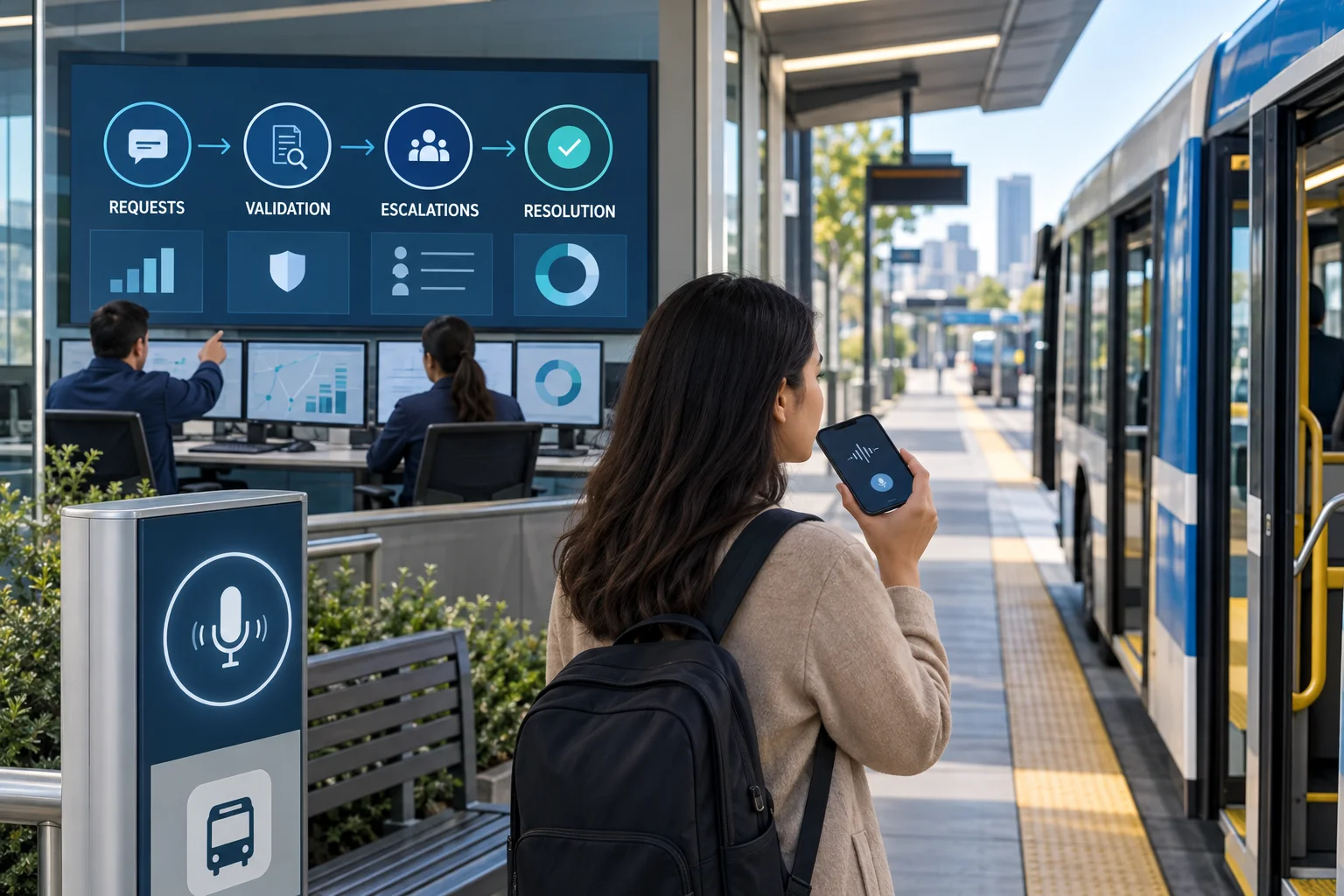
Supply human reviewers with a compact case view: original audio/transcript, source provenance, confidence metrics, and prior corrections. Track reviewer decisions, time to resolve, remediation steps, and whether a systemic change is required. Use periodic review boards to examine repetitive appeals and trigger model or copy changes. Ensure reviewers have clear authority boundaries and documented escalation to operations or legal teams.
- Case view includes: audio, transcript, selected source, validation steps, and user metadata
- Reviewer audit logs for accountability and dispute resolution
- Periodic reviews to convert frequent appeals into product or content fixes
6. Procurement, vendor controls and deployment choices
Procurement clauses and deployment choices determine long‑term risk. This section lists contract provisions, deployment models and what to verify during vendor selection.
Contract must‑haves for transit Voice AI
Contracts should specify data residency, subprocessors, change‑control for model or prompt updates, incident notification SLAs, explainability commitments (how sources are surfaced), and obligations around accessibility remediation. Require vendors to commit to auditable logs, support for redaction/export for appeals, and clearly defined responsibilities for content and system updates.
- Specify hosting region(s), backup region and cross‑border transfer mechanisms
- Require a precise list of subprocessors, support remote‑access policies, and define breach notification timelines
- Include performance SLAs tied to SLO outcomes and audit rights
Deployment patterns and support model
Choose a deployment pattern that fits your security and operational model: agency‑hosted, vendor‑cloud with strict regioning, or hybrid where sensitive data is retained in‑region while models run in a controlled environment. Clarify remote‑support access, maintenance windows, and the vendor’s obligations for model updates and rollback. Where vendors provide managed services, define ownership for observability and incident response.
- Map hosting and backup geography to legal and risk requirements
- Define remote‑support methods and least‑privilege access procedures
- Plan for rollback and rapid hotfixes; include runbooks for degraded modes
Related Peak Demand resources
Industry and AI sources reviewed
- Artificial Intelligence Risk Management Framework (AI RMF 1.0)National Institute of Standards and Technology (NIST)
- Transportation Systems SectorCybersecurity and Infrastructure Security Agency (CISA)
- OECD AI PrinciplesOrganisation for Economic Co-operation and Development
Transit safety, accessibility, privacy, cybersecurity, records, and service-information obligations vary by jurisdiction and operating authority. This article is operational guidance, not legal advice; organizations should confirm applicable requirements with qualified professionals.
Frequently asked questions
Good starting points include lost property, complaints and feedback, stop or shelter issues, fare-machine faults, non-emergency accessibility service requests, schedule information from approved sources, and structured routing to customer service or field teams.
Official reference: Artificial Intelligence Risk Management Framework (AI RMF 1.0)
Use GTFS Realtime only when the agency exposes suitable feeds and the workflow genuinely needs service alerts, trip updates, or vehicle positions. The integration should validate freshness and availability, and the agent should avoid presenting stale feed data as a guaranteed arrival prediction.
Emergency, security, injury, crime, and safety-critical reports should follow approved transfer or emergency-routing procedures. Voice AI may detect and route the call, but it should not make operational safety decisions or replace trained personnel.
Official reference: Transportation Systems Sector
Request realistic call testing, feed and system failure handling, service-request integration, transfer context, audit logs, accessibility channels, monitoring, change control, and evidence that the agent distinguishes scheduled information from dynamic service alerts.
Official reference: Artificial Intelligence Risk Management Framework (AI RMF 1.0)
Design the transit service workflow before automating it
Peak Demand helps transit teams connect Voice AI to rider information, service requests, approved live-data sources, escalation, confirmation, and analytics.
Schedule a discovery call


