
Why Regulated Organizations Need Custom Voice AI Infrastructure
Regulated enterprises require custom Voice AI infrastructure to meet containment, escalation, QA, observability, and compliance constraints — and to scale multilingual, multi‑site operations while controlling cost-to-serve.
1. Why off‑the‑shelf Voice AI is insufficient for regulated environments
Regulated organisations—financial services, healthcare-adjacent operations, utilities, and government — face constraints that generic Voice AI offerings do not address. The difference is operational: it’s not model accuracy alone, but containment, escalation, traceability, and predictable failure behaviour.
Containment quality vs. mere intent accuracy
Containment means the caller’s need is resolved without human handoff when appropriate. Vendors often advertise intent accuracy or NLU scores; procurement must instead quantify containment (percentage of calls completed end‑to‑end) and containment quality (successful transaction completion rate and downstream correction rate). Measure containment with longitudinal, transaction‑level validation — not just transcript matches.
- Define containment KPIs: first‑contact containment rate, successful transaction confirmation rate, rework rate within 24–72 hours.
- Require vendor evidence: annotated call samples, P0/P1 error taxonomies, and examples of failed transactions with root cause.
Escalation quality and explicit failure boundaries
Escalation quality equals the reliability of handoffs: correct routing, immediate human availability, context‑preserved records, and bounded wait times. Specify failure modes (fallback to IVR menu, immediate human transfer, scheduled callback) and measurable SLAs for handoff success. Avoid black‑box fallbacks that create data gaps or compliance risks.
- List allowed escalation paths and data elements that must accompany a handoff (caller identity, intent vector, confidence scores, transcript excerpt, session ID).
- Define failure boundaries in the contract: maximum time to human pickup, maximum acceptable number of dropped escalations per 10,000 calls.
2. Essential architecture: define where control lives
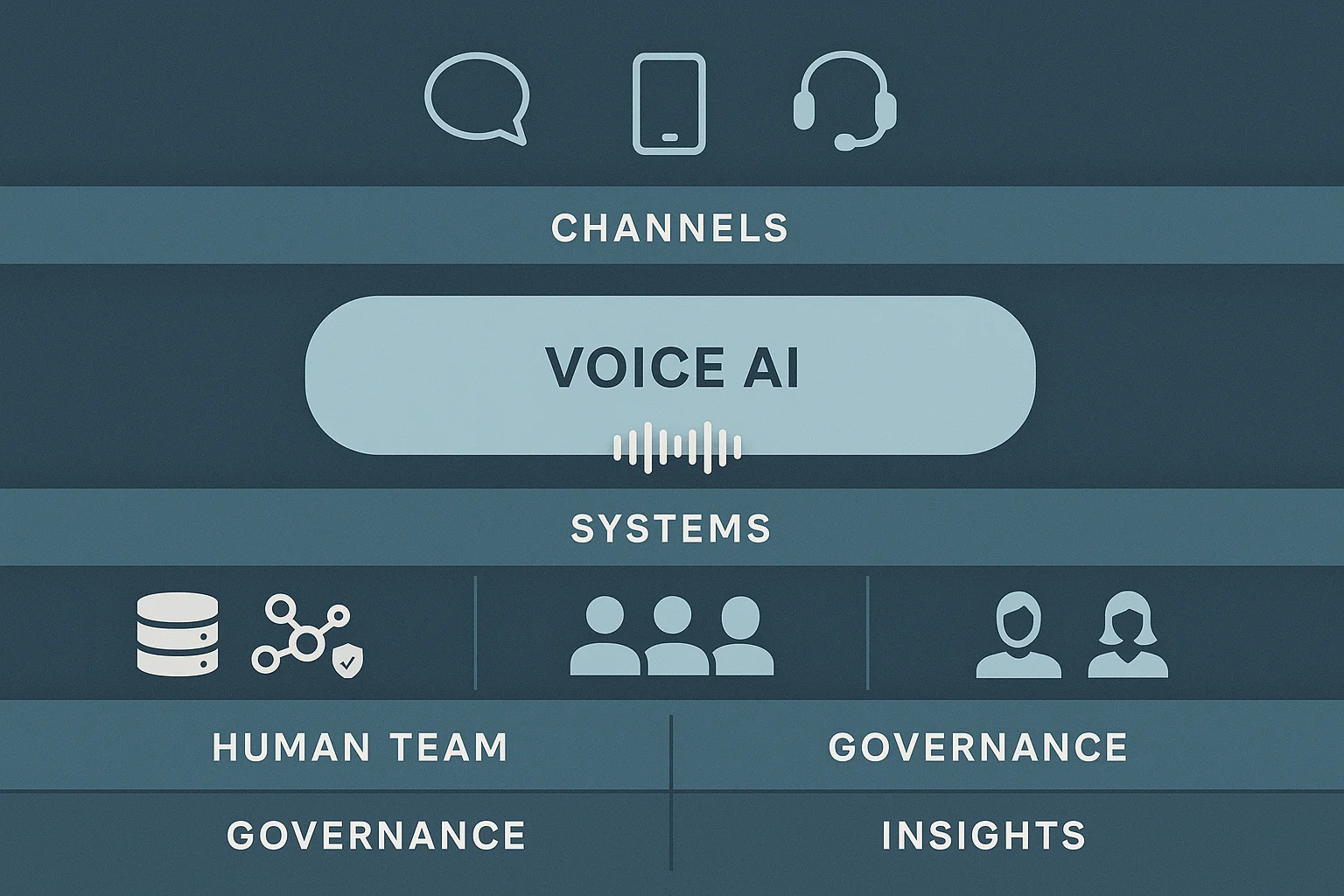
A practical architecture maps operational responsibilities and control points. Use a layered design that makes handoffs, auditing, and governance explicit.
Canonical flow: Caller → Voice AI → business‑rules layer → enterprise systems → outcome
Design the system as discrete components with clear contracts: the Voice AI handles speech I/O and initial NLU; a business‑rules layer enforces policies, data sharing rules, and decision logic; approved enterprise systems perform authoritative transactions; a response engine renders verbal confirmations or executes system updates; and QA/analytics capture evidence.
- Voice AI: ASR, intent classification, confidence scoring, TTS rendering.
- Business‑rules layer: policy enforcement, consent checks, routing, and orchestration adapters to CRM/OMS/ERP.
- Enterprise systems: write operations through approved APIs and audit trails.
- QA/Analytics: store call records, annotated transcripts, system events, and performance telemetry.
Integration choices: adapters, approved APIs, and controlled orchestration
Integrations should use enterprise‑approved APIs and controlled adapters rather than ad‑hoc direct access. Custom adapters translate between Voice AI session outputs and backend APIs and centralise logging, masking, and retry policies. This layer is where regulated organisations enforce data residency, redact PHI/PII, and limit outbound data.
- Use adapters to normalise authentication, throttle calls, and apply transform/masking rules before data leaves the orchestration layer.
- Record an integration inventory with subprocessors, endpoints, and purpose of processing to satisfy procurement and security reviews.
3. QA, observability, and analytics: the operating controls
QA is not optional — it is the primary safety net and continuous improvement engine. Observability must be designed to surface containment and escalation quality problems before they affect service levels.
Practical QA workflows
Combine automated QA scoring with human sample review. Automate transcription alignment, confidence‑based failure flags, and policy checks (consent, identity verification). Route low‑confidence or policy‑triggered calls to human auditors for rapid review and corrective action.
- Automated checks: consistent intent mapping, required slot completion, transaction confirmation matched to system state.
- Human QA: stratified sampling (random + risk‑weighted), annotated outcomes, and root‑cause tagging.
- Feedback loop: QA annotations feed model calibration, business‑rules updates, and dialogue script changes.
Observability metrics that matter
Observe both model and system-level metrics: ASR WER, intent confidence distributions, end‑to‑end containment, escalation rate, human pickup time, transaction reversal rate, and customer satisfaction impact. Set alert thresholds for divergence from baseline and measure the business impact of regressions.
- Operationalize alerts for rising rework or transaction reversal rates.
- Use versioned baselines so A/B tests and model rollouts are measured against an explicit control.
4. Managed service, hybrid, and procurement considerations
Regulated buyers must clarify which party owns what: who operates the Voice AI runtime, who owns connectors, who is the data controller/processor, and how escalation and audit obligations are met.
What to expect from managed Voice AI services
Managed providers should offer a clear scope: infrastructure, model ops, real‑time monitoring, QA services, escalation routing, and continuous optimization. Contracts must state escalation SLAs, audit access, evidence retention, subprocessors, and support for third‑party audits.
- Expect managed services to provide dashboards for containment and escalation metrics and to include human QA teams as part of their offering.
- Require vendor transparency on subprocessors, hosting regions, and remote‑support access policies.
Procurement checklist — what to require in RFPs
Make procurement operationally prescriptive. Include an acceptance plan with test cases, sample call volumes, multilingual tests, and a remediation plan for regressions. Require evidence for claims (live call samples, QA annotations, escalation transcripts) under NDA.
- Technical deliverables: architecture diagrams, integration adapters, data flow, and SLAs for handoff success and QA sampling frequency.
- Operational deliverables: runbooks for failure modes, on‑call roster, and change‑management procedures.
- Contractual: data residency terms, subprocessors list, incident notification windows, and audit right clauses.

5. Scaling across sites and languages while controlling cost‑to‑serve
Scale multiplies operational complexity. Plan for locale specifics, acoustic variability, agent augmentation, and cost‑tradeoffs between automation and human labour.
Multilingual operations and locale adaptation
Local dialects, pronunciation, regulatory disclosures, and language‑specific flows require separate training, testing, and QA regimes. Use locale‑tagged models or custom prompts, and validate with native‑speaker QA. Keep language fallbacks explicit to avoid inappropriate auto‑responses.
- Maintain separate containment and escalation baselines per language and site.
- Test for legal phrasing (disclosures, consent) in every jurisdiction before go‑live.
Measuring and managing cost‑to‑serve
Cost‑to‑serve is the sum of runtime consumption, human QA and escalation labour, integration maintenance, and incident remediation. Model total cost with sensitivity to containment rate and escalation volume.
- Measure per‑call unit economics: average runtime cost + expected human escalation minutes × labour rate + QA overhead per call.
- Plan optimization sprints focused on high‑volume intents to reduce marginal cost through improved containment.

6. Implementation controls, failure modes, and acceptance criteria
Define what a safe, auditable production rollout looks like. Make failure modes explicit and codify acceptance testing, monitoring, and rollback procedures.
Failure boundaries and human‑in‑loop policies
For high‑risk tasks (authorization changes, financial transactions, medical advice), require human authorization. Define automatic failover behaviour for system outages and confidence thresholds that force human handoff.
- Assign risk levels per intent and require preapproved human‑in‑loop for high‑risk categories.
- Document automatic failovers: e.g., if ASR latency > X ms or confidence < Y%, route to human with session context.
Acceptance criteria and measurable outcomes
Acceptance should be data‑driven: baseline KPIs (containment rate, escalation success, rework rate), stability thresholds over 30–90 days, and exit criteria for remediation. Tie acceptance to contractual remedies or phased payments.
- Require a staged rollout (sandbox → pilot → phased production) with measurable gates tied to KPIs.
- Include post‑launch optimization cycles and agreed cadence for model and rules updates.
Related Peak Demand resources
Industry and AI sources reviewed
- Artificial Intelligence Risk Management Framework (AI RMF 1.0)National Institute of Standards and Technology (NIST)
- AI Risk Management Framework: Generative AI ProfileNational Institute of Standards and Technology (NIST)
- OECD AI PrinciplesOrganisation for Economic Co-operation and Development
Privacy, telecommunications, recording-consent, cybersecurity, consumer-protection, employment, and records obligations vary by jurisdiction and use case. This article is operational guidance, not legal advice; organizations should confirm applicable requirements with qualified professionals.
Frequently asked questions
A serious managed service should include discovery, workflow design, telephony, integrations, validation rules, testing, monitoring, human escalation, incident handling, change control, analytics, and ongoing optimization. The value is the complete operating system around the model, not access to a model alone.
Official reference: Artificial Intelligence Risk Management Framework (AI RMF 1.0)
The operating model should assign clear owners for telephony, prompts, knowledge, APIs, credentials, incident response, analytics, approvals, and release management. Enterprise buyers should avoid deployments where those responsibilities are ambiguous or split across vendors without accountability.
Official reference: Artificial Intelligence Risk Management Framework (AI RMF 1.0)
Evaluate the complete workflow under realistic volume, latency, interruption, transfer, integration, and failure conditions. Measure task completion, escalation quality, unsupported responses, system errors, recovery behavior, and how quickly operators can detect and correct problems.
Official reference: Artificial Intelligence Risk Management Framework (AI RMF 1.0)
Ask for documented use-case boundaries, data handling, access controls, model and prompt change management, evaluation procedures, audit logs, human-oversight rules, incident response, subcontractor dependencies, and a process for reviewing material system changes.
Official reference: Artificial Intelligence Risk Management Framework (AI RMF 1.0)
Need deeper enterprise Voice AI integration?
For custom APIs, SIP and telephony architecture, multi-system workflows, QA, observability, and enterprise deployment, Peak Demand commonly evaluates platforms such as Retell AI as part of a managed architecture.
Explore Retell for Enterprise Voice AIPeak Demand may earn a commission from this link.


