
Voice AI Workflows for Parts Requests and Production Service Escalation
Practical, procurement-ready guidance for manufacturers, distributors, and service teams building Voice AI for parts intake and production escalation. Covers validated intake, ERP/CRM integration, containment and escalation quality, OT safety boundaries, multilingual scale, QA, and continuous optimization.
How Voice AI fits into industrial parts and service workflows
A concise operating model clarifies responsibilities, integrations, and safety boundaries. Below is a practical architecture and the responsibilities that must remain human-controlled in regulated manufacturing operations.
Operating model and architecture
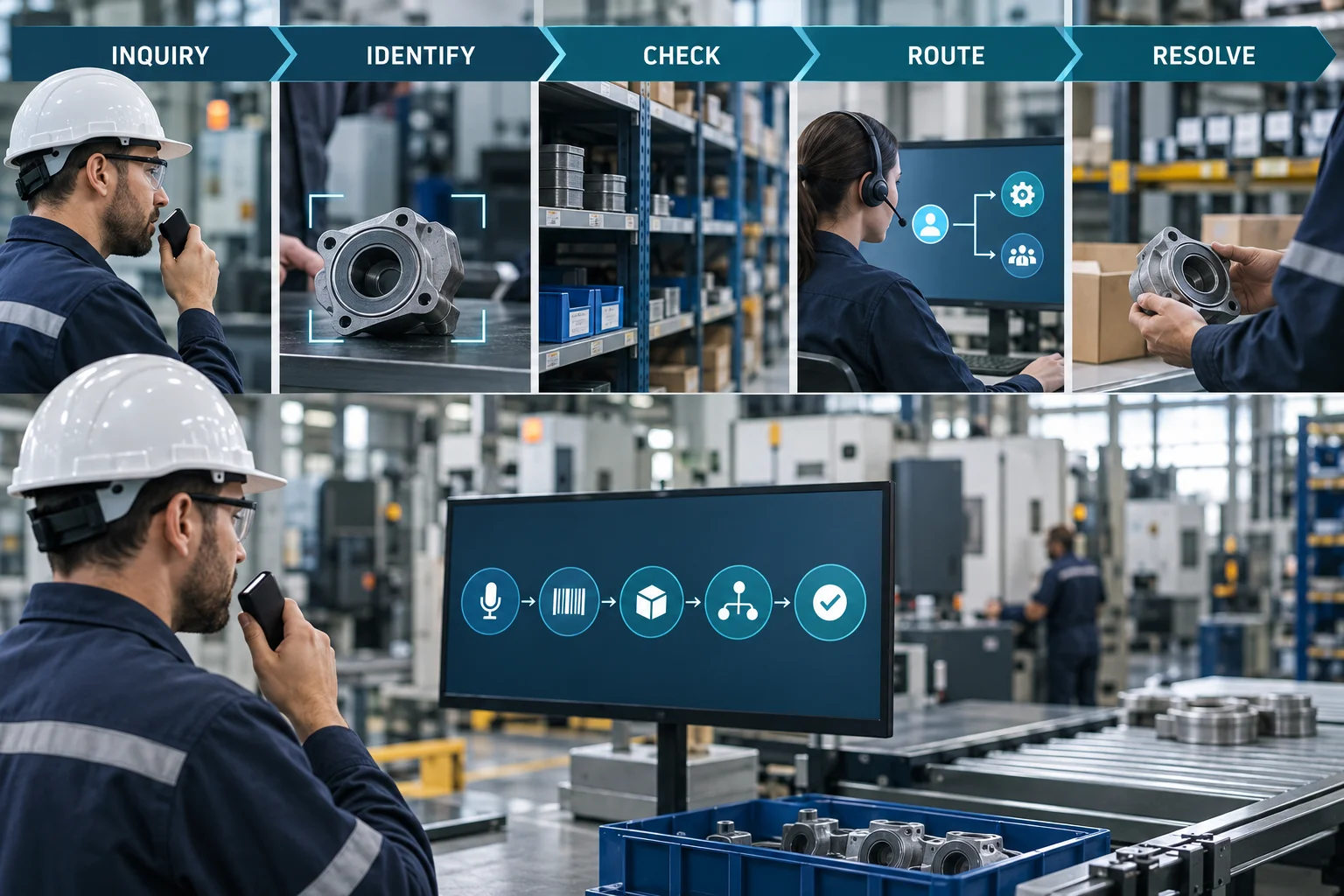
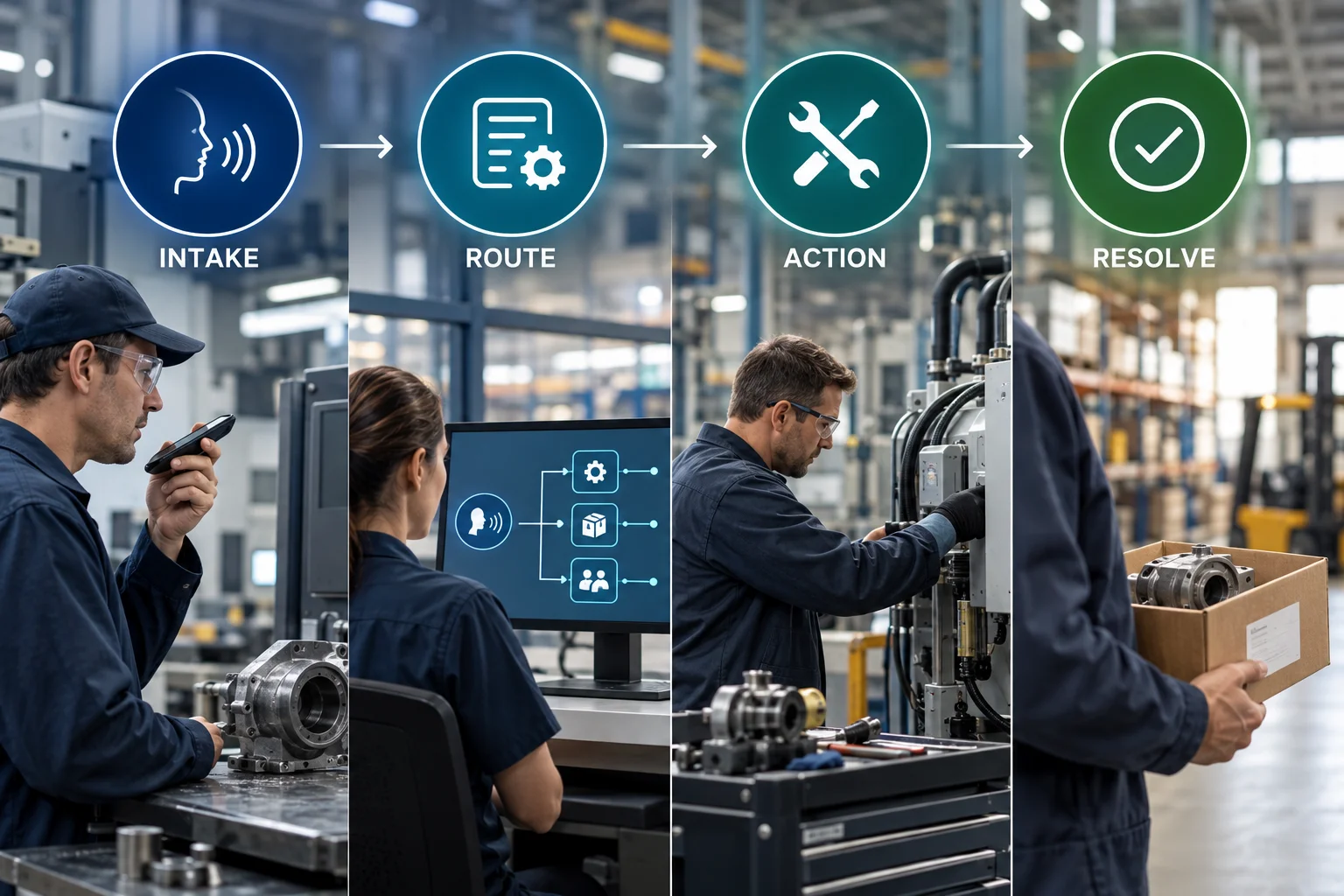
A minimal, production-ready architecture is: Caller → Voice AI (ASR/NLU) → intent and product validation → ERP/CRM/warranty/service API via controlled adapter → create case, order inquiry, or specialist handoff. Voice AI handles structured intake and routing; business systems own master data, pricing, stock, warranty rules, and authorizations. Design system adapters to implement retries, transaction logs, and idempotent operations so a voice session cannot create duplicate orders.
- Validated intent and product lookup against ERP/parts catalog before any write operation.
- Adapters or orchestration layer implement rate limits, retries, and audit logging.
- Human-in-loop gates for warranty approvals, safety actions, and engineering dispositions.
Who controls what: operational boundaries
Voice AI should never be the final authority for warranty approvals, safety-critical engineering decisions, or control-room actions. Assign explicit ownership: customer service owns first-contact validation and case creation, service engineering owns failure analysis and warranty disposition, plant operations own OT access and emergency procedure authorizations. Document these boundaries in runbooks and in the system’s role-based access controls (RBAC).
- Write access to ERP order tables can be granted to trusted adapters but require prechecks (stock, pricing, duplicate detection).
- Warranty disposition requires human signoff or a configurable business-rule engine with audit trails.
- OT integrations should be read-only or segmented to prevent control actions from a conversational channel.
Designing parts-request workflows for accuracy and containment
Parts intake is a high-volume use case with clear cost-to-serve and uptime impacts. The design goal is to maximize accurate containment while minimizing unnecessary specialist handoffs.
Structured intake and validation steps
Use deterministic, slot-based voice flows rather than open-ended dialogs for parts requests. Require the minimum validated data set: caller identity (account/dealer ID), product model, part number or description, serial number (when relevant), location, and urgency. Validate each slot against the ERP/parts catalog in real time and surface likely matches for quick confirmation.
- Prompt for part number; if missing, use guided questions (component location, symptoms) to narrow matches.
- Perform synchronous ERP/parts-catalog lookup and present top matches with confidence score.
- If confidence is below threshold, automatically route to human agent with packaged context (session transcript + matches).
Containment quality: measuring success
Containment quality is the share of interactions completed without human handoff where the system produced a correct outcome (order, shipping instruction, or basic troubleshooting). Track containment quality separately from containment rate. Containment rate only says how often the voice AI handles a call; containment quality measures correctness.
- Key metrics: containment rate, containment quality (accuracy), mean time to fulfillment, first-contact order accuracy, and chargeback rate.
- Sample SLA: >70% containment rate with >95% containment quality for routine parts reorder (benchmarks depend on product complexity).
- Use post-transaction sampling and automated ERP reconciliation to identify false positives and false negatives.
Production service escalation: triage, safety, and urgency
Escalation workflows must balance speed with safety. Voice AI can accelerate triage, surface context, and route to the right on-call specialist, but it must not assume authority for safety-critical instructions.
Triage, severity scoring, and intent routing
Implement structured severity scoring: symptom categories, number of affected lines, production impact, and safety indicators. Map scores to routing outcomes (immediate on-call escalation, next-business-hour specialist, field-service case). Use integrations to read real-time MES/SCADA indicators where available, subject to OT security controls.
- Severity rules should be configurable and auditable; record the score and routing decision in the case record.
- When confidence in intent or severity is low, escalate to a human triage team with contextual packet (transcript, timestamps, ERP info).
- Provide an emergency path (e.g., immediate phone patch to on-call technician) with policy checks and human confirmation prompts.
On-call escalation and handoff controls
Use managed handoff templates: summarize the issue, include suggested next steps, and attach validated data (product, part, serial, ERP stock). Peak Demand’s approach uses configurable call flows and integration adapters to push a structured handoff to mobile or dispatch systems and to initiate an immediate conference with an on-call technician when required.
- Handoff packet must include confidence scores and a ‘why escalated’ tag so the specialist can triage quickly.
- Rate-limit automated patches to control rooms; require two-step confirmation for any safety-related action.
- Log all escalations with timestamps, participants, and the voice session recording for post-incident review.
Failure boundaries and safe defaults
Define fail-safe behaviors: if ERP lookup fails, switch to read-only fallback (cached SKU list) and route to human for confirmation. If NLU confidence drops or caller becomes agitated, degrade to agent transfer. Treat any ambiguity in safety indicators as high-severity and escalate accordingly.
- Fallback: create an unsubmitted case draft with captured context rather than auto-submitting an order.
- Default to human escalation when OT telemetry required for decision is unavailable.
- Document and test these failure paths as part of acceptance testing and runbook drills.
QA, analytics, and the economics of cost-to-serve
A practical QA program ties product accuracy to economics. Analytics should feed continuous improvement loops for prompts, training data, and integration reliability.
Operational KPIs to track
Select KPIs that map to business outcomes: containment rate, containment quality, escalation precision (percent escalations that required human intervention and were correctly routed), average handle time saved, parts order accuracy, time-to-part-shipment, and production downtime attributable to service delays.
- Combine voice logs with ERP reconciliation to measure first-time-order accuracy.
- Report cost-to-serve: incremental cost of automated interaction versus human-handled baseline, and net savings after measuring exception handling.
- Track false escalation costs (unnecessary human effort) and missed escalation costs (production downtime).
QA workflows and auditability
Implement a layered QA program: automated reconciliation (ERP vs. claimed outcome), periodic human audits of recorded sessions, and targeted retraining of NLU on high-risk or low-confidence intents. Tag samples by site, language, and product line to spot systemic issues.
- Define sampling rates by containment bucket (higher sampling for interactions that appear resolved automatically).
- Use post-call surveys selectively for non-urgent parts orders to validate customer satisfaction and correctness.
- Store transcripts, metadata, and audit logs with retention policies aligned to local regulation and procurement contracts.

Scaling across sites and languages, and managing regulatory boundaries
Multi-site rollouts require clear decisions on hosting, data residency, subprocessors, and multilingual models. These are procurement-level decisions and must be explicit in contracts.
Multilingual operations and model choices
Provide localized prompts and intent models per language and site. Use language-specific confidence thresholds because ASR/NLU performance varies by dialect and acoustic conditions. Maintain a shared intent taxonomy to minimize divergence across sites and to keep centralized reporting coherent.
- Configure language-specific fallback flows and human-in-language escalation.
- Keep a central glossary of product and part names to avoid divergent recognition across languages.
- Monitor language-specific containment quality and retrain models for low-performing locales.
Data residency, subprocessors, and cross-border constraints
Decide hosting region, backup region, and subprocessors at procurement. Clarify how recordings are stored, who can access them, and what transfer mechanisms are used for cross-border access. For regulated facilities, isolate OT telemetry from cloud voice systems and ensure any cross-border transfer of telemetry is authorized.
- List hosting region, backup region, and subprocessors in the statement of work; require notification of any proposed changes.
- Specify retention and deletion policies for recordings and transcripts and include breach notification duties.
- Confirm jurisdictional obligations with qualified legal counsel; requirements vary by country and industry.
Procurement, implementation choices, and continuous optimization
Make procurement actionable: specify deliverables, integration ownership, SLAs, QA gates, and runbooks. Plan a phased rollout with measurable gates for scale.
What to specify in RFPs and SOWs
Require clear responsibilities for call-flow ownership, integration adapters, and maintenance. Ask vendors to deliver: documented call flows, adapter contracts for ERP/CRM/service APIs, test plans for failure modes, role-based access, and a QA sampling plan. Require human escalation templates and a change-control process for call-flow changes.
- Include required KPIs (containment quality, escalation precision), testing acceptance criteria, and penalties for missed SLAs.
- Require evidence of secure development lifecycle and an inventory of subprocessors.
- Specify runbook availability, staff training, and on-call support windows.
Phased rollout and continuous optimization
Phase by product line or site: pilot a single product family, measure containment quality and escalation precision, tune prompts and rules, then expand. Establish a monthly optimization cadence with prioritised fixes: taxonomy updates, NLU retraining, adapter hardening, and call-flow simplification.
- Start with high-volume, low-ambiguity tasks (reorders) to prove containment and reconciliation.
- Use A/B testing for prompt wording and confirmation thresholds to raise containment quality.
- Maintain a prioritized backlog of model and integration fixes tied to KPI impact.
Related Peak Demand resources
Industry and AI sources reviewed
- Guide to Operational Technology SecurityNational Institute of Standards and Technology (NIST)
- Cross-Sector Cybersecurity Performance GoalsCybersecurity and Infrastructure Security Agency (CISA)
- Cybersecurity Resources for ManufacturersNIST Manufacturing Extension Partnership
Manufacturing cybersecurity, operational-technology, product, warranty, records, and workplace obligations vary by jurisdiction and operating environment. This article is operational guidance, not legal advice; organizations should confirm applicable requirements with qualified professionals.
Frequently asked questions
Strong starting points include parts and order-status requests, distributor or dealer support, warranty and service intake, appointment scheduling, case creation, basic product information, and routing to technical specialists. Keep engineering judgment, safety decisions, and operational-technology control outside the conversational layer.
Official reference: Cybersecurity Resources for Manufacturers
The workflow should collect structured identifiers such as model, serial number, part number, customer account, asset location, and symptoms, then validate them against ERP, CRM, catalogue, warranty, or service systems. The agent should escalate rather than invent a match when confidence is low.
Official reference: Cybersecurity Resources for Manufacturers
Not by default. Customer-service automation should normally use controlled business-system integrations and tightly governed adapters. Any connection near operational technology requires explicit security architecture, least privilege, monitoring, and separation from safety-critical control functions.
Official reference: Guide to Operational Technology Security
Require workflow mapping, integration ownership, test evidence, fallback behavior, auditability, security boundaries, change control, monitoring, human escalation, and a plan for maintaining product, parts, warranty, and service knowledge after launch.
Official reference: Cybersecurity Resources for Manufacturers
Connect Voice AI to real manufacturing service operations
Peak Demand helps manufacturers automate parts, order, warranty, dealer, distributor, and service requests through controlled integrations, validation, escalation, and reporting.
Schedule a discovery call


