
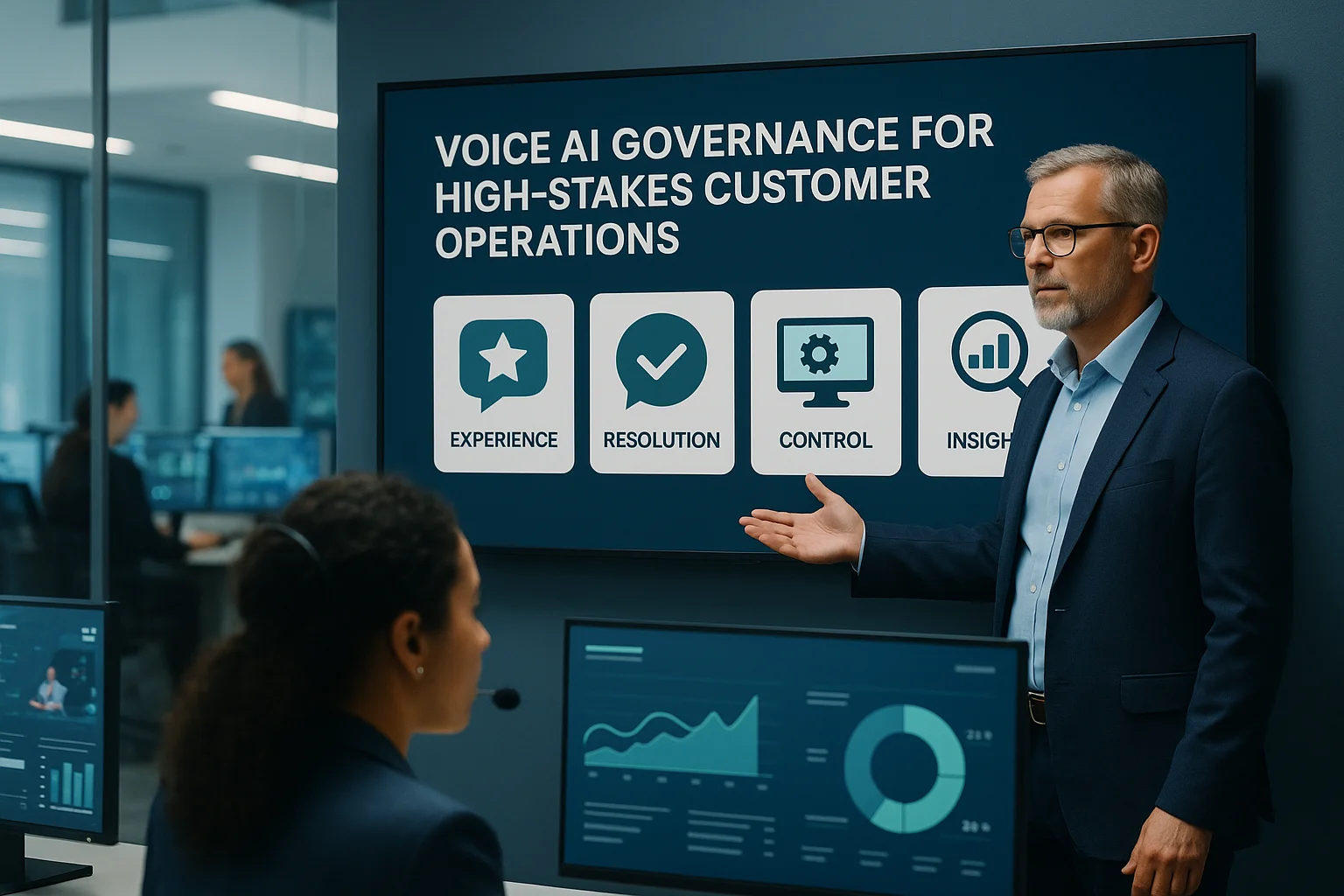
Voice AI Governance for High-Stakes Customer Operations
Decision-grade guidance for enterprise leaders choosing Voice AI for mission‑critical contact‑centre operations. Architecture, managed service scope, QA, observability, escalation and measurable outcomes.
1. Decision framework: what governance must deliver
Governance for Voice AI in high‑stakes customer operations is practical, measurable, and boundary‑driven. This section defines the governance outputs procurement and operations teams should demand before committing budget.
Program-level outcomes
Treat governance as product requirements. Define measurable outcomes that map to business objectives: containment quality (automation success rate), escalation quality (accuracy and context handed to agents), time‑to‑resolution, cost‑to‑serve per contact, and compliance evidence (audit trails, retention controls). Make these outcomes contractual where the vendor controls delivery.
- Containment quality target (e.g., automation resolves X% of incoming calls without human handoff).
- Escalation quality target (e.g., required fields, intent confidence, and conversational context present on handoff).
- Observable metrics with dashboards and exportable reports for audits and SLA adherence.
Decision gates and failure boundaries
Specify explicit failure boundaries that trigger handoff: confidence thresholds, transaction risk level, sensitive topics, or regulatory flags. High‑risk transactions should be disallowed for automation by default. Require vendors to expose hooks for operators to change thresholds without code deployments.
- Fail‑open (route to human) vs fail‑closed (reject) policy per transaction class.
- Runtime thresholds for confidence, slot completion, or business‑rule mismatch.
- Operational runbook for common failure modes and escalation paths.
2. Architecture: orchestrating the caller→Voice AI→systems loop
Buyer decisions should be grounded in a clear architecture. This is the canonical operating model to reference during procurement and technical evaluation.
Canonical call flow and ownership
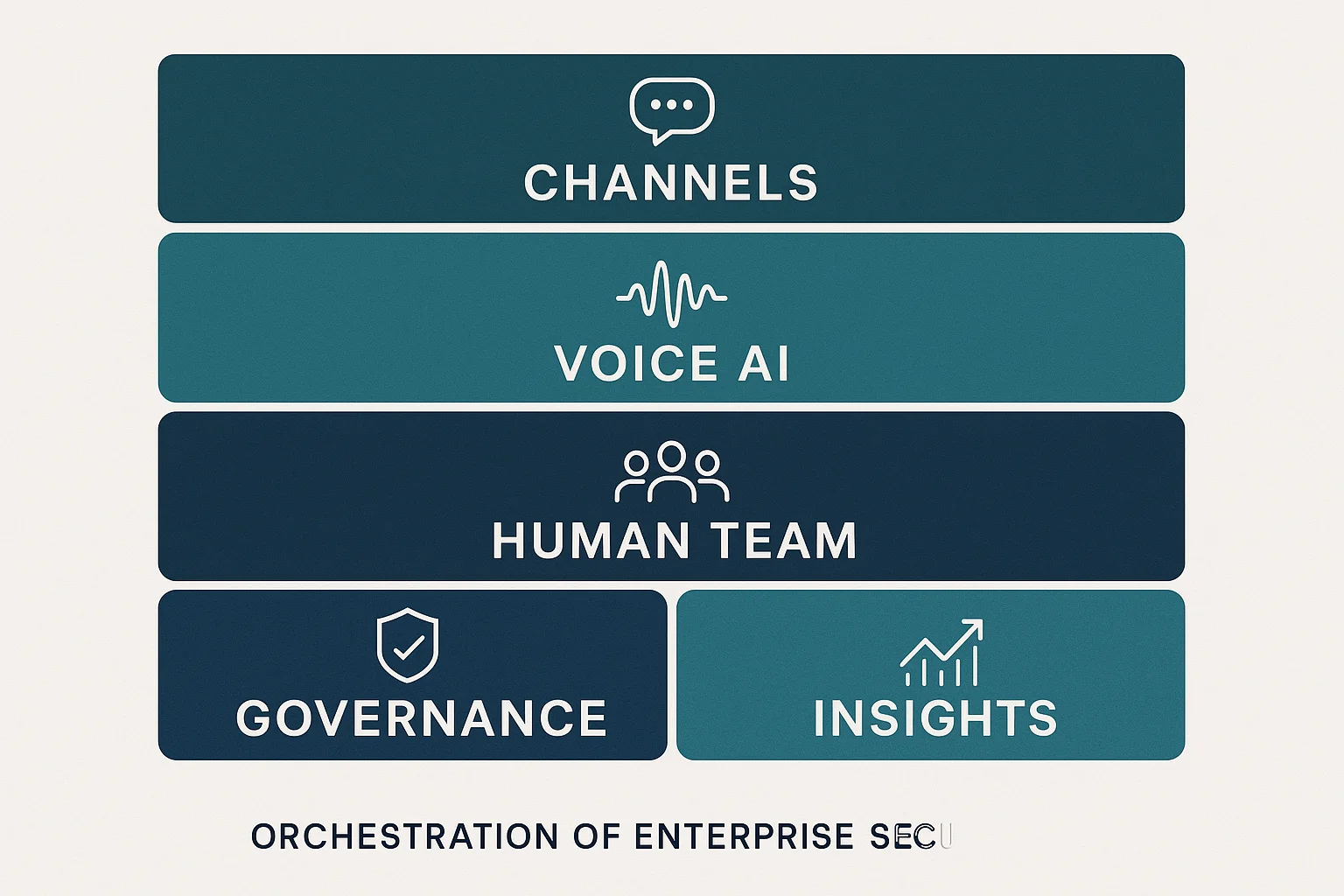
Define the canonical flow and assign ownership at each handoff: Caller → Telephony → Voice AI (NLU/LLM/response logic) → Business‑rules layer (policy, decisioning) → Approved enterprise systems (CRM, billing, order management) → Response/Transaction or Human Handoff → QA & Analytics. Require the vendor to clearly document which components they operate, which remain the buyer’s responsibility, and the APIs or adapters used.
- Ownership matrix specifying operator, vendor-managed, and shared components.
- Clear interface contracts: telemetry, error codes, and retry semantics.
- Logic bridges (adapters) that translate from conversational outputs to enterprise API calls.
Integration and data control patterns
Prefer controlled adapters over broad database-level access. Integrations should use least‑privilege APIs, scoped tokens, and auditable adapters. Separate the conversational model from enterprise credentials: the Voice AI should call an authenticated adapter that applies business rules and records transactions in the approved system.
- Adapter pattern: Voice AI → logic bridge → enterprise API (no direct DB access).
- Scoped credentials, rotation policies, and recorded access for audits.
- Blacklist/whitelist rules for callable enterprise actions from automation.
Deployment topology and regional hosting
Specify hosting region, backup region, remote‑support access method, subprocessors, transfer mechanism, retention period, and recording consent on the contract. Differentiate where runtime inference occurs (vendor cloud, buyer VPC, or hybrid) and require clear documentation of cross‑border transfers and subprocessors.
- Primary hosting region and defined backup/DR region.
- Remote-support access method and privileged access controls.
- List of subprocessors with update notification windows and right to audit.
3. Governance, risk and human oversight
Risk management must be auditable and rooted in documented controls. Human oversight is not a checkbox; it is an operational capability with measurable handoffs.
Risk assessment and control mapping
Conduct a use‑case level AI risk assessment that maps specific harms (privacy, financial, safety, reputational) to mitigations: limiting scope, approval gates, monitoring, and human review. Use risk tiers to determine whether a use case is permitted, conditional, or disallowed for automation.
- Risk tiers (low/medium/high) with mandatory mitigations for each tier.
- Periodic reassessment after model updates or new integration endpoints.
- Evidence‑backed controls for auditability and procurement decisions.
Human‑in‑the‑loop: rules, instrumentation and training
Define when humans must observe, supervise, or take control. Instrument handoffs with structured context: intent, confidence, dialogue transcript (redacted as needed), last successful enterprise calls, and recommended next actions. Train agents on interpreting context tokens and on the failure modes of automation.
- Structured handoff payload with required fields and confidence markers.
- Supervision modes: shadow, assist, takeover — with metrics per mode.
- Agent training tied to observed automation failure classes.
Safe defaults and high‑risk prohibitions
For high‑risk transactions (legal, high‑value financial changes, safety warnings), require human authorization by default. Document explicit prohibitions and ensure the system enforces these at runtime.
- Automatic lockouts for transaction classes by policy.
- Audit trails for any override with operator identity and justification.
- Periodic review of prohibited categories as regulations or business conditions change.
4. QA, observability and measurable quality
Operational QA and observability deliver confidence. Define sampling, tooling, and measurable indicators rather than relying solely on vendor assurances.
Production QA: sampling, shadowing and regression
Adopt a mixed QA approach: pre‑production regression suites, canary deployments, shadowing, and production sampling. Regression suites must include negative tests, slot adversaries, and transaction simulations against the business‑rules layer.
- Shadow testing to compare automation vs human baseline without impacting customers.
- Production sampling plan: stratified by language, site, and call type.
- Regression suites executed on every model or policy update.
Observability: logs, metrics and alerting
Specify the telemetry the vendor must supply: request/response transcripts, intent and slot metrics, confidence distributions, API error rates, transaction latencies, and containment/escalation rates. Ensure logs are exportable to the buyer’s SIEM and analytics platforms under contractual terms.
- Exportable, time‑indexed logs with retention policies aligned to procurement requirements.
- Metric thresholds with operational alerts and escalation playbooks.
- Correlation IDs that trace a call across telephony, Voice AI, adapters, and enterprise systems.
Measuring containment and escalation quality
Containment quality measures how often automation resolves requests; escalation quality measures whether handoffs include necessary context and enable first‑touch resolution. Track both as primary KPIs and measure downstream customer impact (repeat contacts, callbacks, OTR).
- Containment quality: percent of interactions closed by automation without repeat contact within defined window.
- Escalation quality: percent of handoffs where required context fields are present and agent resolves on first touch.
- Linked cost‑to‑serve metrics that report automation savings alongside customer experience impact.

5. Managed service and vendor evaluation
Procurement must move beyond feature lists to operational commitments. This section lists the managed‑service scope and procurement evidence buyers should require.
Core managed‑service scope and SLAs
A managed Voice AI service should clearly state scope: telephony integration, conversational model, logic bridges, enterprise adapters, QA, monitoring, human escalation handling, and optimization services. SLAs should cover uptime, API latency, containment and escalation quality targets, and time to remediate critical incidents.
- Scope checklist: telephony, NLU/LM, business rules layer, adapters, QA, optimization.
- SLA examples: platform availability, median response latency, containment quality floor, escalation payload completeness.
- Remediation windows for critical security or data incidents.
Procurement evidence and due diligence
Request operational evidence: architecture diagrams, runbooks, access control matrices, subprocessor lists, sample dashboards, and results from pilot QA runs. Ask for API contracts and a list of supported enterprise systems and adapters.
- Operational documents: runbooks, run‑rate incident reports, and playbooks for failure modes.
- Pilots with pre‑agreed success metrics and sample production telemetry.
- Right to audit clauses and test windows for upgrades.
Access, subprocessors and security controls
Demand transparency on subprocessors, privileged access, and account separation. Require least‑privilege access, MFA, role‑based access control, and documented remote‑support procedures. Define privileged‑access alerting and audit log retention as contractual items.
- Subprocessor disclosures with update notifications and mitigation timelines.
- Privileged access logs and just‑in‑time access controls for support engineers.
- Encryption-in-transit and at-rest specifications for call recordings and transcripts.
6. Multi‑site, multilingual and scale operations
Scaling Voice AI across sites and languages introduces variability. Manage scale through localized tuning, consistent observability, and cost‑to‑serve telemetry.
Scale patterns and orchestration
Design for horizontal scaling of both telephony and conversational workloads. Use orchestration that allows traffic steering by site, time zone, or load. Implement feature flags per site to manage staggered rollouts and rollback capabilities.
- Traffic steering and regional failover policies.
- Feature flags and per‑site configuration to enable gradual rollouts.
- Capacity planning tied to historical contact volumes and seasonal spikes.
Multilingual quality controls
Multilingual operations require localized NLU, regional voices, and language‑specific regressions. Track containment and escalation separately per language and site. Use native speaker QA for sampling and deploy per‑locale tuning only after pilot pass criteria are met.
- Locale‑specific regression suites and production sampling quotas.
- Vendor responsibilities for local voice models and accent coverage.
- Separate KPIs and cost‑to‑serve for each language.
Cost‑to‑serve and optimization loops
Measure cost‑to‑serve as a composite of telephony, model inference, human handling time, and remediation overhead. Establish continuous optimization cycles—pilot, measure, tune, and scale—with contractual optimization sprints and defined success metrics.
- Normalized cost per resolved contact across automation and human channels.
- Optimization cadences with defined experiments and rollback rules.
- Billing transparency for inference, telephony minutes, and support engineering.
Related Peak Demand resources
Industry and AI sources reviewed
- Artificial Intelligence Risk Management Framework (AI RMF 1.0)National Institute of Standards and Technology (NIST)
- OECD AI PrinciplesOrganisation for Economic Co-operation and Development
- AI Risk Management Framework: Generative AI ProfileNational Institute of Standards and Technology (NIST)
Privacy, telecommunications, recording-consent, cybersecurity, consumer-protection, employment, and records obligations vary by jurisdiction and use case. This article is operational guidance, not legal advice; organizations should confirm applicable requirements with qualified professionals.
Frequently asked questions
A serious managed service should include discovery, workflow design, telephony, integrations, validation rules, testing, monitoring, human escalation, incident handling, change control, analytics, and ongoing optimization. The value is the complete operating system around the model, not access to a model alone.
Official reference: Artificial Intelligence Risk Management Framework (AI RMF 1.0)
The operating model should assign clear owners for telephony, prompts, knowledge, APIs, credentials, incident response, analytics, approvals, and release management. Enterprise buyers should avoid deployments where those responsibilities are ambiguous or split across vendors without accountability.
Official reference: Artificial Intelligence Risk Management Framework (AI RMF 1.0)
Evaluate the complete workflow under realistic volume, latency, interruption, transfer, integration, and failure conditions. Measure task completion, escalation quality, unsupported responses, system errors, recovery behavior, and how quickly operators can detect and correct problems.
Official reference: Artificial Intelligence Risk Management Framework (AI RMF 1.0)
Ask for documented use-case boundaries, data handling, access controls, model and prompt change management, evaluation procedures, audit logs, human-oversight rules, incident response, subcontractor dependencies, and a process for reviewing material system changes.
Official reference: Artificial Intelligence Risk Management Framework (AI RMF 1.0)
Need deeper enterprise Voice AI integration?
For custom APIs, SIP and telephony architecture, multi-system workflows, QA, observability, and enterprise deployment, Peak Demand commonly evaluates platforms such as Retell AI as part of a managed architecture.
Explore Retell for Enterprise Voice AIPeak Demand may earn a commission from this link.


