
Voice AI in Banking: Model Risk, Data Lineage & Operational Resilience
Practical architecture and procurement guidance for deploying Voice AI in regulated banking contact centres: model risk controls, end‑to‑end data lineage, resilience patterns, and vendor‑selection criteria.
1. Why banks must treat Voice AI as an enterprise control surface
Voice AI is not a point feature — it is an always‑on, stateful contact‑centre platform that touches identity, payments, account data and regulatory records. For banking, that means model risk, data lineage, and operational resilience are business requirements, not optional engineering knobs.
Operational stakes and non‑linear failure modes
A misrouted or incorrect automated response can cascade: failed authentication, incorrect balance information, or improper transaction initiation. These are not limited to accuracy: failure modes include degraded latency that breaches SLAs, partial input loss from poor telephony adapters, and onboarding regressions after model updates.
- Voice AI spans telephony, ASR, NLU/generative layers, business‑rules, and backend adapters — failures can occur at any boundary.
- High‑risk intents (payments, transfers, OTP verification) require stronger controls and narrower automation envelopes.
- Prioritize auditable handoffs and conservative default behaviours for uncertain model outputs.
Regulatory and board‑level framing
Treat Voice AI initiatives like other regulated automation projects: include legal, compliance, security, and operations in scope. Require a model inventory, risk tolerance statements for automated decisions, and defined human oversight points where safety or legal risk is material. Avoid claims that Voice AI eliminates the need for supervised operational roles — human oversight remains an essential control.
- Document decision boundaries for automated intents and explicit rules for escalation.
- Ensure senior stakeholders sign off on risk tolerances before increasing automation coverage.
2. Reference architecture and operating model
Use a layered, auditable architecture that separates conversational models from business rules and system‑of‑record adapters. This reduces blast radius for model changes and clarifies procurement boundaries.
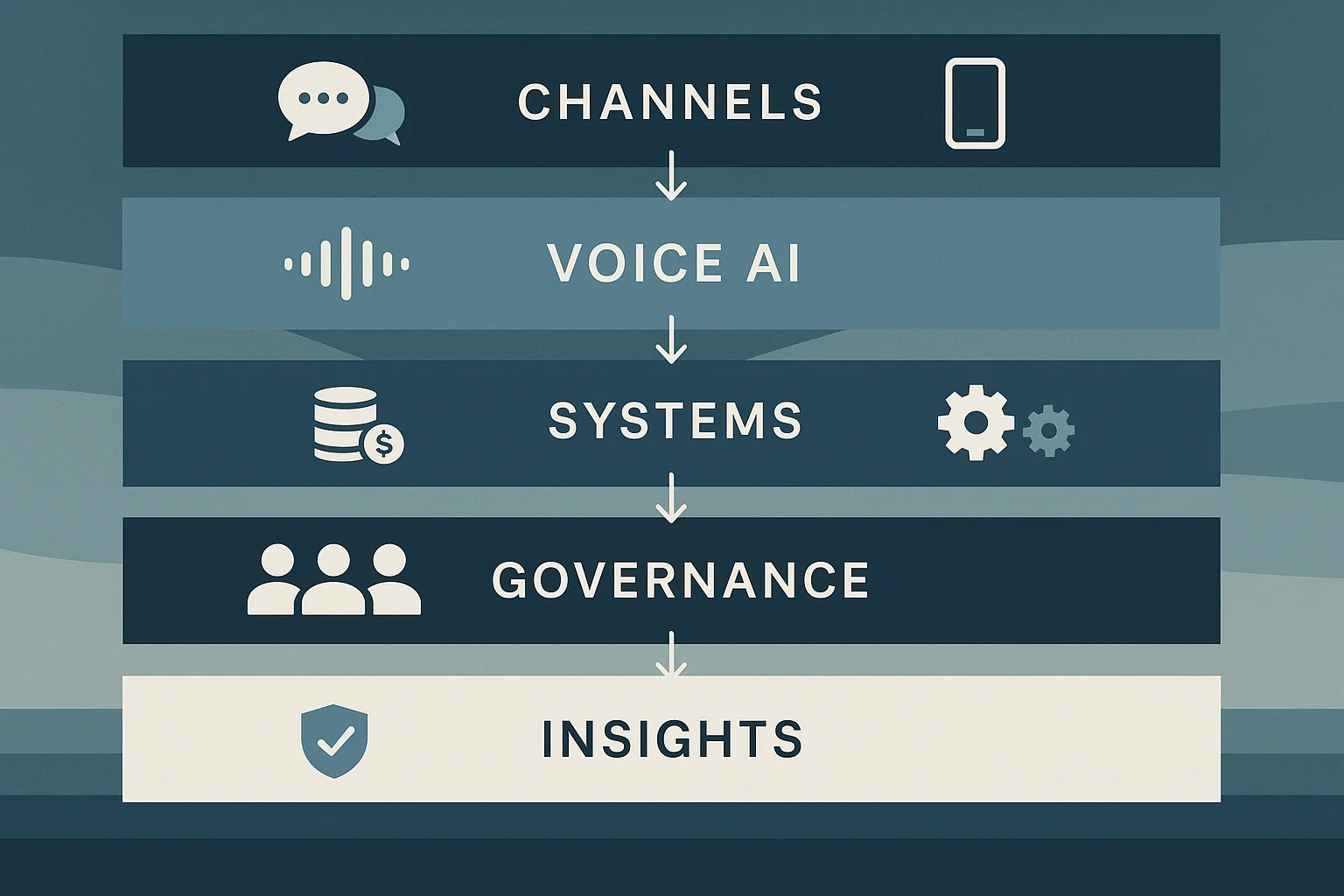
Canonical flow (Caller → Voice AI → Business rules → Systems → Response/Handoff)
Implement a clear flow: telephony gateway captures call; ASR produces transcripts; conversational model or NLU determines intent; business‑rules layer applies policy, authorization and orchestration; approved enterprise systems (CIS, CRM, payments) are called via controlled adapters; final action is rendered or routed to a human. Maintain immutable logs at each handoff.
- Keep conversational models stateless where possible; persist conversation state in the business‑rules layer.
- Business‑rules layer enforces authorization, input validation, and transaction freezes for high‑risk actions.
- Adapters to enterprise systems must be narrow, approved APIs with tokenized credentials and auditable calls.
Deployment options and custody choices
Select a deployment model based on data sensitivity and operational capabilities: (a) hosted managed service with private tenancy and explicit subprocessors; (b) cloud‑native self‑managed with enterprise VPC and BYOK; or (c) hybrid where sensitive components (biometrics, tokenization) run in an enterprise enclave. Procurement should require transparency for subprocessors, remote‑support access controls and the hosting geography for production and backups.
- For high‑sensitivity workloads, prefer architectures where recordings, PII extraction and model prompts remain in the bank's controlled tenancy.
- Require a subprocessors list and documented remote‑support procedures in the contract.
- Define backup geography and restoration time objectives (RTO/RPO) for contact‑centre assets.
3. Model risk: validation, change control and red‑teaming
Model risk management must be operationalized across the model lifecycle: pre‑deployment validation, continuous monitoring, and controlled change processes.
Inventory, validation and acceptance criteria
Maintain a model inventory that includes model identity, version, vendor, training data provenance (to the extent available), intended scope, and performance baselines. Pre‑deployment validation should include accuracy for intent classification, false positive/negative analysis for sensitive intents, and adversarial or input‑perturbation tests for robustness.
- Require vendors to provide a reproducible validation dataset or permit in‑house validation on redacted data.
- Define acceptance thresholds for each intent category and tie release gates to business‑impact metrics.
Change control, experiments and rollback plans
Treat model updates like software releases with staged deployment, canarying, and rollback mechanics. Maintain changelogs of prompt templates, instruction tuning, and model hyperparameters. For generative layers, control instruction/temperature changes centrally and log prompt history.
- Require canary rollouts to a small traffic segment with close monitoring before full promotion.
- Specify automated rollback triggers (e.g., intent drift above thresholds, escalation rate increases).
- Preserve prompt and instruction archives for audit and post‑incident analysis.
4. Data lineage, privacy and cross‑border boundaries
Banks must be able to answer the questions: which audio or transcripts exist, where are they stored, who processed them, and what downstream models saw them?
End‑to‑end lineage and auditable records
Implement immutable event logs that capture telephony metadata, transcript IDs, model version used, business‑rules decisions, adapter calls, and final disposition. Logs must be queryable by conversation ID and retained under the bank's retention policy. Ensure QA and compliance teams can reconstruct conversations including the exact model artifact and prompt state used during any interaction.
- Use unique conversation IDs tied through telephony, ASR, model, and adapter systems.
- Record model version and prompt/instruction snapshot with each decision to enable reproducible audits.
- Store lineage metadata separately from raw audio to support fine‑grained access controls.
Consent, recording, and cross‑border processing
Define explicit consent flows for recording and automated decisioning. For cross‑border processing, document where audio is recorded, model inference occurs, backups reside, and which subprocessors have access. Ensure contractual terms specify transfer mechanisms and responsibilities for breach notifications; confirm legal obligations with qualified counsel for the applicable jurisdictions.
- Differentiate storage region (primary), backup region (secondary), and remote‑support locations (subprocessors) in the SOW.
- Specify retention and deletion procedures for recordings, transcripts and derivative features (voiceprints).
- Limit remote‑model tuning on production PII unless covered by contractual safeguards and documented data minimization.

5. Operational resilience, observability and safe fallbacks
Resilience spans availability, correctness, and recoverability. Observable, well‑tested fallbacks and human handoffs are primary means to limit operational and reputational impact.
Monitoring, KPIs and audible SLAs
Design observability for both system health and behavioural drift. Track telemetry such as latency, ASR confidence, intent‑classification confidence, escalation rate, and human handoff delay. Define SLAs for availability, maximum handoff latency, and error budgets for automated transactions.
- Instrument confidence thresholds that trigger alternative flows or human routing.
- Correlate model performance signals with business KPIs (e.g., failed authentication rate, payment failure occurrence).
- Require periodic synthetic testing (shadow traffic) and chaos testing of call failover paths.
Failure boundaries and human escalation design
Explicitly define failure boundaries: which intents are automated, which require agent approval, and which must default to human handling on anomaly. Ensure human agents have full context: conversation transcript, model decision trace, and recommended actions. Measure handoff success (first‑contact resolution after escalation) as a core operational KPI.
- Use conservative defaults: when model confidence is below the acceptance threshold for sensitive intents, route to human agents.
- Provide agents with one‑click takeovers and clear transaction freeze controls.
- Log every handoff and capture agent resolution metadata for QA.

6. Procurement checklist: what to demand from vendors and managed services
Contracts must convert operational requirements into measurable obligations. A narrow SOW and precise acceptance criteria reduce vendor ambiguity and downstream risk.
Scope, ownership and integration boundaries
Define ownership of adapters, change control, and integrations. Clarify whether the vendor provides adapters to core systems or whether the bank retains integration ownership. Require documented APIs, schema contracts, and test harnesses for integration acceptance.
- Specify which system owners will maintain adapters post‑go‑live and who is responsible for API schema changes.
- Mandate test environments with representative synthetic data and deployment runbooks.
- Require a subprocessors list and advance notice period for material changes.
Service levels, audit rights and KPIs
Include SLAs for availability, escalation time, model update windows, and audit response time. Require quarterly evidence: model inventory, validation reports, prompt archives, and Security/Privacy attestations. Specify breach and incident response duties, including timelines for notification and remediation.
- Contract for observability outputs: dashboards, alerting channels, and scheduled reports.
- Include audit clauses allowing periodic independent reviews and access to lineage records.
- Define KPIs such as escalation latency, automated transaction accuracy by intent, and time‑to‑rollback for failed model releases.
Managed‑service differentiation (Peak Demand operational model)
Prefer managed offerings that combine custom infrastructure, robust logic bridges, hardened adapters, and a documented QA/observability fabric. Peak Demand’s managed voice AI approach emphasizes: narrow, auditable adapters to enterprise systems; a business‑rules layer that enforces authorization and safe defaults; structured QA and human‑in‑the‑loop workflows; and managed optimization rather than black‑box model swaps.
- Insist on change control that separates model tuning from business rules changes.
- Require human escalation protocols and QA sampling plans as part of the managed service.
- Demand clear onboarding documentation that maps integration ownership and access controls.
Related Peak Demand resources
Industry and AI sources reviewed
- OECD AI PrinciplesOrganisation for Economic Co-operation and Development
- Artificial Intelligence Risk Management Framework (AI RMF 1.0)National Institute of Standards and Technology (NIST)
- AI Risk Management Framework: Generative AI ProfileNational Institute of Standards and Technology (NIST)
Privacy, telecommunications, recording-consent, cybersecurity, consumer-protection, employment, and records obligations vary by jurisdiction and use case. This article is operational guidance, not legal advice; organizations should confirm applicable requirements with qualified professionals.
Frequently asked questions
A serious managed service should include discovery, workflow design, telephony, integrations, validation rules, testing, monitoring, human escalation, incident handling, change control, analytics, and ongoing optimization. The value is the complete operating system around the model, not access to a model alone.
Official reference: Artificial Intelligence Risk Management Framework (AI RMF 1.0)
The operating model should assign clear owners for telephony, prompts, knowledge, APIs, credentials, incident response, analytics, approvals, and release management. Enterprise buyers should avoid deployments where those responsibilities are ambiguous or split across vendors without accountability.
Official reference: Artificial Intelligence Risk Management Framework (AI RMF 1.0)
Evaluate the complete workflow under realistic volume, latency, interruption, transfer, integration, and failure conditions. Measure task completion, escalation quality, unsupported responses, system errors, recovery behavior, and how quickly operators can detect and correct problems.
Official reference: Artificial Intelligence Risk Management Framework (AI RMF 1.0)
Ask for documented use-case boundaries, data handling, access controls, model and prompt change management, evaluation procedures, audit logs, human-oversight rules, incident response, subcontractor dependencies, and a process for reviewing material system changes.
Official reference: Artificial Intelligence Risk Management Framework (AI RMF 1.0)
Need deeper enterprise Voice AI integration?
For custom APIs, SIP and telephony architecture, multi-system workflows, QA, observability, and enterprise deployment, Peak Demand commonly evaluates platforms such as Retell AI as part of a managed architecture.
Explore Retell for Enterprise Voice AIPeak Demand may earn a commission from this link.


