
Utilities Voice AI Governance for Safe Escalation and Human Oversight
A practical operational framework so utilities can deploy high‑volume Voice AI for customer service and outage communications with measurable containment, safe escalation, and accountable human oversight.
1. Scope, non‑goals, and reference workflow
Clear scope, a shared architecture, and explicit non‑goals are the most operationally useful governance starting points. This section defines the decision boundary for Voice AI in customer contact, outage communications, service‑request intake, and human escalation.
Scope and non‑goals
Voice AI should automate routine requests, provide status information, and safely escalate when intent or safety is ambiguous. Non‑goals: Voice AI must not make safety-critical infrastructure decisions, dispatch field crews without human confirmation for safety items, or substitute emergency response. Define these constraints in policy, training, and procurement.
- Automate predictable, account‑scoped workflows (status, planned outage info, simple scheduling).
- Escalate for safety, ambiguous intent, access or meter‑safety concerns, suspected fraud, or legal requests.
- Document and publish non‑goals to vendors, ops, field, and regulatory affairs teams.
Reference workflow (operating model)
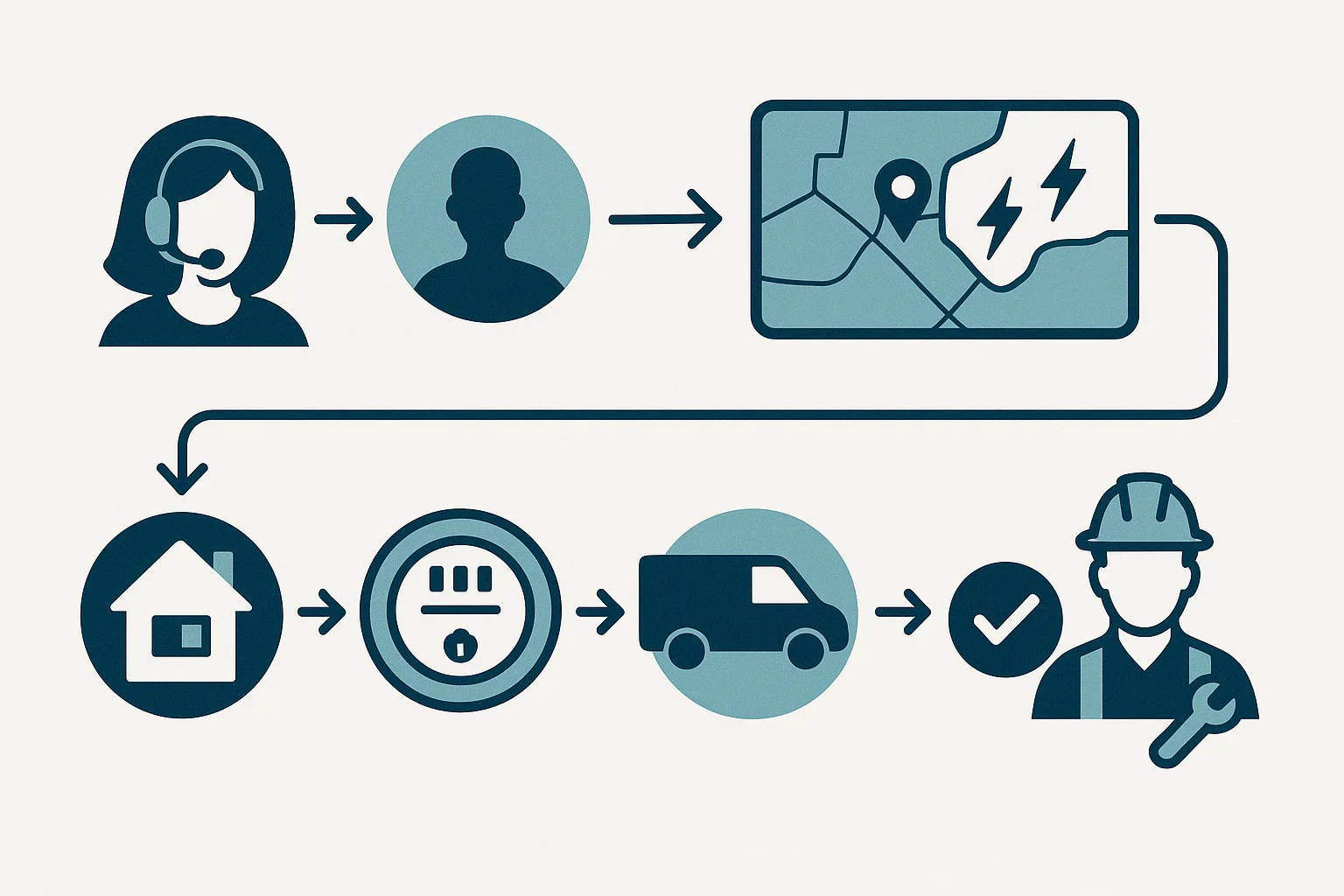
Operationalize a simple, observable workflow: Customer call → Voice AI → account/premise validation → approved utility API or knowledge source → action: status response, create service request, or escalate to a human agent. Each hop must be logged as an event with the decision rationale.
- Call intake and initial intent detection with labeled confidence score.
- Account or location validation via a single approved API or adapter; avoid ad‑hoc data lookups.
- Action gating: only allow system actions that are permitted for the validated identity and intent.
- Escalation handoff includes context package (transcript, intent, validation tokens, integration call results).
2. Containment quality and escalation controls
Containment and escalation are the primary safety controls. Define measurable thresholds, human oversight triggers, and the quality checks that keep automation reliable at scale.
Define containment vs. escalation
Containment is when the Voice AI completes a caller’s intent without human handoff. Escalation occurs when the system cannot meet policy, confidence, or safety thresholds. Treat containment as a safety control, not just a cost metric.
- Map every intent to a disposition: contain, confirm+contain, or escalate.
- Use conservative confidence thresholds for safety‑adjacent intents (e.g., gas smell reports, transformer arcing).
- Require explicit human confirmation before creating safety‑critical work orders.
Escalation handoff and human oversight
Design handoffs as immediate, information‑rich transfers. Agents must receive a prioritized work queue with the AI rationale and raw event package to minimize context switching and re‑ask rates.
- Include: intent, confidence, transcript/audio snippet, validation tokens, recent API responses, and timestamped decision trail.
- Handoff SLAs for live agents, callback scheduling, or field‑service escalation must be explicit in the SOW.
- Monitor escalation quality: percent of escalations resolved without re‑escalation, time to resolution, and agent satisfaction.
3. Account and premise validation — integration safeguards
Account and location validation is both a user experience and a security control. Architect integrations so that validation is auditable, minimal, and resilient to failures.
Account‑safe validation patterns
Prefer tokenized lookups and short‑lived validation tokens from the CIS/CRM rather than reading full PII in the call. Use strict access control on adapters that translate Voice AI events into API calls.
- Step 1: Locator (phone number/verified caller ID) → lookup via approved adapter.
- Step 2: Respond with a minimal validation token (e.g., 'accountValidated: true, token: xyz') and permissible attributes.
- Step 3: Gate actions by mapping tokens to allowed operations; never pass full account numbers in transcriptable fields.
Integration failure modes and safe fallback
Plan for partial failures: API timeouts, degraded knowledge sources, or model drift. Fail closed on actions that require validation and fail open only for non‑actionable information with clear user disclaimers.
- Fail‑closed: creating service requests that change field schedules or require access permissions.
- Fail‑open: responding with non‑actionable status updates when caches provide recent, read‑only info.
- Implement circuit breakers, retry policy, and a visible degraded mode for front‑line staff.
4. QA, analytics, and continuous optimization
QA and analytics are the operational levers that convert automation into reliable service. A measurable QA program reduces false containment and improves escalation quality over time.
Sampling, labeling, and audit trails
Operate a dual QA stream: event‑level analytics for business KPIs and targeted sampling for safety review. Ensure every event includes an immutable audit trail for post‑incident review.
- Automate random and risk‑based sampling (e.g., all safety‑adjacent intents, low‑confidence contains).
- Label at the interaction, intent, and outcome levels to train a continuous improvement loop.
- Store decision metadata (confidence, API return codes, token exchanges) alongside audio/transcript with access controls.
Operational analytics and cost‑to‑serve
Move beyond containment rate to measure containment quality (accuracy), escalation quality (first‑hand‑off resolution), and true cost‑to‑serve. Instrument event‑level metrics for accurate attribution of savings and risks.
- Key metrics: containment rate, containment accuracy, escalation resolution rate, average handle time (post‑escalation), and event‑level cost modeling.
- Use event‑level data to reconcile Voice AI outcomes with OMS/CIS/CRM work orders and billing systems.
- Maintain observable dashboards and weekly exception reports for ops and regulatory teams.

5. Scale: multilingual, multi‑site, and surge operations
Scaling Voice AI across regions and languages exposes governance gaps. Standardize controls and instrument cross‑site variance so local teams retain operational control.
Regional hosting, data residency, and access boundaries
Establish hosting region, backup region, remote‑support access, subprocessors, and data transfer mechanisms in procurement. Document retention rules for recordings and transcripts, and state that organizations must confirm applicable obligations with qualified professionals.
- Define primary region and backup region for hosting and backups.
- Document subprocessors and cross‑border transfer mechanisms in contracts.
- Specify data retention, recording consent mechanisms, and breach notification duties in the SOW and privacy addendums.
Surge capacity and multilingual parity
Surge plans must include capacity, agent augmentation, and consistent QA across languages. Avoid deploying different decision thresholds by region without documented governance.
- Plan surge routing: predictable overflow to human agents with preserved context packages.
- Maintain parity in intent models and confidence thresholds across supported languages or document justified exceptions.
- Monitor language‑specific containment accuracy and re‑train models where systemic variance appears.

6. Procurement, SLOs, and incident readiness
Buyers must insist on measurable evidence, clear handoff responsibilities, and documented incident response and recovery plans that reflect utility operations.
SOW, evidence, and vendor evaluation
Procure with measurable deliverables: event logs, continuity proof points, QA sampling methodology, and integration contracts. Require vendor evidence for high‑volume Voice AI operations and the ability to deliver event‑level analytics.
- Minimum contract artifacts: data contracts, event schema, audit trail access, and predefined handoff packages.
- Insist on vendor test plans that demonstrate both normal and degraded modes.
- Request sample dashboards and the mechanism for raw event export for independent verification.
Incident response and business continuity
Ensure documented runbooks for AI model failures, integration outages, and security incidents. Recovery must be measured in callable fallbacks and the ability to route to human agents with context intact.
- Include runbooks for model drift detection, rapid rollback, and retraining governance.
- Define recovery objectives for Voice AI and for the downstream impact on field scheduling and OMS.
- Coordinate incident exercises with IT, ops, field, and customer‑service teams.
7. Implementation checklist and measurable outcomes
A concise implementation checklist and a set of measurable outcomes make governance operational. Use this to guide pilots and staged rollouts.
Recommended rollout steps
Adopt a phased deployment: pilot on narrow intents, expand by intent family, then scale geographically with strict QA gating.
- Phase 0: Policy and non‑goal signoff (ops, legal, field‑service, regulatory affairs).
- Phase 1: Pilot limited intents with gated escalation and full audit logging.
- Phase 2: Expand intents and languages after meeting containment quality and escalation KPIs.
- Phase 3: Multi‑site roll‑out with standardized SLOs, surge plans, and continuous QA.
Measurable outcomes to track
Reportable outcomes tie governance to utility performance: containment accuracy, escalation resolution rate, system availability, and event‑level cost attribution.
- Containment quality = contained interactions that correctly completed the intent (audit sample numerator/denominator).
- Escalation quality = percent of escalations resolved without escalation loopbacks and average time to resolution.
- Operational availability = percent time integrations provide validated responses within SLA thresholds.
- Cost‑to‑serve visibility = event‑level cost allocation that reconciles AI handling vs. human agent time.
Related Peak Demand resources
Industry and AI sources reviewed
- AI Risk Management Framework — Critical Infrastructure ProfileNational Institute of Standards and Technology (NIST)
- Cross-Sector Cybersecurity Performance GoalsCybersecurity and Infrastructure Security Agency (CISA)
- Cybersecurity Capability Maturity Model (C2M2)U.S. Department of Energy
Utility cybersecurity, critical-infrastructure, records, customer-protection, and emergency-communications obligations vary by jurisdiction and service type. This article is operational guidance, not legal advice; organizations should confirm applicable requirements with qualified professionals.
Frequently asked questions
Good starting points include billing and account questions, move-in or move-out intake, appointment scheduling, service-request capture, outage-status messaging from approved systems, payment-routing assistance, and structured escalation. Safety-critical and infrastructure-control decisions should remain with qualified utility teams.
Official reference: Cross-Sector Cybersecurity Performance Goals
Use the minimum approved identifiers needed for the workflow, validate them against the utility's system of record, limit data exposure, and provide a human-assisted path when verification fails. The Voice AI should not guess account, premise, or outage information.
Official reference: Cross-Sector Cybersecurity Performance Goals
Use controlled adapters, strict schemas, timeouts, retries, audit logs, safe failure states, and human escalation. The system should distinguish approved utility data from model-generated language and should never present stale or unverified operational information as fact.
Official reference: Cybersecurity Capability Maturity Model (C2M2)
Track containment by request type, successful validations, transfers, abandoned calls, integration errors, incorrect or stale responses, time to resolution, customer follow-up, and the percentage of cases completed safely without manual rework.
Official reference: Cybersecurity Capability Maturity Model (C2M2)
Build resilient utility customer-service automation
Peak Demand helps utilities connect Voice AI to approved customer-information, outage-communication, service-request, dispatch, escalation, and analytics workflows.
Schedule a discovery call


