
Trust & Governance Framework for Automated Voice AI in Canadian Services
A practical guide for Canadian small and regional businesses to deploy an AI receptionist that answers calls, books jobs, captures leads, and hands off to humans—without a heavy custom project.
Short answer — what this does for your business
If your team gets too many routine calls, an AI receptionist can answer, gather details, book simple appointments, capture leads, and transfer tricky calls to a person. It’s not a full replacement for staff. It’s a tool to reduce repetitive work and stop missed calls.
What an AI receptionist actually does
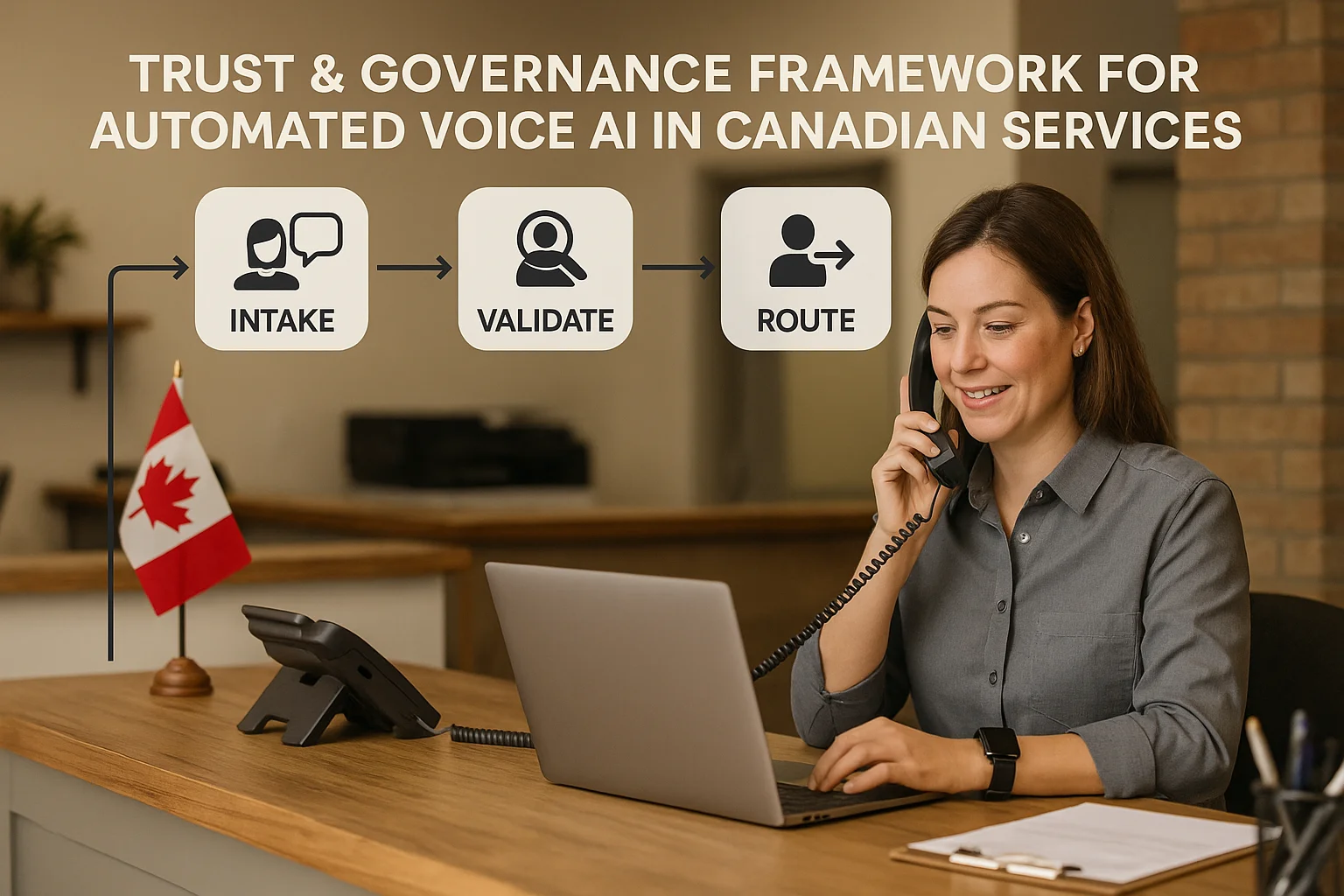
It answers the phone and follows a short script. It can confirm address and preferred time, check a connected calendar, create or update a lead in your CRM, and either book a slot or queue the caller for a human. Calls can be recorded or transcribed for review. Think: caller → AI receptionist → answer/capture/book/route → confirm or hand off.
- Answer common questions (hours, pricing, basic service scope).
- Capture caller name, phone, address, and service needed.
- Offer and book available appointment slots when calendars are connected.
- Create or update leads in a CRM or job-management tool.
Where it fits in everyday workflows
Use an AI receptionist for predictable, repeatable call types. Keep humans for judgement, safety, finance, and sensitive issues.
Common, high-value workflows
Home-service and appointment businesses commonly use voice AI to reduce missed calls, handle after-hours booking, and qualify leads. Example flows: confirm an available time and create a Jobber job; capture a lead and send an SMS confirmation; or record a service request and route to the dispatcher.
- After-hours calls: AI takes details and offers next-day slots.
- Daytime overflow: AI answers simple asks so staff focus on on-site jobs.
- Lead capture: AI collects contact details and stores them in your CRM or job system.
When a human must take over
Escalate immediately if the call involves safety risks, legal or medical questions, disputed billing, complex complaints, or detailed diagnostics. Also set clear rules for callers who ask to speak to a manager.
- Emergencies and safety: human required.
- Complex troubleshooting or warranty disputes: human review.
- Legal, medical, or sensitive personal data: human review and consent.
Integrations and an integration-light option
You don’t need a custom engineering project to get useful automation. Many small businesses use integration-light platforms to connect phone, calendar, CRM, and job tools.
What to expect connecting your tools
A practical deployment will connect at least two systems: your phone number and a calendar or job system. Deeper setups add a CRM or Jobber. Integration depth varies: some tools write a calendar event and create a basic lead record; others can create a full job in a field-management app. Confirm what the vendor will update directly and what still needs manual review.
- Phone system → AI: answers incoming calls.
- AI → Calendar: checks and books available times.
- AI → CRM/Job system: creates leads or jobs with collected fields.
- Human handoff: warm transfer or notification via SMS/email.
Ask Benny: a practical Canadian option
If you want an integration-light deployment that works for service businesses, consider Ask Benny. It’s built for Canadian small businesses, supports calendar and CRM links, and has a specific Jobber integration for job creation and updates. For many owner‑operators, Ask Benny offers quick setup without a heavy custom project. Peak Demand may earn a commission from this link: https://askbenny.ca/?via=alex
- Good fit: appointment-driven teams, home services, and small offices.
- Can handle after-hours booking, basic lead capture, and routing.
- Jobber integration can create or update jobs directly when configured.
Privacy, records, and Canadian law basics
Voice calls and recordings are personal information. Treat them like any customer data: know where they live, who can access them, and how long you keep them.
Practical PIPEDA considerations
PIPEDA requires you to collect, use, and disclose personal information only for reasonable purposes, and to protect it. Tell callers if you record calls. Document retention policies and who has access. If your operations cross borders, note where your provider stores or processes recordings and transcriptions and confirm cross‑border handling with the vendor.
- Notify callers about recording and get consent where required.
- List processors and where data is hosted in your vendor agreement.
- Keep an audit log of access to call recordings and transcriptions.

Related Peak Demand resources
Industry and AI sources reviewed
- Ask Benny — Canadian AI Virtual ReceptionistAsk Benny
- Ask Benny FeaturesAsk Benny
- Ask Benny IntegrationsAsk Benny
- Ask Benny Jobber IntegrationAsk Benny
- PIPEDA in briefOffice of the Privacy Commissioner of Canada
Canadian privacy, call-recording, consumer-protection, employment, and sector-specific obligations vary by province, business type, and workflow. Ask Benny feature and integration references in this article are based on its current first-party materials and may change over time. This article is operational guidance, not legal advice; organizations should confirm applicable requirements with qualified professionals.
Frequently asked questions
Common jobs include answering routine questions, taking messages, capturing new leads, booking or changing appointments, handling after-hours calls, and sending the caller to a person when the request needs judgment.
Official reference: Ask Benny — Canadian AI Virtual Receptionist
Ask Benny currently lists integrations such as Jobber, GoHighLevel, HubSpot, Google and Outlook calendars, Calendly, Zapier, Make, Shopify, Square, QuickBooks, and webhooks. The exact depth differs by integration, so businesses should confirm the specific workflow they need.
Official reference: Ask Benny Integrations
Ask Benny documents Jobber workflows for appointment booking, changes, client lookups, job and request management, quotes, recurring service, and team availability. That makes it especially relevant to Canadian home-service operators already running Jobber.
Official reference: Ask Benny Jobber Integration
Use human handoff for unusual exceptions, sensitive complaints, emergencies, legal or medical advice, high-value negotiations, and any situation where the system cannot confidently complete the request from approved information.
Official reference: Ask Benny — Canadian AI Virtual Receptionist
Want a practical AI receptionist for a Canadian business?
Ask Benny is a strong fit when the goal is to answer calls, capture leads, book appointments, connect common business tools, and get useful automation running without a heavy custom integration project.
Explore Ask BennyPeak Demand may earn a commission from this link.


