Strategic Workforce & Vendor Ecosystem for Municipal Voice AI at Scale
A practical operating framework for municipal leaders to design workforce roles, procurement guardrails, vendor tiers, and integration patterns that enable safe, auditable, and scalable Voice AI for resident services.
1. Why a vendor-and-workforce ecosystem is essential
Voice AI projects repeatedly stall when procurement, workforce expectations, and technical integrations are treated as independent problems. Municipal leaders need an ecosystem view that aligns procurement categories, operational roles, and technical responsibilities across departments.
Scale and cross‑channel orchestration
Voice AI is not a standalone product: it must interoperate with web forms, SMS, webchat, and the municipal case management system to keep records coherent and residents informed. The operating model should be channel‑agnostic at the orchestration layer and preserve canonical case identifiers across channels.
- Use a single case identifier returned to residents as a confirmation number across channels.
- Synchronize form fields and validation rules centrally to avoid diverging resident experiences and duplicate records.
- Design orchestration so Voice AI handoffs and web/self‑service are identical from a records and audit perspective.
Public accountability and risk concentration
Municipal services are public records. A Voice AI failure can create missing records, duplicate enforcement actions, or privacy exposures. Treat governance and vendor oversight as operational requirements—publishable and audit-ready—rather than optional controls.
- Require auditable logs of resident interactions, redaction controls for PII, and a documented retention schedule.
- Define failure modes: record not submitted, partial submission, incorrect routing, and recording errors—with concrete mitigations and SLAs.
- Assign ownership for audit and FOIA/FOI responses within the municipal governance model.
2. Operational architecture — the authoritative flow
A clear, repeatable architecture reduces ambiguity between vendors and municipal teams. Use a canonical flow for every resident request and make the handoff and records submission deterministic.
Canonical operating flow
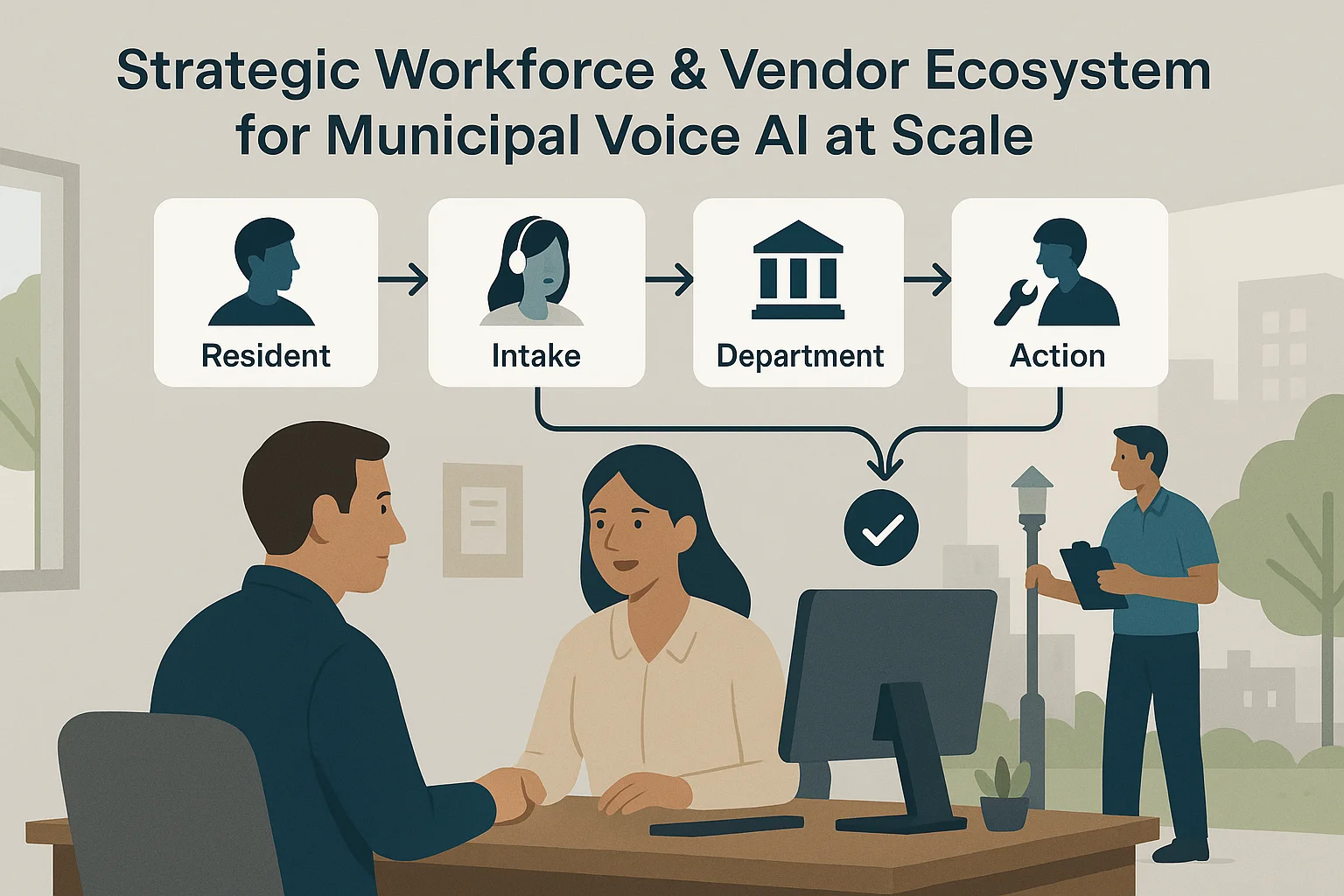
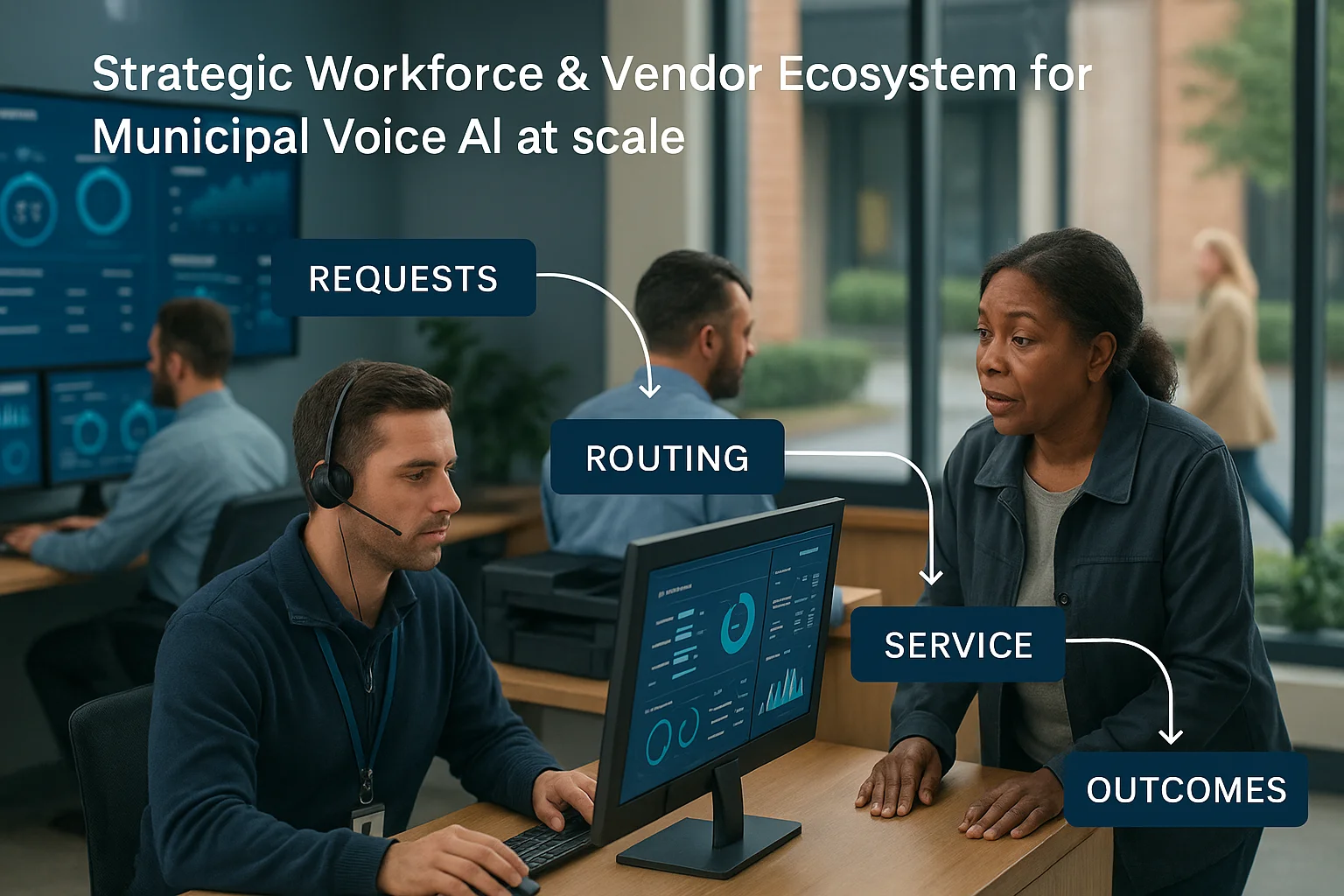
Define and document the core flow: Resident → Voice AI (NLP/ASR) → Logic bridge (dialog manager, business rules) → Form & field retrieval → Validation (syntactic and authoritative lookup) → Municipal case system (create/update) → Confirmation or human handoff. This is the audit chain and the primary contract boundary with vendors.
- Logic bridge enforces business rules, rate limits, and routing decisions and acts as the integration gateway.
- Form & field retrieval uses centrally managed definitions so any channel presents the same data requirements.
- Validation includes syntactic checks (phone, address), authoritative lookups (parcel, utility account), and duplicate detection.
Integration patterns and controlled adapters
Prefer approved APIs and controlled adapters for municipal systems. The vendor ecosystem typically contains: platform vendors (speech/NLU), systems integrators (dialog, orchestration), and connector specialists that maintain adapters to CRM/CMS/CAD/records systems. Explicitly state supported integration authentication methods, error handling, and retry semantics.
- Use adapter patterns that surface standardized error codes to the logic bridge for deterministic retry or human-queue routing.
- Record the hosting region, subprocessors, and remote-support access in procurement documents to evaluate data residency and breach duties.
- Require vendors to deliver integration tests and a runbook for failover to human agents.
3. Workforce design and roles
A balanced workforce model keeps high‑risk decisions with trained staff while letting automation handle deterministic tasks. Organize teams around capability rather than channels.
Resident‑facing roles and escalation
Define roles for automated handling, human triage, and specialist escalation. Voice AI should resolve routine, rule‑based requests and pass complex cases to human operators with full context and the original transcript.
- Tier 1 — Voice AI + automated resolution for deterministic requests (status lookups, basic service requests).
- Tier 2 — Human agents with decision support (access to case context, validation hints).
- Tier 3 — Subject Matter Experts for legal, enforcement, eligibility, or sensitive discretionary decisions.
Control tower, content owners and integration ownership
Create a control tower function responsible for monitoring system health, quality metrics, and vendor SLAs. Assign content owners (for scripts, prompts and dynamic forms) and a separate integration owner who validates end‑to‑end data flows into the municipal case system.
- Control tower duties: QA sampling, anomaly detection, escalation of vendor incidents, and monthly governance reporting.
- Content owners ensure language matches public policy and accessibility requirements; they own change control for form fields.
- Integration owner manages API keys, schema changes, and acceptance testing on each vendor release.
4. Vendor tiers, procurement evidence, and contract controls
Procurement should reflect capability tiers and include technical attachment schedules that clarify what each vendor must deliver. Include performance evidence and operational runbooks in contracts.
Vendor tiers and responsibilities
Segment vendors into platform providers, systems integrators, connector specialists, and managed‑services operators. Each tier has discrete responsibilities and deliverables in the SOW to avoid gaps during incidents.
- Platform vendors — ASR/NLU, hosted speech; responsible for availability and core model updates.
- Systems integrators — dialog design, logic bridge, orchestration, and acceptance testing.
- Connector specialists — certified adapters for municipal case systems, authoritative lookups, and duplicate suppression.
- Managed operations — 24/7 incident handling, QA sampling, and SLA reporting; provide runbooks and staff augmentation where required.
Procurement evidence and contract clauses
Require tangible evidence before award: integration acceptance tests, privacy impact or algorithmic impact assessments (when applicable), sample audit logs, accessibility conformance statements, and a vendor incident response plan. Contracts should include clearly defined SLAs for record submission success, latency, and mean time to human handoff.
- Insist on test harnesses and end‑to‑end acceptance criteria, including duplicate detection and confirmation number issuance.
- Require vendors to provide redaction and export capabilities for transcripts and logs for records requests.
- Define breach notification timelines, subprocessors, hosting regions, and support access conditions in the contract.

5. Controls, QA and failure boundaries
Operational reliability depends on deterministic controls and defined failure boundaries. Make these concrete and measurable prior to launch.
Validation, duplicate controls and auditability
Enforce multi‑stage validation: client‑side (ASR confidence thresholds), logic‑bridge syntactic checks, and authoritative lookups before case creation. Implement duplicate detection at the logic bridge to avoid multiple records for the same issue and always return a confirmation number to the resident.
- ASR confidence thresholds route to confirmation prompts or human triage when low.
- Use authoritative lookups (account, parcel, service point) to prefill and validate fields.
- Log every submission with a unique confirmation id, timestamp, agent (human or automated), and the validation trail for audit purposes.
Failure modes and safe‑stop boundaries
Define and test failure paths: fail to record, partial record, incorrect routing, and degraded model performance. For safety‑critical or discretionary decisions (legal, enforcement, homelessness/health), default to human handling. Document the criteria that cause an automated interaction to escalate.
- Default to human handoff for any request that affects legal status, eligibility, enforcement, or personal safety.
- Establish a 'safe stop' when validation fails three times or when sensitive keywords are detected.
- Maintain a runbook describing exact steps for operators to recover lost records and notify affected residents.
6. Data governance, privacy, and cybersecurity
Data governance must be operational: treat residency, retention, subprocessors, access controls, and breaches as decision points in procurement and daily operations.
Privacy and records management
Document retention schedules and redaction rules aligned to records laws and FOIA/FOI requirements. Ensure the vendor can export logs and transcripts in a format acceptable for public records requests and has documented redaction and access controls.
- Specify retention and export formats in the contract and test export during acceptance.
- Separate access roles for transcript review, export, and redaction to maintain separation of duties.
- Define which artifacts are records (case object, confirmation id, minimal transcript) and which are operational logs.
Cybersecurity and operational resilience
Align cybersecurity priorities with municipal CISO objectives and published performance goals. Require vendors to demonstrate secure deployment models, documented subprocessors, and a plan for cross‑region backups and remote support that matches municipal risk tolerances.
- Require vendor attestations for secure development lifecycle and patching policies.
- Clarify hosting region, backup geography, and whether remote support accesses production data.
- Include regular penetration testing, logging to a centralized SIEM (or secure vendor logs), and incident response playbooks.
7. Implementation checklist and measurable outcomes
A phased rollout with measurable success criteria reduces risk while producing operational value. Track outcomes, not promises.
Phased rollout and acceptance gates
Start with a limited pilot: a small set of deterministic services, one or two languages, and a fast‑path to human agents. Use acceptance gates (integration tests, records export, duplicate suppression validation) before broadening scope.
- Pilot gate 1 — Technical integration and end‑to‑end case creation verified.
- Pilot gate 2 — QA sampling and audit log export validated; accessibility checks completed.
- Pilot gate 3 — Operational KPIs (submission success rate, mean time to human handoff) achieved for three consecutive weeks.
KPIs, SLAs and governance cadence
Define measurable KPIs and vendor SLAs tied to public outcomes: record submission success, duplicate rate, average time to confirmation, escalation rate, and accessibility conformance. Maintain a monthly governance cadence that reviews these metrics, incidents, and change requests.
- Suggested KPIs: record submission success (target %), duplicate creation rate, confirmation latency, and percent of calls escalated to humans.
- Operational SLAs: end‑to‑end submission latency, time to human handoff, and incident remediation timelines.
- Governance cadence: weekly control‑tower standups during rollout; monthly steering committee reviews post‑rollout.
Related Peak Demand resources
Industry and AI sources reviewed
- Artificial Intelligence Risk Management Framework (AI RMF 1.0)National Institute of Standards and Technology (NIST)
- ISO/IEC 27701 Privacy Information ManagementInternational Organization for Standardization
- ISO/IEC 27001 Information Security Management SystemsInternational Organization for Standardization
- Cross-Sector Cybersecurity Performance GoalsCybersecurity and Infrastructure Security Agency (CISA)
- Algorithmic Impact AssessmentGovernment of Canada
Public-sector procurement, privacy, accessibility, records, cybersecurity, and administrative-law obligations vary by jurisdiction. This article is operational guidance, not legal advice; organizations should confirm applicable requirements with qualified professionals.
Frequently asked questions
Suitable workflows include structured resident inquiries, service-request intake, permit or program information, appointment scheduling, department routing, status updates from approved systems, and after-hours overflow. Adjudication, enforcement discretion, emergency response, and binding eligibility decisions should remain with authorized staff.
Official reference: Artificial Intelligence Risk Management Framework (AI RMF 1.0)
Use a controlled service catalogue, required fields, department ownership rules, validation, duplicate checks, confirmation numbers, and documented handoff paths. The system should create an auditable record and avoid silently dropping requests when a downstream system is unavailable.
Official reference: Algorithmic Impact Assessment
Municipal deployments should document purpose, affected services, data use, human oversight, complaint and appeal paths, accessibility channels, records handling, monitoring, and the process for approving material changes.
Official reference: Algorithmic Impact Assessment
Require workflow demonstrations, integration and security architecture, testing evidence, auditability, data-location and subcontractor details, incident response, accessibility support, human escalation, exit planning, and clear ownership of ongoing updates.
Official reference: Artificial Intelligence Risk Management Framework (AI RMF 1.0)
Modernize public-service intake without losing control
Peak Demand helps municipal teams connect Voice AI to service requests, department routing, validation, escalation, records, and operational analytics.
Schedule a discovery call


