
SLOs, Escalation Playbooks and Accessibility KPIs for Multisite Transit Voice AI
A practical operational framework for defining SLOs, escalation playbooks, QA, cost-to-serve and multilingual accessibility KPIs when scaling voice AI across multiple transit sites.
1. Why SLOs and Playbooks are the operational spine
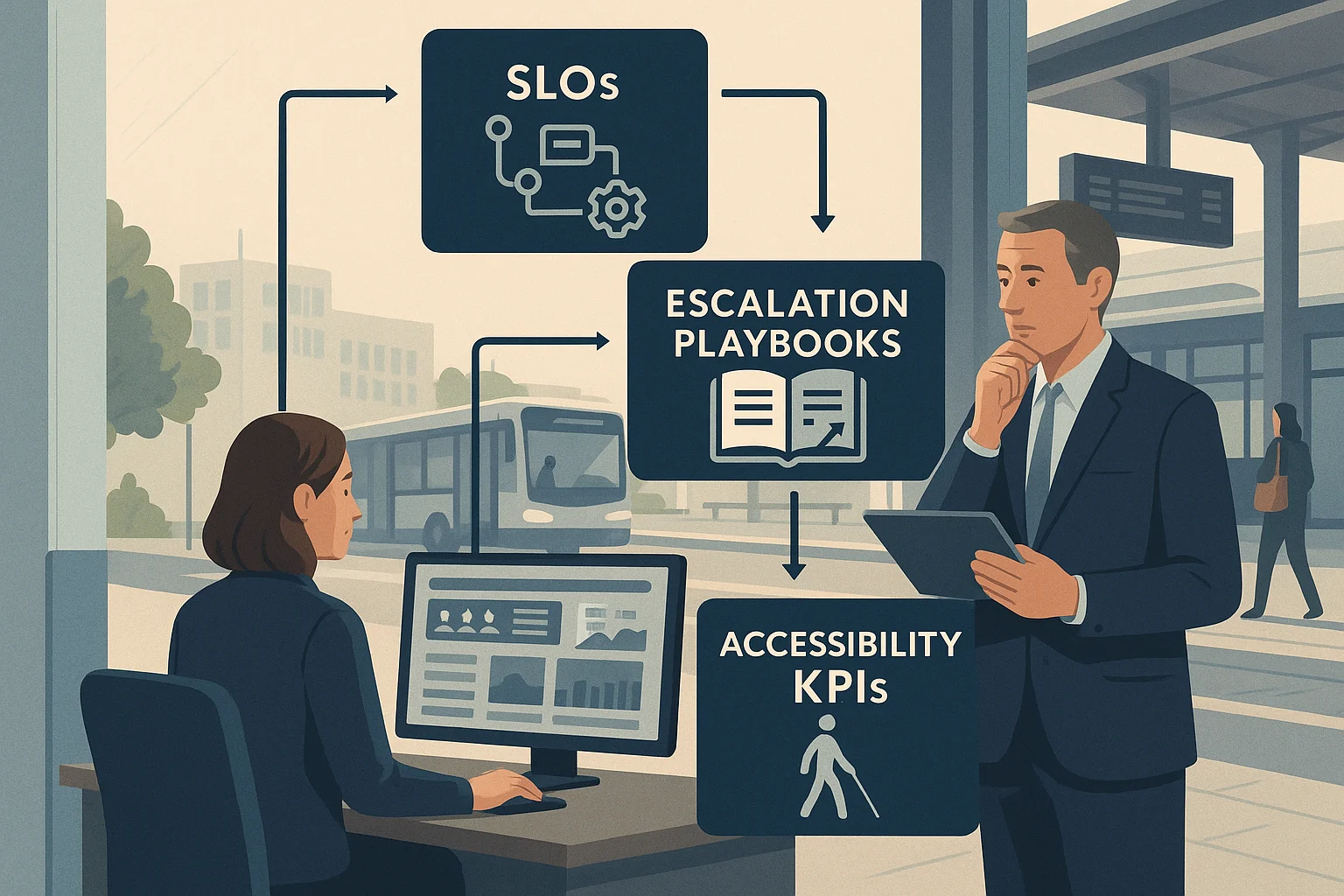
SLOs and escalation playbooks translate Voice AI behavior into predictable operational outcomes for transit. Define what success looks like in operational terms—containment, timely escalation, accessibility coverage—and map measurable thresholds to staffing and budget.
Operational SLOs to adopt
Pick a small set of primary SLOs that connect product, operations and finance. For multisite transit Voice AI the essential SLOs are: - Containment quality: percent of contacts resolved without human handoff while meeting accuracy and accessibility checks. - Escalation quality: percent of escalations that include validated context, required attachments, and routing to the correct team. - Escalation latency (MTTE/MTTR windows): maximum allowable time between escalation and first human response and between escalation and final resolution. - Accessibility KPIs: percent coverage for supported languages, successful completion rate for defined accessibility workflows (TTY/relay, plain-language pathways, human escalation on request). Map each SLO to an owner, measurement method (telemetry + sampled transcript review), and a consequence: staffing.
- Define containment quality with a minimum confidence threshold and human-sampling rule.
- Require structured escalation payloads (validated fields) to count as ‘quality’ escalations.
- Tie accessibility KPIs to both coverage (languages and features) and success (task completion with accessibility accommodations).
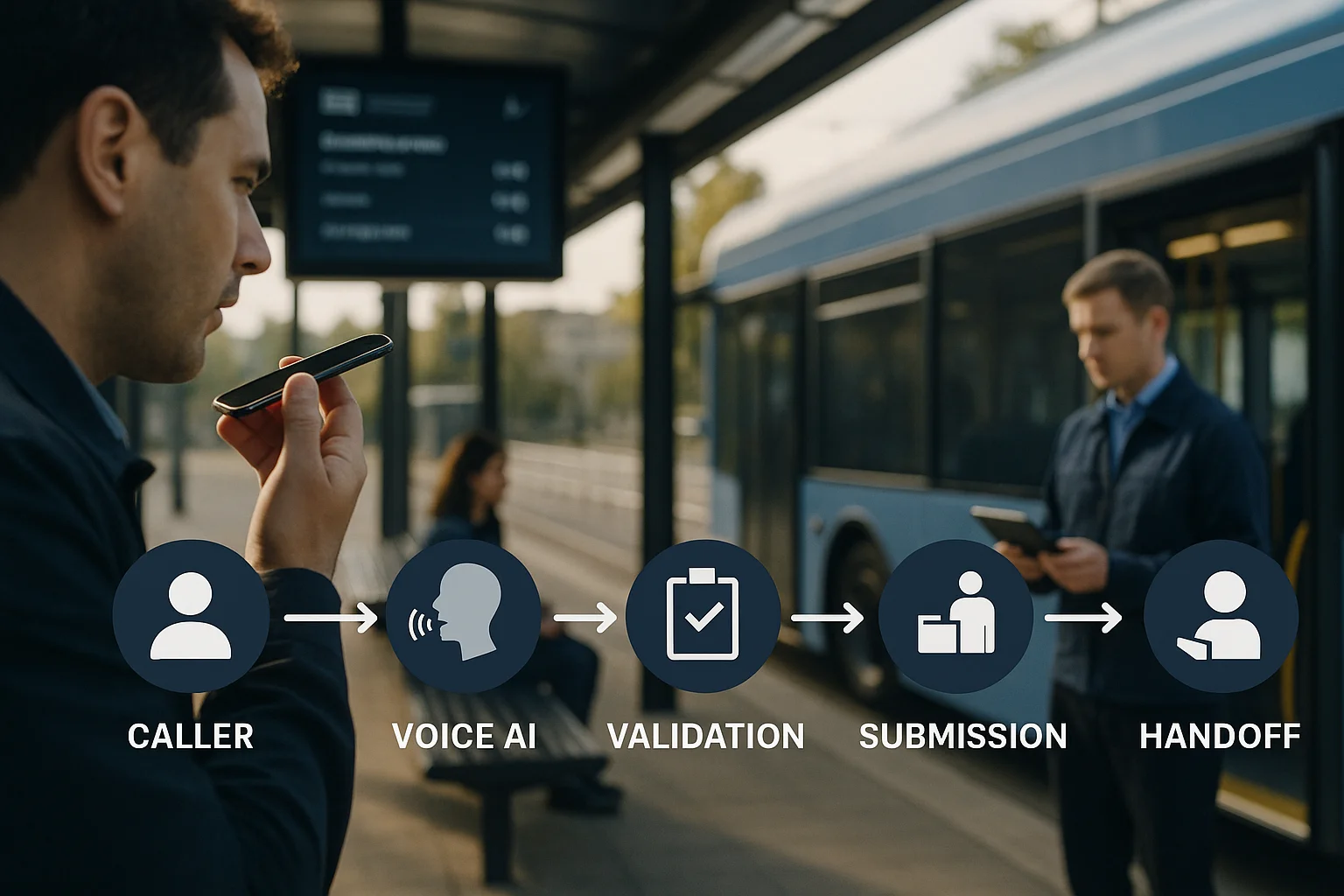
Rider → Voice AI → Controlled knowledge/APIs → Validation → Outcome
Use a single, repeatable operating architecture for every contact: Rider → Voice AI → controlled schedule knowledge base (for planned timetables) or approved service-alert APIs (for detours, delays and real-time disruptions) → automated validation (format, duplication, identity where required) → response, case submission, or human handoff. This explicit separation prevents unsafe mixing of scheduled facts and transient alert data, and gives clear failure boundaries.
- Scheduled information (timetables, fare rules) lives in a controlled knowledge store updated via governed content pipeline.
- Service-alerts (detours, cancellations) are surfaced only from approved APIs or orchestration adapters and treated as ephemeral.
- Validation layer prevents malformed or duplicate submissions and records audit metadata for every escalation.
2. Defining containment, escalation quality and cost-to-serve
Containment reduces human load but must be measured against accuracy, accessibility, and downstream costs. Escalations should add context and reduce rework. Cost-to-serve ties operational SLOs to procurement and budget.
Containment quality: measurement and failure boundaries
Containment is not simply ‘no human involved.’ Make it a composite KPI: successful intent recognition, correct information delivered, accessibility accommodations applied, and no re-opened cases within a defined window (e.g., 48–72 hours). Track containment leakage—cases that appear contained but re-enter the queue—and use stratified sampling to detect silent failures.
- Count as contained only when the response matches validated KB or approved API and passes an automated confidence threshold plus sampled human review.
- Flag and track re-opens and follow-ups as containment failures for root-cause analysis.
- Report containment alongside cost-to-serve (average handling minutes and downstream human minutes avoided).
Escalation quality and handoff SLAs
An escalation is useful only if it reduces the recipient’s time-to-resolution. Require structured payloads: canonical identifiers (account, vehicle or case ID), validated free-text fields, attachments (photos, recordings) when relevant, and a suggested routing. Measure escalation quality by first-response time, completeness score (automated check of required fields), and final disposition accuracy.
- Define first-response SLOs (e.g., <30 minutes for critical safety-adjacent events; operational windows tailored by agency).
- Automate routing validation to avoid human triage overhead; log decision path.
- Track escalation bounce rate—percent of escalations returned for additional context.
3. QA, analytics and observability for continuous optimization
QA and analytics are the engine that converts telemetry into operational improvements. Build sampling rules, automated scoring and dashboards that answer the questions operators need every day.
Automated QA and human review workflows
Combine automated scoring (intent confidence, slot accuracy, required-field completeness) with stratified human review. Sample by risk strata: low confidence, high-impact intents, new language variants, and post-release dialog changes. Create a feedback loop that maps defects to conversational updates, training data, or knowledge base fixes.
- Automated scorecards should drive triage: failing conversations route to human QA with annotated failure reasons.
- Use blind double-review for high-risk or accessibility-sensitive interactions.
- Maintain an 'issue to remediation' register with owner, priority and SLAs.
Real-time monitoring, alerts and risk management
Real-time signals (sharp increases in re-opens, sudden drops in containment, or repeated escalation rejections) require automated alerting and rollback options. Adopt risk-management principles for AI operations—identify failure modes, set monitoring thresholds, and define rollback playbooks so an operator can switch to human queue or degraded prompts immediately.
- Create automated monitors for containment, escalation completeness, language failure rates, and accessibility errors.
- Include 'circuit breaker' thresholds tied to SLOs that trigger human takeover.
- Correlate Voice AI telemetry with network and API health to detect upstream causes.
4. Multisite and multilingual operations
Scaling across cities, regions or countries raises predictable challenges: local policy differences, language nuance, and uneven data quality. Solve these with templates, localization governance and centralized observability.
Site templates and deployment governance
Treat each site as a configured instance of a canonical template: policy profile, supported languages, escalation routing, SLA tiers, and local contacts. Manage differences via configuration rather than code. This accelerates rollouts and keeps governance consistent across jurisdictions.
- Maintain a versioned site template registry and change-control process.
- Automate deployment checks: required fields, local escalation mappings, and data-residency flags.
- Use centralized analytics to compare performance across templates and iterate.
Language packs, translation QA and accessibility
For each supported language, create a language pack containing canonical utterances, disambiguation prompts, and localized accessibility flows. Use native reviewers for QA and track language-specific SLOs. For illustration and operational guidance, see our considerations for Hindi support and accessible municipal voice deployments.
- Localize not just prompts but validation rules and escalation payloads.
- Monitor per-language containment and accessibility KPIs; treat low-performing languages as high-priority pipelines.
- Use native-speaker QA and real-world sampling rather than purely automated translation checks.
Regional hosting, data residency and failover
Specify hosting region, backup region, remote-support access, and subprocessors in contracts. For cross-border operations, document transfer mechanisms and retention policies. Plan regional failover so a site can operate in degraded mode if a primary region is unavailable.
- Contractually require disclosure of subprocessors, backup geography and remote support access.
- Define data-retention and recording consent policies per jurisdiction and confirm with legal counsel.
- Test failover runbooks and degraded-mode prompts regularly.

5. Escalation playbooks, safety boundaries and human handoff
Escalation playbooks are operational contracts: they specify the exact data, timing and human actions required for a successful handoff. They also define what the Voice AI must never handle.
Designing escalation playbooks
Each escalation playbook should include: trigger conditions, required validation steps, structured payload schema, routing logic, first-response SLO, and audit trail requirements. Use dynamic service-request forms where appropriate and validate user entries (location, account) before submission to reduce return work.
- Standardize payload fields so receiving systems can process escalations without manual triage.
- Implement safe-submission checks: duplicate detection, format validation, and consent capture.
- Log conversational context and decision reasoning to support follow-up and audit.
Safety, emergencies and failure boundaries
Exclude emergencies and safety-critical incidents from automated containment. Provide immediate escalation to trained staff via a high-priority routing channel and ensure voice prompts discourage using the automated channel for emergencies. Maintain an explicit list of ‘not-for-automation’ intents and a tested human takeover workflow.
- Create a clear policy that emergencies are always routed to human responders; document in the playbook.
- Test emergency handoffs with simulations and confirm timing against SLOs.
- Include audit evidence showing that safety incidents bypass automated processing.
Audit trails, records and accountable handoff
Every escalation must create an immutable record with timestamps, participant IDs, validation results, and attachments. This enables accountable operations, supports dispute resolution and informs continuous improvement. For governance patterns, see our governance playbook and municipal records guidance.
- Require vendor access to full, time-ordered audit trails for investigations.
- Store essential metadata separately from raw transcripts for long-term retention policies.
- Link audit trails to QA reviews so recurring issues are visible to leadership.
6. Procurement, contracts and measurable outcomes
Procurement should procure measurable outcomes, not black-box claims. Define SLO-backed payment terms, observability requirements, and change-control clauses that protect transit stakeholders.
What to require from vendors
Contracts should include: explicit SLOs for containment and escalation quality, telemetry endpoints or data exports, subprocessors and hosting regions disclosure, and failure-mode runbooks. Require regular SLO reports and a clear remediation path for missed targets.
- Specify per-contact telemetry and sampling slices (site, language, intent).
- Include requirements for accessibility support and native-language QA processes.
- Contract for transparent incident response and post-incident analysis.
Contract SLO examples and remedies
Use service credits, remediation plans, or accelerated reviews as remedies for missed SLOs. Avoid inflexible penalties that discourage collaborative remediation. Ensure the contract allows for rapid configuration changes and forensics access during incidents.
- Tie a portion of fees to verified SLO attainment and remediation progress.
- Require joint post-mortems with data-sharing commitments if SLOs fail.
- Include scheduled performance reviews and a documented change-control process.
Procurement evidence and vendor evaluation
Evaluate vendors on observable metrics: ability to export telemetry, explainability of routing decisions, and operational runbooks for rollbacks and upgrades. Prefer vendors with documented experience in regulated or public-sector environments and with clear policies on subprocessors and data residency.
- Run a proof-of-performance with representative traffic before full rollout.
- Require sample audit trails and redactable transcript access during evaluation.
- Validate language-pack QA workflows and staffing for covered languages.
Related Peak Demand resources
Industry and AI sources reviewed
- Artificial Intelligence Risk Management Framework (AI RMF 1.0)National Institute of Standards and Technology (NIST)
- Transportation Systems SectorCybersecurity and Infrastructure Security Agency (CISA)
- OECD AI PrinciplesOrganisation for Economic Co-operation and Development
Transit safety, accessibility, privacy, cybersecurity, records, and service-information obligations vary by jurisdiction and operating authority. This article is operational guidance, not legal advice; organizations should confirm applicable requirements with qualified professionals.
Frequently asked questions
Good starting points include lost property, complaints and feedback, stop or shelter issues, fare-machine faults, non-emergency accessibility service requests, schedule information from approved sources, and structured routing to customer service or field teams.
Official reference: Artificial Intelligence Risk Management Framework (AI RMF 1.0)
Use GTFS Realtime only when the agency exposes suitable feeds and the workflow genuinely needs service alerts, trip updates, or vehicle positions. The integration should validate freshness and availability, and the agent should avoid presenting stale feed data as a guaranteed arrival prediction.
Emergency, security, injury, crime, and safety-critical reports should follow approved transfer or emergency-routing procedures. Voice AI may detect and route the call, but it should not make operational safety decisions or replace trained personnel.
Official reference: Transportation Systems Sector
Request realistic call testing, feed and system failure handling, service-request integration, transfer context, audit logs, accessibility channels, monitoring, change control, and evidence that the agent distinguishes scheduled information from dynamic service alerts.
Official reference: Artificial Intelligence Risk Management Framework (AI RMF 1.0)
Design the transit service workflow before automating it
Peak Demand helps transit teams connect Voice AI to rider information, service requests, approved live-data sources, escalation, confirmation, and analytics.
Schedule a discovery call


