
How to Set Up an AI Receptionist Without Rebuilding Your Business Systems
Add an AI receptionist that answers calls, books jobs, captures leads and hands off to a human — without a heavy custom technology project. Practical steps for Canadian businesses.
What an AI receptionist actually does (and what it shouldn't)
In plain terms: the AI answers routine calls so your team focuses on work. It can greet customers, capture details, check and book availability, update Jobber or a calendar, and transfer tricky calls to a human.
Common call tasks
Think of the receptionist as a reliable teammate for simple, repeatable work. Useful tasks include: greeting and confirming caller identity, taking service requests, checking available appointment slots, creating a job or lead in Jobber or your CRM, sending a confirmation text or email, and transferring calls to on‑call staff when needed.
- After‑hours booking and lead capture
- New customer intake (name, address, problem description)
- Simple reschedules or cancellations with calendar confirmation
- Routing urgent or complicated calls to a human
What to avoid giving the AI
Don't let the AI make high‑risk decisions. This includes authorizing refunds, taking large payments, giving legal or medical advice, or handling complex complaints. For these, require a human handoff.
- No unsupervised payments
- No sensitive legal/medical handling
- Escalate ambiguous situations to staff
How it fits with the tools you already use
You don't need a full re‑build. Typical deployments plug the AI into three places: your phone line, one business system (calendar, Jobber, or CRM), and a messaging or confirmation channel (SMS/email).
Simple technical flow
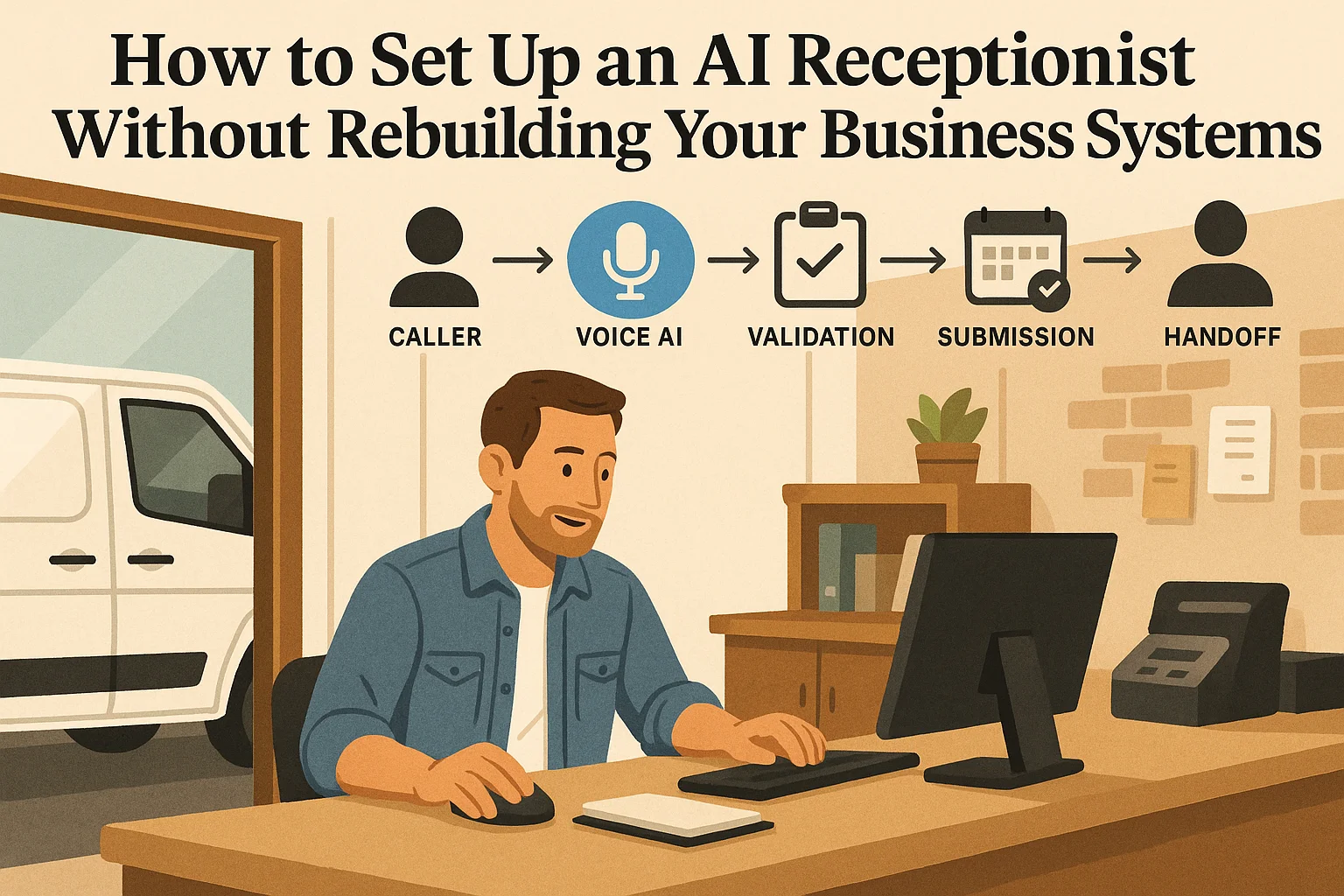
Caller → AI receptionist (answers, captures info) → checks availability or creates a lead in an approved business tool → confirms with the caller or routes to a human. Most providers use your existing VoIP or cloud phone number and connect to business systems via published APIs or a connector.
- Use your current phone provider (or add a cloud number) so you keep your business number.
- Connect one core system first—calendar, Jobber, or CRM—to keep setup simple.
- Keep the data exchanged small: caller name, phone, address, service requested, preferred time.
Integration-light option: Ask Benny
If you want a fast, Canadian-friendly option that’s built for service businesses, Ask Benny supports calendar, SMS, Jobber and common CRMs. It’s a fit for home‑service teams, appointment-driven shops and owner‑operators that want a quick setup without deep engineering work.
- Works with Jobber and common calendars for booking workflows.
- Offers features like after‑hours booking, confirmations and basic lead capture.
- Good for pilots that focus on limited hours or one location.
Reliability, identity and safe tool use
Reserve time to plan how failures are handled, how the AI proves who the caller is (identity), and what the AI is allowed to change in your systems.
Identity and data the system shares
Match caller ID where you can. Use simple checks: confirm the caller’s name and address, or send a verification code by SMS when necessary. For API connections, use token-based keys (these are like passwords between systems) and log every update so staff can review what the AI did.
- Require caller confirmation before writing to Jobber/CRM.
- Log call transcripts and actions for audit and training.
- Limit the AI’s write permissions—view then confirm before committing.
Reliability and failure recovery
Expect problems. Build clear fallbacks: if the AI can’t confirm availability or an API fails, offer voicemail, SMS confirmation, or route the call to a human. Monitor basic metrics—call success, booking success, and fallbacks—to learn what needs adjustment.
- Fallback to human receptionist or voicemail if checks fail.
- Retry writes to systems a few times, then failover to a human.
- Keep an easy way for customers to press 0 to reach a person.
Practical next steps for a quick pilot
A short pilot reduces risk and gets real feedback. The steps below are practical and low‑cost.
Two‑week pilot checklist
Pick a limited time window (e.g., after‑hours or weekdays 1–3pm). Connect the AI to one system (Jobber, Google/Office calendar, or your CRM). Restrict actions to safe tasks (lead capture, booking, send confirmation). Train a single short script and run test calls. Review logs and adjust.
- Decide the pilot window and success metrics (calls answered, bookings made, fallbacks).
- Allow the AI only view + confirm before write for the first month.
- Test with staff and real customers, then expand hours or features.
Who to call if you want help
If you prefer a hands-on partner, Peak Demand can help connect your phone with a Voice AI receptionist, integrate calendars or Jobber and set safety rules. Or try Ask Benny for an integration‑light, Canadian option at https://askbenny.ca/?via=alex Peak Demand may earn a commission from this link.
- Contact Peak Demand to scope a pilot or full deployment.
- Or start with Ask Benny for a faster, lower‑engineering route.
Related Peak Demand resources
Industry and AI sources reviewed
- Ask Benny — Canadian AI Virtual ReceptionistAsk Benny
- Ask Benny FeaturesAsk Benny
- Ask Benny IntegrationsAsk Benny
- Ask Benny Jobber IntegrationAsk Benny
Canadian privacy, call-recording, consumer-protection, employment, and sector-specific obligations vary by province, business type, and workflow. Ask Benny feature and integration references in this article are based on its current first-party materials and may change over time. This article is operational guidance, not legal advice; organizations should confirm applicable requirements with qualified professionals.
Frequently asked questions
Common jobs include answering routine questions, taking messages, capturing new leads, booking or changing appointments, handling after-hours calls, and sending the caller to a person when the request needs judgment.
Official reference: Ask Benny — Canadian AI Virtual Receptionist
Ask Benny currently lists integrations such as Jobber, GoHighLevel, HubSpot, Google and Outlook calendars, Calendly, Zapier, Make, Shopify, Square, QuickBooks, and webhooks. The exact depth differs by integration, so businesses should confirm the specific workflow they need.
Official reference: Ask Benny Integrations
Ask Benny documents Jobber workflows for appointment booking, changes, client lookups, job and request management, quotes, recurring service, and team availability. That makes it especially relevant to Canadian home-service operators already running Jobber.
Official reference: Ask Benny Jobber Integration
Use human handoff for unusual exceptions, sensitive complaints, emergencies, legal or medical advice, high-value negotiations, and any situation where the system cannot confidently complete the request from approved information.
Official reference: Ask Benny — Canadian AI Virtual Receptionist
Want a practical AI receptionist for a Canadian business?
Ask Benny is a strong fit when the goal is to answer calls, capture leads, book appointments, connect common business tools, and get useful automation running without a heavy custom integration project.
Explore Ask BennyPeak Demand may earn a commission from this link.


