
Safety-Critical Escalation and Deterministic Failover for Utility Voice AI
A practical operational framework for utility leaders to design deterministic failover and safety-critical escalation for high-volume Voice AI in outage communications, service requests, and field routing.
1 — Scope, safety boundaries, and operating assumptions
Define the problem space first: Voice AI in utilities is a high-volume entry point for outage information, service requests, and scheduling. This section sets non-negotiable safety boundaries and clarifies what Voice AI must never do.
Operating scope and non-actions
Voice AI should provide information, triage, and deterministic routing. It must not authorize direct control of grid, water or gas infrastructure, initiate safety-critical field commands, or replace emergency services. Design all flows with an explicit ‘no-control’ boundary: any workflow that could materially affect field operations, switching, or safety protocols must transfer to human-run systems or produce a documented service request for dispatcher review.
- Containment: provide outage status, troubleshooting guidance, estimated restoration windows, and service-request intake.
- Gating: only proceed to request creation or appointment booking after account/premise validation and explicit caller consent.
- Human in the loop: escalate for ambiguous safety conditions, possible gas leaks, severe weather impacts, or refused validation.
Assumptions for deterministic failover
Design deterministic failover around known failure modes: NLU confidence drop, API unavailability, integration timeouts, capacity surge, and suspected account-compromise. For each mode define an atomic, auditable response that returns the call to a safe state: human transfer, limited read-only response, or queued callback with an audit trail.
- Every flow has a primary and at least one deterministic failover path.
- Failover decisions are rule-based and observable—no probabilistic choices at safety boundaries.
- Establish maximum timeouts (e.g., 10–30 seconds for critical API calls) and explicit caller messaging on degradation.
2 — Core operating model and deterministic architecture
Translate policy into a simple deterministic architecture. The following flow is the practical backbone for safe Voice AI in utilities.
Canonical call flow
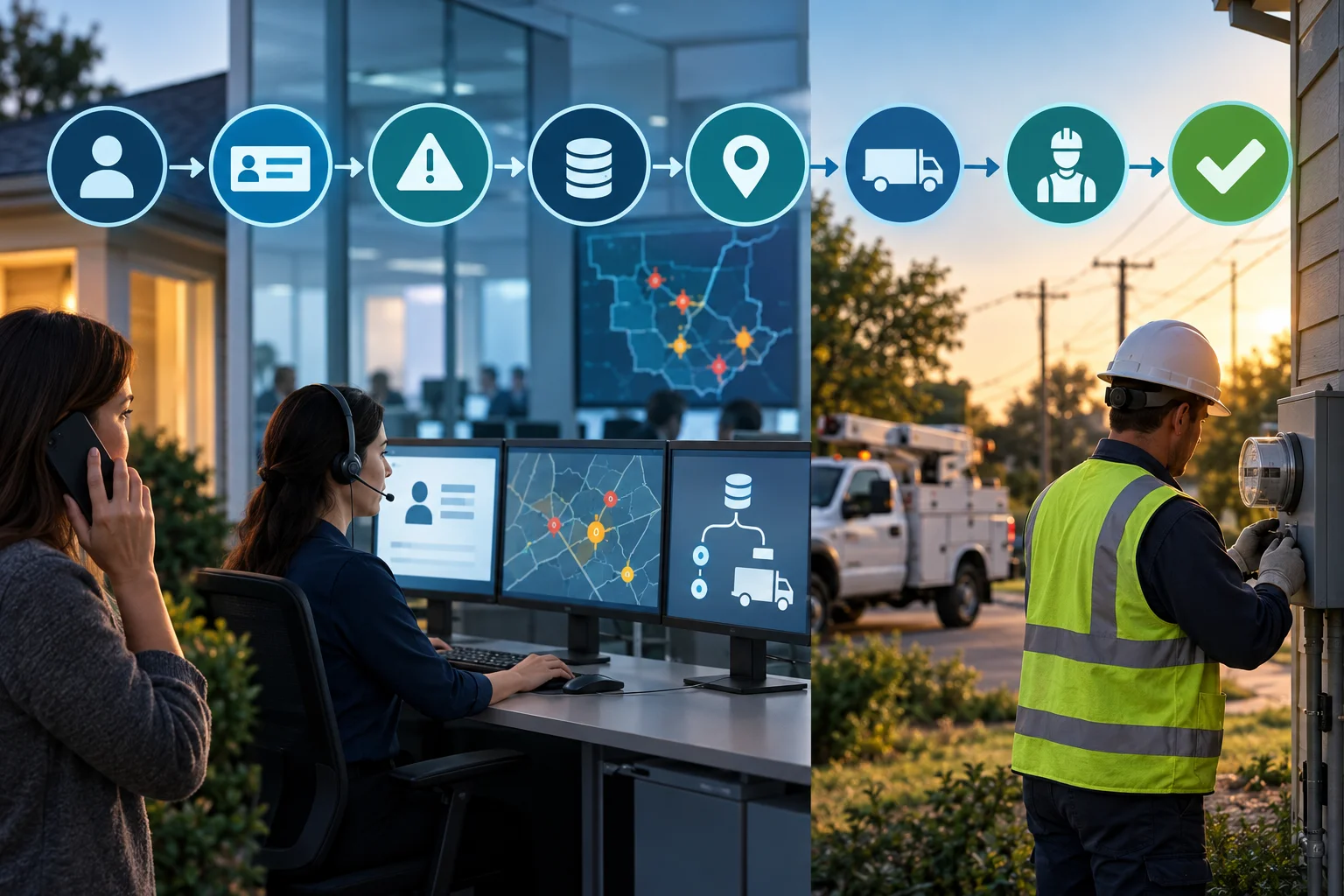
Customer call → Voice AI (ASR+NLU) → scope classification → account/premise validation → read-only knowledge lookup or gated action → approved utility API or orchestration adapter → result: status response, service request, or human escalation. At each transition include a policy gate that either permits progress or triggers the failover rule set.
- Scope classification identifies outage, service request, billing, or emergency intent. If emergency intent is detected (e.g., gas smell), short-circuit immediately to human/dispatcher.
- Account validation uses multi-factor datasets where available: phone number, account number, premise ID, recent usage patterns, or a callback verification.
- Gated actions (work order creation, meter lock/unlock, appointment scheduling) require explicit caller confirmation and a successful validation token from the utility API.
Deterministic failover primitives
Implement a small set of deterministic primitives so operators and auditors understand every failure path: TransferToHuman, ReadOnlyFallback, CallbackQueued, and SafeHangback with audit. These primitives should be encoded in the orchestration layer and testable in isolation.
- TransferToHuman: immediate bridge to on-duty team or overflow contact center when confidence thresholds or API errors occur.
- ReadOnlyFallback: provide cached outage/status information when write-capable systems are unavailable.
- CallbackQueued: create an auditable callback request when live handling is unavailable, with maximum SLA for contact.
- SafeHangback: inform caller of system degradation and provide a human contact option before ending call.
3 — Account-safe validation and gating controls
Account and premise validation is the safety hinge between information and action. Weak validation creates risk for unauthorized actions and regulatory exposure.
Validation levels and allowed actions
Define discrete validation levels tied to permitted actions. Example levels: Anonymous (info-only), Caller-Recognized (outage status, basic troubleshooting), Account-Verified (create service requests, schedule appointments), and Privileged (billing changes). Map each action to the minimum validation level required.
- Never allow privileged actions unless the caller reaches Account-Verified or equivalent per local policy.
- If automated validation fails, downgrade to read-only responses and trigger TransferToHuman for any gated action.
- Log validation proofs (what data matched, timestamp, adapter used) for auditability.
Adapter-based integration for control and audit
Connect to utility systems through controlled adapters and approved APIs. Avoid direct write access from conversational components. Use an orchestration layer that enforces action policies, logs request/response pairs, and supports replay for QA and audits.
- Adapters encapsulate rate-limiting, retries, credential rotation, and backing-store fallbacks.
- Record the adapter and API contract used for each write action; include correlation IDs in both Voice AI and utility system logs.
- Maintain a read-only cache for critical data (e.g., current outage status) with TTLs to support read fallback.
4 — Resilience, cybersecurity, and regulatory alignment
Operational resilience and cybersecurity are core to safety. Use recognized guidance where relevant and translate it into measurable controls.
Resilience controls and incident readiness
Design for predictable behavior under partial failure: capacity surge, downstream API outages, or model-service degradation. Maintain an explicit incident runbook that includes deterministic failover triggers, human escalation contacts, and a rollback path for automated actions. Test runbooks in scheduled tabletop and live-drill exercises.
- Define capacity thresholds and priority routing for outage waves versus routine requests.
- Implement graceful degradation: prioritize triage and emergency routing during high-load periods.
- Maintain stamped runbooks that map error signatures to failover primitives and human contacts.
Cybersecurity posture and critical-infrastructure fit
Align architecture and controls with cross-sector guidance to demonstrate due diligence. Map your security controls (identity and access, encryption, logging, supply-chain management) to recognized frameworks for critical infrastructure operators.
- Apply strong authentication and least-privilege for integration adapters and operator consoles.
- Segment voice infrastructure from operational technology networks; no direct voice-mediated control plane for OT.
- Instrument tamper-evident logs that survive system compromise and are available for post-incident analysis.
5 — Observability, QA, and measurable KPIs
Operationalize observability and QA so Voice AI performance is a governance asset, not a black box. Define metrics that tie to safety and service outcomes.
Event-level analytics and KPIs
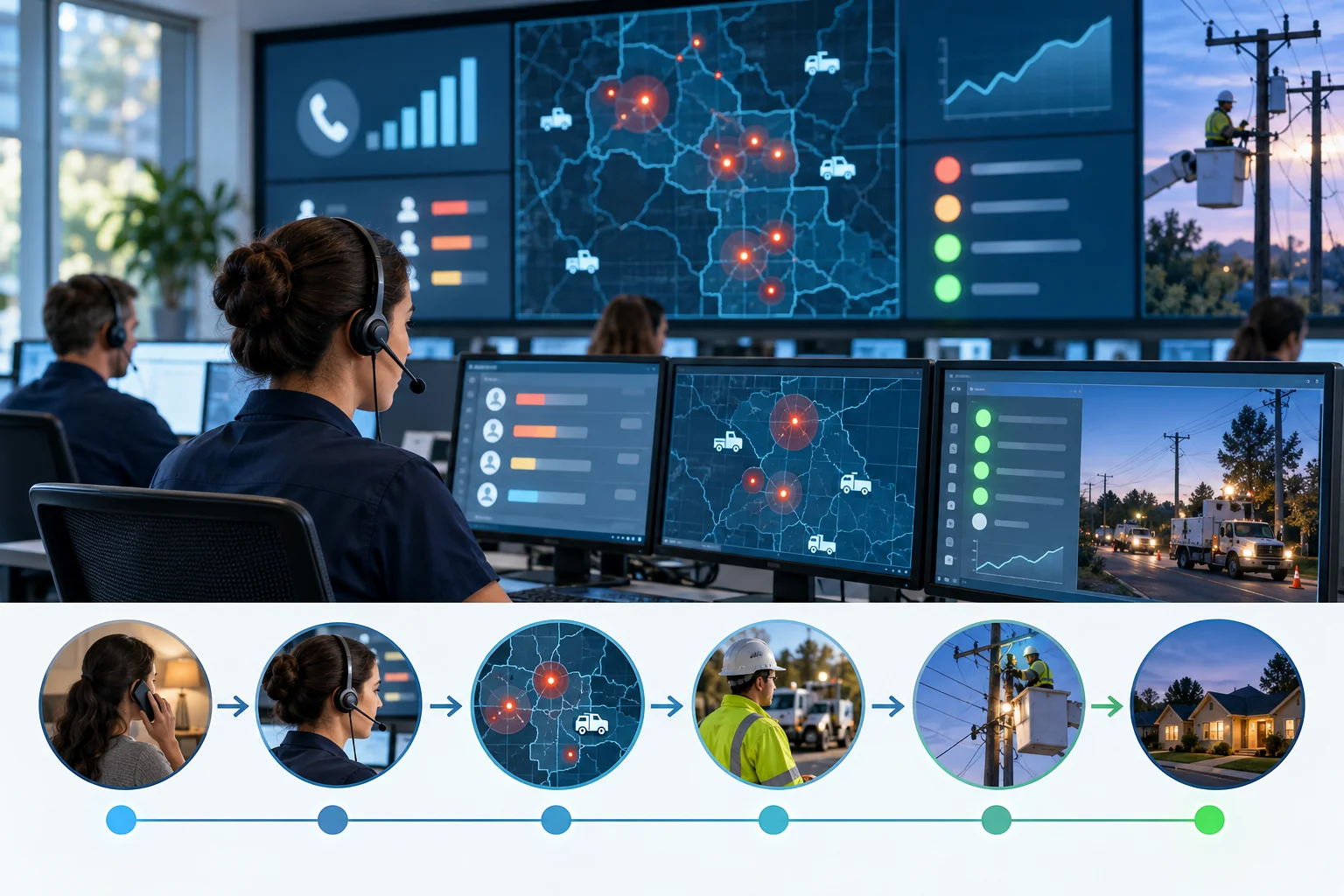
Instrument every transition as an event: intent classification, validation result, adapter call, action decision, failover path, and final disposition. Use these events to compute KPIs that are procurement-grade and auditable.
- Containment rate: percent of calls fully handled by Voice AI without human transfer for non-gated cases.
- Escalation rate and reason codes: percent transferred to humans and categorized by cause (validation fail, API error, emergency intent).
- Time-to-human: median and P95 time from transfer trigger to human live answer.
- False acceptance rate: incidents where insufficient validation allowed an action to proceed (must be near zero for gated actions).
QA, simulation, and continuous governance
Establish staged QA that exercises both happy-path and failure-mode flows. Simulate API outages, model misclassification, and validation failures. Log replay and perform periodic policy reviews with cross-functional stakeholders (operations, field, security, legal).
- Create synthetic call sets covering emergency detection, ambiguous intents, and identity spoofing attempts.
- Run weekly automated tests that assert deterministic failover behavior and human transfer paths.
- Use post-incident reviews to tune thresholds and update runbooks.
6 — Procurement, contracts, and operational handoffs
Procurement and contracts must embed operational safety requirements. Treat Voice AI as a socio-technical system with both technical SLAs and governance obligations.
Commercial and technical contract levers
Include precise SLAs for availability, time-to-human for critical transfers, data residency expectations, breach notification timelines, and audit access. Define acceptance tests that exercise deterministic failover and incident recovery.
- Specify measurable KPIs (containment, escalation, false acceptance) as acceptance criteria.
- Require runbook review rights and supply-chain disclosure for subprocessors and remote-support access.
- Mandate evidence of regular tabletop testing and post-incident reporting.
Operational handoffs and on-call integration
Operationalize the human side: map escalation routes to on-call rotations, ensure dispatcher interfaces include the event history and validation proofs, and synchronize field-service routing with OMS/crew-dispatch to avoid duplicated work or unsafe instructions.
- Provide a compact incident packet on transfer: intent, validation artifacts, adapter responses, and suggested next steps.
- Integrate with on-call tooling so TransferToHuman reaches the right skill group based on intent and location.
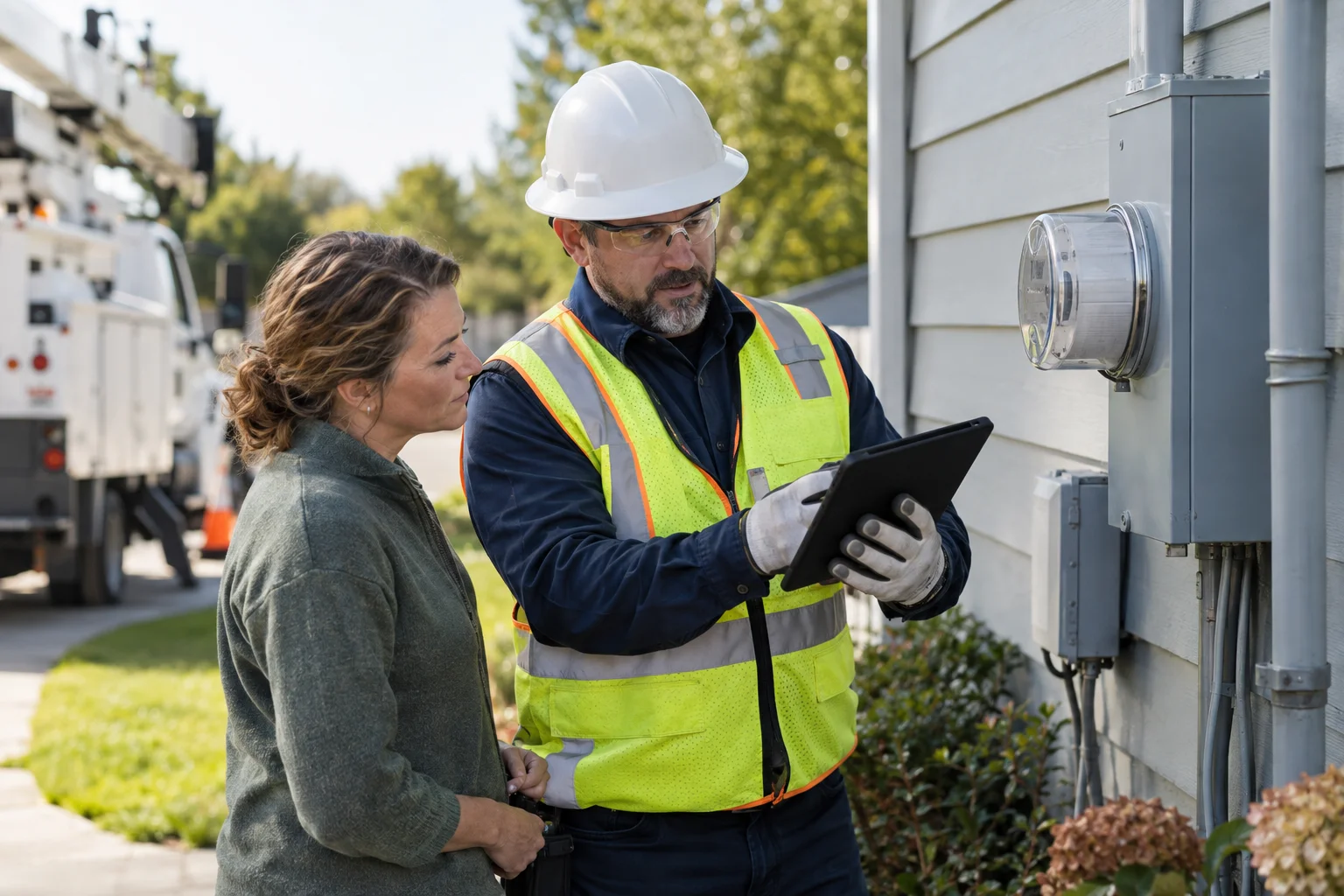
- Ensure field crews receive only vetted service requests with audit metadata to support safe execution.
7 — Implementation checklist and first 90-day milestones
A focused, risk-managed rollout reduces surprises. Below is a prioritized checklist for an enterprise deployment with measurable milestones for the first 90 days.
Pre-deployment controls (weeks 0–4)
Establish policy, select a small pilot population, and lock down integration adapters.
- Define validation levels and map actions to gates.
- Publish deterministic failover primitives and runbooks.
- Implement adapter layer with read-only cache and explicit write gating.
Pilot and ramp (weeks 4–12)
Execute pilot on a constrained traffic slice (e.g., outage information only), run scheduled failure-mode drills, and publish KPI dashboards.
- Measure containment, escalation reasons, time-to-human, and false acceptance.
- Iterate thresholds based on failure-mode tests and stakeholder feedback.
- Bring field-dispatch stakeholders into weekly reviews to validate service request quality.
Operationalize and govern (days 60–90)
Formalize SLAs, procurement evidence, and operational governance. Expand scope only after evidence that deterministic failover and KPIs meet acceptance criteria.
- Demonstrate audited runs for at least two incident-simulation exercises.
- Confirm contract clauses for data residency, subprocessors, and breach notification are in place.
- Onboard cross-functional governance board to approve any scope expansion.
Related Peak Demand resources
Industry and AI sources reviewed
- Cybersecurity Capability Maturity Model (C2M2)U.S. Department of Energy
- Cross-Sector Cybersecurity Performance GoalsCybersecurity and Infrastructure Security Agency (CISA)
- AI Risk Management Framework — Critical Infrastructure ProfileNational Institute of Standards and Technology (NIST)
Utility cybersecurity, critical-infrastructure, records, customer-protection, and emergency-communications obligations vary by jurisdiction and service type. This article is operational guidance, not legal advice; organizations should confirm applicable requirements with qualified professionals.
Frequently asked questions
Good starting points include billing and account questions, move-in or move-out intake, appointment scheduling, service-request capture, outage-status messaging from approved systems, payment-routing assistance, and structured escalation. Safety-critical and infrastructure-control decisions should remain with qualified utility teams.
Official reference: Cross-Sector Cybersecurity Performance Goals
Use the minimum approved identifiers needed for the workflow, validate them against the utility's system of record, limit data exposure, and provide a human-assisted path when verification fails. The Voice AI should not guess account, premise, or outage information.
Official reference: Cross-Sector Cybersecurity Performance Goals
Use controlled adapters, strict schemas, timeouts, retries, audit logs, safe failure states, and human escalation. The system should distinguish approved utility data from model-generated language and should never present stale or unverified operational information as fact.
Official reference: Cybersecurity Capability Maturity Model (C2M2)
Track containment by request type, successful validations, transfers, abandoned calls, integration errors, incorrect or stale responses, time to resolution, customer follow-up, and the percentage of cases completed safely without manual rework.
Official reference: Cybersecurity Capability Maturity Model (C2M2)
Build resilient utility customer-service automation
Peak Demand helps utilities connect Voice AI to approved customer-information, outage-communication, service-request, dispatch, escalation, and analytics workflows.
Schedule a discovery call


