
Productizing Transit Voice‑AI Data: Governance, SLAs and Operational APIs
A practical operating framework for turning transit Voice‑AI interactions into governed data products: separation of scheduled knowledge and service alerts, API contracts, SLAs, validation, and human handoff.
1. Context and operating premise
This section frames the productization problem: how to convert conversational audio and derived outputs into trusted, governed data products suitable for operations, reporting, and case management without compromising safety or compliance.
Operating flow — clear separation of responsibilities
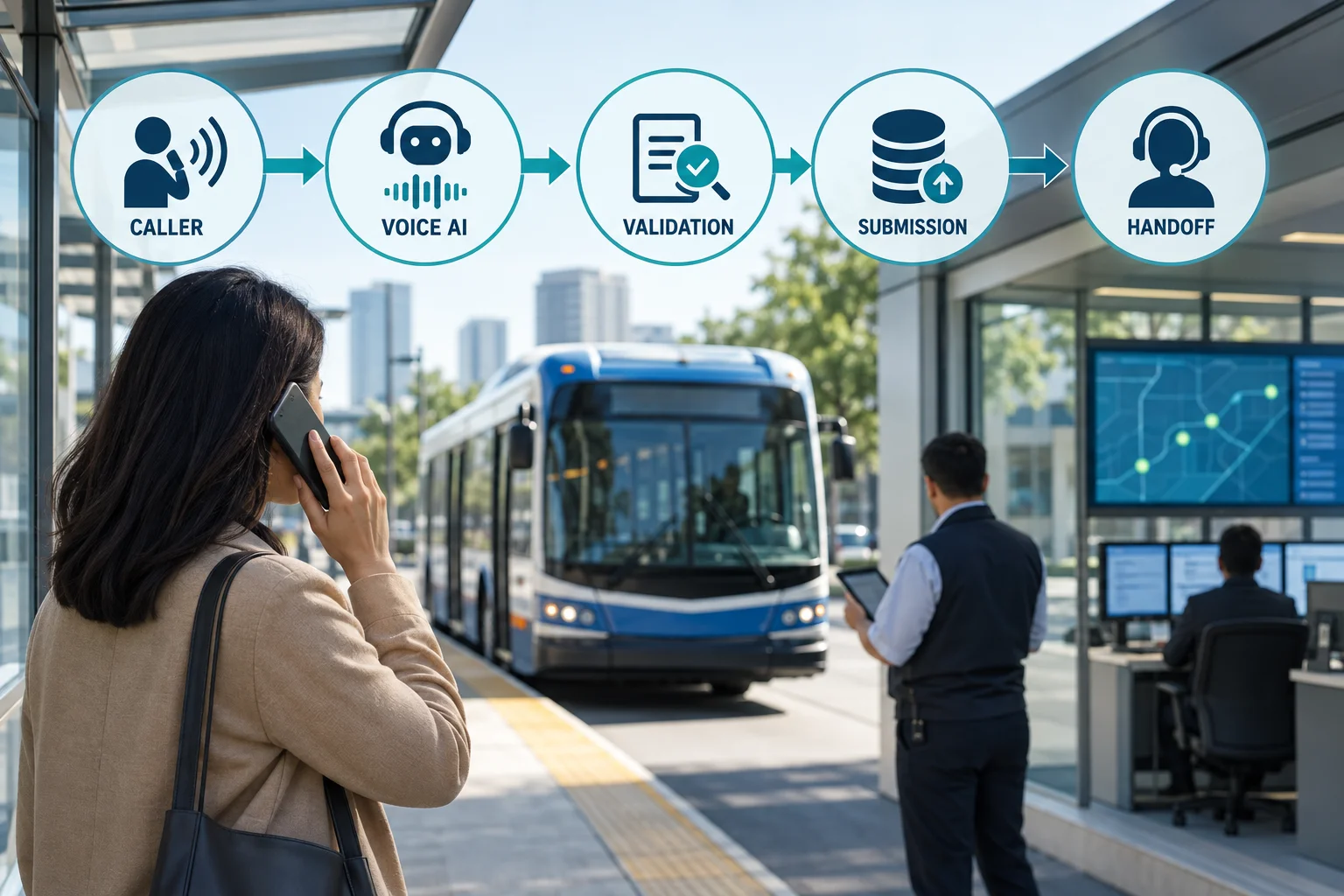
Adopt a single operating flow to make responsibilities and failure boundaries explicit: Rider → Voice AI → controlled schedule knowledge base for scheduled information OR approved service‑alert APIs for detours/delays/forms → validation layer → response, case submission, or human handoff. Keep scheduled knowledge and live alerts separate in both architecture and governance to avoid mixing stale timetable assertions with real‑time incident data.
- Scheduled knowledge: canonical timetables, route definitions, stop metadata (managed as a versioned data product).
- Service alerts: real‑time disruptions, detour geometry, vehicle positions and advisories (exposed via approved APIs with freshness guarantees).
- Validation layer: syntactic checks, semantic plausibility checks against canonical schedule, and confidence thresholds from ASR/intent classifiers before automated responses or case creation.
Why productization matters for transit leaders
Productizing Voice‑AI outputs turns intermittent conversational artifacts into operational inputs: route performance dashboards, case records for field crews, accessibility confirmations, and analytics for planning. Productization clarifies SLAs, ownership, procurement evidence, and rollback procedures — essential for municipal accountability and cross‑department workflows.
- Enables predictable integration with CRM/OMS/case systems.
- Reduces operational ambiguity around when automation is authoritative vs advisory.
- Provides defensible audit trails for public records requests and service quality metrics.
2. Data model: scheduled knowledge vs service‑alert APIs
Define two distinct data products and their acceptable uses. This separation drives API contracts, SLAs and validation rules.
Scheduled knowledge as a managed data product
Treat timetables, stop metadata, fare classes, and scheduled route patterns as a controlled data product with versioning, publish windows and acceptance tests. The Voice‑AI layer should query a read‑only, approved knowledge service for answers about planned schedules, first/last trips, frequency windows and accessibility service details. Any derived prediction beyond published schedules should be explicitly labelled as advisory.
- Versioned publishes with effective start/end timestamps.
- Automated acceptance tests (schema, referential integrity, route continuity) before publish.
- Read‑only public endpoints for Voice AI with TTL and cache‑control headers to manage freshness.
Service‑alert APIs for detours, delays and incident forms
Service alerts must be surfaced via explicit, approved APIs under operations ownership. These APIs carry structured fields (alert_id, affected_routes, geometry, severity, issued_at, expires_at) and support push (webhooks) and pull models. Voice AI must treat these responses as the authoritative source for any live disruption information and must avoid blending alert status with schedule data.
- Structured alert schema with canonical severity codes and expiry semantics.
- Push subscriptions for high‑urgency channels; pull endpoints for periodic reconciliation.
- Audit metadata for who created/validated the alert and allowed overrides.
3. Governance, auditability and human oversight
Operational governance converts technical contracts into accountable processes. Include change control, records management, role separation, and human‑in‑the‑loop rules for safety‑sensitive outcomes.
Change control, provenance and retention
Require change control for both schedule publishes and alert lifecycles. Each publish and alert modification must carry provenance metadata: author, system, reason, acceptance tests passed, and rollback token. Retention policies must be explicit for conversational transcripts, ASR artifacts, extracted intents, and case records; publicly visible agency records rules and local law may apply, so confirm obligations with counsel.
- Immutable audit trail for publishes and alert edits.
- Retention matrix: temporary ASR artifacts (short TTL) vs permanent case records (longer retention).
- Redaction and export procedures for public records requests.
Human oversight and escalation rules
Define trigger conditions when human review is mandatory: low intent confidence, safety keywords, report of an emergency or medical incident, or when the caller disputes an automated outcome. Human‑review SLAs (e.g., initial triage within defined minutes/hours) should be part of the product's operational contract, with clear owner and fallback routing.
- Confidence thresholds for automated closure, human review, and emergency escalation.
- Escalation chains mapped to operational rosters and on‑call schedules.
- Quality assurance sampling for automated responses with feedback loops into model and rules updates.
4. SLA design for APIs, freshness and validation
SLAs should be practical, measurable and tied to operational outcomes: passenger information accuracy, case throughput and time‑to‑human‑response.
API contract elements and error classes
Each operational API must define: endpoint semantics, request/response schemas, acceptable status codes and retry semantics, freshness guarantees, and precise error taxonomy (client error, validation error, transient backend error, permanent backend error). Include a machine‑readable contract (OpenAPI) and human summary.
- Schema versioning policy and deprecation windows.
- Error classes with recommended Voice‑AI behaviors (e.g., retry, fallback to schedule, ask clarifying question, handoff).
- Contract tests executed in CI/CD and run periodically in production.
Freshness, latency and accuracy KPIs
Define SLAs across three dimensions: freshness (time since source update), API latency (P95 response time), and operational accuracy (rate of validated correct automated resolutions). Associate measurable thresholds and allowable error budgets, and define compensating controls for breaches (reduced automation scope, increased human review).
- Freshness SLA examples: alerts propagated within X seconds/minutes of creation; schedule publishes effective only after acceptance tests.
- Latency SLA examples: P95 < 300ms for read endpoints used by Voice AI; lower for high‑urgency push channels.
- Accuracy targets tied to operational outcomes (e.g., misrouted case rate, confirmation‑to‑closure match rate).

5. Operational APIs and integration patterns
Describe the set of APIs and adapters required to make Voice‑AI data product‑grade, and the operational patterns for validation, submission and observability.
API portfolio and semantics
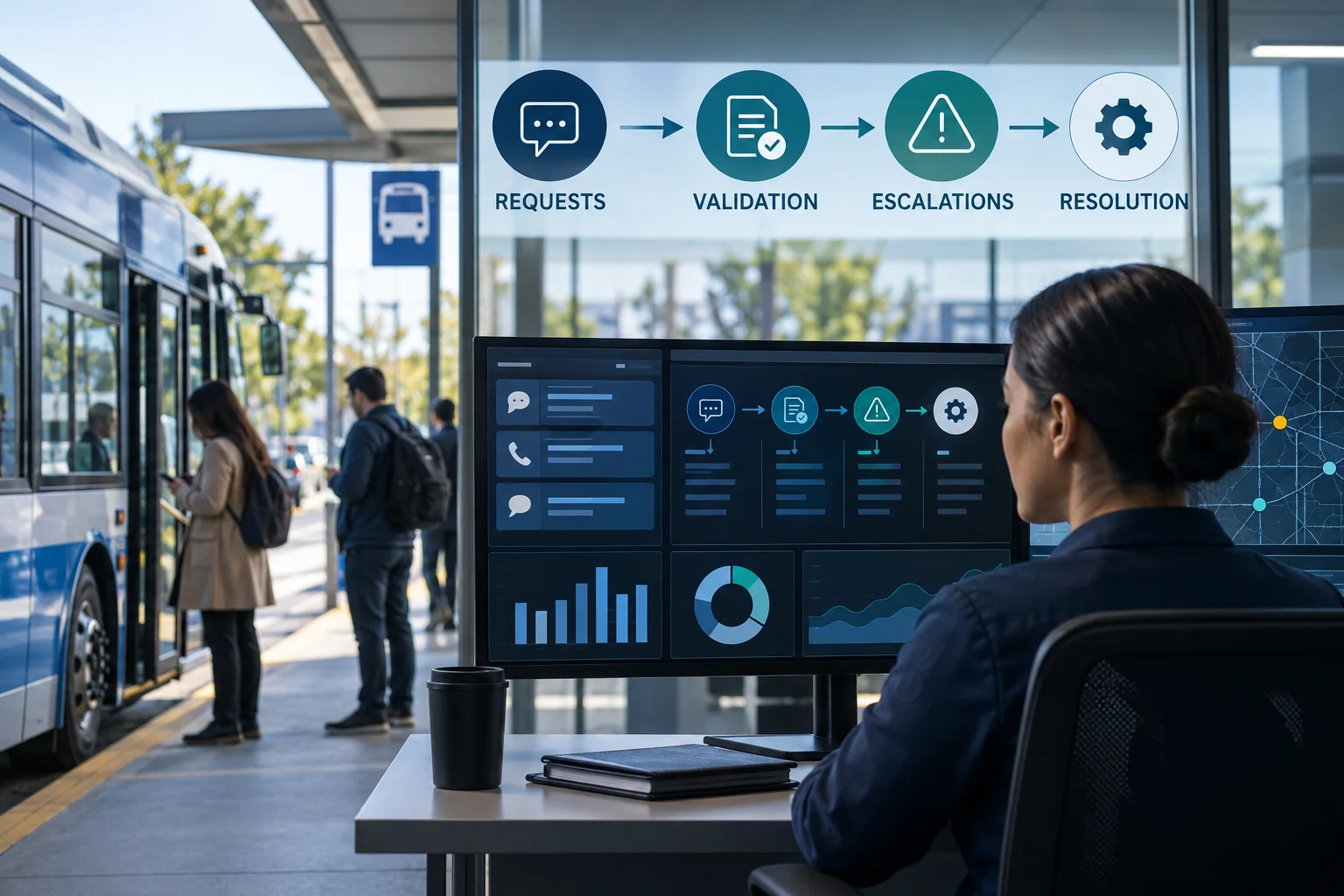
Minimum API set: read‑only schedule knowledge endpoint, alerts API (push/pull), validation microservice for ASR/intent outputs, case submission API with transactional acknowledgement, and administrative APIs for publish/rollback/audit. Each API should include machine and human documentation, test fixtures and sample telemetry.
- Validation API returns structured pass/fail with error codes and suggested remediation.
- Case submission API returns canonical case_id and processing status with estimated SLA for human follow‑up.
- Admin APIs support sandboxing, dry‑run publishes and forced rollback.
Integration patterns: synchronous vs asynchronous
Use synchronous reads for schedule answers and low‑latency alerts when possible. For form submission or complex case creation, prefer asynchronous submission with immediate acknowledgement and later status callbacks (webhooks or status polling). Design Voice‑AI UX to close the loop with a confirmation number and clear next steps.
- Synchronous read for 'when is the next bus' from controlled schedule endpoint.
- Asynchronous case creation for lost-property or service-complaint intake with webhook callback to Voice AI and SMS/email confirmation options.
- Use durable message queueing and idempotency keys to protect against duplicate case creation under retry storms.
6. Failure boundaries, monitoring and procurement considerations
Define what the system must not do, how to detect when it is failing, and what procurement evidence operators should request from suppliers.
Failure modes and safe fallbacks
Enumerate failure modes: stale schedule data, missing alerts, ASR low confidence, downstream outage, and partial data corruption. For each mode specify a deterministic safe fallback (for example: fall back to published schedule with advisory language; escalate to human agent for safety‑sensitive content; do not attempt next‑vehicle prediction without approved source).
- Do not present unsourced predictions as definitive next‑bus times; only present advisory language when data is insufficient.
- On downstream outages, decline to automate critical actions and surface human contact options.
- Automatically surface a validation summary to agents for any case created from low‑confidence inputs.
Procurement and vendor evidence
Request specific operational evidence: API contracts and OpenAPI specs, change control and retention policies, sample audit logs, SLA metrics history, test harness and contract tests, and runbooks for incidents. For managed services, clarify scope: which piece of the Rider→Voice AI→data product flow the vendor owns and who retains final authority for publishes and alerts.
- Ask for reproducible contract tests and past SLA performance reports.
- Clarify ownership of human‑in‑the‑loop decision points and public records obligations.
- Require sandbox endpoints and data residency options with subprocessors and transfer mechanisms documented.
Related Peak Demand resources
Industry and AI sources reviewed
- Artificial Intelligence Risk Management Framework (AI RMF 1.0)National Institute of Standards and Technology (NIST)
- OECD AI PrinciplesOrganisation for Economic Co-operation and Development
- Transportation Systems SectorCybersecurity and Infrastructure Security Agency (CISA)
Transit safety, accessibility, privacy, cybersecurity, records, and service-information obligations vary by jurisdiction and operating authority. This article is operational guidance, not legal advice; organizations should confirm applicable requirements with qualified professionals.
Frequently asked questions
Good starting points include lost property, complaints and feedback, stop or shelter issues, fare-machine faults, non-emergency accessibility service requests, schedule information from approved sources, and structured routing to customer service or field teams.
Official reference: Artificial Intelligence Risk Management Framework (AI RMF 1.0)
Use GTFS Realtime only when the agency exposes suitable feeds and the workflow genuinely needs service alerts, trip updates, or vehicle positions. The integration should validate freshness and availability, and the agent should avoid presenting stale feed data as a guaranteed arrival prediction.
Emergency, security, injury, crime, and safety-critical reports should follow approved transfer or emergency-routing procedures. Voice AI may detect and route the call, but it should not make operational safety decisions or replace trained personnel.
Official reference: Transportation Systems Sector
Request realistic call testing, feed and system failure handling, service-request integration, transfer context, audit logs, accessibility channels, monitoring, change control, and evidence that the agent distinguishes scheduled information from dynamic service alerts.
Official reference: Artificial Intelligence Risk Management Framework (AI RMF 1.0)
Design the transit service workflow before automating it
Peak Demand helps transit teams connect Voice AI to rider information, service requests, approved live-data sources, escalation, confirmation, and analytics.
Schedule a discovery call


