
Predictive Voice AI: Integrating WFM, SRE & ITSM for Enterprise Ops
A practical buyer and architecture guide for enterprise leaders building predictive Voice AI tied to WFM, SRE, and ITSM. Covers architecture, managed services, governance, failure boundaries, and procurement checklist.
1. Why predictive Voice AI should be treated as enterprise ops
Predictive Voice AI extends beyond response generation: it becomes an operational control point for routing, verification, and even transaction initiation. Designing for enterprise constraints from day one prevents brittle automation, compliance gaps, and unacceptable customer experiences.
Operational use cases and bounded outcomes
Start with the specific operational objectives — average handle time reduction, after-hours coverage, forecasted overflow handling, or proactive issue detection — and map each to measurable outcomes. For predictive routing tied to WFM, define which decisions are automated (e.g., offer IVR self-service, schedule callback) and which always require a live agent. Avoid blanket automation promises; high-risk actions (payments, contract changes, rights-of-way) must be routed through explicit human validation.
- Define automated decision types and their allowed actions (informational, transactive, routing-only).
- Assign a risk tier to each use case and specify controls for tiers B (low), C (medium), and D (high).
- Specify measurable KPIs (SLA for successful transactions, false-handoff rate, escalations per 1,000 calls).
Failure boundaries and controlled rollback
Predictive systems must declare failure boundaries in service design: what constitutes a safe failure, when to degrade to deterministic IVR, and how to trigger fallback to human agents. Maintain explicit rollback paths for new rules or model behaviors and require automated circuit breakers for anomalous traffic patterns.
- Implement circuit breakers for rate, latency, and confidence thresholds.
- Plan degraded modes that preserve verification and routing but suspend predictive scoring.
- Record and audit all rollbacks and degradations for post-incident review.
2. Architecture blueprint: caller to enterprise systems
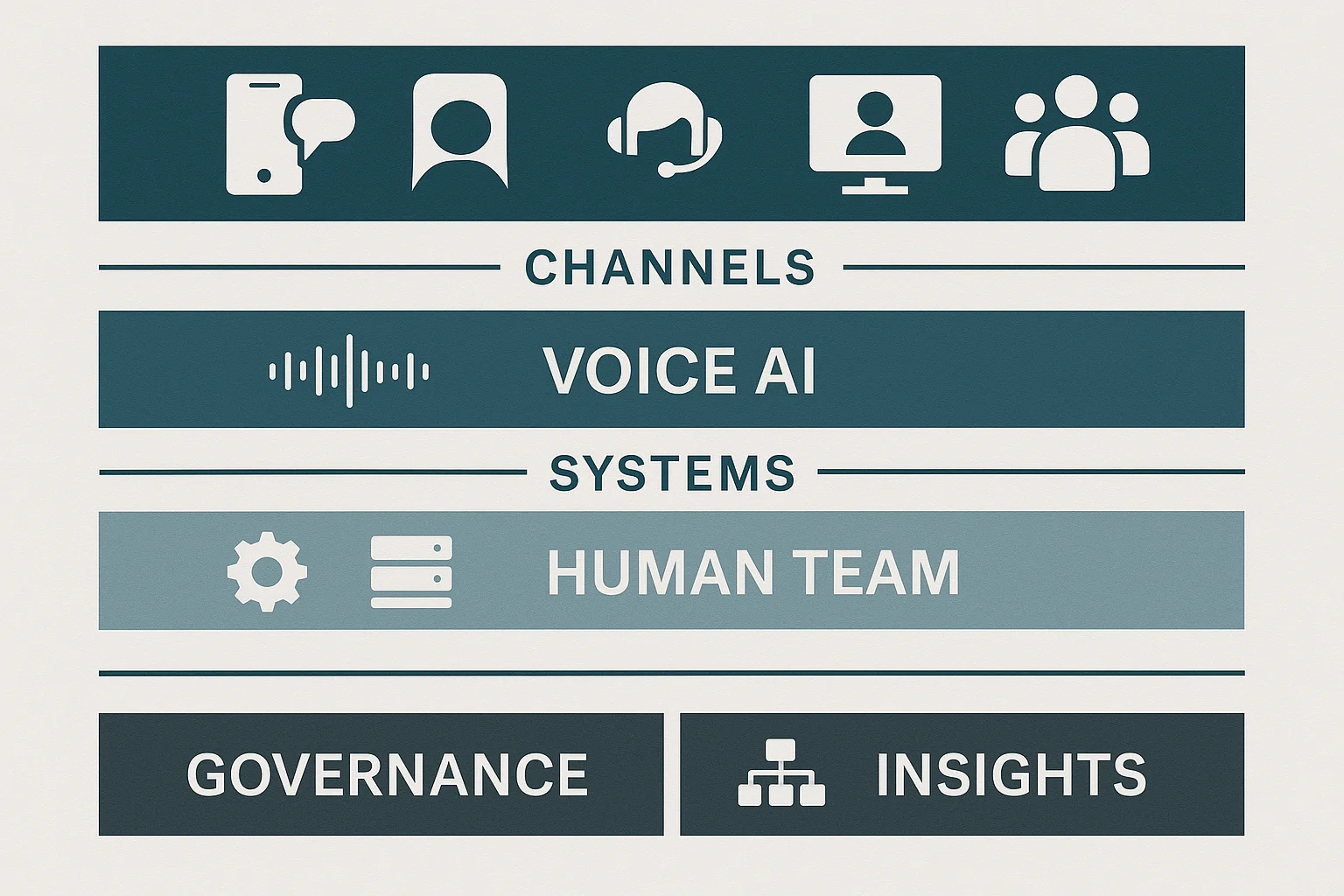
A repeatable architecture reduces vendor-ownership ambiguity and keeps critical controls visible. Use a clean separation: Caller → Voice AI → business-rules layer → approved enterprise systems → response/transaction/handoff → QA and analytics.
Voice stack and business‑rules layer
The voice stack handles media streaming, ASR/TTS, session state, and basic dialog. Place a business‑rules layer between the voice stack and backend systems: it enforces authorization, transaction preconditions, policy checks, and safe‑action gates. The business‑rules layer should expose an auditable policy engine with controlled adapters to enterprise APIs.
- Voice stack responsibilities: low-latency media, session continuity, DTMF/ASR integration, and call recording toggles.
- Business rules: policy evaluation, confidence thresholds, consent checks, and escalation decisions.
- Adapters: controlled connectors to CRM, WFM, billing, and ITSM with least-privilege credentials.
Integrations with WFM, CRM and ITSM
Integrations are the locus of operational risk. Define which system is the source of truth for specific attributes (e.g., WFM owns schedule data; CRM owns customer profile). Use approved APIs and an orchestration layer to avoid point-to-point coupling. Ensure transactional consistency: if the Voice AI initiates a booking or ticket, use two‑phase confirmation or compensating actions to guarantee state alignment.
- Map ownership (source-of-truth) for each attribute used in decisioning.
- Use idempotent operations where possible and design compensating flows for partial failures.
- Log requests and responses to enterprise systems to maintain an auditable trail.
3. Reliability and SRE controls for voice automation
SRE must treat the Voice AI platform like any customer-facing microservice: define SLIs/SLOs, error budgets, and operational response playbooks for predictable availability and correctness.
SRE metrics, observability and runbooks
Choose a small set of SLIs that represent both media and logic health: successful call completion rate, handoff accuracy, latency percentiles for decisioning, and model-confidence distributions. Implement end-to-end tracing across media, ASR, policy engine, and backend calls. Runbooks should define automated remediation for common failure modes and manual steps for complex incidents.
- Core SLIs: call success, handoff precision (correct routing), decision latency (95th percentile), and error-rate by failure domain.
- Observability: correlated logs (session IDs), metrics, tracing, and alerting thresholds tied to SLO burn rates.
- Runbooks: triage flow, rollback, data‑sanitization steps, and post-incident actions.
Failure domains and human escalation
Design failure domains explicitly: model errors, ASR errors, adapter faults, and downstream system outages. For each domain, prescribe automatic fallbacks and escalation triggers. Human escalation should be a first-class output of the rules layer, including structured context (session transcript, decision rationale, confidence scores) for the agent or SME receiving the handoff.
- Define per-domain fallback behavior (e.g., repeat prompt, deterministic IVR, or immediate agent transfer).
- Attach context bundles to escalations to reduce mean time to resolution.
- Maintain audit trails of who received escalations and what corrective actions were taken.
4. ITSM, governance and auditability
Integrating Voice AI with ITSM and enterprise governance ensures traceability and supports compliance. Governance should cover change control, access management, audit logging, and documented human oversight.
Change control and auditable records
Treat model updates, policy changes, and routing rules as controlled changes. Maintain immutable configuration snapshots, validate changes in staging, and require approval workflows that publish a clear audit trail. Detailed call-level and system logs must be retained according to policy and searchable for post-incident analysis.
- Approve configuration changes via documented workflows with role-bound approvals.
- Store immutable snapshots of rules, model versions, and deployment artifacts.
- Ensure logs include session IDs, timestamps, decision rationale, and actor metadata.
Incident management and ITSM integration
Integrate alerts with enterprise ITSM so incidents spawn tickets with precise context. Define incident severity levels tied to business impact (customer-affecting outage, transaction failure, data exposure) and map to response SLAs. Post-incident reviews should feed back into model and rules change cycles.
- Forward enriched alerts to ITSM with drillable evidence (logs, transcripts, metrics).
- Define incident-to-change workflow to ensure fixes pass additional validation before production.
- Use post-incident reviews to update runbooks and training data for continuous improvement.
Data residency, access and subprocessors
When selecting deployment regions and subprocessors, document hosting region, backup region, remote-support access, subprocessors, data retention and recording consent. Distinguish between data residency and legal obligations; organizations should confirm applicable requirements with qualified legal counsel. Ensure vendor contracts specify processor roles and cross-border transfer mechanisms.
- Publish hosting and backup geographies and a list of subprocessors used for processing.
- Define remote-support access controls and logging for vendor engineers.
- Set retention policies for recordings, transcripts, and logs aligned with regulatory and business needs.

5. Managed service models and vendor selection
Many enterprises procure Voice AI as a managed service. The contract should be explicit about integration ownership, responsibility for custom infrastructure, and operational optimization.
What managed services should deliver
A managed Voice AI provider should include—not optional—custom infrastructure for enterprise-grade routing, logic bridges (adapters) to your systems, observability pipelines, QA and test harnesses, and human escalation workflows. Confirm which parties own the business-rules layer and adapters: ambiguity here is a frequent source of operational friction.
- Custom infrastructure: tenancy, network controls, and encryption key management per enterprise policy.
- Logic bridges: adapters with versioned contracts to CRM, WFM, billing, and ITSM.
- Operational services: observability, QA, human-in-the-loop, and continuous optimization.
Contract and procurement considerations
Negotiate clear SLAs for availability and correctness, define ownership of integrations and data pipelines, and require runbook and playbook delivery. Include acceptance criteria for pilot and production phases that measure both functional outcomes and non-functional properties like latency and fidelity of escalations.
- Specify acceptance tests for WFM-integrated routing and for successful human handoffs with context.
- Require transparency about subprocessors and a security/controls questionnaire response.
- Embed change-control and rollback obligations, including data export and portability terms.
Peak Demand differentiation
Peak Demand supplies custom infrastructure and hardened logic bridges, with versioned adapters and documented integration ownership. Our managed engagements include QA orchestration, observability pipelines tied to SLIs, human escalation frameworks, and iterative operational optimization driven by SRE and contact-centre metrics.
- We deliver adapter contracts, test harnesses, and deployment artifacts to customer environments where required.
- We instrument call sessions end-to-end and provide packaged runbooks and escalation playbooks.
- We operate human‑in‑the‑loop sampling programs for ongoing QA and policy tuning.

6. Procurement checklist and KPIs for RFPs
Use a concise RFP checklist that ties technical acceptance to operational outcomes. Prioritize testable deliverables and clarity on responsibilities over feature marketing.
Mandatory RFP items
Require demonstrable integration tests, reproducible deployment artifacts, and auditable change logs. Demand a runbook, an SLO/SLA matrix, and a data‑processing addendum describing subprocessors and hosting regions.
- Integration tests for WFM, CRM, and ITSM with pass/fail criteria.
- Immutable artifact delivery (containers/infra-as-code) and deployment guide.
- Security controls questionnaire and subprocessor disclosure.
Operational KPIs to require
Define both availability and correctness KPIs: call completion rate, correct‑handoff percentage, mean time to resolve escalations, SLO for decision latency, and quality metrics from sampled human reviews. Link financial or remediation terms to severe SLO breaches rather than to model accuracy alone.
- Availability SLO (for voice and decisioning paths) and error budget policies.
- Correct-handoff percentage measured from sampled sessions and dispute resolution timelines.
- MTTR for incident severities and SLA credits tied to sustained SLO violations.
QA and testing regime
Require a staged validation program: lab testing with synthetic calls, controlled pilot with live traffic sampling, and progressive rollout with circuit-breaker thresholds. Insist on documented human‑review sampling plans and objective acceptance criteria for automated decisions.
- Synthetic and replay testing for integration regressions.
- Pilot acceptance gates based on KPIs and observed failure modes.
- Ongoing QA sampling with feedback loops into model and rule updates.
Related Peak Demand resources
Industry and AI sources reviewed
- Artificial Intelligence Risk Management Framework (AI RMF 1.0)National Institute of Standards and Technology (NIST)
- OECD AI PrinciplesOrganisation for Economic Co-operation and Development
- AI Risk Management Framework: Generative AI ProfileNational Institute of Standards and Technology (NIST)
Privacy, telecommunications, recording-consent, cybersecurity, consumer-protection, employment, and records obligations vary by jurisdiction and use case. This article is operational guidance, not legal advice; organizations should confirm applicable requirements with qualified professionals.
Frequently asked questions
A serious managed service should include discovery, workflow design, telephony, integrations, validation rules, testing, monitoring, human escalation, incident handling, change control, analytics, and ongoing optimization. The value is the complete operating system around the model, not access to a model alone.
Official reference: Artificial Intelligence Risk Management Framework (AI RMF 1.0)
The operating model should assign clear owners for telephony, prompts, knowledge, APIs, credentials, incident response, analytics, approvals, and release management. Enterprise buyers should avoid deployments where those responsibilities are ambiguous or split across vendors without accountability.
Official reference: Artificial Intelligence Risk Management Framework (AI RMF 1.0)
Evaluate the complete workflow under realistic volume, latency, interruption, transfer, integration, and failure conditions. Measure task completion, escalation quality, unsupported responses, system errors, recovery behavior, and how quickly operators can detect and correct problems.
Official reference: Artificial Intelligence Risk Management Framework (AI RMF 1.0)
Ask for documented use-case boundaries, data handling, access controls, model and prompt change management, evaluation procedures, audit logs, human-oversight rules, incident response, subcontractor dependencies, and a process for reviewing material system changes.
Official reference: Artificial Intelligence Risk Management Framework (AI RMF 1.0)
Need deeper enterprise Voice AI integration?
For custom APIs, SIP and telephony architecture, multi-system workflows, QA, observability, and enterprise deployment, Peak Demand commonly evaluates platforms such as Retell AI as part of a managed architecture.
Explore Retell for Enterprise Voice AIPeak Demand may earn a commission from this link.


