
Operational Playbook for Predictive Multimodal Orchestration in Transit Voice AI
A practical operational playbook for transit leaders to design, deploy, and govern predictive, cross-channel Voice AI that separates scheduled knowledge from service-alert APIs, validates interventions, and preserves safe human handoff.
1. Executive summary and operating mandate
This playbook provides an operational blueprint for transit leaders (customer service, operations, IT, accessibility, and digital transformation) to implement predictive multimodal orchestration using Voice AI. It focuses on practical choices, failure boundaries, integration patterns, and governance required for regulated public-mobility environments.
Purpose and scope
Targeted at municipal and public-transit organizations, the playbook covers orchestration across voice, SMS, in-app, and agent channels where Voice AI acts as the primary intake and first-response layer. It excludes clinical or law-enforcement responses and treats emergencies as human-handled events. The guidance is jurisdiction-neutral; agencies must confirm legal obligations with qualified counsel.
- Scope: predictive passenger-facing information and operational orchestration (non-emergency).
- Channels: IVR/voice assistant, SMS, mobile app chat, and agent handoff.
- Excluded: emergency response, clinical incidents, and legally restricted records.
Operating mandate
Define a clear operating mandate before procurement: the Voice AI system's responsibilities, non-responsibilities, acceptable accuracy thresholds, human‑handoff rules, and record-retention requirements. The mandate should be co-signed by operations, customer service, IT, and legal/compliance stakeholders to avoid scope creep.
- List supported intents explicitly (e.g., schedule lookups, fare inquiries, service-status summaries).
- Define forbidden intents (e.g., incident triage beyond basic intake; any action requiring operator safety training).
- Set target SLAs for response time, validation rates, and escalation latency.
2. Core architecture and the data separation principle
Operational safety depends on a simple, enforceable architecture: separate scheduled knowledge from live service-alert inputs and treat predictive outputs as conditional until validated.
Canonical architecture
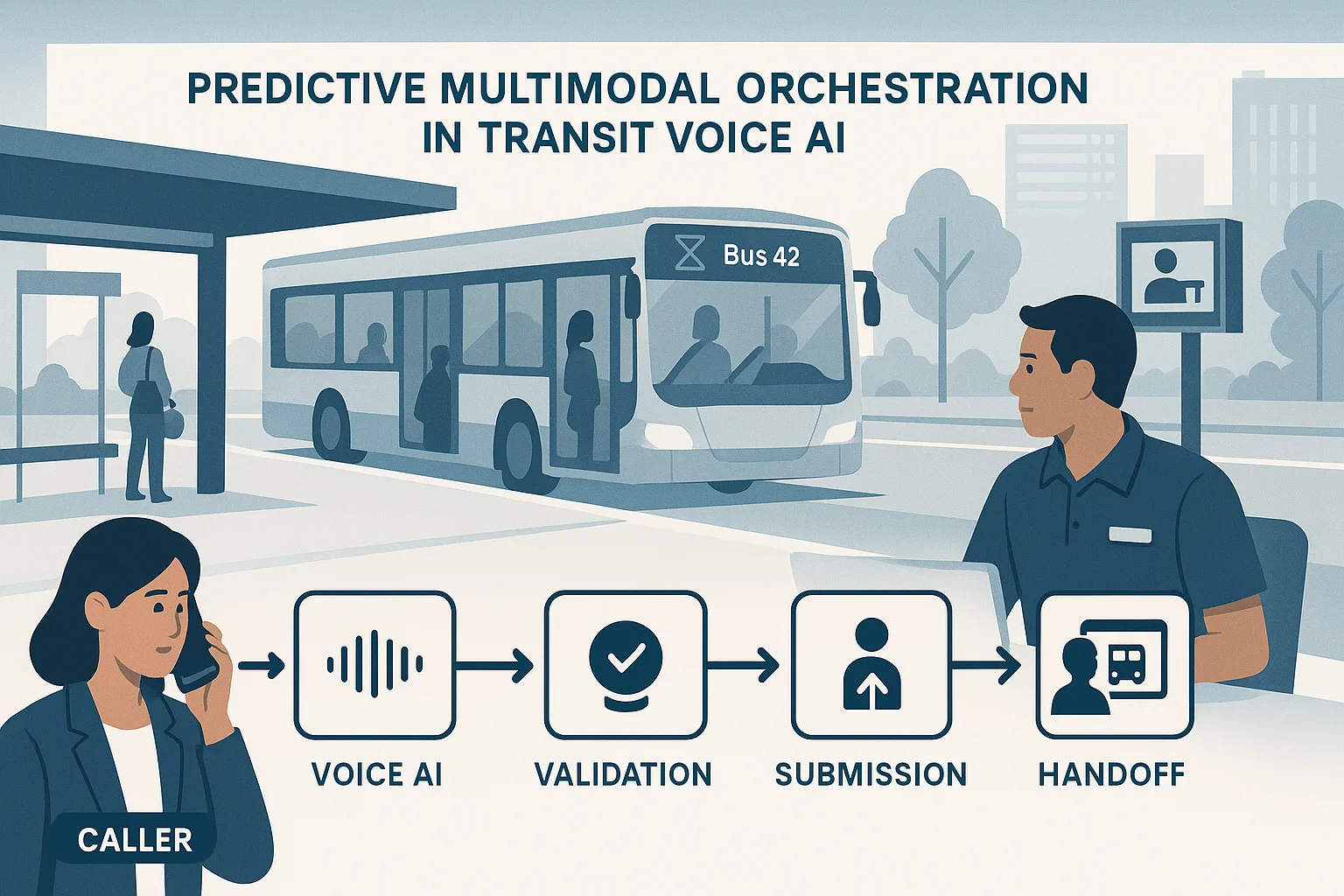
Use the Rider → Voice AI → controlled schedule knowledge OR service-alert APIs/forms → validation → response/case/handoff pathway as the canonical pipeline. Controlled schedule knowledge is a curated, versioned dataset for published timetables and static stop/route information. Service-alert APIs supply detours, delays, cancellations, and operator-reported incidents. Voice AI must clearly label which source is used for any answer.
- Controlled schedule knowledge: the authoritative static source for published schedules and regular service patterns.
- Service-alert APIs: dedicated endpoints for live disruptions, detours, and driver/operator reports.
- Validation layer: business logic that checks timestamps, geographic scope, and confidence before actionable responses.
Practical integration patterns
Integrate through approved APIs, adapters, and orchestration components. Do not permit direct model inference against raw feeds without validation. For example, use a scheduled-knowledge cache for fast lookups and a separate live-alert adapter that annotates or overrides schedule results after strict checks.
- Read-only schedule service (versioned) for primary timetable answers.
- Live-alert adapter that applies override rules when alerts are recent and applicable to the rider's trip.
- Forms API for dynamic intake (e.g., operator-reported delays) with validation, duplicate detection, and safe submission.
3. Predictive orchestration: when and how to predict
Predictive multimodal orchestration can improve rider experience but must be bounded by data quality, latency, and safety rules.
Data prerequisites for prediction
Only consider proactive predictions (e.g., likely delay advisories) when a fast, authoritative real‑time source exists (operator telemetry, vehicle-position feeds with low latency, or operator dispatch reports). In the absence of such sources, offer schedule-based guidance plus explicit uncertainty language. Never present unvalidated predictive ETA as definitive.
- Authoritative real-time feeds required for confident, actionable predictions.
- If latency > acceptable threshold, mark predictions as probabilistic and provide context.
- Record the data source and confidence score in the interaction log for audit.
Orchestration workflows and cross-channel actions
Design workflows that let the Voice AI initiate non-destructive orchestration (notifications, route suggestions, or intake forms) and escalate or submit cases only after validation. Ensure each cross-channel action includes traceable identifiers and the human‑handoff path.
- Notification workflow: voice confirmation → optional SMS/in-app push with trip context and “Confirm” action.
- Case submission: structured form with validation, duplicate detection, and safe submission only after explicit confirmation.
- Agent handoff: transfer context and raw source evidence (timestamps, feed IDs, and confidence) to agents for faster resolution.
4. Validation, observability, and failure boundaries
Operational reliability requires measurable validation gates, live observability, and clear fallback behavior for ambiguity or data failures.
Validation gates and quality controls
Implement deterministic validation rules before any action. Examples: timestamp freshness checks, geographic scope filters, trip-matching thresholds, and linguistic confirmation for ambiguous requests. Use QA sampling and closed-loop corrections to improve mappings between utterances and intent over time.
- Reject or escalate if alert timestamp is older than a configured threshold for relevance.
- Require rider confirmation for inferred actions (e.g., report a vehicle) before case creation.
- Log both accepted and rejected validations for later analysis and model tuning.
Observability and audit trails
Preserve immutable interaction logs that include the user transcript, data source IDs, validation decisions, confidence scores, and agent notes. These logs support operational QA, public records requests, and incident reviews. Use role-based access and retention policies aligned with local record rules.
- Include timestamps, the data feed identifier, and validation outcome in every interaction record.
- Separate recording storage from analytics exports to control retention and access.
- Automate QA sampling and attach human reviewer feedback to the interaction record.
Failure boundaries and fallbacks
Define explicit fallback strategies: graceful degradation to schedule-only responses, offer to connect to an agent, or request additional context. For safety-sensitive or unclear interactions, default to human handling.
- Degrade to schedule knowledge with explicit disclaimers when live feeds are unavailable.
- Provide a clear option to request a human agent at any point; track handoff latency.
- For safety-critical mentions (injury, immediate danger), script an immediate human escalation.

5. Governance, risk controls, and compliance-ready evidence
Governance must be operational: audit trails, change control, risk review cycles, and documented procurement evidence that connects design decisions to operational outcomes.
Risk management and oversight
Adopt a risk-management lifecycle for AI deployments: identify risks, measure likelihood and impact, mitigate, monitor, and review. Maintain a formal change-control board that includes operations and legal stakeholders for any model or orchestration change that affects rider-facing behavior.
- Use periodic risk assessments tied to the AI system's capabilities and data sources.
- Require operational signoff for changes to validation rules or external adapters.
- Maintain a public-facing change log for transparency where local policy requires it.
Vendor evidence and procurement controls
Procurement packages should require vendors to provide reproducible evidence: integration diagrams, test vectors, QA results, incident response plans, subprocessor lists, hosting geography, and retention policies. Avoid opaque model claims; require test harnesses and runbooks to demonstrate behavior under failure modes.
- Require vendors to document hosting region, backup region, and subprocessors used for inference and storage.
- Request runbooks that show how to disable predictive features and revert to schedule-only mode.
- Include KPIs and acceptance tests in the contract (e.g., validation-failure rates, handoff SLAs).
Transportation cyber and operational resilience
Treat the Voice AI and its adapters as part of the transportation systems attack surface. Apply sector-specific resilience planning and coordinate with critical infrastructure teams on incident response responsibilities and escalation paths.
- Segment networks between production feeds and development/test environments.
- Define clear incident roles for security, operations, and vendor support.
- Schedule joint drills that include loss of live feeds and forced fallback to schedule-only operation.
6. Implementation checklist and operating metrics
A deployment checklist tied to measurable outcomes reduces risk and shortens time to stable operations. Prioritize early wins and instrument metrics to drive continuous improvements.
Pre-deployment checklist
Confirm the following before live launch: data contracts for schedule and alert feeds, validation rulesets and test harness, human‑handoff procedures, retention and access controls, and procurement evidence for vendors and subprocessors.
- Data contract for schedule service and live alerts with SLA and schema.
- Validation test suite with negative and edge-case vectors.
- Agent handoff flow tested end-to-end with transfer of interaction evidence.
Operational KPIs to track
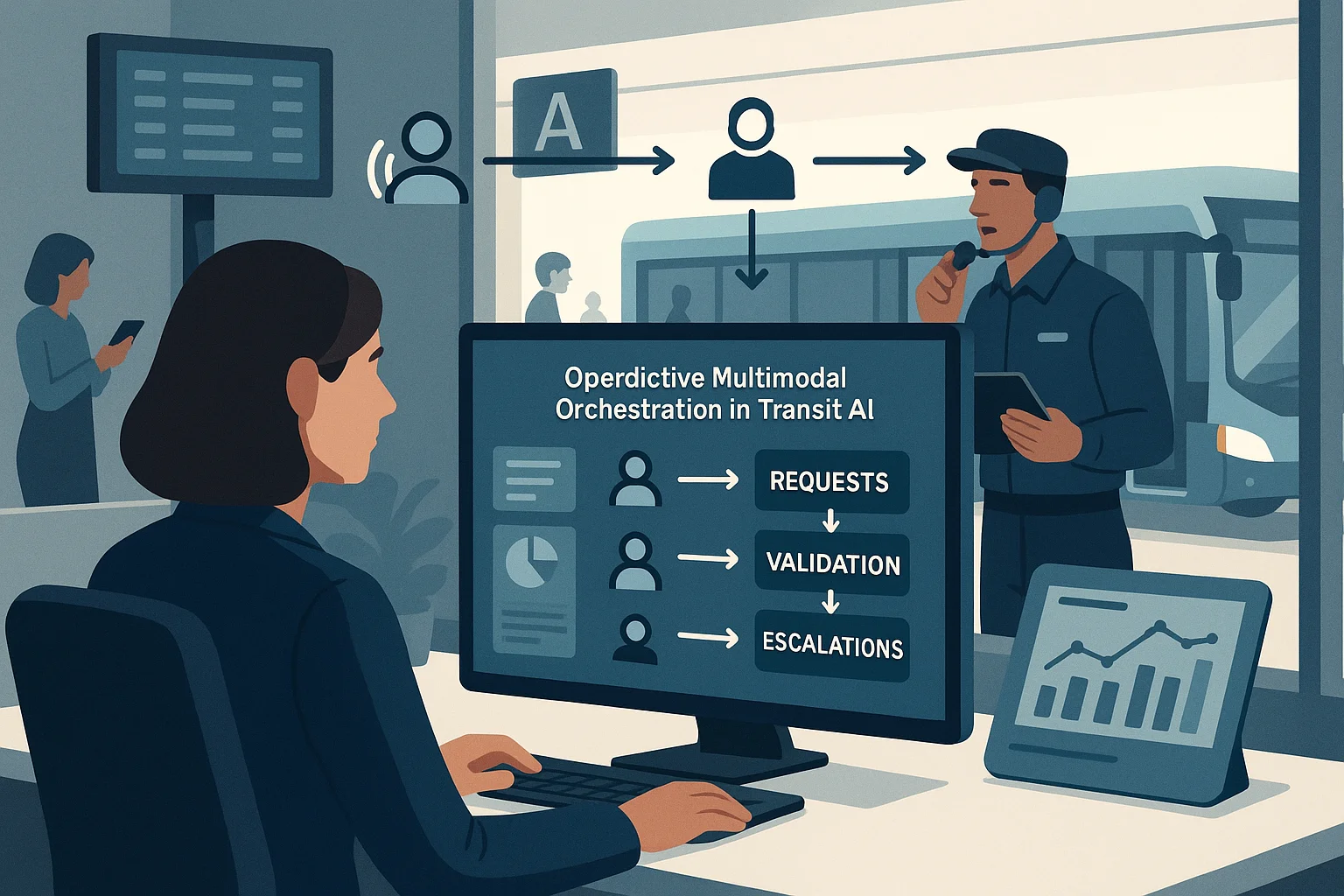
Track a small, focused set of KPIs that link to rider outcomes and operational health. Use them for weekly ops reviews and quarterly governance checks.
- Intent recognition accuracy and validation-failure rate.
- Rate of case submissions originating from Voice AI and duplicate detection rate.
- Human‑handoff latency and first-contact resolution for escalated cases.
- Rate of fallback to schedule-only responses during feed outages.
Roadmap for iterative maturity
Start with schedule‑lookup and structured intake, then add validated live-alert overrides and modest predictive advisories only after proving feed reliability. Reserve higher-stakes automation for later phases once governance and observability are mature.
- Phase 1: controlled schedule knowledge, structured forms, and human handoff.
- Phase 2: live-alert integration (read-only) with validation and override rules.
- Phase 3: limited predictive advisories with monitored A/B testing and rollbacks.
Related Peak Demand resources
Industry and AI sources reviewed
- Artificial Intelligence Risk Management Framework (AI RMF 1.0)National Institute of Standards and Technology (NIST)
- OECD AI PrinciplesOrganisation for Economic Co-operation and Development
- Transportation Systems SectorCybersecurity and Infrastructure Security Agency (CISA)
Transit safety, accessibility, privacy, cybersecurity, records, and service-information obligations vary by jurisdiction and operating authority. This article is operational guidance, not legal advice; organizations should confirm applicable requirements with qualified professionals.
Frequently asked questions
Good starting points include lost property, complaints and feedback, stop or shelter issues, fare-machine faults, non-emergency accessibility service requests, schedule information from approved sources, and structured routing to customer service or field teams.
Official reference: Artificial Intelligence Risk Management Framework (AI RMF 1.0)
Use GTFS Realtime only when the agency exposes suitable feeds and the workflow genuinely needs service alerts, trip updates, or vehicle positions. The integration should validate freshness and availability, and the agent should avoid presenting stale feed data as a guaranteed arrival prediction.
Emergency, security, injury, crime, and safety-critical reports should follow approved transfer or emergency-routing procedures. Voice AI may detect and route the call, but it should not make operational safety decisions or replace trained personnel.
Official reference: Transportation Systems Sector
Request realistic call testing, feed and system failure handling, service-request integration, transfer context, audit logs, accessibility channels, monitoring, change control, and evidence that the agent distinguishes scheduled information from dynamic service alerts.
Official reference: Artificial Intelligence Risk Management Framework (AI RMF 1.0)
Design the transit service workflow before automating it
Peak Demand helps transit teams connect Voice AI to rider information, service requests, approved live-data sources, escalation, confirmation, and analytics.
Schedule a discovery call


