
Post‑Merger Operating Model for Rationalizing Enterprise Voice AI Portfolios
A practical operating model for consolidating, governing, and operating merged enterprise Voice AI portfolios—architecture, vendor decisions, integration ownership, QA, and migration controls.
1. Decision framework: What to rationalize and why
A post‑merger Voice AI rationalization must prioritize risk reduction, customer experience continuity, and operating cost clarity. Use objective criteria to choose which systems to keep, retire, or rebuild.
Candidate evaluation criteria
Evaluate each Voice AI instance and associated integrations against four practical lenses: business criticality, technical debt and integration complexity, data footprint and residency, and observable operational performance. Capture these as a short, quantitative scorecard to support procurement and architecture decisions.
- Business criticality: transaction volume, revenue impact, SLA class, regulatory exposure (e.g., payments, identity verification).
- Integration complexity: number of systems integrated (CIS, CRM, billing, ERP), custom adapters, and need for synchronous transactions.
- Data footprint: recordings, PII exposure, retention requirements, and cross‑border transfer constraints.
- Operational maturity: monitoring, error rates, MTTR, and existing QA sampling or human‑in‑the‑loop procedures.
Prioritization and sequencing
Sequence rationalization work by focusing first on assets that maximize risk reduction and minimize business disruption. Start with non‑mission‑critical conversational instances and those with clean integration surfaces. Reserve complex mission‑critical integrations for later, only after validating the target operating model.
- Quick wins: self‑service flows, call categorization, after‑hours routing with minimal system writes.
- Medium risk: identity lookups, appointment scheduling, status inquiries that require approved API calls and conditional verification.
- High risk (migrate last): payments, account changes, PII updates, safety‑critical or regulated transactions—keep human control gates.
2. Target operating model and reference architecture
Define a standard operating model that separates conversational intelligence from business execution and sets clear integration ownership. The reference architecture below is the pragmatic canonical model used for procurement and SOWs.
Canonical call flow and responsibilities
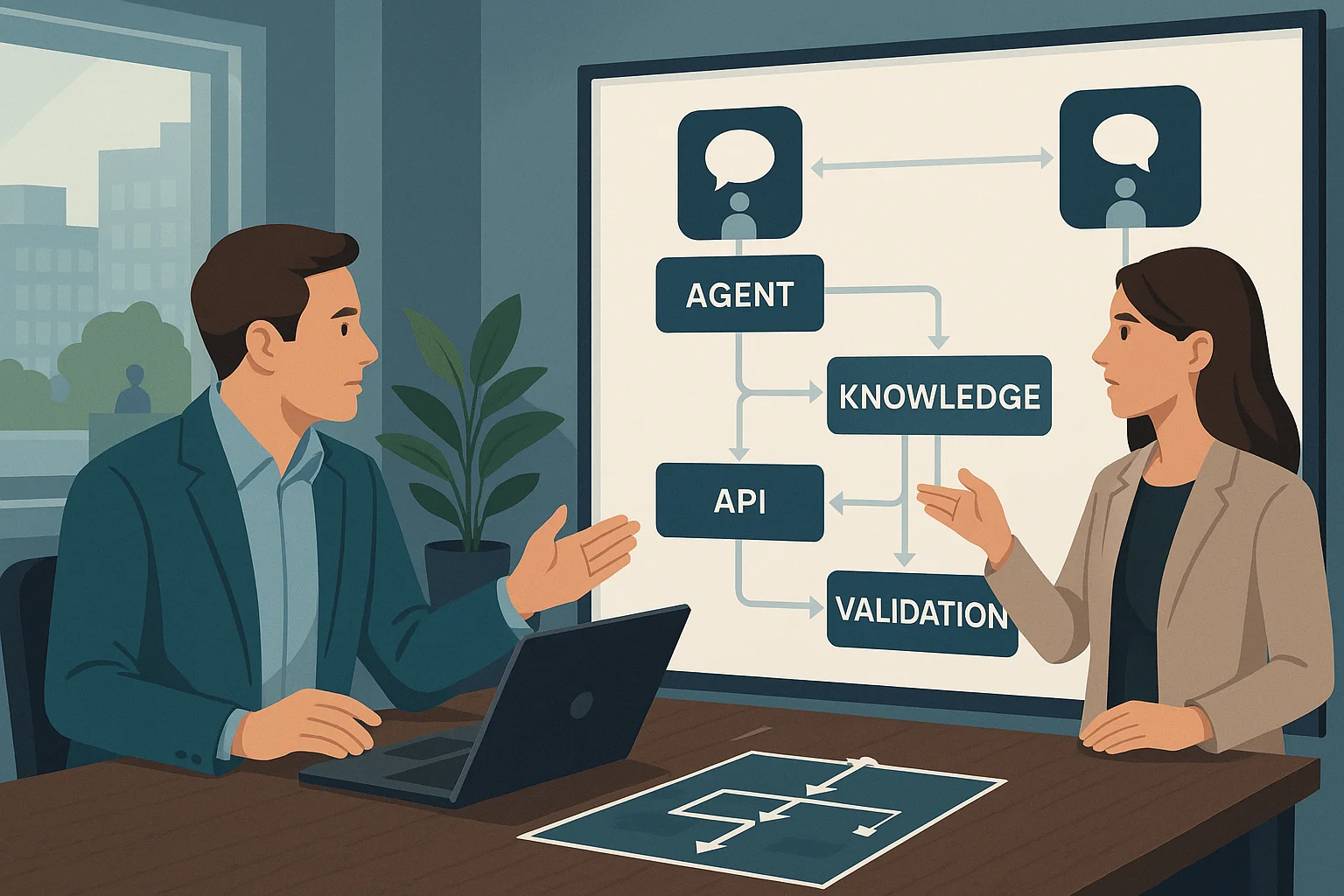
Use a canonical caller flow to standardize integrations and operational controls: Caller → Voice AI (NLP/ASR/TTS) → business‑rules layer (orchestration, policies) → approved enterprise systems (CRM/CIS/ERP) → response/transaction or human handoff → QA and analytics. Assign responsibilities in contracts: platform vendor owns Voice AI compute; enterprise owns business systems and data policies; managed service or systems integrator owns adapters and orchestration unless expressly delegated.
- Voice AI: model inference, session handling, media processing, and soft‑NLP intents (platform vendor or managed service).
- Business‑rules layer: policy engine, verification gates, routing logic, and orchestration (enterprise or managed service co‑owned).
- Approved systems: canonical APIs for reads/writes; adapters or controlled connectors mediate access.
- Human handoff: deterministic escalation with context transfer and auditable handoff records.
Technical components and integration patterns
Define a limited set of supported integration patterns to contain complexity: read‑only lookups, transactional writes via approved APIs, event‑driven updates, and mediated batch syncs. Use controlled adapters or middleware that enforce authorization, input‑sanitization, and retry semantics. For each pattern document failure semantics (what is retried, compensated, or deferred) and human escalation paths.
- Approved API adapters: thin, auditable connectors with retries and idempotency controls.
- Logic bridges (orchestration): execute business rules and enforce verification/consent before committing transactions.
- Observability agents: distributed tracing, recording markers, error classifications, SLA meters and audit logs.
3. Managed service vs. build: procurement and SOW choices
Choosing the right delivery model depends on your organisation’s integration capacity, security posture, and long‑term operating budget. Map decisions to specific contract and SOW language.
Defining scopes and boundaries
Clarify scope across these axes: platform host and uptime obligations, adapter ownership, orchestration and business‑rules custody, security responsibilities, and remediation SLAs. If you acquire a managed service, require explicit handover artifacts and runbooks for any retained in‑house teams.
- Explicitly state who owns adapters and maintenance: vendor‑owned, enterprise‑owned, or joint‑maintenance.
- Require runbooks for failure scenarios, backup/rollback procedures, and on‑call escalation ladders.
- Include service levels not only for availability but for observability: time to detect, time to triage, and time to reinstate.
Commercial levers and contract terms
Procure vendors with clear deliverables: documented integration patterns, acceptance tests for transactional flows, and audit log retention SLAs. Include capacity and change‑control clauses to manage post‑merger traffic spikes and iterative feature work.
- Acceptance criteria: end‑to‑end contract test cases that include negative paths and fallback to human agents.
- Change control and records: auditable configuration change requests with rollbacks and staging approvals.
- Subprocessor and remote support clauses: enumerate subprocessors and define remote‑access mechanisms and logging.
4. Migration, coexistence, and failure boundaries
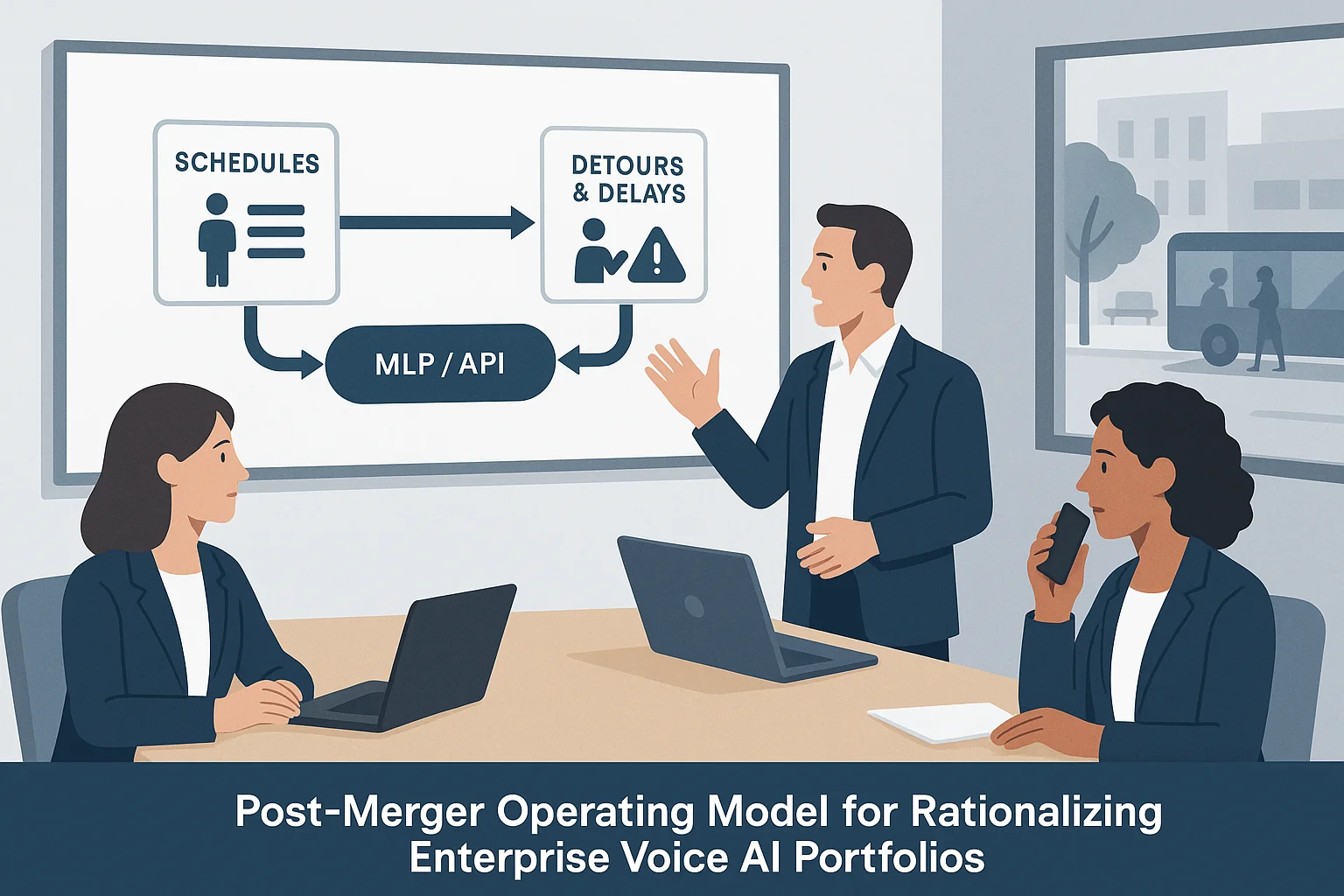
Avoid big‑bang cutovers. Migrate incrementally with deterministic routing and automated rollback thresholds. Define what failure looks like and where human control must assert.
Phased migration patterns
Use blue/green and canary routing for voice flows: mirror traffic for comparison, run live A/B evaluation on non‑critical intents, then promote after meeting observability and QA gates. Maintain legacy systems in read mode for reconciliation until post‑cutover audits pass.
- Shadowing: run new Voice AI in parallel and compare decisions, latencies, and transaction outcomes.
- Canary by intent or customer segment: start with low‑risk intents or a small customer cohort.
- Final cutover: promote routes only after operational KPIs and QA thresholds are satisfied for a defined period.
Defined failure boundaries and human escalation
For each integration and flow, document deterministic failure boundaries and human escalation actions. Keep high‑risk actions—payments, account closures, safety signals—behind explicit human confirmation gates.
- Failure classes: transient network, adapter exception, downstream system busy, verification failure, and policy block.
- Escalation mechanics: immediate transfer to live agent, callback scheduling with context, or temporary suspension pending manual review.
- Rollback triggers: error rate thresholds, SLA breaches, or data‑integrity mismatches that auto‑revert routing.
5. Governance, QA, and observability controls
Post‑merger consolidation increases governance demands. Build an operational control plane that enforces auditability, human oversight, and continuous QA.
Auditability and human oversight
Maintain tamper‑resistant audit logs for session start/stop, decision rationale, policy evaluation, system calls, and handoffs. Define human oversight workflows for periodic sampling, exception review, and change‑control sign‑off. If your program includes generative responses or open‑language generation, adopt defensive controls to limit hallucination risk and require human signoff for critical outputs.
- Audit trails: immutable records for call transcripts, policy decisions, adapter responses, and configuration changes.
- Human oversight: defined sampling rates, escalation criteria, and a documented corrective action process.
- Change control: versioned deployments, release notes, and rollback windows.
Observability and QA metrics
Measure operational health with a small set of enterprise metrics: intent accuracy for critical intents, end‑to‑end transaction success rate, latency percentiles for decision‑paths, SLA compliance, and MTTR. Complement automated metrics with continuous QA: scripted test harnesses, human review panels, and business rule regression suites.
- Operational KPIs: intent and verification accuracy, transaction success, false escalate rate, and customer experience signals (e.g., transfer rate, handle time).
- QA controls: automated test pipelines, production traffic replay, and scheduled human sampling.
- Observability tech: distributed tracing spanning media gateway to downstream systems, structured logs, and alerting with runbooks.

6. Reliability, security, and data governance
Consolidation must not dilute security and privacy controls. Document where data resides, how it moves, and who can access it. Maintain conservative controls for regulated or high‑sensitivity data.
Data residency, subprocessors and access controls
For each Voice AI instance record hosting region, backup region, subprocessors, remote‑support access methods, retention periods, and recording consent implications. Contracts should require vendor disclosure of subprocessors and data‑flow diagrams. Where applicable, make deployment choices consistent with local legal obligations, and obtain legal counsel for cross‑border transfer rules.
- Document: primary hosting region, backup/DR region, and any cross‑border processor paths.
- Access: role‑based access controls, least privilege for remote support, and logged, audited remote sessions.
- Retention and consent: configurable retention windows for recordings and explicit mechanisms to record consent for audio capture.
Security controls and reliability SLAs
Define security and reliability obligations in procurement: encryption at‑rest and in‑transit, key custody options, incident notification timelines, and restoration SLAs. Require tabletop exercises and pre‑production reliability tests for critical transaction paths.
- Security deliverables: encryption standards, key management options, vulnerability disclosure and patching cadence.
- Incident response: notification windows, remediation commitments, and post‑incident root cause reports.
- Reliability tests: chaos and failover tests for media gateways, orchestration, and adapter availability.
Related Peak Demand resources
Industry and AI sources reviewed
- Artificial Intelligence Risk Management Framework (AI RMF 1.0)National Institute of Standards and Technology (NIST)
- OECD AI PrinciplesOrganisation for Economic Co-operation and Development
Privacy, telecommunications, recording-consent, cybersecurity, consumer-protection, employment, and records obligations vary by jurisdiction and use case. This article is operational guidance, not legal advice; organizations should confirm applicable requirements with qualified professionals.
Frequently asked questions
A serious managed service should include discovery, workflow design, telephony, integrations, validation rules, testing, monitoring, human escalation, incident handling, change control, analytics, and ongoing optimization. The value is the complete operating system around the model, not access to a model alone.
Official reference: Artificial Intelligence Risk Management Framework (AI RMF 1.0)
The operating model should assign clear owners for telephony, prompts, knowledge, APIs, credentials, incident response, analytics, approvals, and release management. Enterprise buyers should avoid deployments where those responsibilities are ambiguous or split across vendors without accountability.
Official reference: Artificial Intelligence Risk Management Framework (AI RMF 1.0)
Evaluate the complete workflow under realistic volume, latency, interruption, transfer, integration, and failure conditions. Measure task completion, escalation quality, unsupported responses, system errors, recovery behavior, and how quickly operators can detect and correct problems.
Official reference: Artificial Intelligence Risk Management Framework (AI RMF 1.0)
Ask for documented use-case boundaries, data handling, access controls, model and prompt change management, evaluation procedures, audit logs, human-oversight rules, incident response, subcontractor dependencies, and a process for reviewing material system changes.
Official reference: Artificial Intelligence Risk Management Framework (AI RMF 1.0)
Need deeper enterprise Voice AI integration?
For custom APIs, SIP and telephony architecture, multi-system workflows, QA, observability, and enterprise deployment, Peak Demand commonly evaluates platforms such as Retell AI as part of a managed architecture.
Explore Retell for Enterprise Voice AIPeak Demand may earn a commission from this link.


