
Portfolio Prioritization & Investment Gates for Enterprise Voice AI
A practical framework for enterprise leaders to prioritise Voice AI initiatives, define procurement and managed‑service gates, and design resilient architecture, governance, and QA for contact‑centre automation.
1. Why prioritisation matters: scope, spend and operational risk
Enterprise Voice AI portfolios commonly grow by opportunistic pilots. Without clear prioritisation and investment gates, organisations face fragmented integrations, regulatory exposure, and unpredictable Opex. This section explains the business reasons to create a disciplined portfolio.
Why a portfolio approach beats ad hoc pilots
Pilot projects deliver learning but create long‑tail maintenance and technical debt if promoted without controls. A portfolio approach groups pilots by integration complexity, user impact, and regulatory profile so gating, governance, and platform components can be reused. That reduces duplicated connectors and delivers predictable total cost of ownership.
- Consolidates integration work into reusable adapters and logic bridges.
- Enables standard observability and unified QA across use cases.
- Supports predictable procurement for hosting, subprocessors, and support.
Outcome metrics that define 'go / slow / stop'
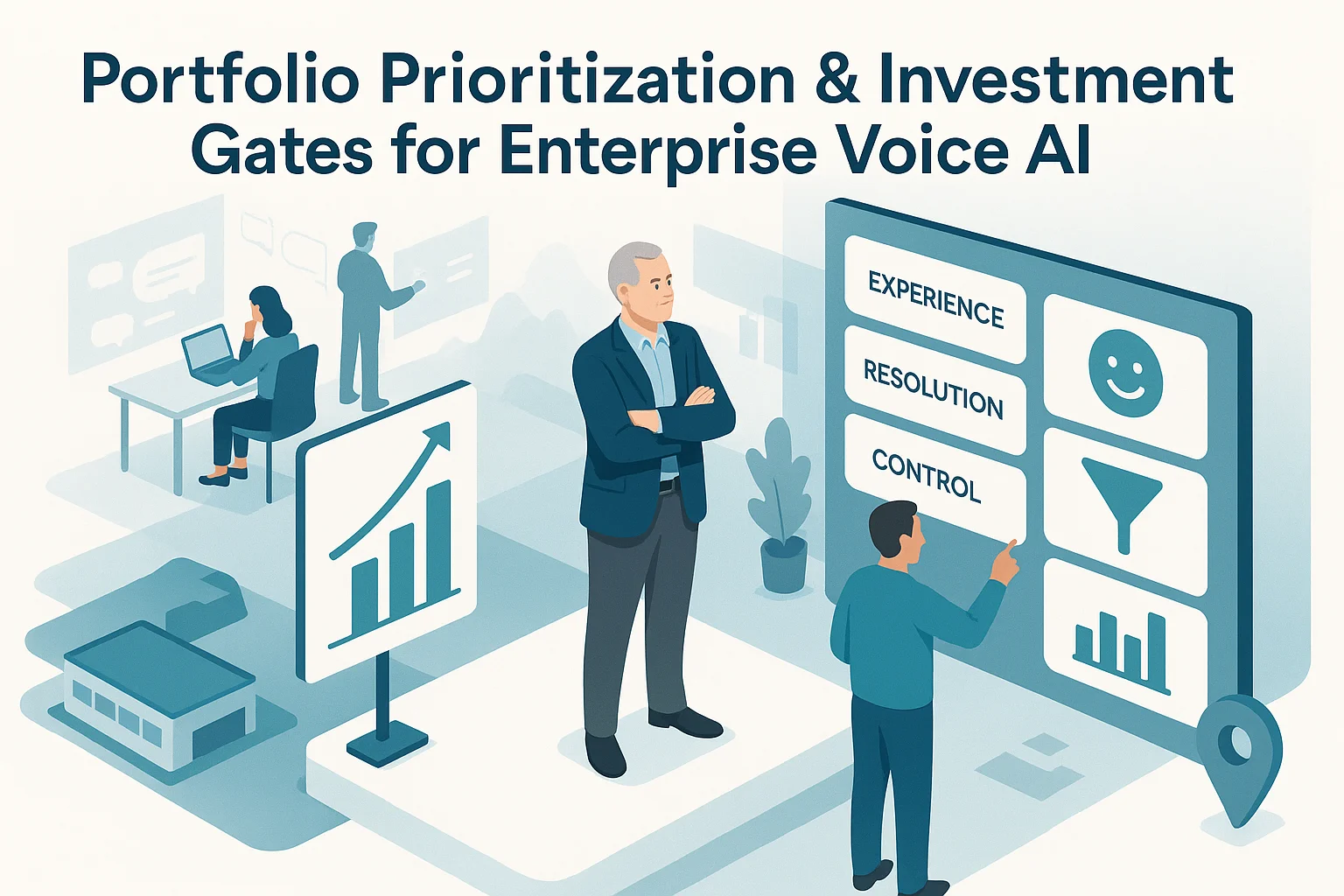
Define the success metrics that will determine when to expand, postpone, or retire a Voice AI use case. Use operational, customer, compliance, and financial KPIs. Make the investment gate explicit: a use case advances only if it meets a defined minimum on at least two outcome categories.
- Operational: containment rate, handoff latency, error budget, MTTI/MTTR for failures.
- Experience: customer satisfaction delta, contact deflection without increased repeat contacts.
- Compliance: audit completeness, consent capture, records retention and redaction where required.
2. Prioritisation framework: balancing value, risk, and effort
Use cases should be scored against three dimensions—Value, Risk, and Effort—to produce an actionable roadmap. Scores determine investment gates and the level of controls required before scaling.
Value / Risk / Effort matrix
Score each use case numerically on expected revenue or cost impact (Value), operational and regulatory exposure (Risk), and integration plus product effort (Effort). Map outcomes to four buckets: Quick Wins, Platform Investments, High‑Risk/High‑Value, and Low Priority.
- Quick Wins: high value, low risk, low effort — accelerate with standard gates.
- Platform Investments: moderate value, low risk, high effort — consolidate into roadmap for shared infrastructure.
- High‑Risk/High‑Value: high value, high risk — require strict human oversight, auditability and staged deployments.
- Low Priority: low value, high effort — deprioritise or prototype in isolated sandboxes.
Scoring details and gate thresholds
Define numeric thresholds that trigger different procurement and technical controls. For example, cases above a Risk threshold require documented human‑in‑loop procedures, dedicated audit logging, and a rollback plan before production. Use a central governance board to approve exceptions.
- Risk threshold sets mandatory human oversight and additional QA cycles.
- Effort threshold triggers reuse of platform adapters rather than one‑off builds.
- Value threshold informs budget sizing and SLA expectations.
3. Reference architecture and integration ownership
Design a reproducible architecture to reduce bespoke work and to make gates operationally enforceable. The following reference flow captures the essential integration and failure boundaries.
Reference flow and failure boundaries
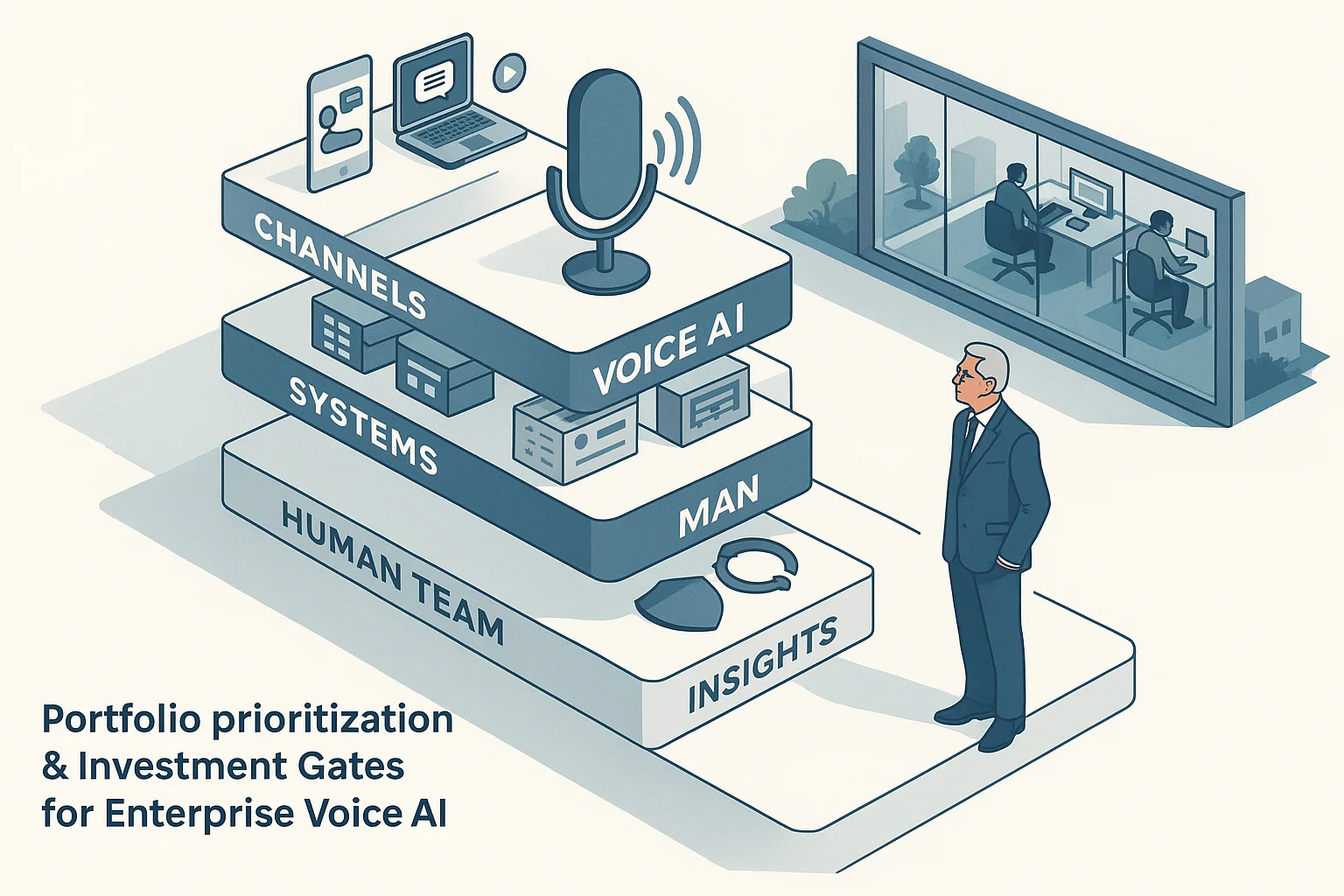
Adopt the canonical flow: Caller → Voice AI (ASR/NLU/Dialog) → business‑rules layer → approved enterprise systems (CRM/OMS/Payment/ERP) → response/transaction/human handoff → QA and analytics. Define explicit failure boundaries where automated processing must stop and a human takes over.
- Boundary 1: Input verification — block or require live verification on ambiguous identity or consent.
- Boundary 2: Transactional write — require two‑step confirmation or human approval before financial or safety‑critical transactions.
- Boundary 3: Escalation — predefine triggers for immediate human handoff (confidence thresholds, repeated failures, regulated inputs).
- Instrument each boundary with traceable audit logs and an auditable timestamped decision trail.
Integration ownership and adapters
Assign ownership for each integration: vendor, enterprise integrator, or a neutral middleware team. Prefer controlled adapters with approved APIs and role‑based credentials rather than direct database access. Standardise connectors for CRM, billing, and identity systems to reduce security variance.
- Vendor‑owned adapters should have SLAs for backward compatibility and documented change notifications.
- Enterprise teams should own identity, authorization, and production credentials.
- Use a business‑rules layer (policy engine) to decouple Voice AI logic from core systems and to centralise consent and validation logic.
4. Managed services: scopes, SLAs, and Peak Demand differentiators
Managed services are common for enterprise Voice AI. Procurement must define the managed scope precisely and require measurable controls for observability, QA, and security.
Defining managed‑service scope and SOW controls
Ask for line‑item descriptions: model hosting, speech stack maintenance, connectors, QA cycles, observability, on‑call support, and human‑escalation staffing. Require the SOW to specify responsibilities for integration changes, platform upgrades, and subprocessors.
- Clear ownership for enterprise system adapters and who performs breaking change testing.
- Change‑control procedures for conversational prompts, business rules, and model updates.
- Vendor obligation to provide structured audit logs and trace exports on demand.
Service levels, observability and Peak Demand differentiation
Negotiate SLAs that combine availability with operational observability. Beyond uptime, require error budgets, call latency percentiles, model confidence distributions, and monitoring of containment and handoff rates. Peak Demand differentiates by building custom infrastructure, logic bridges, QA automation, unified observability stacks, and managed optimisation focused on operational KPIs rather than black‑box model hosting.
- Observability: real‑time dashboards for call flows, error rates, and escalation counts.
- QA and human escalation: managed annotation workflows, sampling plans and rapid human takeover paths.
- Optimization: ongoing tuning and controlled A/B experiments delivered as part of the managed service.

5. Governance, QA and human oversight
Operational governance turns policy into repeatable controls. For regulated or high‑impact use cases, governance is the mechanism that enforces gates and documents decisions.
Operational controls, auditability and change control
Require auditable records for all automated decisions, configuration changes, and human interventions. Implement role‑based change approvals, mandatory test suites for updates, and immutable call‑level traces. Governance procedures should map to organisational risk tolerances and ensure escalation paths are documented and exercised.
- Immutable audit logs for inputs, model outputs, decisions and downstream actions.
- Role‑based access for production changes and documented rollback procedures.
- Regular audits and sampling of escalations and automated transactions.
Testing, measurement and rollback gates
Use staged deployments with quantitative acceptance criteria before a use case proceeds to the next gate. For generative or conversational models, include scenario‑based tests, adversarial prompts, and monitoring for hallucination or incorrect transaction responses. Define automated rollback triggers based on KPIs such as error budget breach or spike in handoffs.
- Staged canary and blue/green deployment patterns with live traffic quotas.
- Scenario test suites that mirror high‑risk customer journeys.
- Automated rollback when defined thresholds are exceeded.
6. Procurement checklist & explicit investment gates
Translate risks into contract terms. Use procurement instruments to make gates enforceable, and require visibility into hosting, subprocessors, and data flows.
Contractual items to demand
Contracts should specify hosting region, backup/geographic redundancy, subprocessors and their locations, remote‑support access methods, data retention and deletion obligations, breach notification timelines, and the mechanism for cross‑border transfers. Require the vendor to publish a subprocessor list and to notify the enterprise before onboarding new subprocessors.
- Hosting and backup geography with stated recovery objectives.
- Subprocessor list and documented transfer mechanisms for data moving across borders.
- Provisions for evidence: audit logs, trace exports, and independent audit access where applicable.
Investment gate checklist
Before moving a use case to production, require sign‑off on these items: security review, integration testing, AI/ML risk assessment, QA pass rate, defined rollback criteria, staffed escalation rota, and commercial KPIs that justify the next tranche of investment.
- Security and penetration testing for adapters and management endpoints.
- AI risk assessment and operational mitigation plan.
- Documented handoff SLAs and human resources allocated to escalation.
7. Implementation roadmap, failure modes and continuous optimisation
Structure phased delivery and define expected checkpoints for measurement, remediation, and scale decisions. Establish a continuous optimisation cadence to prevent degradation and to capture value.
90 / 180 / 365 day gates
Use time‑boxed gates tied to outcomes rather than calendar milestones. Example: 90 days for pilot stabilisation and baseline KPIs; 180 days for full integration and SLA attainment; 365 days for ROI review and platform consolidation. Each milestone includes required artifacts: audit logs, QA reports, performance dashboards, and documented incidents.
- 90 days: instrumented pilot, baseline metrics, documented failure responses.
- 180 days: production readiness, integration retrofit, SLA verification.
- 365 days: investment review, scale or sunset decision, and lessons‑learned archive.
Failure modes and continuous optimisation
Document the likely failure modes (ASR errors, NLU confusion, API timeouts, downstream transactional errors) and assign ownership for each. Maintain a continuous optimisation loop with KPI targets, A/B test plans, and governed model update processes. Keep high‑risk decisions behind manual controls until sustained evidence shows safe automation.
- Classify failures by detectability, severity and recoverability.
- Assign runbooks and MTTx targets for common failure classes.
- Use periodic audits and sample reviews to validate long‑running automation.
Related Peak Demand resources
Industry and AI sources reviewed
- Artificial Intelligence Risk Management Framework (AI RMF 1.0)National Institute of Standards and Technology (NIST)
- OECD AI PrinciplesOrganisation for Economic Co-operation and Development
- AI Risk Management Framework: Generative AI ProfileNational Institute of Standards and Technology (NIST)
Privacy, telecommunications, recording-consent, cybersecurity, consumer-protection, employment, and records obligations vary by jurisdiction and use case. This article is operational guidance, not legal advice; organizations should confirm applicable requirements with qualified professionals.
Frequently asked questions
A serious managed service should include discovery, workflow design, telephony, integrations, validation rules, testing, monitoring, human escalation, incident handling, change control, analytics, and ongoing optimization. The value is the complete operating system around the model, not access to a model alone.
Official reference: Artificial Intelligence Risk Management Framework (AI RMF 1.0)
The operating model should assign clear owners for telephony, prompts, knowledge, APIs, credentials, incident response, analytics, approvals, and release management. Enterprise buyers should avoid deployments where those responsibilities are ambiguous or split across vendors without accountability.
Official reference: Artificial Intelligence Risk Management Framework (AI RMF 1.0)
Evaluate the complete workflow under realistic volume, latency, interruption, transfer, integration, and failure conditions. Measure task completion, escalation quality, unsupported responses, system errors, recovery behavior, and how quickly operators can detect and correct problems.
Official reference: Artificial Intelligence Risk Management Framework (AI RMF 1.0)
Ask for documented use-case boundaries, data handling, access controls, model and prompt change management, evaluation procedures, audit logs, human-oversight rules, incident response, subcontractor dependencies, and a process for reviewing material system changes.
Official reference: Artificial Intelligence Risk Management Framework (AI RMF 1.0)
Need deeper enterprise Voice AI integration?
For custom APIs, SIP and telephony architecture, multi-system workflows, QA, observability, and enterprise deployment, Peak Demand commonly evaluates platforms such as Retell AI as part of a managed architecture.
Explore Retell for Enterprise Voice AIPeak Demand may earn a commission from this link.


