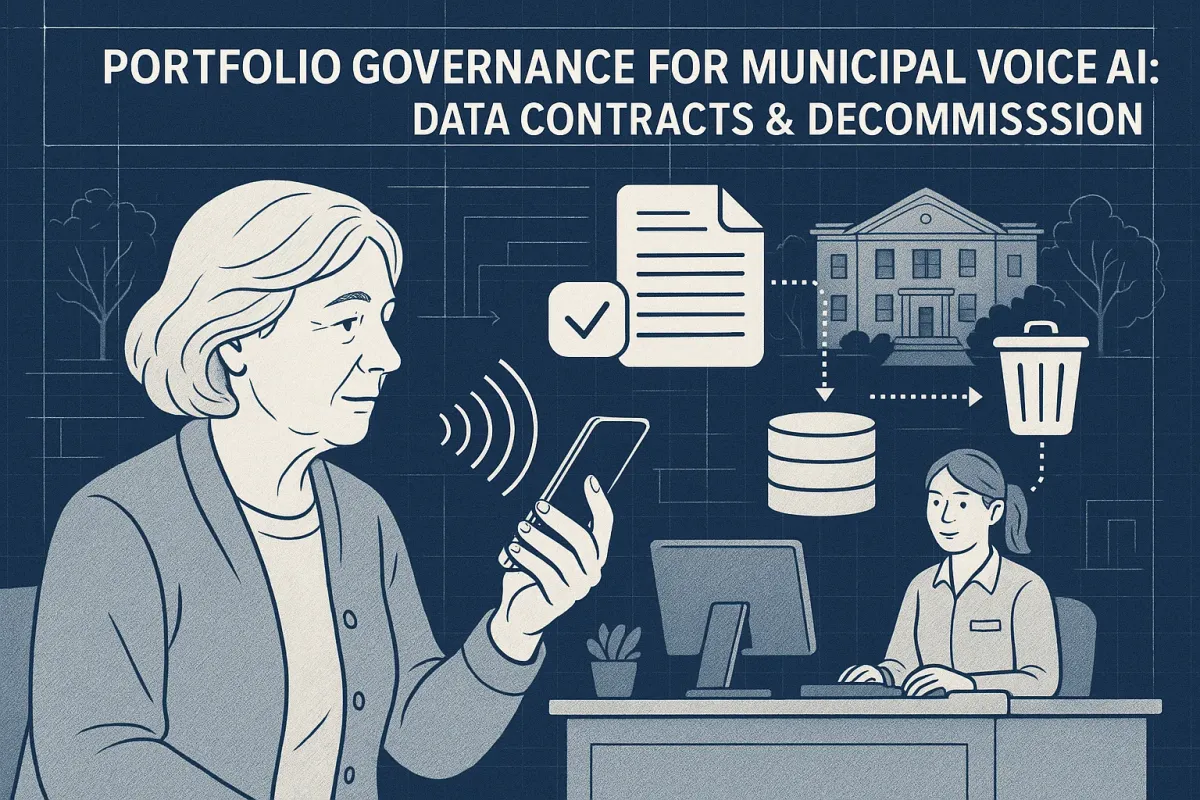
Portfolio Governance for Municipal Voice AI: Data Contracts & Decommission
A practical operating model for municipal Voice AI portfolios that ties resident intake to validated case records, prescribes data contracts and retention, and defines safe decommissioning and human‑oversight controls for regulated public services.
1. Why portfolio governance matters for municipal Voice AI
Municipal agencies adopt Voice AI to scale intake, reduce wait times, and provide 24/7 access. But a fragmented or undocumented portfolio risks lost records, inconsistent routing, inaccessible experiences, and unclear accountability. Strong portfolio governance aligns Voice AI projects with records, privacy, procurement, and human‑oversight obligations.
Operational risks that governance mitigates
Without governance, voice channels can produce orphaned interactions, conflicting validations, duplicate cases, and unclear chains of custody for public records. These outcomes can frustrate residents, complicate FOI or records requests, and increase legal and operational work for departments.
- Unvalidated intake leads to duplicate or rejected records in case systems.
- Lack of standard schemas makes cross‑department analytics and reporting unreliable.
- Undefined handoff rules push enforcement or sensitive decisions into automated systems inappropriately.
Goal of this framework
Provide a practical, jurisdiction‑neutral operating model that is decision‑useful for municipal leaders: specify interfaces and data contracts, define validation and duplicate controls, set human‑in‑the‑loop boundaries, and prescribe decommission workflows that preserve public accountability.
- Translate voice interactions into auditable case records with confirmation numbers.
- Keep controls and logs to support auditability, accessibility, and records management.
- Embed procurement and contract clauses that preserve data access and decommissioning rights.
2. Core operating model: Resident → Voice AI → case record
Operational clarity begins with a compact, repeatable flow. This section defines each element, integrations, and how the flow enforces validation and auditability.
Canonical intake flow
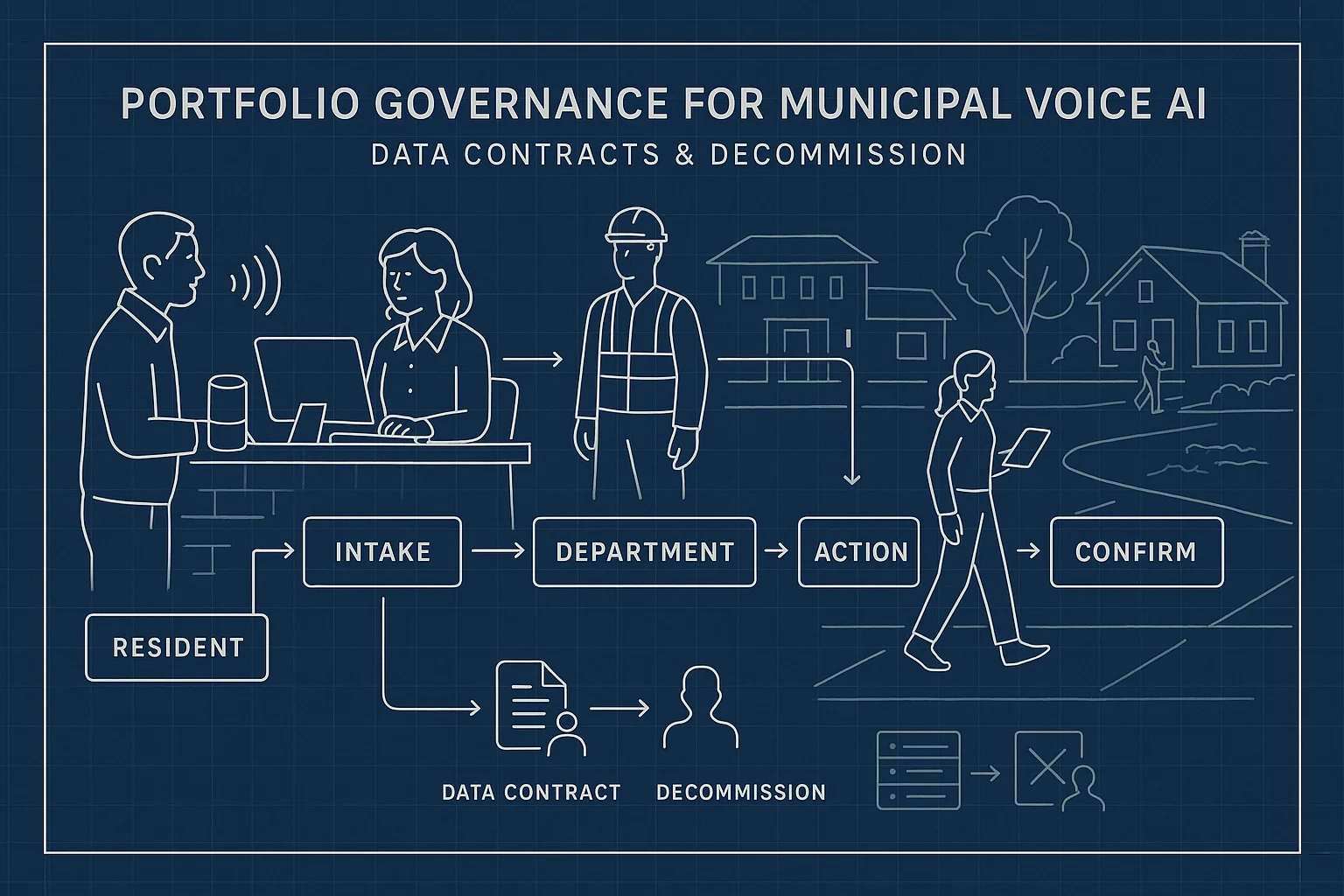
Use a single canonical pathway so every Voice AI interaction that intends to create or update municipal records follows the same validated conversion process. The minimal, recommended flow is: Resident → Voice AI → logic bridge → form & field retrieval → validation & duplicate controls → municipal case system → confirmation or human handoff. Keep emergency and sensitive escalations out of automated decisioning.
- Voice AI: conversational layer that captures intent and fields using prompts and dynamic forms.
- Logic bridge: stateless orchestration that maps fields to canonical schema, applies validation rules and duplicate checks, and calls downstream APIs.
- Form & field retrieval: canonical forms hosted as versioned schemas; downstream systems retrieve fields via approved APIs.
- Municipal case system: accepts validated payload or returns handoff tokens for human reviewers.
- Confirmation: issue persistent confirmation or case IDs for residents; log full interaction metadata for auditing.
Integration patterns and adapters
Integrate through approved APIs, controlled adapters, and orchestration layers—not by embedding business logic in the voice layer. The logic bridge should be the only component allowed to write to authoritative case systems. Keep connectors thin, documented, and versioned so decommissioning or vendor changes do not orphan records.
- Use standardized RESTful or event‑driven adapters with schema validation and field mappings.
- Implement rate‑limit and retry policies to protect case systems during surges.
- Log every API call, response, and payload hash for non‑repudiation and troubleshooting.
3. Data contracts and records lifecycle
Formal data contracts are the single most important control for converting conversational interactions into auditable municipal records. Contracts define schemas, validation, retention, residency, and access.
What a municipal data contract contains
A data contract should be machine‑readable and include: canonical schema (fields/types), mandatory validations, field provenance metadata (voice transcript excerpts, confidence scores), unique identifiers, retention class, allowed downstream processors, encryption and transfer rules, and audit log requirements.
- Canonical schema with types (text, geo, timestamp, identifier) and optionality.
- Validation rules (regex, geofencing, cross‑field constraints) enforced by the logic bridge.
- Provenance and trace metadata to show how each field was captured (voice confidence, ASR version).
- Retention class mapped to municipal records schedule and accessibility needs.
Duplicate controls and confirmation numbers
Use deterministic and probabilistic matching before writing a case. If a possible duplicate exists, surface a human decision or merge suggestion rather than creating a new case. Every successful write must return a stable confirmation number for the resident and a separate audit key for the municipal records team.
- Deterministic matches on explicit identifiers (account number, address) first.
- Probabilistic matches using normalized text, timestamps, and geography next.
- Human review workflow for ambiguous merges to maintain records integrity.
Data residency, transfers, and subprocessors
Document hosting region, backup geography, remote‑support access, subprocessors, and onward transfer mechanisms in the data contract and procurement documents. Where applicable, include transfer mechanisms (standard contractual clauses, adequacy decisions) and explicit retention and deletion instructions. Municipal leaders should confirm local obligations with legal counsel.
- List primary hosting region and backup regions used for archival copies.
- Specify allowed subprocessors and whether remote support engineers have cross‑border access.
- Define recording consent requirements and how recordings are tagged and stored.
4. Portfolio governance and change control
A municipal Voice AI portfolio needs a governance structure that ties product ownership, records policy, procurement, and IT security into an operational loop: propose → approve → deploy → monitor → retire.
Roles and responsibilities
Assign clear ownership across: a governance board (policy and records oversight), product owners (service experience and SLAs), IT/security (architecture and incident response), legal/privacy (contract and compliance), and operations (day‑to‑day monitoring and agent handoff).
- Governance board approves new voice services and decommissioning.
- Product owner authorizes schema changes and service KPIs.
- IT/security enforces integration policies, logging, and patching schedules.
Versioning, testing and deployment gates
Treat form schemas and logic bridge mappings as versioned artifacts. Changes should require automated tests: schema validation, duplicate detection simulation, negative‑case handling, and accessibility checks. Gate a schema or logic change until tests and a business‑owner signoff pass.
- Pre‑production mirrors for live traffic testing and acceptance criteria.
- Regression tests to ensure existing confirmation numbers remain resolvable.
- Accessibility checks to ensure alternate paths for those who cannot use voice.
Procurement and contract evidence
Procurement documents should require vendor disclosure of subprocessors, data flows, test reports, audit logs, and decommission plans. Preserve the right to export raw records and logs in open formats on contract termination.
- Require verifiable retention and deletion clauses, and archival export formats.
- Demand documented decommission procedures and dry‑run outcomes as part of evaluation.
- Request operational runbooks for human handoff and escalation.
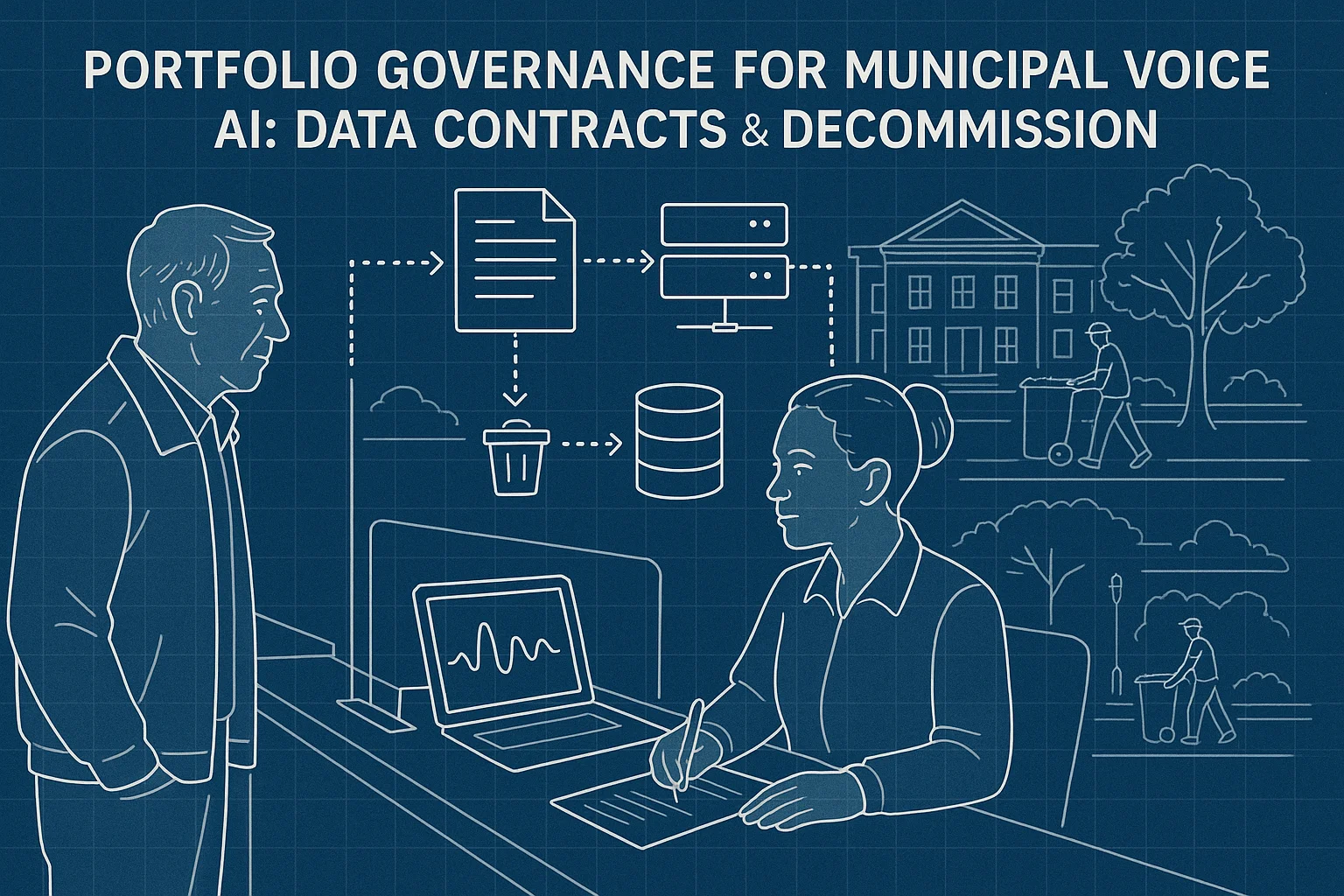
5. Human oversight, failure boundaries, and measurable controls
Human oversight is not optional for public services that involve enforcement, eligibility, legal consequences, or discretionary decisions. Define explicit failure boundaries and measurable controls that ensure safety and accountability.
Failure boundaries and mandatory human handoff
Automate intake and routing for non‑discretionary requests. Require human review when: the request implicates enforcement, when confidence thresholds fall below policy, when an appeal or eligibility decision is required, or when the resident requests a human. Log the reason for handoff to preserve audit trails.
- Set explicit confidence thresholds and field‑level flags that trigger agent callbacks.
- Never automate emergency calls, criminal enforcement, welfare eligibility, or legal determinations.
- Provide agents with a case context snapshot (confirmation ID, transcript excerpt, metadata) to reduce rework.
Observability and KPIs for governance
Observe both system and human metrics. Track: successful case writes, duplicate rate, validation failures, handoff frequency and reasons, confirmation ID resolution time, resident satisfaction, and audit log completeness. Use thresholds to trigger governance review.
- Operational KPIs: validation success rate, average time to confirmation, handoff percentage.
- Governance KPIs: schema change frequency, audit log completeness, data export test success.
- Security KPIs: failed integration attempts, patch lag, subprocessor incidents.
QA, red‑team, and auditing
Regular QA cycles should include scripted voice tests, live sampling, and red‑team scenarios that test edge cases (ambiguous addresses, multilingual input, domain‑specific terms). Keep testing results and remediation actions in an auditable trail.
- Include accessibility testing and assistive‑tech compatibility in QA plans.
- Retain test artifacts with timestamps and tester identities for post‑incident review.
- Schedule periodic third‑party audits as required by procurement or risk posture.
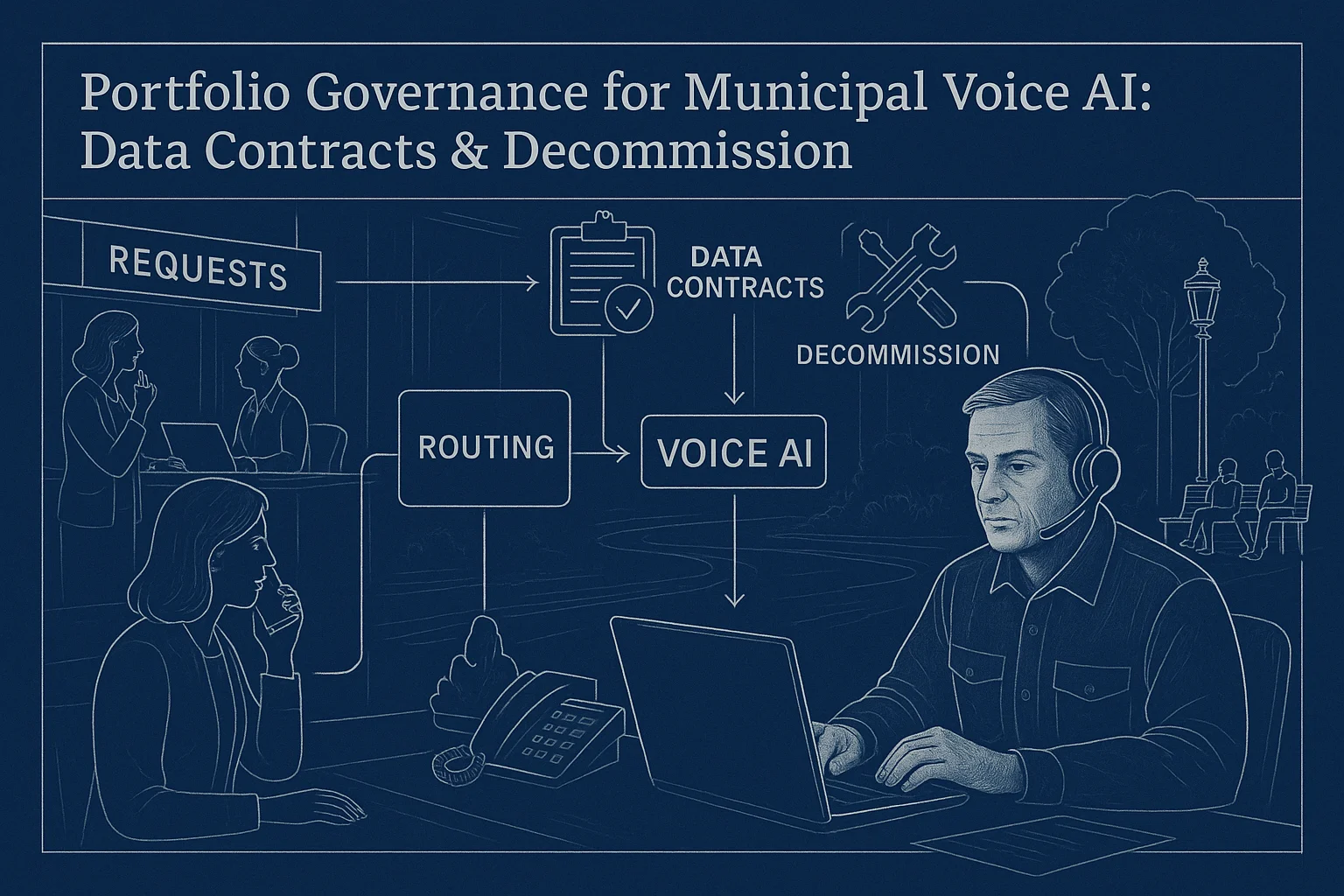
6. Decommission and safe sunsetting
Retiring a voice channel without a decommission plan risks permanent records loss, broken resident experience, and procurement disputes. Decommissioning must be treated as a reversible, documented program activity.
Criteria to trigger decommissioning
Common triggers: service consolidation, vendor termination, unacceptable risk posture, or migration to a new voice platform. Before any decommission action, evaluate the impact on records access, ongoing cases, and resident notifications.
- Identify all active cases and set a freeze period to prevent mid‑flight writes.
- Notify residents and provide alternate contact paths with their confirmation IDs.
- Confirm archival and export readiness for all stored interactions and logs.
Preserve records and ensure access
Export authoritative records and audit logs in open, documented formats. Preserve mapping between confirmation numbers and archived artifacts. Maintain read access to archived data for records officers, FOI teams, and auditors for the period defined in records schedules.
- Export transcripts, audio (if recorded), form payloads, confirmation IDs, and audit keys.
- Document retrieval APIs or export files with schema and checksum for integrity verification.
- Define the archival host, backup geography, and restoration SLA in the decommission plan.
Contract exit, subprocessors and onward transfer
Decommissioning commonly requires transferring data holders, revoking subprocessors, and certifying deletion. Include contractual clauses that mandate cooperation, a documented transfer mechanism, and proof of deletion where applicable.
- Require vendor cooperation for full data export and explicit deletion certificates.
- List subprocessors and their roles; secure necessary transfer agreements before handover.
- Keep a rollback plan and a short‑term read‑only fallover in case of export issues.
Related Peak Demand resources
Industry and AI sources reviewed
- ISO/IEC 27001 Information Security Management SystemsInternational Organization for Standardization
- ISO/IEC 27701 Privacy Information ManagementInternational Organization for Standardization
- Artificial Intelligence Risk Management Framework (AI RMF 1.0)National Institute of Standards and Technology (NIST)
- ISO/IEC 42001 Artificial Intelligence Management SystemInternational Organization for Standardization
- Cross-Sector Cybersecurity Performance GoalsCybersecurity and Infrastructure Security Agency (CISA)
- Algorithmic Impact AssessmentGovernment of Canada
Public-sector procurement, privacy, accessibility, records, cybersecurity, and administrative-law obligations vary by jurisdiction. This article is operational guidance, not legal advice; organizations should confirm applicable requirements with qualified professionals.
Frequently asked questions
Suitable workflows include structured resident inquiries, service-request intake, permit or program information, appointment scheduling, department routing, status updates from approved systems, and after-hours overflow. Adjudication, enforcement discretion, emergency response, and binding eligibility decisions should remain with authorized staff.
Official reference: Artificial Intelligence Risk Management Framework (AI RMF 1.0)
Use a controlled service catalogue, required fields, department ownership rules, validation, duplicate checks, confirmation numbers, and documented handoff paths. The system should create an auditable record and avoid silently dropping requests when a downstream system is unavailable.
Official reference: Algorithmic Impact Assessment
Municipal deployments should document purpose, affected services, data use, human oversight, complaint and appeal paths, accessibility channels, records handling, monitoring, and the process for approving material changes.
Official reference: Algorithmic Impact Assessment
Require workflow demonstrations, integration and security architecture, testing evidence, auditability, data-location and subcontractor details, incident response, accessibility support, human escalation, exit planning, and clear ownership of ongoing updates.
Official reference: Artificial Intelligence Risk Management Framework (AI RMF 1.0)
Modernize public-service intake without losing control
Peak Demand helps municipal teams connect Voice AI to service requests, department routing, validation, escalation, records, and operational analytics.
Schedule a discovery call


