
Portfolio Governance and Capital Allocation for Enterprise Contact‑Centre Voice AI
A practical guide for enterprise leaders to structure governance, capital allocation, and vendor selection for Voice AI across contact‑centre portfolios. Includes architecture patterns, managed‑service boundaries, QA controls, observability, and procurement-ready decision criteria.
1. Portfolio governance: structure, priorities, and funding
Voice AI deployments succeed when treated as a portfolio of capabilities with clear owners, prioritized funding, and stage‑gated delivery. This section describes the governance constructs you need to decide which automations to build, how to fund them, and who signs off.
Define scope and portfolio taxonomy
Classify contact‑centre automations into a simple taxonomy: informational (low risk), transactional (moderate risk), and decisioned (high risk). Use this taxonomy to assign risk‑based controls, SLA targets, and capital buckets. Low‑risk flows (status checks, FAQs) are life‑cycle candidates for rapid automation; high‑risk flows (billing disputes, credit decisions, clinical triage) must remain under explicit human oversight and stricter procurement controls.
- Map each flow to risk tier, expected call volume, and rough automation value.
- Require a business owner, SRO (senior responsible officer), and a technical owner for every portfolio item.
- Set capital buckets: discovery and prototype, build and integration, and sustained operations (monitoring, QA, optimization).
Governance bodies and stage gates
Create a Voice AI council (cross‑functional: CX, operations, IT, security, procurement, legal) and an operational centre of excellence (COE) responsible for repeatable build, observability, and QA patterns. Use stage gates: discovery, risk assessment, pilot, production, and sunset. Approve funding at stage transitions based on measurable criteria (user satisfaction, containment, error rates, security findings).
- Council approves portfolio prioritization and risk appetite.
- COE enforces architecture, integration patterns, and auditability.
- Stage‑gate criteria should include test cases, fallback and escalation patterns, and retraining plans.
2. Reference architecture and integration boundaries
A predictable runtime topology limits operational surprises. Adopt a canonical flow and make integration and failure boundaries explicit in procurement documents.
Canonical runtime: Caller → Voice AI → business‑rules layer → enterprise systems → response/handoff → QA
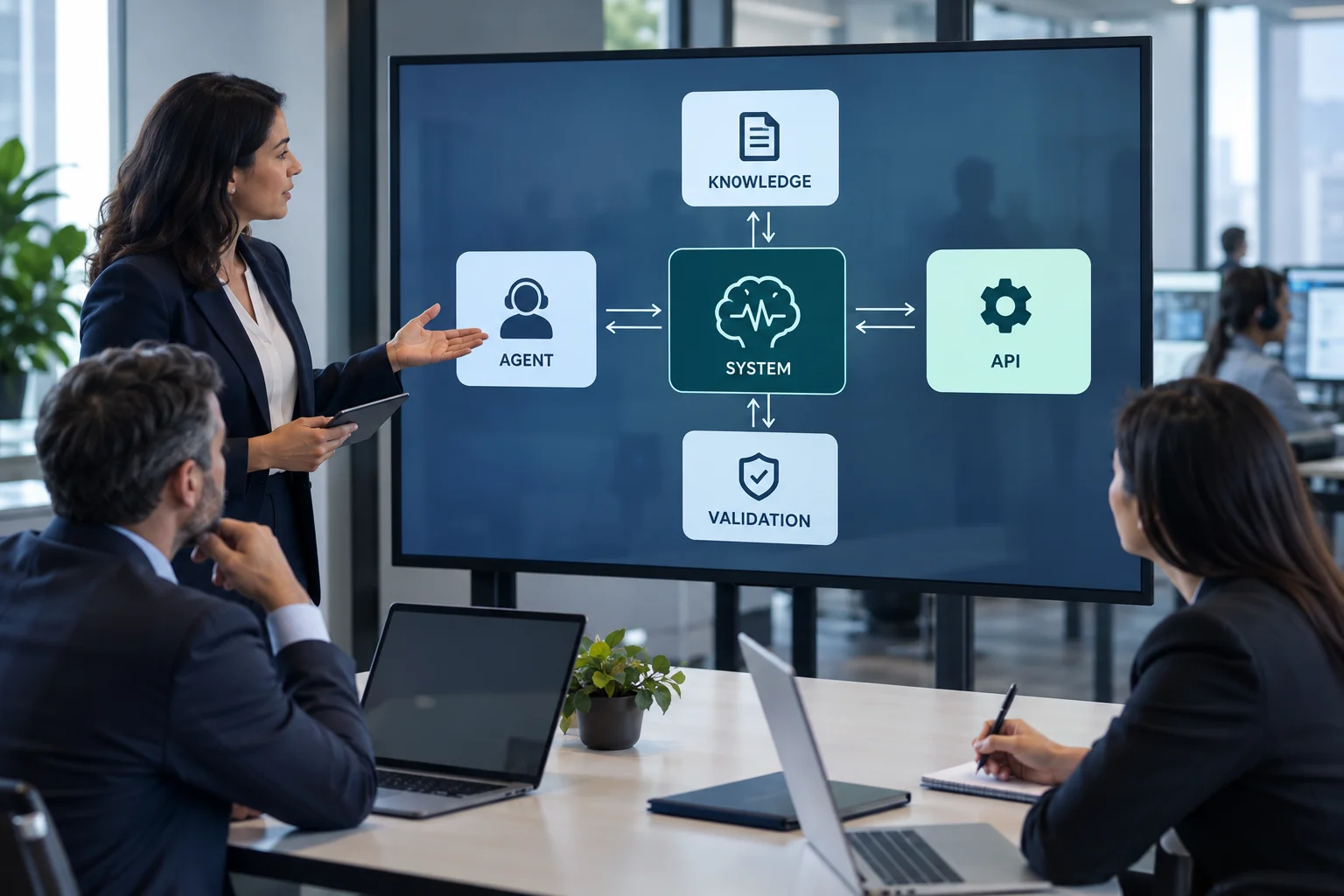
Operationalize a single reference pattern across projects: inbound caller connects to the Voice AI runtime which handles ASR/NLU and dialog. The Voice AI calls a business‑rules layer (stateless or stateful microservice) that enforces approvals, routing logic, fraud checks, and policy decisions. Approved enterprise systems (CRM, billing, ticketing) are accessed only through controlled adapters. The runtime either emits a response/transaction or triggers a human handoff. All interactions produce auditable records forwarded to QA and analytics systems.
- Enforce approved APIs and controlled adapters for all system access.
- Separate the business‑rules layer to keep policy and approvals out of model prompts.
- Persist call transcripts, decision logs, and transactional confirmations to an immutable record store for audit and QA.
Integration and hosting considerations
Specify hosting region, backup region, subprocessors, remote support access, and data‑at‑rest locations during procurement. Define acceptable cross‑border transfer mechanisms, retention policies for recordings and transcripts, and backup geography. Require vendors to describe remote access methods (VPN, jump host, role‑based privileges) and subprocessors used for cloud services or specialist AI tooling.
- Include explicit expectations for subprocessors and onward transfers.
- Require clear data retention, recording‑consent capture, and breach‑notification procedures.
- Ensure failover topology and backup region are documented and tested.
3. Managed service boundaries and vendor selection
Decide early which responsibilities remain in‑house and which are outsourced. Structure contracts to make responsibilities, observability, and change control auditable.
Scope: who owns what
Define ownership boundaries for: integration adapters, business‑rules, data retention, records and audit, human escalation, and security controls. For higher control, retain business‑rules and sensitive integrations in‑house; for rapid scale, procure a managed service that provides hardened adapters and an operations team. Require vendors to document exactly which artifacts they will operate, which they will maintain, and what handover looks like.
- Specify ownership for adapters to CRM/CIS/ERP, including test suites and rollback procedures.
- Clarify whether the vendor runs model inference, or if inference runs on your cloud under a managed contract.
- Make human escalation routing and tiered ownership part of the operational SLA.
Selection criteria and proof-of-play
Ask vendors for: documented integration playbooks, failure‑mode test results, a reproducible QA suite, observability dashboards, and runbooks for human escalation. Require proof‑of‑play: a staged pilot with scripted failure scenarios (API outage, misrecognition, data mismatch) and measurable KPIs. Include audit rights to review code, adapters, and records for compliance-sensitive projects.
- Require vendor evidence of tested adapters and documented failure rehearsals.
- Include observability primitives in the contract: traces, metrics, call sampling, and secure log access.
- Contractually require a security incident and breach response plan with explicit timelines.

4. QA, observability, and human oversight
Operational reliability depends on measurable QA, continuous monitoring, and human oversight that is auditable and actionable.
Auditable QA and change control
Treat model updates, prompt or prompt‑template changes, and business‑rule updates as controlled changes. All changes should pass automated regression suites (functional, privacy, security), a signed approval by the business owner, and a staged rollout with rollback capability. Persist change metadata and test results in an immutable change log accessible by auditors.
- Require automated test coverage that exercises high‑risk paths and fallbacks.
- Log rationale and approvals for each change to satisfy audit trails.
- Use canary releases and monitor error budgets tied to business KPIs before full rollout.
Observability and operational metrics
Instrument Voice AI with traces, request/response latency, recognition accuracy proxies, fallback and handoff rates, containment, false‑positive/false‑negative flags for intent detection, and customer satisfaction signals. Define SLOs (e.g., containment percentage, mean time to human escalation) and link them to runbooks and on‑call responsibilities.
- Capture sampling of audio, transcripts, decision logs, and downstream API responses for root cause analysis.
- Surface business‑metric KPIs in the same dashboard as technical telemetry for operational alignment.
- Ensure retention windows and access controls for observability data are documented.
Human oversight and escalation design
Design handoffs with clear preconditions (confidence thresholds, policy triggers, fraud indicators) and deterministic routing rules. Train escalation agents with provided context: short transcript summary, decision log, and suggested resolution options. Maintain a human review queue with SLA commitments and metrics on review quality and remediation actions.
- Use confidence and business‑rule triggers to determine deterministic handoffs.
- Provide agents with a compact, auditable context card for each handoff.
- Document who can override automated decisions and how overrides are recorded.
5. Security, privacy, and compliance controls
Security and privacy are non‑negotiable. Specify controls that reflect the portfolio's risk tiers and ensure legal/contractual obligations are captured in procurement documents.
Data minimization and access control
Minimize data forwarded to third parties and to model inference where possible. Apply role‑based access control to transcripts and decision logs, and separate environments for dev/test and production. Use tokenized or masked attributes for PII when downstream systems support it.
- Define what data elements are required for processing and what can be redacted or pseudonymized.
- Maintain separate keys and accounts for dev/test versus production.
- Keep a documented list of subprocessors and their purposes.
Breach, retention, and cross‑border considerations
Require vendors to describe breach notification timelines, retention policies for recordings/transcripts, and geographical locations used for storage and backups. Buyers should confirm obligations with qualified legal/privacy professionals; jurisdictional requirements vary. Document mechanisms for cross‑border transfers and whether encryption or contractual safeguards are used.
- Include retention and deletion guarantees for recordings and transcripts.
- Document backup geography and restoration procedures.
- Specify breach notification SLAs and evidence requirements for forensics.

6. Procurement playbook and implementation roadmap
Translate governance and architecture into procurementable artifacts and a practical rollout plan. Keep capital allocations aligned with proven outcomes and decommission paths.
Procurement artifacts to include
Issue an RFP or SOW that includes: the reference architecture diagram, itemized responsibilities matrix, integration and failure‑mode tests, observability and data access requirements, audit rights, and a staging plan with acceptance criteria. Require vendors to return a risk register and a runbook as part of their bid.
- Attach stage‑gate acceptance criteria against which capital is released.
- List required deliverables: adapters, test harness, runbooks, audit logs, and training materials.
- Insist on defined remediation obligations for security or performance failures.
Implementation phases and KPIs
Run projects as a sequence: discovery & risk assessment, pilot with scripted failures, phased rollout by queue or geography, and sustained operations with continuous improvement. Track containment rate, human escalation rate and MTTR, transcript QA scores, and business outcomes (e.g., average handle time for combined automated/human workflows). Reallocate capital toward flows that meet containment and customer‑experience thresholds.
- Use short pilots to de‑risk integrations and show measurable operational gains.
- Move up the value chain only once QA and observability meet defined thresholds.
- Plan decommission and rollback costs as part of total cost of ownership.
Peak Demand differentiation: what to expect from a specialized partner
When engaging a partner, prefer firms that provide custom infrastructure for sensitive workloads, logic bridges for legacy systems, hardened integration adapters, dedicated QA pipelines, observability tooling aligned with your telemetry stack, and managed optimization services that tune behaviour without replacing governance. Require documented human‑escalation workflows and contractual SLAs for runbook execution.
- Custom infrastructure reduces unintended data exposure for regulated workloads.
- Logic bridges isolate legacy systems from evolving model interfaces.
- Managed optimization should deliver measurable improvement cycles with transparent change logs.
Related Peak Demand resources
Industry and AI sources reviewed
- Artificial Intelligence Risk Management Framework (AI RMF 1.0)National Institute of Standards and Technology (NIST)
- OECD AI PrinciplesOrganisation for Economic Co-operation and Development
- AI Risk Management Framework: Generative AI ProfileNational Institute of Standards and Technology (NIST)
Privacy, telecommunications, recording-consent, cybersecurity, consumer-protection, employment, and records obligations vary by jurisdiction and use case. This article is operational guidance, not legal advice; organizations should confirm applicable requirements with qualified professionals.
Frequently asked questions
A serious managed service should include discovery, workflow design, telephony, integrations, validation rules, testing, monitoring, human escalation, incident handling, change control, analytics, and ongoing optimization. The value is the complete operating system around the model, not access to a model alone.
Official reference: Artificial Intelligence Risk Management Framework (AI RMF 1.0)
The operating model should assign clear owners for telephony, prompts, knowledge, APIs, credentials, incident response, analytics, approvals, and release management. Enterprise buyers should avoid deployments where those responsibilities are ambiguous or split across vendors without accountability.
Official reference: Artificial Intelligence Risk Management Framework (AI RMF 1.0)
Evaluate the complete workflow under realistic volume, latency, interruption, transfer, integration, and failure conditions. Measure task completion, escalation quality, unsupported responses, system errors, recovery behavior, and how quickly operators can detect and correct problems.
Official reference: Artificial Intelligence Risk Management Framework (AI RMF 1.0)
Ask for documented use-case boundaries, data handling, access controls, model and prompt change management, evaluation procedures, audit logs, human-oversight rules, incident response, subcontractor dependencies, and a process for reviewing material system changes.
Official reference: Artificial Intelligence Risk Management Framework (AI RMF 1.0)
Need deeper enterprise Voice AI integration?
For custom APIs, SIP and telephony architecture, multi-system workflows, QA, observability, and enterprise deployment, Peak Demand commonly evaluates platforms such as Retell AI as part of a managed architecture.
Explore Retell for Enterprise Voice AIPeak Demand may earn a commission from this link.


