Portfolio and Data Governance for Predictive Outage Response with Voice AI
A practical operating framework for utilities to govern Voice AI in predictive outage response: portfolio controls, data contracts, integration patterns, validation, escalation, and measurable outcomes.
1. Scope, use cases, and governance posture
Define the operating perimeter before design or procurement. Predictive outage response has distinct safety, privacy, and operational boundaries compared with routine billing or appointment workflows.
Operational scope and prohibited actions
Limit Voice AI roles in predictive outage response to customer communication, intake of service requests, status queries, and routing to field or contact-centre staff. Do not permit Voice AI to execute control-plane operations, issue crew work directives, or make safety-critical decisions. Maintain explicit human ownership for any action that affects distribution or field safety, and log every decision that leads to dispatch or safety escalation.
- Allowed: outage information, outage-acknowledgement, validated service requests, scheduled callbacks, automated status updates.
- Prohibited: remote switching commands, real-time grid control, issuing lockout or clearance, replacing emergency dispatch.
Portfolio governance model
Treat Voice AI deployments as a portfolio of capabilities—examples: predictive outage notifications, self-service outage reporting, outage-status queries, and field-service scheduling. Assign each capability a product owner, risk tier (low/medium/high), and lifecycle plan. For each item record data flows, APIs used, SLA commitments, fallback plans, and acceptance criteria.
- Risk-tier determines needs for human oversight, logging retention, and periodic third‑party audit.
- Use sprinted rollout by risk tier: non-sensitive notifications first; validated intake and service-request creation later.
- Maintain a register mapping capability → owner → integration endpoints → escalation SOP.
Linking governance to existing frameworks
Integrate Voice AI governance with enterprise incident and change-management processes. Ensure product owners coordinate with outage-communications, field operations, IT, and regulatory teams. For a practical governance baseline see Peak Demand’s operational guidance on safety-critical customer operations.
- Embed Voice AI change requests into the utility’s change advisory board (CAB) with required test evidence.
- Use the governance register to scope compliance reviews, privacy impact assessments, and cyber risk scans.
2. Data contracts, event architecture, and provenance
Predictive outage response depends on reliable signals from AMI, SCADA summaries, weather, CRM/CIS, and OMS. Formalize what data is used, where it lives, and who can act on it.
Data contracts and event schemas
Create machine-readable data contracts that define event schema, field types, authoritativeness, and TTL. Contracts should specify canonical source (e.g., OMS outage ID), expected event cadence (push vs poll), allowed transformations, and conflict-resolution rules. Ensure an event envelope includes provenance metadata: source system, event timestamp, sequence number, and confidence score.
- Use versioned contracts to prevent silent breakage during upgrades.
- Reject or quarantine events that violate schema or lack provenance.
- Map contract fields to Voice AI intents unambiguously to avoid misinterpretation.
Event routing and adapters
Use controlled adapters to convert enterprise events into Voice AI consumable messages. Adapters enforce security, validation, rate limiting, and masking before data reaches the Voice AI runtime. Prefer approved utility APIs and read-only knowledge sources for status lookups; use narrow write APIs for creating service requests with explicit authorization tokens and scoped permissions.
- Adapters should implement retry logic, circuit breakers, and clear failure codes for Voice AI to surface to customers.
- Segment event topics: critical outage changes, estimated-restoration-time updates, customer-reported events, and billing queries.
Provenance, retention, and cross-border considerations
Specify retention periods for call recordings, transcripts, and event logs tied to the portfolio risk tier and legal obligations. Document geographic hosting (primary region, backup region), subprocessors, and any cross‑border transfers. Where data residency or localization is a regulatory factor, assign higher-tier capabilities to local-only processing or implement tokenization to minimize transfers. Confirm specific obligations with legal counsel.
- Record and store an immutable audit trail for each customer interaction that leads to an OMS/CIS change.
- Define which data elements are replicated across regions and which remain in-region.
3. Integration architecture and core workflow
Operational clarity demands a canonical workflow with explicit control points. This pattern minimizes ambiguity during high-volume outage events.
Canonical workflow
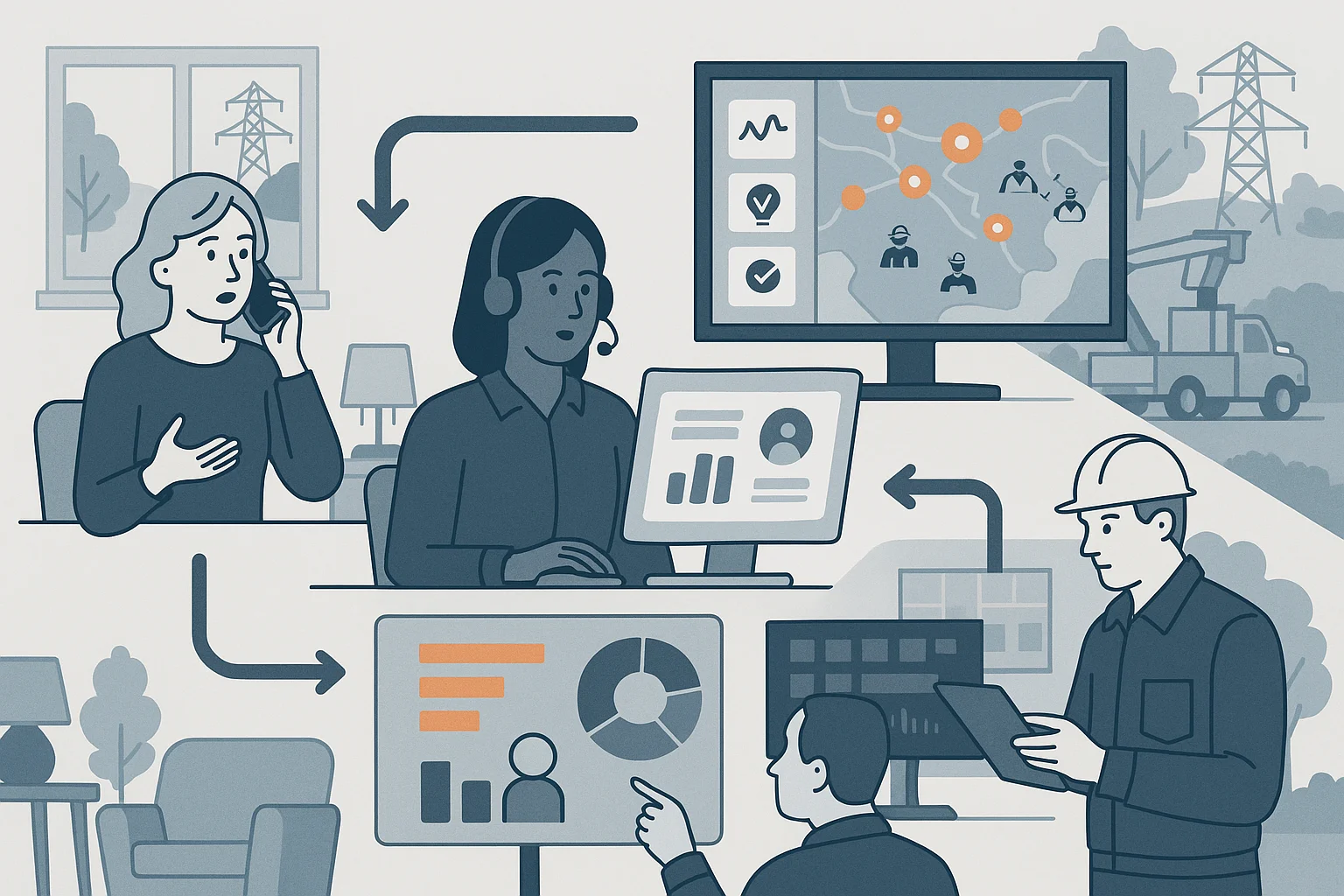
Design the primary operational flow as: Customer call → Voice AI intake → account or premise validation → lookup to approved API or knowledge source → determine action: service request creation, status response, or human escalation. Each transition must be guarded by policy checks and produce audit metadata.
- Validation gates: CLI/ANI match, multi-factor voice phrase or callback verification for account-sensitive actions.
- Decision gates: if confidence < threshold then escalate to human; if external API unavailable then play standard script and offer callback.
- All write actions (e.g., creating an OMS ticket) require a scoped write token and a second‑factor service confirmation where mandated by policy.
Supported integration patterns
Use a small set of hardened integration patterns: read-only lookups (status, ETAs), idempotent write APIs for service-request creation, event subscriptions (push), and batch reconciliation. Avoid brittle point-to-point connectors; prefer an event bus or orchestration layer that centralizes routing, auditing, and throttling.
- Implement idempotency keys for service requests to prevent duplicate work during retries.
- Use standard response codes and structured failure reasons so Voice AI can map to consistent customer messages.
Where to place the ‘control plane’
Centralize control-plane logic (validation, authorization, routing rules) outside the Voice AI runtime in a thin orchestration layer owned by the utility. This preserves a clear separation: Voice AI handles human-language interaction; the orchestration layer enforces business rules and talks to OMS/CIS/CRM through approved APIs.
- Benefits: consistent policy enforcement, single source of truth for authorization, simpler audit trails.
- Keep orchestration code versioned and subject to the utility’s release governance.

4. Operational controls: validation, escalation, and QA
High-volume outage events stress people and systems. Implement controls that preserve customer trust, protect accounts, and maintain operational continuity.
Account-safe validation and fraud controls
Use multi-signal validation before permitting account-sensitive actions. Combine ANI/CLI, callback validation, account-specific challenge questions, and cross-checks against recent activity. Place higher-verification requirements for actions that create work orders or change service status.
- Implement risk-based thresholds: low-sensitivity queries may use ANI alone; service-request creation requires callback or PIN validation.
- Log verification proof points in the audit trail (which signal validated and their timestamps).
Human-in-the-loop escalation and routing
Design explicit escalation paths with SLA-backed routing rules: when and how Voice AI transfers a call, what context accompanies the handoff, and how the receiving agent verifies prior validation steps. Include an emergency escalation flow for safety-related reports that immediately pages field operations and the duty dispatcher.
- Attach a structured context package (OMS outage ID, customer verification summary, and relevant transcripts) to each escalated interaction.
- Measure and report escalation latency and percent of escalations with complete context.
Quality assurance and continuous testing
Implement layered QA: synthetic testing for intent accuracy, integration contract testing, and sampling of real interactions for human review. Define acceptance criteria by capability; for higher-risk capabilities require a higher acceptance threshold and a slower rollout cadence.
- Automate contract tests for all APIs; fail deployments on contract drift.
- Use labeled interaction sets to periodically benchmark transcription and intent accuracy.

5. Security, risk management, and compliance baseline
Voice AI introduces specific AI-related risks plus standard cybersecurity concerns. Use established frameworks to set a baseline and document gaps.
AI risk and critical infrastructure alignment
Assess AI-specific risks—output reliability, model drift, and hallucination—using an AI risk framework adapted for critical infrastructure. Map Voice AI capabilities to an AI risk register and require mitigation controls (validation gates, human review, conservative confidence thresholds) for medium and high-risk items.
- Document model provenance, training-data constraints, and the expected failure modes for each capability.
- Require pre-deployment risk assessments and periodic re-evaluations.
Cybersecurity and operational resilience
Use cross-sector cybersecurity performance goals to define minimum controls for identity, privileged access, endpoint security, logging and monitoring, and supply-chain risk. Align defensive controls and maturity goals with energy-sector models to keep outage workflows resilient during events.
- Maintain least-privilege access for integration tokens; rotate credentials and store them in hardened vaults.
- Monitor integration endpoints for anomalous patterns and implement automated failover.
Third-party processors and remote access
Document subprocessors, remote-support access methods, and backup geographies. Contractually require subprocessors to support incident notification timelines and independent audits. For cross-border transfers and data residency, identify what data elements are permitted to move and which must remain local. Confirm obligations with legal and privacy teams.
- Define breach duties, notification SLA, and minimum evidence in vendor contracts.
- Limit remote administrative access to jump hosts with multi-factor authentication and session recording.
6. Procurement, deployment choices, and measurable outcomes
Procurement and vendor selection should be driven by operational needs and measurable KPIs rather than feature checklists alone.
Evaluation criteria and evidence
Request evidence aligned to the portfolio risk tier: architecture diagrams, integration contracts, incident response playbooks, audit logs, and sample anonymized transcripts. For managed-service bids require clear scopes—who owns integrations, who owns orchestration, and who responds to incidents—and hold vendors to defined SLAs for latency and availability.
- Ask for third-party penetration test reports, data-flow diagrams, and a runbook for high-volume events.
- Confirm vendor responsibilities for regulatory data requests and subpoenas.
Deployment options and tradeoffs
Choices include on-premises adapters for sensitive data, cloud-hosted Voice AI with local-only orchestration, or fully managed services. Tradeoffs: on-prem adapters offer stronger residency guarantees but increase operational overhead; managed services accelerate time-to-value but require careful subprocess and remote-support controls. Map the tradeoff matrix to the portfolio risk tiers before selection.
- Prefer hybrid: local orchestration and validation with cloud-hosted natural-language capabilities when residency or latency is a concern.
- Define rollback and dark-launch plans for every go-live.
Operational KPIs and dashboards
Measure outcomes that matter operationally: intent accuracy by capability, percent of validated service requests that become valid OMS tickets, escalation rate and latency, integration success rate, and system capacity during peak event windows. Use event-level analytics to reconcile Voice AI actions against OMS/CIS outcomes for continuous improvement.
- Example KPIs: integration availability, false‑acceptance rate for validation gates, mean time to human-hand-off, and percent of escalations with complete context.
- Report KPIs monthly and publish a post-event after-action for major outage events.
Related Peak Demand resources
Industry and AI sources reviewed
- AI Risk Management Framework — Critical Infrastructure ProfileNational Institute of Standards and Technology (NIST)
- Cross-Sector Cybersecurity Performance GoalsCybersecurity and Infrastructure Security Agency (CISA)
- Cybersecurity Capability Maturity Model (C2M2)U.S. Department of Energy
Utility cybersecurity, critical-infrastructure, records, customer-protection, and emergency-communications obligations vary by jurisdiction and service type. This article is operational guidance, not legal advice; organizations should confirm applicable requirements with qualified professionals.
Frequently asked questions
Use Voice AI to absorb high call volumes, provide approved outage and restoration messaging, validate the caller's account or service location, capture non-emergency service details, and route exceptions to trained staff. It should not estimate restoration times unless those estimates come from an approved utility system of record.
Official reference: Cross-Sector Cybersecurity Performance Goals
The integration design typically depends on the use case, but common systems include the customer information system, outage management system, CRM, knowledge base, notification platform, scheduling tools, and service-request or work-order systems. The Voice AI layer should receive only the data and actions required for the approved workflow.
Official reference: Cybersecurity Capability Maturity Model (C2M2)
No. Voice AI should remain a customer-communication, intake, validation, routing, and escalation layer. Infrastructure control, switching, dispatch authority, emergency response, and safety-critical decisions must remain within approved operational systems and qualified human teams.
Official reference: Cross-Sector Cybersecurity Performance Goals
Ask for evidence of surge and latency testing, account and premise validation, integration failure handling, auditable logs, data minimization, human escalation, change control, incident response, monitoring, and a clear operating model for updates after launch.
Official reference: Cross-Sector Cybersecurity Performance Goals
Build resilient utility customer-service automation
Peak Demand helps utilities connect Voice AI to approved customer-information, outage-communication, service-request, dispatch, escalation, and analytics workflows.
Schedule a discovery call


