
Policy and Appeals Control Plane for Municipal Voice AI Decisioning
A practical operating model and control plane for municipal Voice AI decisioning that preserves resident trust, ensures accountable appeals, and integrates safely with case systems and human teams.
Why a Dedicated Policy and Appeals Control Plane Matters
Voice AI can route thousands of resident interactions into municipal business systems. A policy and appeals control plane separates decision logic from conversational capabilities so that policy owners can maintain rules, appeals workflows, and audit trails without reengineering voice models.
Control plane defined for municipal decisioning
A policy and appeals control plane is a managed layer that stores decision rules, mapping tables, appeal rights, and handoff criteria. It exposes those rules through controlled APIs to the Voice AI runtime (the conversational layer) and to downstream case systems. For municipalities this means policy teams, legal counsel, and operations staff can update routing, eligibility checks, and appeal paths without retraining voice models or redeploying contact-center logic.
- Stores rule versions, effective dates, and responsible owners.
- Implements appeal eligibility logic (who can appeal, time windows, priority tiers).
- Provides an auditable change log for public-accountability records.
Operational benefits and boundaries
Operational advantages include faster policy updates, consistent cross-channel decisioning, and clear handoff criteria for human review. Equally important are failure boundaries: keep emergency response, enforcement discretion, legal determinations, and eligibility decisions for benefits or entitlements in human hands. The control plane should explicitly mark these decision classes as 'human-only' and route them to trained staff.
- Enables consistent application of municipal policy across voice, web forms, and chat.
- Reduces model drift risk by removing static policy from conversational prompts.
- Clarifies when automated decisions are provisional and require staff confirmation.
Resident-to-Case Architecture: A Practical Flow
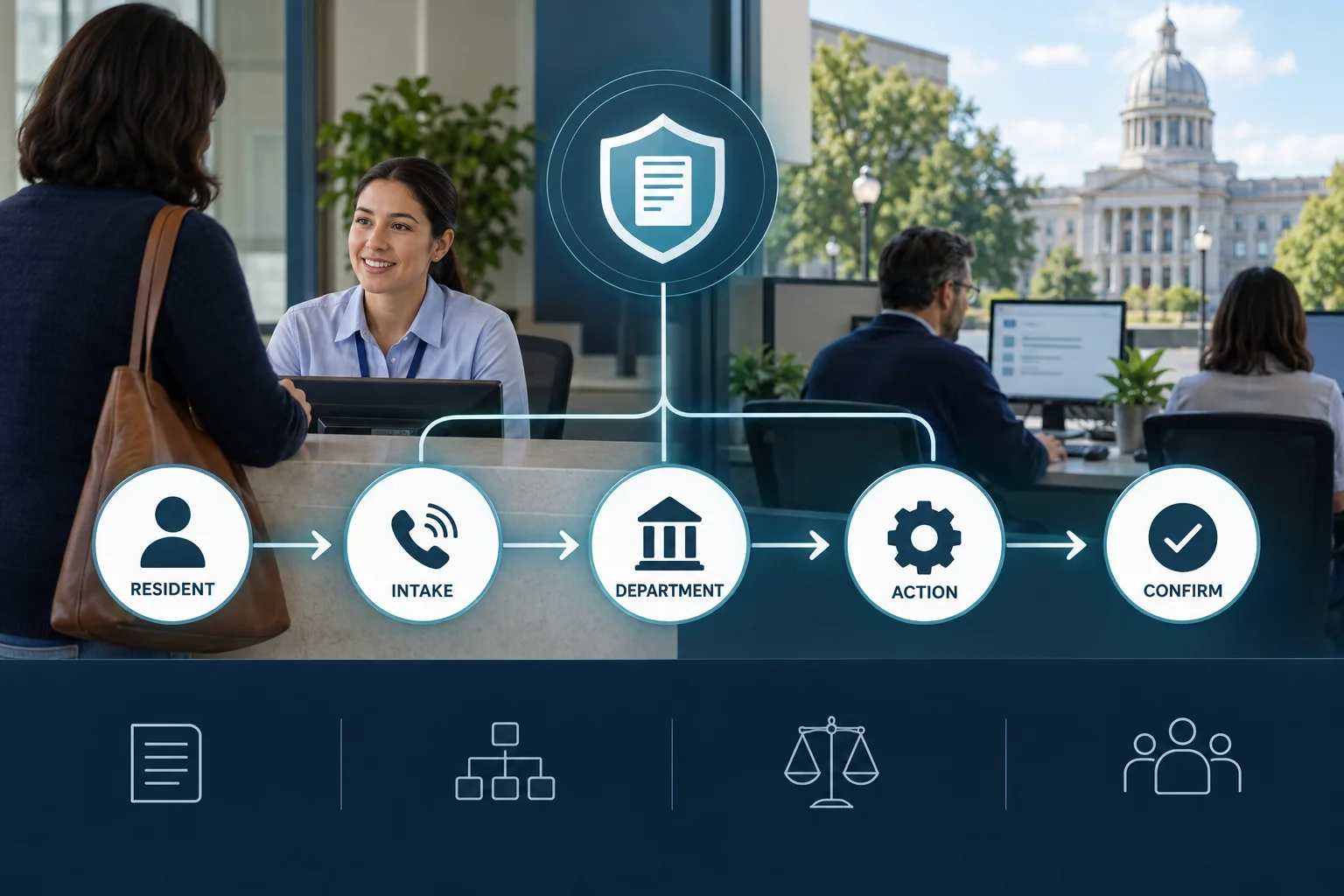
The recommended architecture follows a predictable path from resident contact to case submission or human handoff. Describing the components and their interaction helps teams assign ownership, test end-to-end behavior, and validate auditability.
Canonical flow: Resident → Voice AI → logic bridge → form retrieval
Design the runtime so that the Voice AI session is a conversational front end. As the resident speaks, the Voice AI identifies intents and captures entities. It then queries the control plane's logic bridge for the authoritative form and field definitions tied to the chosen service (for example: noise complaint, tree trimming request, or property-record inquiry). The logic bridge returns dynamic forms and field-level validation rules which the Voice AI uses to prompt, verify, and confirm resident inputs.
- Voice AI captures intent and preliminary entities (location, date, type).
- Logic bridge resolves the correct form and fields based on policy and context.
- Forms are dynamic: questions can change based on prior answers or eligibility checks.
Validation, duplicate checks, and case submission
Before case submission, the logic bridge performs field-level validation and duplicate detection using approved APIs to the municipal case-management system. If validation passes, it assembles a case payload and submits it via the case system's API, returning a confirmation number to the resident. If validation fails or a policy flag is raised (e.g., potential enforcement action), the flow routes to a human queue with an annotated transcript and the policy reason code.
- Field validation includes geo-plausibility, address normalization, and date/time sanity checks.
- Duplicate controls use normalized keys and fuzzy matching to avoid repeat cases.
- Every submission returns a confirmation number and an abbreviated rights-and-appeals message.
Policy Mapping, Appeals Workflow, and Human Oversight
A robust appeals pathway preserves resident rights and municipal accountability. The control plane must both enforce policy guardrails and make appeals visible and measurable.
Mapping policy to automation and human thresholds
Policy owners should decompose services into decision classes: fully automatable, assisted automation (requires human confirmation), or human-only. Each decision class maps to explicit thresholds in the control plane—such as monetary limits, legal-impact flags, or safety risk scores—that determine whether an interaction is auto-submitted or escalated. Maintain a policy catalog with examples and owner contacts to accelerate triage.
- Define thresholds for action (e.g., auto-create case for low-risk requests only).
- Label fields that may require redaction or restricted storage.
- Keep an owner and review cadence for each policy entry.
Appeals receipt, tracking, and resolution
When a resident requests review, the control plane records the appeal request, links it to the original case, and updates the case system with an appeals flag and tracking identifier. Appeals workflows should include an initial acceptance check (is the appeal timely and from an authorized party?), an evidence-gathering step, and a final disposition. Every stage is timestamped for public accountability.
- Capture appeal metadata at intake (who, when, grounds).
- Provide residents with a clear timeline and confirmation number.
- Route appeals to trained staff using priority and subject-matter tagging.
Validation, Duplicate Controls, and Data Quality Guards
Data quality failures are the most common source of poor outcomes. Implement defensive controls at the form and field level to prevent misrouted or duplicate work items and to protect resident privacy.
Dynamic forms and field-level validation
Dynamic forms delivered from the control plane reduce mis-capture. Field definitions include type, requiredness, normalizers, validation rules, and privacy classification. Validation can run at multiple stages: during voice capture (real-time checks), in the logic bridge, and on final submission by the case system.
- Use normalizers for common inputs (addresses, phone numbers, permit numbers).
- Run geo-validation to ensure reported location matches municipal boundaries.
- Tag sensitive fields for additional handling (restricted access, shorter retention).
Duplicate detection and idempotent submission
Deduplication protects staff time and resident experience. Implement normalized keying (address + last 4 of phone or device fingerprint) and fuzzy matching thresholds that the policy owner can tune. The control plane should return an existing-case suggestion with clear guidance, not silently merge, so residents and staff have choice and auditability.
- Normalize records to canonical forms before matching.
- Expose suggested duplicates with confidence scores and require human confirmation above a high-confidence threshold.
- Ensure idempotent APIs so repeated submissions return the same confirmation number when appropriate.

Governance, Risk Assessment, and Cyber Controls
Governance practices must combine AI-specific risk assessment, public-sector transparency, and baseline cyber hygiene. Adopt structured risk processes early, and maintain clear records for audit and public accountability.
AI risk management and algorithmic impact assessment
Municipalities should integrate an AI risk-management process that documents intended use, risk tolerances, and mitigation strategies. For jurisdictions with formal advice on algorithmic impact assessments, treat that process as a compliance-aligned exercise that evaluates impacts on rights, fairness, and accuracy. Perform assessments before rollout and at cadence thereafter.
- Document use cases, data inputs, outputs, and decision boundaries.
- Maintain impact logs and remediation plans when bias, error, or harm is identified.
- Coordinate with legal and records offices on retention and disclosure.
Cybersecurity: baseline and municipal alignment
Secure integrations and maintain clear processor relationships. Design controls for authentication, least-privilege access, encryption in transit and at rest, and operational logging. Align plans with cross-sector cybersecurity performance goals relevant to municipal services to reduce operational risk and ensure continuity.
- Define hosting region, backup region, and subprocessors for each provider.
- Limit remote-support access and document access justifications.
- Log all policy changes and appeals activity for forensic traceability.

Procurement, Implementation Choices, and Failure Boundaries
Procurement and implementation decisions determine how well the control plane supports policy owners, operations, and residents. Make vendor responsibilities explicit and plan for service degradation modes.
Vendor scope and managed-service expectations
Specify responsibilities in procurement docs: API interfaces, update SLAs for policy changes, transcript and recording access, audit logs, and evidence for procurement reviews. Expect managed-service vendors to provide configurable dynamic forms, standard validators, duplicate controls, and documented handoff payloads. Peak Demand’s materials on managed services offer guidance for enterprise procurement expectations and operational components.
- Require documented API schemas and change-notification channels.
- Ask for role-based access controls and evidence of operational logging.
- Include acceptance testing around appeals and escalation flows.
Failure modes, fallback behavior, and human handoff
Design for predictable failures: voice recognition errors, case-system outages, and policy mismatches. For each failure mode, define a fallback: retry, cached offline form, human warm-transfer, or scheduled callback. Ensure residents always receive a confirmation number or clear instruction on next steps.
- On case-system outage, queue validated submissions locally and provide a provisional token.
- If policy lookup fails, default to human escalation and label the case for manual review.
- Log failed submissions for reconciliation and post-incident review.
Operational Metrics, Observability, and Continuous Improvement
Quantify outcomes so policy owners and operations teams can iterate. Use the control plane to expose signals that inform quality improvement and public reporting.
Core metrics and observability
Monitor measures that matter to municipal operations: first-contact resolution for automated requests, rate of appeals per service type, duplicate-prevention success, human handoff frequency, and average appeal resolution time. Instrument events at the control plane (policy invoked, validation passed/failed, appeal opened) so analytics teams can attribute outcomes to policy changes.
- Track appeal conversion rates (appeals filed / auto-decisions made).
- Measure duplicate-suppression rate and false-positive human reviews.
- Log policy-change impacts on downstream approval or escalation volumes.
Phased rollout and policy cadence
Adopt a phased deployment: pilot a limited set of low-risk services, expand to assisted automation, then to broader automated routing. Use a policy change cadence (for example, monthly review with emergency ad-hoc updates) and publish a short public-facing summary of automated decisioning for transparency.
- Start with low-risk, high-value services (information requests, routine service orders).
- Use controlled experiments to measure resident experience and error modes.
- Schedule regular audits of appeals and error rates for continuous improvement.
Related Peak Demand resources
Industry and AI sources reviewed
- Artificial Intelligence Risk Management Framework (AI RMF 1.0)National Institute of Standards and Technology (NIST)
- Algorithmic Impact AssessmentGovernment of Canada
- Cross-Sector Cybersecurity Performance GoalsCybersecurity and Infrastructure Security Agency (CISA)
Public-sector procurement, privacy, accessibility, records, cybersecurity, and administrative-law obligations vary by jurisdiction. This article is operational guidance, not legal advice; organizations should confirm applicable requirements with qualified professionals.
Frequently asked questions
Suitable workflows include structured resident inquiries, service-request intake, permit or program information, appointment scheduling, department routing, status updates from approved systems, and after-hours overflow. Adjudication, enforcement discretion, emergency response, and binding eligibility decisions should remain with authorized staff.
Official reference: Artificial Intelligence Risk Management Framework (AI RMF 1.0)
Use a controlled service catalogue, required fields, department ownership rules, validation, duplicate checks, confirmation numbers, and documented handoff paths. The system should create an auditable record and avoid silently dropping requests when a downstream system is unavailable.
Official reference: Algorithmic Impact Assessment
Municipal deployments should document purpose, affected services, data use, human oversight, complaint and appeal paths, accessibility channels, records handling, monitoring, and the process for approving material changes.
Official reference: Algorithmic Impact Assessment
Require workflow demonstrations, integration and security architecture, testing evidence, auditability, data-location and subcontractor details, incident response, accessibility support, human escalation, exit planning, and clear ownership of ongoing updates.
Official reference: Artificial Intelligence Risk Management Framework (AI RMF 1.0)
Modernize public-service intake without losing control
Peak Demand helps municipal teams connect Voice AI to service requests, department routing, validation, escalation, records, and operational analytics.
Schedule a discovery call


