
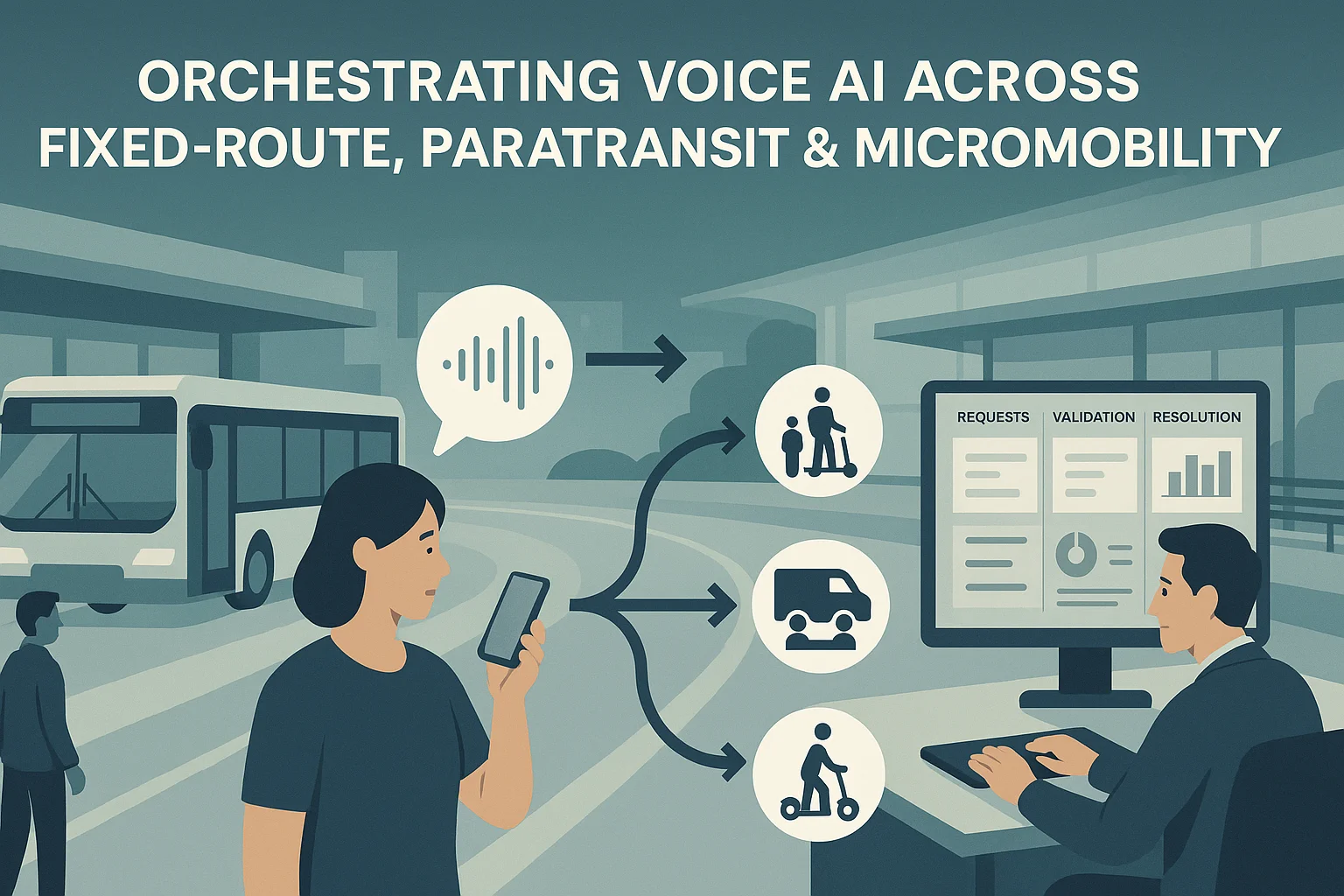
Orchestrating Voice AI Across Fixed‑Route, Paratransit & Micromobility
A practical operational framework for transit leaders to deploy and govern voice AI across fixed‑route, paratransit and micromobility services. Focuses on architecture, data separation, validation, human handoff, procurement evidence and measurable operating outcomes.
1. Where to start: a minimal, operational architecture
A compact, decisive architecture reduces operational risk and clarifies responsibility. The model below is intentionally prescriptive and mode‑aware so teams can scope integrations, governance and SLAs.
Canonical architecture (one line)
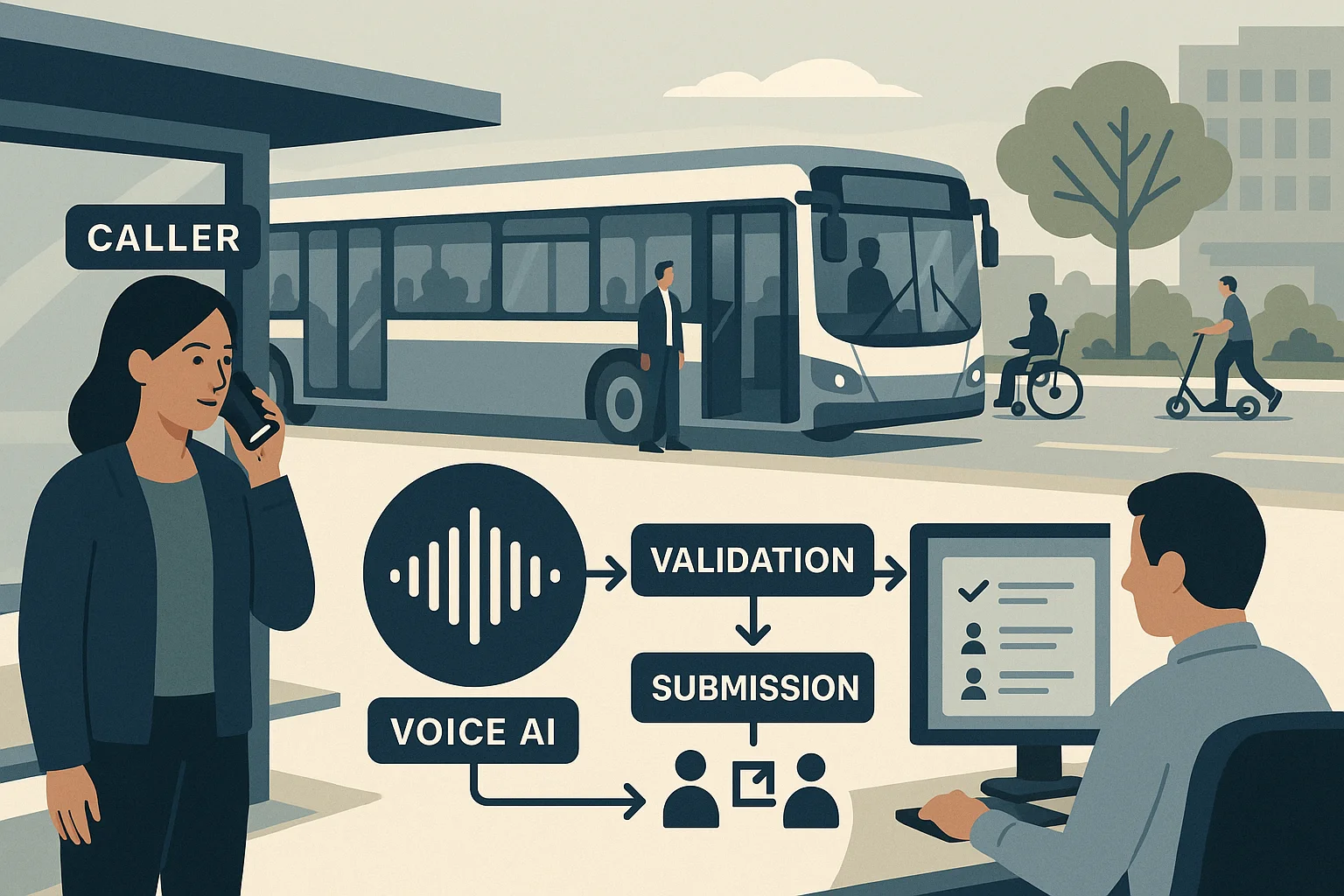
Rider → Voice AI → controlled knowledge base for scheduled information or approved service‑alert APIs for detours/delays/forms → validation → response, case submission, or human handoff. Keep this lineage explicit in design, logging, and procurement documents so telemetry and failure paths are unambiguous.
- Controlled knowledge base: governed, versioned, and used only for scheduled service, timetables, stop lists, fares and static accessibility attributes.
- Service‑alert APIs: the single source for active detours, delays, cancellations and operator notices; Voice AI must check these at runtime and surface them distinctly.
- Validation layer: business rules that confirm temporal plausibility, stop/route matching, and user identity when required.
- Human handoff: deterministic rules that move callers to trained staff for safety, disclaimers, or ambiguous requests.
Why separate schedule knowledge from alerts
Scheduled information (e.g., published timetables) is stable and suitable for declarative answers. Detours, delays and incidents are transient, safety‑sensitive and must be retrieved from approved runtime APIs. Mixing sources creates liability and operational confusion—voice agents must label answers clearly and defer to human staff for conflicting signals.
- Static answers: route paths, stop names, scheduled headways (from a governed feed).
- Dynamic answers: detours, delays, vehicle incidents (from service‑alert APIs).
- Operational control: versioned schedule knowledge should be auditable; alerts should be time‑stamped and logged with the Voice AI query that triggered them.
2. Mode‑specific workflows and operational boundaries
Fixed‑route, paratransit and micromobility have different risk profiles and service rules. Design tailored conversational flows and escalation points for each.
Fixed‑route: containment and signposting
Use Voice AI to answer common schedule queries, route lookups and published fare information from the controlled knowledge base. On every query, check the service‑alert API; if the API indicates a detour or delay affecting the requested trip, surface the alert prominently and offer a human handoff.
- Containment: resolve routine questions end‑to‑end (e.g., ‘first bus on route X’ using static schedule), but always verify with alerts before confirming a trip plan.
- Human handoff triggers: conflicting data, missed‑bus inquiries without a verified vehicle position feed, or requests that imply emergency or health risk.
- Operational outcome measures: containment rate, validated response rate (responses checked against an alert API), and handoff latency.
Paratransit: verification, eligibility and safe escalation
Paratransit workflows must combine identity/eligibility checks with booking and disruption handling. Voice AI can capture intent and pre‑validate fields, but bookings, schedule changes and safety issues must be verified and finalized by trained staff.
- Pre‑qualification: collect basic booking parameters and eligibility tokens for staff review using dynamic service forms that include validation rules and duplicate suppression.
- Safe boundaries: deny automated completion for requests involving medical transfers, emergency assistance or ambiguous accessibility needs.
- Measurables: time to confirmed booking, validation fail rate, duplicate detection rate, and percentage of requests requiring manual completion.
3. Data and integration patterns for reliable answers
Voice AI’s accuracy depends on data architecture and interface patterns. Be explicit about polling cadence, back‑off, staleness policies, and observable failures.
Controlled knowledge: static and versioned
Store timetables, route hierarchies, stop names and accessibility attributes in a governed knowledge base. Publish change windows and use versioning so the voice agent references a known build of schedule knowledge.
- Refresh cadence: align updates with formal timetable change processes; allow manual override in real time for planned service changes.
- Auditability: every published schedule version should be retained with provenance metadata for dispute resolution.
- Data readiness: run the AI Data Readiness Checklist as part of each update cycle to reduce mismatch and confusion.
Service‑alert APIs: runtime truth for disruptions
Service‑alert APIs (webhook streams or REST endpoints) should be the runtime truth for detours, delays and cancellations. Voice agents must check these at query time and surface alerts before confirming scheduled details.
- Staleness policy: define maximum age for an alert to be considered authoritative and fall back to handoff if data is missing or delayed.
- Retry and timeout: set conservative API timeouts; implement retries with exponential backoff and a clear fallback script for callers.
- Observability: log API latencies, error codes and the matching logic used to decide whether an alert applies to the caller’s query.
4. Governance, risk controls and regulatory boundaries
Operational AI in transit intersects safety, privacy and public accountability. Implement controls that are concrete, auditable and tied to operational roles.
Risk management and human‑in‑loop controls
Adopt a risk management approach: classify conversational intents by risk level and require human sign‑off for high‑risk classes. Maintain logged transcripts, decision reasons, and handoff triggers so incidents are reconstructable.
- Intent risk tiers: low (static schedule answers), medium (bookings or fare disputes), high (safety, medical or emergency).
- Human oversight: require explicit human review for medium/high tiers or when confidence is below a predefined threshold.
- NIST guidance: align risk‑management practices with AI risk frameworks to establish governance, monitoring and mitigation plans.
Ethics, transparency and public accountability
Follow transparency and fairness principles: disclose when callers speak to an automated agent, provide clear escalation paths, and ensure nondiscriminatory treatment of callers, especially in paratransit contexts.
- Public disclosures: automated assistance statements and clear human‑contact options.
- Bias mitigation: test conversational flows across demographic and accessibility scenarios during pilot phases.
- OECD alignment: use principled governance to govern deployment, monitoring and public accountability.
Transportation cybersecurity and availability
Protect interfaces to operational systems and service‑alert APIs with strong authentication, rate limiting and incident playbooks. Treat these integrations as part of critical infrastructure security planning.
- Access controls: short‑lived credentials, IP allow‑lists for vendors, and role‑based permissions for staff.
- Availability: design for graceful degradation; if realtime feeds fail, voice flows should surface disclaimers and route callers to human assistance.
- CISA alignment: coordinate cyber resilience planning with sector guidance to protect continuity of service.

5. Procurement, vendor evaluation and evidence
Procurement for Voice AI should prioritize operational controls, evidence of enterprise practice, and clear SOW items covering data handling and support.
Contractual controls and evidence
Request demonstrable evidence: architecture diagrams, subprocessors, hosting regions, backup geography, remote‑support access protocols, retention policies and breach duties. Define acceptance tests and rollback criteria in the SOW.
- Data residence: specify hosting region(s), backup geography and subprocessors; require vendor disclosure of onward transfer mechanisms.
- Remote access: limit vendor remote support to auditable VPN sessions and require service windows and escalation SLAs.
- Acceptance tests: containment, validation accuracy, handoff latency and shadow‑mode agreement for rollout acceptance.
Operational SLAs and KPIs
Move beyond generic availability targets. Tie SLAs to operational outcomes that matter to transit: validated response rate, safe‑handoff latency, booking confirmation time (paratransit), and FCR for micromobility accounts.
- Examples: median handoff time, percent of calls resolved without human intervention (by intent class), and error rate for service‑alert mismatches.
- Observability: require vendor dashboards, near‑real‑time logs and periodic audit data exports for internal analytics.
- Managed services: consider a managed‑service agreement for 24/7 coverage with defined escalation matrices and runbooks (see Managed Voice AI Services).
Procurement checklist highlights
Ask for a technical appendix in each bid response that includes integration patterns, data lineage, consent flows for recorded calls, and a failure‑mode matrix. Validate these during technical proof‑of‑concepts.
- Failure modes: missing alert API, conflicting schedule, low confidence answer, and downstream system errors—each with a deterministic response.
- Evidence: shadow testing reports, simulation results and runbook excerpts.
- Local presence: when required, confirm on‑site support options and local legal counsel involvement for sensitive deployments.
6. Implementation roadmap and acceptance testing
A disciplined rollout minimizes public impact. Use phased pilots, shadow mode, synthetic tests and measurable acceptance gates.
Phase 0–1: readiness and pilot
Start with static Q&A for fixed‑route schedules and a small paratransit booking pilot. Run the AI Data Readiness Checklist to fix gaps in stop naming, route identifiers, and fare rules before any public traffic.
- Shadow mode: route real calls to human staff while capturing agent responses for evaluation.
- Synthetic testing: scripted journeys that exercise boundary conditions—detours, cancellations, and identity edge cases.
- Acceptance criteria: containment accuracy, validation pass rate, and supervised handoff performance.
Phase 2–3: scaled rollout and continuous improvement
Expand coverage to more routes and micromobility inquiries; tighten SLAs and implement continuous monitoring, model/product updates and quarterly risk reviews.
- Operational telemetry: monthly dashboards for KPIs and an incident log for trigger‑based reviews.
- Feedback loop: capture user reports, manual corrections and policy changes into the controlled knowledge base.
- Governance cadence: regular audits of privacy, security and performance with documented remediation timelines.
Support and change management
Train call‑center and operations staff on the voice agent’s decision rules, handoff flows and incident procedures. Ensure a clear on‑call roster for escalations and incident review.
- Training: scripted scenarios and a knowledge transfer package for human agents.
- Change process: scheduled updates to the knowledge base with rollback capability.
- Public messaging: coordinated announcements of new capabilities and how to reach human support.
Related Peak Demand resources
Industry and AI sources reviewed
- Artificial Intelligence Risk Management Framework (AI RMF 1.0)National Institute of Standards and Technology (NIST)
- OECD AI PrinciplesOrganisation for Economic Co-operation and Development
- Transportation Systems SectorCybersecurity and Infrastructure Security Agency (CISA)
Transit safety, accessibility, privacy, cybersecurity, records, and service-information obligations vary by jurisdiction and operating authority. This article is operational guidance, not legal advice; organizations should confirm applicable requirements with qualified professionals.
Frequently asked questions
Good starting points include lost property, complaints and feedback, stop or shelter issues, fare-machine faults, non-emergency accessibility service requests, schedule information from approved sources, and structured routing to customer service or field teams.
Official reference: Artificial Intelligence Risk Management Framework (AI RMF 1.0)
Use GTFS Realtime only when the agency exposes suitable feeds and the workflow genuinely needs service alerts, trip updates, or vehicle positions. The integration should validate freshness and availability, and the agent should avoid presenting stale feed data as a guaranteed arrival prediction.
Emergency, security, injury, crime, and safety-critical reports should follow approved transfer or emergency-routing procedures. Voice AI may detect and route the call, but it should not make operational safety decisions or replace trained personnel.
Official reference: Transportation Systems Sector
Request realistic call testing, feed and system failure handling, service-request integration, transfer context, audit logs, accessibility channels, monitoring, change control, and evidence that the agent distinguishes scheduled information from dynamic service alerts.
Official reference: Artificial Intelligence Risk Management Framework (AI RMF 1.0)
Design the transit service workflow before automating it
Peak Demand helps transit teams connect Voice AI to rider information, service requests, approved live-data sources, escalation, confirmation, and analytics.
Schedule a discovery call


