
Operational Measurement & Closed-Loop QA for Multisite Multilingual 311 Voice AI
A jurisdiction-neutral operational framework for municipal 311 Voice AI: closed‑loop QA, containment and escalation quality, cost‑to‑serve, multisite and multilingual scale, procurement controls, and continuous optimization.
1. Why operational measurement must drive municipal 311 Voice AI
Municipal 311 programs are accountable public services. Voice AI can improve access and efficiency, but only when performance is measured against public outcomes: requests resolved, transparency, and reliable handoffs. This section defines the core metrics and the data model required to make those metrics actionable.
Core metrics: containment, escalation quality, and cost-to-serve
Three primary metrics anchor operational decision‑making for 311 Voice AI. - Containment rate: the share of inbound contacts that the Voice AI completes end‑to‑end without a human handoff (and where the resident accepts the outcome, e.g., receives a confirmation number or required information). - Escalation quality: the accuracy of handoffs — measured by correct department routing, minimal re‑routing, and reduced rework after human takeover. - Cost‑to‑serve: the fully loaded unit cost per interaction (including platform, telephony, ASR/TTS, agent time when escalated, and downstream case handling costs). Operationalization requires persistent linkage between the audio interaction, the structured case (including schema fields populated by the Voice AI), and post‑case outcomes (closed, reassigned, or reworked).
- Containment and escalation quality must be tracked separately — high containment with low resident satisfaction is not acceptable.
- Cost‑to‑serve needs both telephony/compute inputs and downstream case handling costs to be accurate.
Design a usable data model: transcript → canonical fields → case ID
Every 311 voice interaction must produce a minimum viable set of observables that lock audio to business outcomes: - Unique call ID and timestamp. - Full transcribed and time‑stamped interaction (or pointer to recording) with redaction for sensitive data where required. - Canonical field set populated by the Voice AI (service type, address/premise identifier, resident contact or consent flag, urgency, and attachments if applicable). - Case ID after submission, or escalation ticket ID and routing metadata for human handoffs. This canonical structure supports closed‑loop QA, duplicate controls, and measurement of containment vs escalation traceably.
- Canonical field names should be shared across sites to enable cross-site analytics.
- Store both raw and validated fields; validation status is required to measure quality and rework.
2. Operational architecture and integration controls
A simple, enforceable architecture reduces operational risk and enables measurement. Use a logic bridge between the conversational layer and municipal business systems so that every submitted request is validated, deduplicated, and recorded.
Resident → Voice AI → logic bridge → municipal case system
Operational architectures should implement the following flow: 1) Resident interacts with the Voice AI; ASR and NLU extract intents and fields. 2) The logic bridge receives structured fields and performs synchronous validation and enrichment (address normalization, geocoding, resident identity/consent flags). The bridge enforces duplicate detection before case submission. 3) On successful validation, the bridge submits a case via approved APIs or a controlled adapter to the municipal case system and returns a confirmation number to the resident. 4) If validation fails, the bridge either requests clarification, opens a 'clarify and call back' workflow, or escalates to an agent depending on rules. This separation ensures that the conversational layer cannot submit incomplete or invalid cases directly.
- Use controlled adapters or orchestration layers to shield municipal systems from unvalidated inputs.
- Return explicit confirmation numbers and persistence pointers to the resident for transparency and audit trails.
Validation, duplicate controls and auditability
Validation checks should be explicit and measurable: schema completeness, address validity, acceptable urgency flags, and permitted request types. Duplicate controls compare candidate submissions against recent open cases for the same address and service type to prevent unnecessary rework. Maintain an immutable audit trail that ties audio, transcript, filled fields, validation outcomes, adapter calls, and final case IDs.
- Flag cases that pass conversational validation but later require rework; use that signal to improve the QA process and model prompts.
- Keep a versioned audit log of business rules and validation logic so decision makers can trace why the system accepted or rejected a submission.
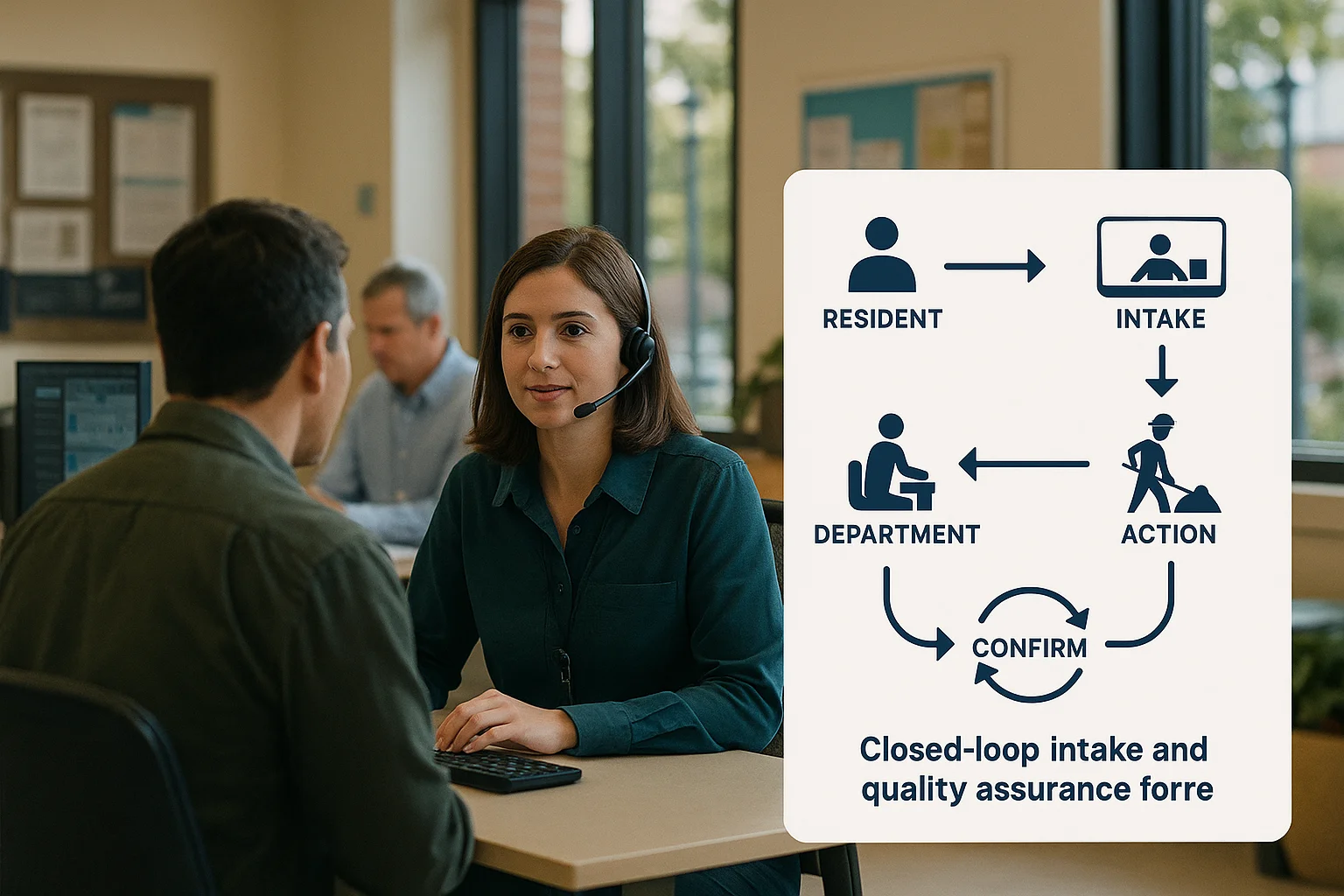
3. Closed‑loop quality assurance and the feedback engine
Closed‑loop QA ties production interactions to labeled outcomes and then routes corrective action to models, conversation design, agents, or policy owners. Without traceable feedback, measurement is meaningless.
A three‑tier QA workflow: monitoring, annotation, remediation
Implement a closed loop with three operational tiers: - Monitoring: automated alerts for sudden drops in containment, spikes in re‑routing, or ASR confidence anomalies. - Annotation: statistically valid sampling of calls (regular stratified samples by language, site, time, top intents) and targeted sampling for low-confidence or high-risk interactions. Annotators tag intent accuracy, field correctness, validation outcomes, resident sentiment, and final disposition. - Remediation: annotated results feed prioritized tickets: quick fixes for conversation prompts, model retraining candidates, agent coaching sessions, or business-rule changes in the logic bridge. Link each annotated call back to the case ID and downstream outcome so QA can measure remediation effectiveness.
- Sample both successful containments and escalations to detect false positives and false negatives.
- Use continuous A/B tests where feasible to measure change without large platform-wide risk.
Scorecards, SLAs and closed-loop KPIs
Quality scorecards must be operational: contain key performance indicators (KPIs) such as containment rate, escalation accuracy, rework rate, resident confirmation receipt rate, and time to confirmation. Define service-level objectives for containment and escalation quality per service type. Track remediation lead times (how quickly a flagged issue is fixed) and the impact on downstream rework.
- Scorecards should roll up to department and municipal leadership and be available to operational teams daily.
- Pair KPIs with minimum sample sizes and confidence intervals to avoid overreacting to noise.
4. Multisite and multilingual scale: practical choices
Scaling across multiple municipal departments, satellite offices, and languages introduces complexity. Make local differences explicit while preserving a shared core schema and governance model.
Canonical field schemas and local overrides
Adopt a canonical field schema for common service types (pothole, graffiti, streetlight, noise complaint, bylaw inquiry) that all sites implement. Allow local overrides for jurisdiction‑specific fields, business rules, and service hours. This pattern supports cross-site analytics while enabling local flexibility.
- Maintain a central schema registry and publish change notices to sites before rollouts.
- Use feature flags or logic bridge configuration to gate local overrides and avoid accidental divergence.
Multilingual design and fallbacks
Operationalize language support by defining primary language routes, fallbacks, and human interpreter handoffs. For each language, maintain: ASR/TTS profiles, NLU intent models or prompts, phrase lists for locality-specific names, and QA annotation pools. Use fallback policies for low-confidence recognition (e.g., escalate or transfer to an interpreter) rather than making business decisions on low-confidence transcriptions.
- Treat each language as an operational channel with its own QA cadence and annotated samples.
- Monitor per-language containment and escalation quality; use these measures to allocate interpreter resources.

5. Analytics, cost‑to‑serve and containment quality in practice
Translate raw metrics into actionable analytics that inform procurement, capacity planning, and staffing. Measurement must be granular enough to allocate costs to specific services, languages, and sites.
Measuring cost‑to‑serve
A practical cost‑to‑serve calculation includes telephony and compute costs for Voice AI, transcription and storage, third‑party services (ASR/TTS), agent wages for escalations, and downstream case handling. Allocate fixed platform costs across volume drivers and track marginal costs per additional contained interaction. Use containment rate improvements to model marginal savings conservatively — recognizing that some savings translate into reallocated staff rather than direct budget reductions.
- Break costs into fixed, variable, and semi‑variable buckets for realistic budgeting.
- Model sensitivities for containment improvement scenarios to inform procurement scale.
Containment quality: beyond raw containment rate
Containment quality requires resident confirmation and low rework. Track the proportion of contained cases that are later reopened, reassigned, or disputed. Measure resident confirmation receipt (confirmation number acknowledged) and post‑interaction satisfaction where feasible. Use these signals to detect systemic errors even when containment rate looks favorable.
- Define acceptable thresholds for reopened cases per service type.
- Correlate containment quality with annotated QA results to identify root causes.

6. Procurement, risk controls, and regulatory alignment
Procurement for 311 Voice AI must specify operational and audit requirements, not just functional features. Include measurable QA obligations, data handling constraints, and change management expectations in contracts.
Contractual requirements and vendor evaluation
Include the following in procurements: accessible confirmation numbers for every submitted case, dynamic form support to populate local fields, controlled API adapters, duplicate prevention controls, and audit logging that preserves provenance for each case. Require vendors to deliver SLAs for availability and measurable KPIs for containment and escalation accuracy. Ask vendors for references in municipal contexts and for documented operational runbooks.
- Specify output artifacts: case confirmation schema, audit logs, model and rule versioning metadata, and access controls.
- Require demonstrable integration patterns (APIs/adapters) rather than ad‑hoc direct database writes.
Security and cybersecurity performance goals
Security requirements should align with municipal CISO priorities and accepted cross‑sector goals: least privilege access, secure telemetry, encrypted transports, and documented subprocessors and remote support practices. Municipal teams should evaluate vendors against practical cyber goals and require evidence of controls.
- Define hosting region, backup region, subprocessors, remote-support access methods, and breach notification duties in procurement documents.
- Require vendors to detail data residency, transfer mechanisms, and retention policies so municipalities can assess local constraints and obligations.
Related Peak Demand resources
Industry and AI sources reviewed
- Cross-Sector Cybersecurity Performance GoalsCybersecurity and Infrastructure Security Agency (CISA)
- Artificial Intelligence Risk Management Framework (AI RMF 1.0)National Institute of Standards and Technology (NIST)
- Algorithmic Impact AssessmentGovernment of Canada
Public-sector procurement, privacy, accessibility, records, cybersecurity, and administrative-law obligations vary by jurisdiction. This article is operational guidance, not legal advice; organizations should confirm applicable requirements with qualified professionals.
Frequently asked questions
Suitable workflows include structured resident inquiries, service-request intake, permit or program information, appointment scheduling, department routing, status updates from approved systems, and after-hours overflow. Adjudication, enforcement discretion, emergency response, and binding eligibility decisions should remain with authorized staff.
Official reference: Artificial Intelligence Risk Management Framework (AI RMF 1.0)
Use a controlled service catalogue, required fields, department ownership rules, validation, duplicate checks, confirmation numbers, and documented handoff paths. The system should create an auditable record and avoid silently dropping requests when a downstream system is unavailable.
Official reference: Algorithmic Impact Assessment
Municipal deployments should document purpose, affected services, data use, human oversight, complaint and appeal paths, accessibility channels, records handling, monitoring, and the process for approving material changes.
Official reference: Algorithmic Impact Assessment
Require workflow demonstrations, integration and security architecture, testing evidence, auditability, data-location and subcontractor details, incident response, accessibility support, human escalation, exit planning, and clear ownership of ongoing updates.
Official reference: Artificial Intelligence Risk Management Framework (AI RMF 1.0)
Modernize public-service intake without losing control
Peak Demand helps municipal teams connect Voice AI to service requests, department routing, validation, escalation, records, and operational analytics.
Schedule a discovery call


