
Municipal Voice AI Workflow Design at the Advanced Operating Models and Strategic Transformation Stage
A practical, jurisdiction-neutral operating model for municipal Voice AI at the advanced transformation stage. Covers intake-to-case workflows, cross‑channel orchestration, data and records strategy, procurement choices, safety boundaries, and measurable outcomes.
1. Stage and scope: what 'Advanced Operating Models' means for municipal Voice AI
This section frames the organisational and technical expectations for municipalities moving Voice AI from pilots to enterprise-grade, cross-departmental services.
Operational objectives at this stage
Advanced operating models prioritise predictable citizen outcomes, measurable service levels, and accountable records. The objective is not to replace staff but to ensure Voice AI delivers consistent, validated inputs into municipal business systems and reduces avoidable manual routing while preserving oversight.
- Deterministic intake and validated case creation with audit trails.
- Cross-channel continuity: voice, chat, web forms, and SMS share canonical case data.
- Predictive operations: queue forecasting and capacity adjustments based on historical patterns.
Boundaries and non-goals
Advanced models avoid speculative autonomy. Do not use Voice AI for emergency response decisions, enforcement discretion, eligibility determinations, or other legally or ethically sensitive decisions. The system should collect and validate structured inputs for humans to review when decisions carry legal or safety consequences.
- Voice AI prepares the record and suggests routing, but humans retain final authority for sensitive cases.
- Maintain explicit escalation pathways and priority flags for time-critical or high-risk calls.
- Track all handoffs with timestamps and user IDs for public accountability.
2. Core architecture and deterministic workflow
A concise, repeatable architecture reduces variability and supports cross-channel orchestration, validation, and auditability.
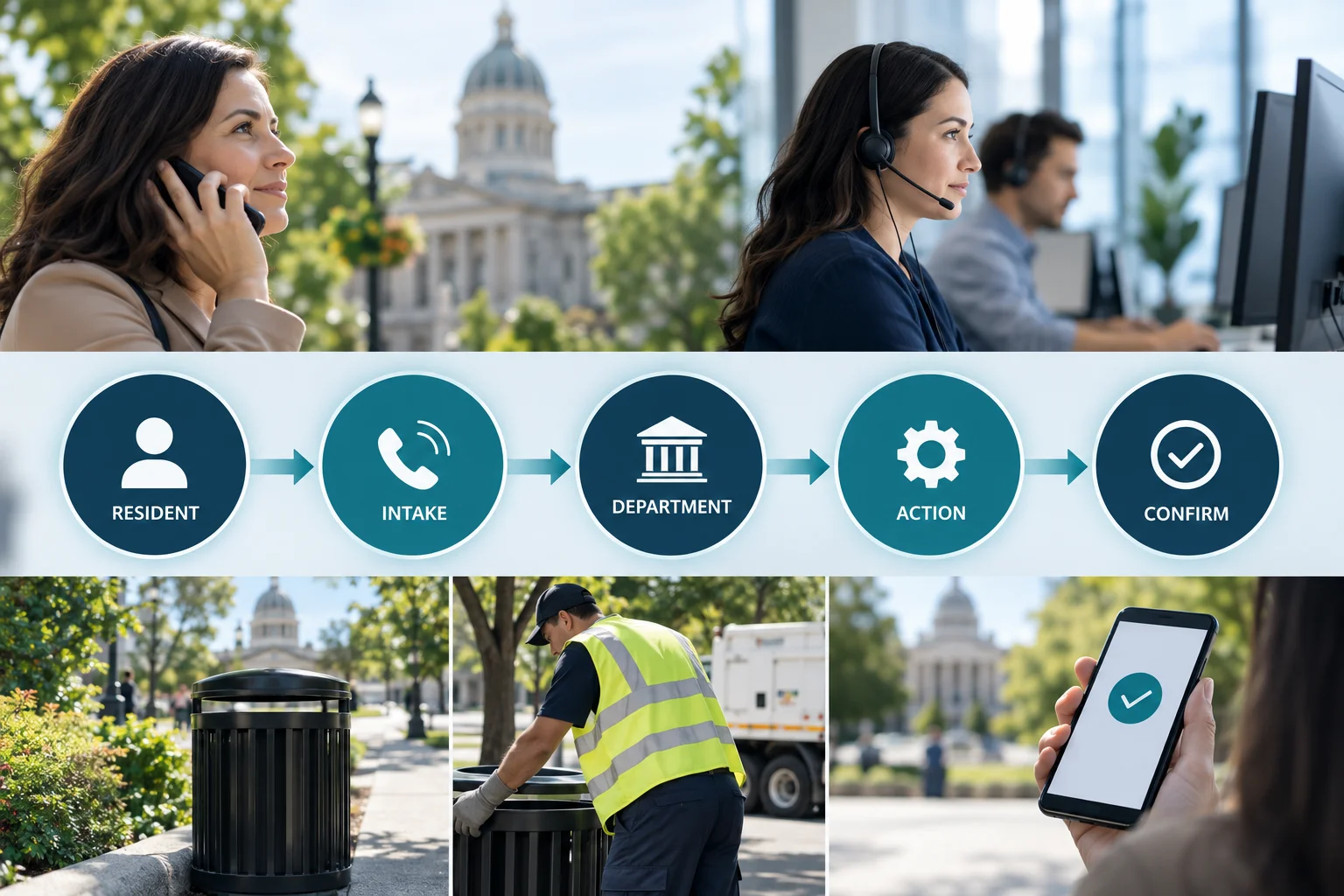
Canonical architecture (Resident → Voice AI → logic bridge → case system)
Design the workflow as a linear, observable pipeline: resident contact is handled by a Voice AI front end which captures intent and structured fields. A lightweight logic bridge maps intents to canonical forms and calls business-system APIs to retrieve form templates and validation rules. After field-level validation, the system submits a case to the municipal case management system and returns a confirmation number or triggers a human handoff.
- Resident (caller) interacts with Voice AI via phone or WebRTC-enabled channels.
- Voice AI captures intent and normalized field values (address, permit type, descriptors) and hands structured data to the logic bridge.
- Logic bridge retrieves form and field rules via approved APIs, runs deterministic validations, and applies duplicate-check logic.
- On successful validation the case is submitted to the municipal case system; the resident receives confirmation and next steps.
- If validation fails or a safety boundary is triggered, route to a trained human with a pre-populated case draft.
Design decisions that materially change risk
Two choices materially affect reliability and risk: whether Voice AI stores citizen PII and where recording/processing occurs; and whether semantic intent detection is used to populate free-text fields without deterministic validation. Prefer short-lived structured representations, server-side validation, and explicit consent for recordings.
- Store only normalized fields necessary for the case; avoid keeping raw voice transcripts longer than retention policy requires.
- Use deterministic field validation for critical data (address formats, dates, permit numbers).
- Recordings should be optional and consented where law or policy requires; keep metadata for traceability if transcripts are purged.
3. Intake workflows: validation, duplicate controls, and handoffs
This section gives a step-by-step workflow designers can implement, with concrete controls for quality and auditability.
Stepwise intake flow
Implement a structured, stepwise intake where each step produces a validated data element and an auditable decision. Keep fallback paths explicit.
- 1) Identity and consent: confirm the call and capture opt-in for recording/long-term retention.
- 2) Intent confirmation: binary validation (e.g., 'You are reporting a fallen tree, correct?'), avoiding ambiguous open prompts.
- 3) Field capture: collect canonical fields using reusable dynamic forms (address, location type, urgency, photos reference).
- 4) Server-side validation: logic bridge verifies fields against allowed lists, spatial lookups, or previous records.
- 5) Duplicate check: run fingerprinting and heuristic matching; if duplicate, offer to update existing case rather than creating a new one.
Handoff and confirmation controls
When human intervention is required, handoffs must include a pre-populated case draft, confidence scores, and a clear instruction set for the assessor. Always provide residents a confirmation number and predictable SLAs for follow-up.
- Attach a case summary, confidence indicators, and skipped-field flags to the agent desktop.
- Issue a persistent confirmation number for citizen tracking and public-portal queries.
- Log the handoff event, agent ID, and time to resolution metrics for performance measurement.
4. Cross-channel orchestration and predictive operations
Voice AI must be part of a multichannel ecosystem: the same canonical case should be editable via web, SMS, or in-person intake, and ops teams should predict demand to optimise staffing.
Canonical case and cross-channel continuity
Maintain one canonical case record with an event stream of interactions. The Voice AI must read and update the same fields used by web forms and agent desktops so that updates via any channel are authoritative.
- Use form-and-field retrieval APIs so the Voice AI always uses current validation rules and dropdown lists.
- When a web or SMS update occurs, reconcile with ongoing voice sessions and present conflicts to staff as proposed changes.
- Avoid parallel records by enabling in-place updates or merging with human review and a transparent audit trail.
Predictive operations and capacity planning
Use historical interaction data to forecast peaks (events, weather, holidays) and to pre-warm human queues or scale digital concurrency. Predictions should be operational inputs, not opaque model outputs.
- Schedule staff and digital capacity using short-term forecasts (24–72 hours) and event-based triggers.
- Integrate predictive signals into fallback rules: when predicted load exceeds thresholds, shift non-urgent intents to deferred callbacks or digital channels.
- Report forecast accuracy and operational impact in weekly governance reviews.

5. Data, records, auditability, and accessibility
Municipal systems are public records systems. Design data flows, retention, and accessibility with records management and public accountability in mind.
Records strategy and audit trails
Treat Voice AI interactions as inputs to public records. Ensure each case stores an immutable event log: who captured which field, when validations ran, and when human reviews occurred. Define retention and redaction consistent with local records law and publishable FOI processes.
- Immutable event logs per case with timestamps and actor IDs (system, Voice AI, human).
- Store normalized fields; retain full transcripts only when legally required or consented.
- Provide role-based access controls and exportable logs for audits and public‑records requests.
Accessibility and inclusive design
Offer equivalent access paths and avoid voice-only dependencies. Provide TTY/relay compatibility, simple DTMF navigation, callback options, and equivalent web forms. Validate all service messages for plain-language clarity.
- Design parallel touchpoints: accessible web forms, SMS confirmations, and agent callbacks.
- Ensure voice prompts are short and tested for comprehension with representative users.
- Log accessibility preferences and make them persistent across channels.
Cybersecurity and data locality considerations
Secure APIs, enforce least privilege, and be explicit about hosting region, subprocessors, backup geography, and remote-support access. Implement incident response and breach notification processes mapped to municipal obligations.
- Define hosting and backup regions and document subprocessors and cross‑border transfers in contracts.
- Use encrypted transport and at-rest protections; apply role-based access to records and logs.
- Run tabletop exercises for data incidents and coordinate escalation with legal and records teams.
6. Procurement, implementation choices, and failure boundaries
Procurement should separate core platform capabilities from systems integration and managed services. Acceptance tests must include behaviour under failure and human-handoff quality.
Contract architecture and acceptance tests
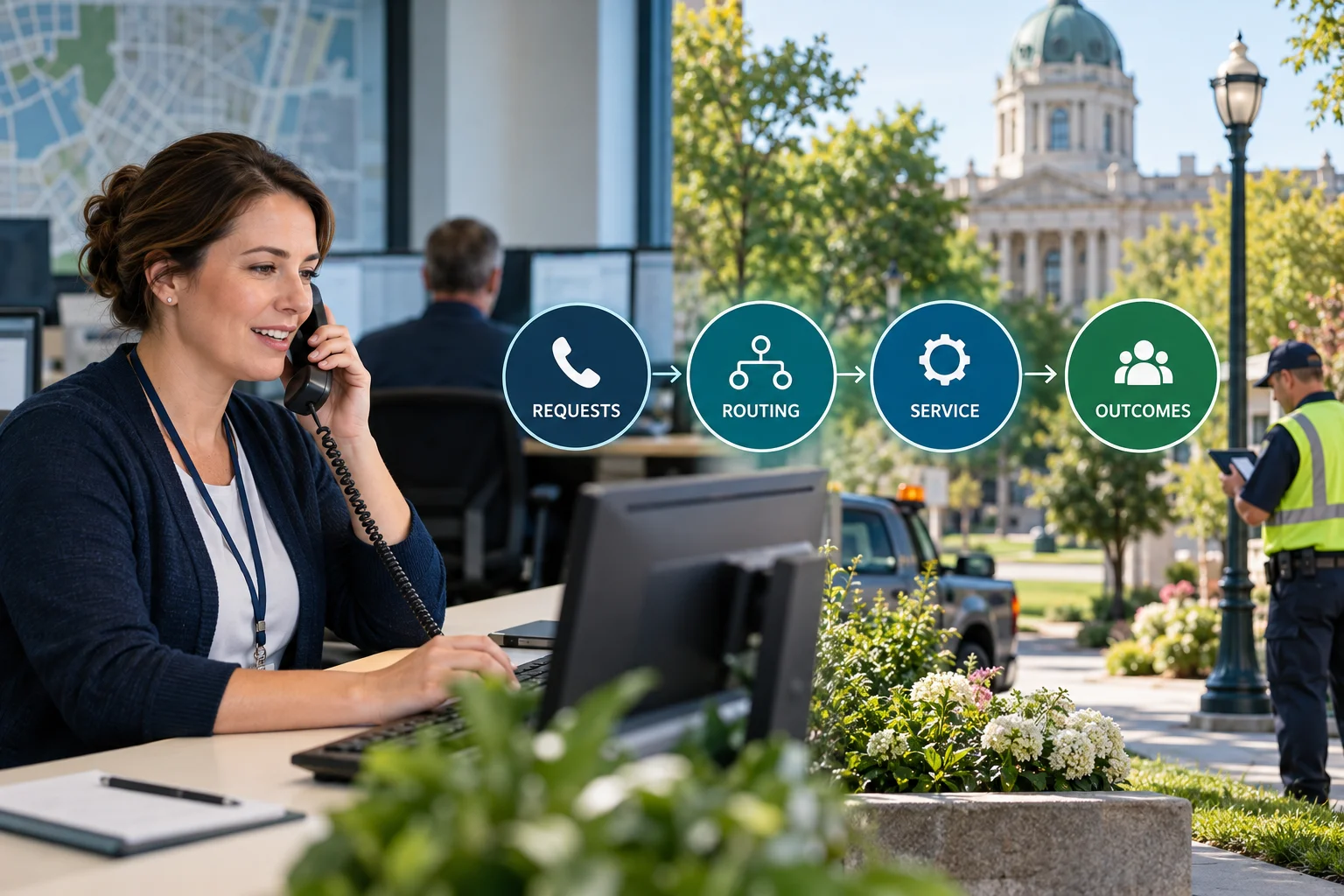
Structure procurement with clear capability blocks: platform (speech, NLU), orchestration/logic bridge, integrations (case system, spatial lookup), and managed‑service SLAs. Acceptance tests should simulate peak loads, validation failures, duplicate detection, and handoffs.
- Define acceptance criteria for confirmation issuance, duplicate suppression rate, and human-handoff completeness.
- Include test cases for degraded connectivity and third-party API timeouts to verify safe fallback behaviours.
- Require documentation of hosting regions, subprocessors, and remote-support procedures before go-live.
Failure boundaries and safe fallbacks
Explicitly describe failure modes in the SOW. For example: if form retrieval fails, the system must either use a cached template in read-only mode and queue a manual reconciliation task, or route the call to staff with a pre-filled draft. Never silently create cases with missing critical fields.
- Fail-open vs fail-closed decisions must be documented per intent and risk class.
- Implement clear operator signals when Voice AI confidence is low and require human verification.
- Ensure a human-in-loop path for any case that triggers legal, enforcement, or eligibility flags.
Related Peak Demand resources
Industry and AI sources reviewed
- Artificial Intelligence Risk Management Framework (AI RMF 1.0)National Institute of Standards and Technology (NIST)
- Cross-Sector Cybersecurity Performance GoalsCybersecurity and Infrastructure Security Agency (CISA)
- Algorithmic Impact AssessmentGovernment of Canada
Public-sector procurement, privacy, accessibility, records, cybersecurity, and administrative-law obligations vary by jurisdiction. This article is operational guidance, not legal advice; organizations should confirm applicable requirements with qualified professionals.
Frequently asked questions
Suitable workflows include structured resident inquiries, service-request intake, permit or program information, appointment scheduling, department routing, status updates from approved systems, and after-hours overflow. Adjudication, enforcement discretion, emergency response, and binding eligibility decisions should remain with authorized staff.
Official reference: Artificial Intelligence Risk Management Framework (AI RMF 1.0)
Use a controlled service catalogue, required fields, department ownership rules, validation, duplicate checks, confirmation numbers, and documented handoff paths. The system should create an auditable record and avoid silently dropping requests when a downstream system is unavailable.
Official reference: Algorithmic Impact Assessment
Municipal deployments should document purpose, affected services, data use, human oversight, complaint and appeal paths, accessibility channels, records handling, monitoring, and the process for approving material changes.
Official reference: Algorithmic Impact Assessment
Require workflow demonstrations, integration and security architecture, testing evidence, auditability, data-location and subcontractor details, incident response, accessibility support, human escalation, exit planning, and clear ownership of ongoing updates.
Official reference: Artificial Intelligence Risk Management Framework (AI RMF 1.0)
Modernize public-service intake without losing control
Peak Demand helps municipal teams connect Voice AI to service requests, department routing, validation, escalation, records, and operational analytics.
Schedule a discovery call


