
Municipal Voice AI Portfolio Governance: Funding, Risk & Service Rationalization
A practical, jurisdiction‑neutral operating model for municipal Voice AI portfolios. Covers funding models, risk controls, service rationalization, integrations, and measurable governance so municipal leaders can scale safe, auditable voice services across 311 and citizen-facing channels.
1. Operating model overview: a portfolio approach
Municipal Voice AI initiatives must be governed as a portfolio of services that span 311, bylaw, permits, and general information. This section lays out the minimal, decision‑useful operating model and a deployment pattern municipalities can adopt immediately.
Why a portfolio mindset matters
Municipal leaders should stop treating Voice AI as a single feature and instead manage it as a portfolio of inbound services. A portfolio approach requires: a canonical inventory of voice use cases, risk and complexity tiering, a prioritized roadmap, and common controls that scale across implementations (accessibility, records retention, validation). This prevents piecemeal standards and inconsistent resident experiences while simplifying procurement, measurement, and escalation pathways.
- Create a single Use‑Case Registry with tags for department, risk tier, channel coverage, and required integrations.
- Classify each use case by complexity (simple info, transactional intake, validation, escalation to staff) and by risk (low to high).
- Apply a consistent set of baseline controls to all low/medium risk services to reduce duplicated work and speed delivery.
A compact operating architecture
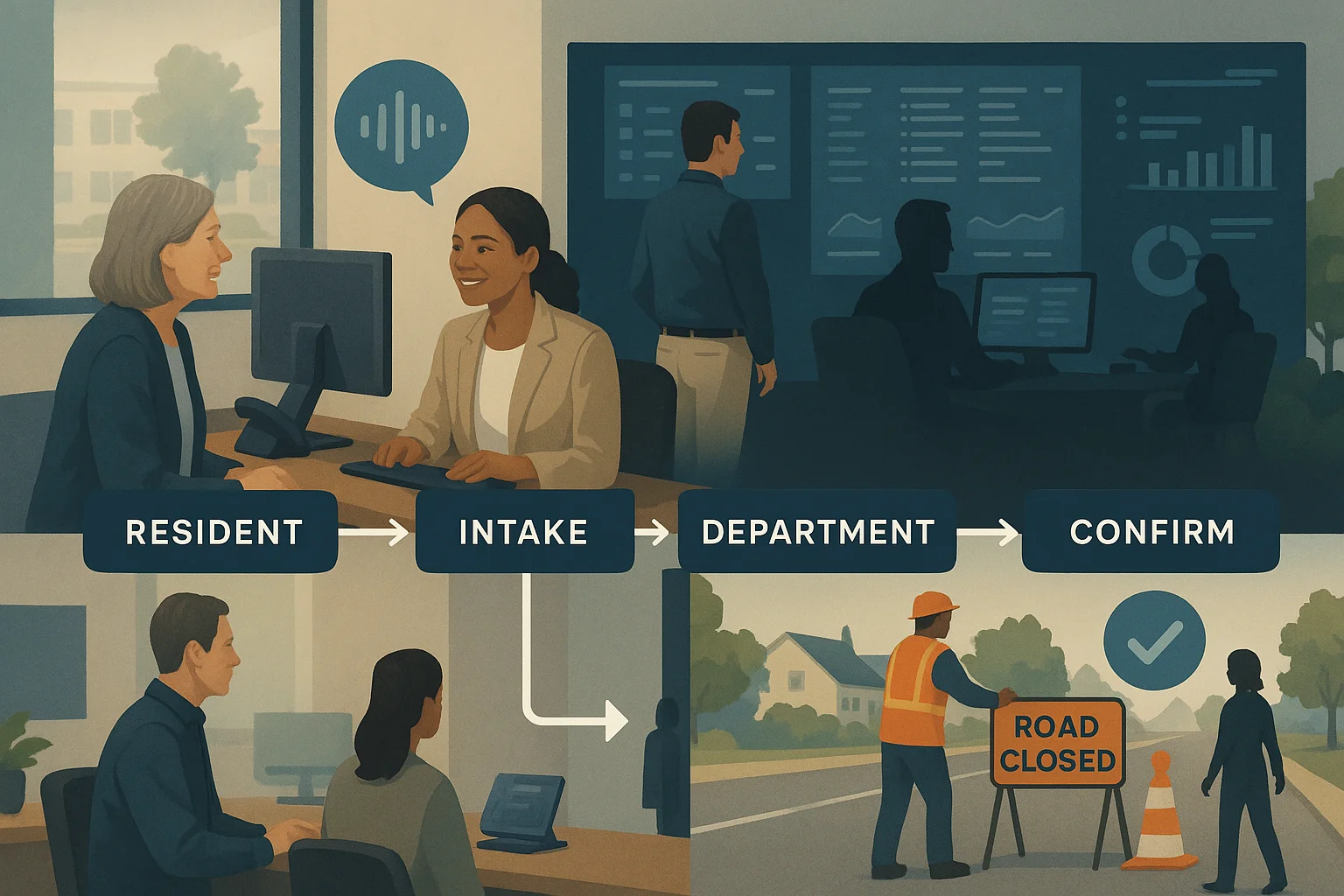
Adopt a compact architecture that’s easy to describe to procurement and non‑technical stakeholders: Resident → Voice AI → logic bridge → form & field retrieval → validation → municipal case system → confirmation or human handoff. The voice layer handles speech and NLU; the logic bridge orchestrates lookups, field population, and validation; the back‑end case system persists records and triggers work queues. This separation keeps vendor boundaries clean and ties automated intake to auditable case records.
- Logic bridge responsibilities: routing, API orchestration, duplicate detection, rate limiting, and recording metadata.
- Validation examples: address/parcel lookup, account existence, appointment slots, and consent capture.
- Handoff: structured handoff payloads and confirmation numbers so humans receive the same, verifiable case context.
2. Funding models and procurement choices
Municipal IT and finance leaders must align funding to the lifecycle stage and operating risk of each Voice AI project. This section describes funding splits, procurement constructs, and contract controls that support accountable scaling.
Align funding to lifecycle and risk
Separate funding into three practical pools: pilot/innovation (small, time‑boxed), platform/capability (core voice platform, logic bridge, integrations), and service‑delivery OPEX (per‑interaction costs, maintenance, and human‑in‑loop staffing). Use pilots to validate assumptions, but only move to platform funding when a use case shows repeatable demand, reduced friction, or public value (e.g., extended hours, accessibility). Budget human‑in‑loop capacity explicitly for higher‑risk use cases.
- Pilot/Innovation: 6–12 month funding for concept, testing, and UX validation.
- Platform/Capability: one‑time capital for systems that support many use cases—logic bridge, integration adapters, and case system connectors.
- Service/OPEX: staff, vendor run costs, telephony, transcription, and ongoing QA.
Procurement constructs and SOW guardrails
Prefer statement‑of‑work models that separate capability delivery (platform and adapters) from operational service levels. Contractually require: defined integration APIs, data handling and subprocessors disclosure, access to logs for auditing, SLA‑aligned handoff times, and a defined exit/transition plan. Where possible, procure outcome metrics (percent of successful automated intakes, accuracy baselines, average handoff time) rather than black‑box performance claims.
- Require vendor transparency on subprocessors and hosting regions; include audit clauses and access to logs in the contract.
- Define acceptance criteria that map to municipal records and legal obligations (for example, immutable case creation or exportable case bundles).
- Include transition support and data export in the SOW to prevent vendor lock‑in.
3. Risk, legal boundaries, and human oversight
Voice AI introduces specific governance obligations in records, privacy, accountability, and safety. Municipal leaders must set clear, non‑negotiable boundaries where humans make decisions and ensure automated paths are auditable and reversible.
Define risk tiers and human‑in‑loop rules
Map each use case to a risk tier that determines required controls and human oversight. Keep emergency, enforcement, eligibility, and discretionary or legally sensitive decisions strictly within trained staff. For medium‑risk cases, use automated intake with mandatory human review before actions are taken. For low‑risk informational services, allow fully automated outcomes with confirmation numbers and clear resident consent.
- High risk: no automated final decisions; machine assists intake only, with immediate human ownership.
- Medium risk: automation collects verified, validated inputs; staff approval required for execution.
- Low risk: automation may complete transactions if resident consent, validation checks, and audit logs are present.
Use impact assessments and risk frameworks
Apply a formal AI risk assessment before moving a voice use case beyond pilot. Use frameworks to document potential harms, data flows, human oversight points, and remedial controls. Where local mechanisms exist, adapt them; when not, use international frameworks (for example, NIST AI RMF for public sector risk management) to structure governance, continuous monitoring, and roles and responsibilities.
- Conduct a pre‑deployment impact assessment for each medium‑ or high‑risk use case.
- Document decisions on data retention, recording consent, and allowable downstream processing.
- Define acceptability thresholds and revert‑to‑human triggers for live service.
4. Architecture and integration controls
Operational resilience and public accountability depend on a clear integration pattern and pragmatic controls. This section outlines the recommended technical architecture and the controls that must be in place between voice, orchestration, and municipal back offices.
Canonical integration pattern
Use the Resident → Voice AI → logic bridge → form/field retrieval → validation → municipal case system → confirmation/handoff model. The logic bridge is the trusted orchestration layer: it enforces validation rules, duplicate detection, API throttling, and generates confirmation numbers. Keep speech and NLU vendors stateless with respect to final case records—persisted records should live in municipal systems or an auditable intermediary.
- Keep personally identifiable information (PII) minimised in the voice vendor and favour tokenization or transient references.
- Place duplicate detection logic in the bridge to avoid multiple case creation from cross‑channel submissions.
- Ensure confirmation numbers map to immutable case IDs in the municipal record system for auditability.
Cybersecurity and resiliency controls
Apply standard municipality cybersecurity goals to voice integrations: secure API gateways, least‑privilege service accounts, multi‑region backup strategies for essential records, and monitored logging. The Cross‑Sector Cybersecurity Performance Goals provide a useful baseline for enterprise controls; combine those controls with municipal incident response and vendor subprocess management.
- Require encrypted transport (TLS) and mutual authentication for inter‑system calls.
- Define hosting region, backup region, subprocessors, and remote support access in the contract and review for transfer mechanisms.
- Instrument observability across the logic bridge and case system to detect anomalies (traffic spikes, malformed payloads, repeated failures).

5. Service rationalization and cross‑channel orchestration
Rationalization prevents an explosion of redundant voice services and improves resident experience by aligning voice with web, SMS, and in‑person channels. This section gives a practical prioritization rubric and operational rules for cross‑channel orchestration.
Prioritizing services and avoiding duplication
Use four criteria to prioritize voice services: resident demand, transactional complexity, public value (accessibility/coverage), and risk/effort ratio. Decommission or postpone services that duplicate high‑value digital channels unless voice extends coverage (off‑hours, low digital access). Where multiple channels exist for the same function, ensure canonical case creation rules so duplicates are collapsed into single records with clear provenance.
- Inventory existing channels and tag per use case to identify overlap.
- Use the logic bridge to normalize and deduplicate submissions from voice, web, and mobile channels.
- Maintain a canonical channel precedence policy for case creation to reduce work duplication.
Cross‑channel orchestration and resident experience
Design voice interactions to reference existing resident context when available (open cases, account status) and to hand off seamlessly to human agents with the same context. Confirmation numbers and persistent case links are essential for cross‑channel continuity: a resident who starts via voice can return later by web or phone and see the same case. Track and measure cross‑channel completion rates and re‑contact drivers to refine routing rules.
- Expose case lookup APIs so voice sessions can reference or update existing records.
- Provide explicit user prompts for consent to link channels (recording consent, data sharing).
- Measure channel escalation rates, repeat contact, and time‑to‑resolution by channel.
6. Implementation controls, QA and measurable outcomes
To move from pilot to city‑wide rollouts, municipal programs need operational controls, repeatable QA patterns, and measurable KPIs. This section sets out the testable controls and outcomes procurement and operations teams should demand.
Baseline QA and acceptance testing
Require a reproducible QA regimen: scripted scenarios, adversarial testing (slot‑filling errors, ambiguous speech), accessibility testing (screen readers and DTMF fallbacks), and privacy‑preserving log exports. Acceptance criteria should include accuracy baselines for field capture (not black‑box intent scores), successful API call rates to municipal systems, and handoff fidelity (do human agents receive full context?).
- Use canned and real‑world (anonymized) utterance sets to validate field extraction and validation logic.
- Include accessibility testing for common assistive technologies and DTMF fallbacks for key flows.
- Require vendors to provide an exportable log format for audit and records retention.
KPIs and service metrics to govern the portfolio
Track a concise set of operational metrics to govern the portfolio: automated completion rate, mean time to handoff, duplication rate, confirmation number resolution rate, resident satisfaction (CSAT), and accessibility coverage. Use these metrics to decide whether to scale, pivot, or retire a use case. Make KPIs visible to stakeholders and include them in vendor SLAs where operationally and legally appropriate.
- Automated completion rate: percent of intents completed without human handoff (only for low‑risk services).
- Duplication rate: percent of cases merged at creation due to cross‑channel overlap.
- Confirmation resolution rate: percent of residents who can resolve or reference their confirmation number successfully.
Related Peak Demand resources
Industry and AI sources reviewed
- Artificial Intelligence Risk Management Framework (AI RMF 1.0)National Institute of Standards and Technology (NIST)
- Cross-Sector Cybersecurity Performance GoalsCybersecurity and Infrastructure Security Agency (CISA)
- Algorithmic Impact AssessmentGovernment of Canada
Public-sector procurement, privacy, accessibility, records, cybersecurity, and administrative-law obligations vary by jurisdiction. This article is operational guidance, not legal advice; organizations should confirm applicable requirements with qualified professionals.
Frequently asked questions
Suitable workflows include structured resident inquiries, service-request intake, permit or program information, appointment scheduling, department routing, status updates from approved systems, and after-hours overflow. Adjudication, enforcement discretion, emergency response, and binding eligibility decisions should remain with authorized staff.
Official reference: Artificial Intelligence Risk Management Framework (AI RMF 1.0)
Use a controlled service catalogue, required fields, department ownership rules, validation, duplicate checks, confirmation numbers, and documented handoff paths. The system should create an auditable record and avoid silently dropping requests when a downstream system is unavailable.
Official reference: Algorithmic Impact Assessment
Municipal deployments should document purpose, affected services, data use, human oversight, complaint and appeal paths, accessibility channels, records handling, monitoring, and the process for approving material changes.
Official reference: Algorithmic Impact Assessment
Require workflow demonstrations, integration and security architecture, testing evidence, auditability, data-location and subcontractor details, incident response, accessibility support, human escalation, exit planning, and clear ownership of ongoing updates.
Official reference: Artificial Intelligence Risk Management Framework (AI RMF 1.0)
Modernize public-service intake without losing control
Peak Demand helps municipal teams connect Voice AI to service requests, department routing, validation, escalation, records, and operational analytics.
Schedule a discovery call


