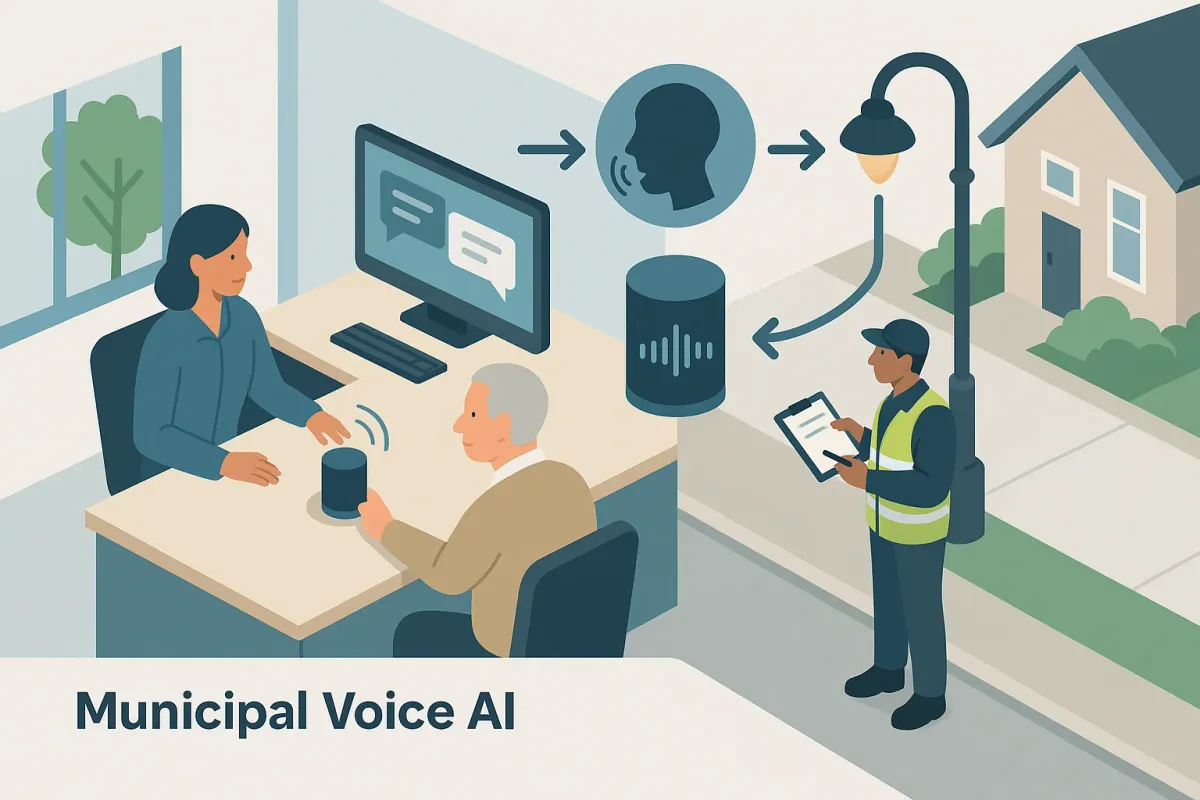
Municipal Voice AI: Cross-Channel Orchestration, Predictive SLAs & SORs
A practical operating model for municipal Voice AI that connects resident voice channels to municipal case systems, maintains a definitive source‑of‑record, and uses predictive SLAs to stabilise operations while preserving human oversight, auditability and accessibility.
1. Operating model: orchestration, canonical forms and the SoR
A pragmatic municipal operating model separates resident-facing intelligence from authoritative municipal records and workflows. This section describes a canonical architecture and the principles that protect records, auditability and continuity.
Core architecture: Resident → Voice AI → logic bridge → SoR
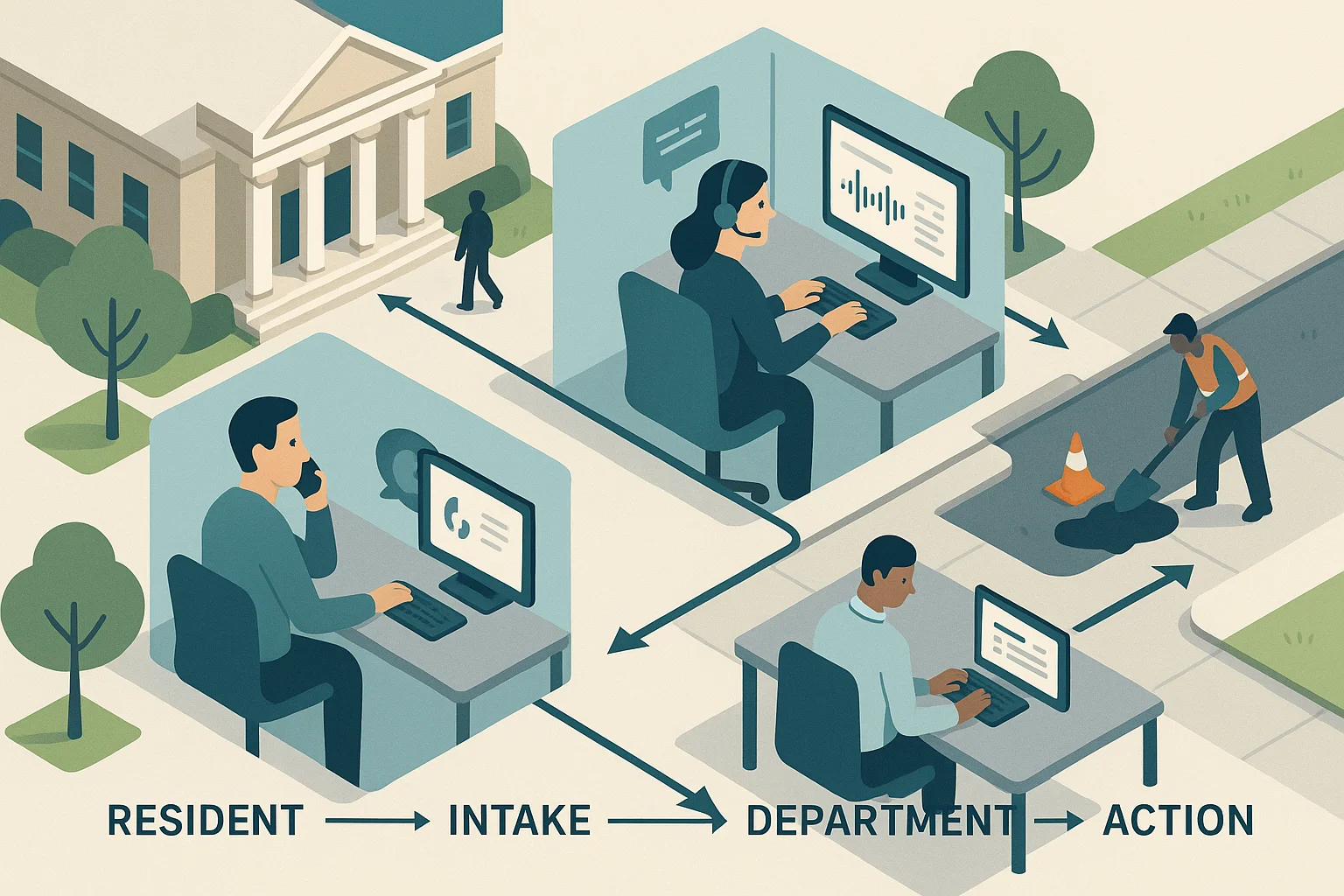
Design Voice AI as the resident‑facing orchestration layer, not the authoritative case store. The canonical data path should be: Resident (phone, callback, web voice, or smart speaker) → Voice AI agent (NLU, dialog manager, channel adaptor) → logic bridge (deterministic business logic, validation, duplicate checks) → form/field retrieval and population → municipal case system (SoR) → confirmation or human handoff. Keep the municipal case system (311/CRM/EDS) as the single source of record for decisions, audit trails and public records requests. This separation reduces risk: the Voice AI captures and normalises inputs; the SoR persists authoritative records and custody.
- Voice AI captures intent and populates a canonical form model (field names, types, permissible values).
- Logic bridge enforces sequence, validation rules, business routing and rate limits before API submission.
- SoR writes generate immutable confirmation numbers and server timestamps; these are returned to the resident via Voice AI and stored in call logs.
Canonical forms, validation and duplicate controls
Build a canonical form and field dictionary aligned to municipal taxonomy (service type, location, related asset IDs, resident identity fields). The logic bridge should run deterministic validation rules (required fields, geometry checks, civic address format) and duplicate detection before creating a case. Duplicate controls prevent multiple unresolved records for the same incident, reducing bounce and investigative overhead.
- Use API queries to the SoR to check recent similar cases by location and descriptor, then either merge, reference, or create a new record.
- Return a confirmation number for every accepted submission; for merged records, include the primary record number and a brief explanation.
- Where confidence is low, retain partial drafts in a secure staging store and prompt for human review or callback.
2. Cross‑channel orchestration and continuity
Residents expect consistent experiences across phone, web voice and callback. Orchestration should provide session continuity, channel stitching and single‑thread case creation.
Session stitching and channel handoff
Assign a session identifier at first contact and propagate it through voice transcripts, web interactions and case submissions. When a voice interaction becomes a case, link all prior touchpoints to the case in the SoR. If a handoff to an agent occurs, the agent workspace should display the stitched history, voice transcript, confidence scores and prior validations to reduce time to resolution.
- Session IDs must be unique, non‑guessable, logged with timestamps, and retained according to record retention policy.
- Real‑time channel handoff requires API endpoints for transferring session context and last‑known field values to agent desktops.
Orchestrating follow‑ups and callbacks
Use the same orchestration layer to schedule and manage callbacks, notifications and reminders. Predictive SLA signals (queue pressure, agent availability, case complexity) should adjust callback windows dynamically and surface urgent handoffs.
- Provide residents with explicit expected response windows and confirmation numbers during initial intake.
- Avoid ad‑hoc promises: use predictive SLA outputs to set realistic windows and maintain service credibility.
3. Predictive SLAs and operational forecasting
Predictive SLAs remove brittle promises by replacing static targets with real‑time forecasts and dynamic thresholds that inform routing and human intervention.
Why predictive SLAs matter
Municipal contact volumes spike with weather, events and media. Predictive SLA models ingest queue length, agent availability, historical throughput, and incident severity to forecast expected wait and resolution time ranges. Operational leaders then set dynamic thresholds for automated resolution, limited self‑service, or mandatory live handoff.
- Forecasts should be expressed as probabilistic windows (e.g., 80% of cases of this type will be resolved within X hours under current load).
- Use forecasts to adjust routing rules and to trigger temporary increases in human review for high‑risk categories.
Operationalising predictive outputs
Embed predictive outputs in the logic bridge so that routing decisions are reproducible and auditable. For example, when forecasted delay exceeds an escalation threshold for high‑severity reports, the system should automatically queue a supervisor notification and escalate to a staffed channel.
- Store the predictive input snapshot (queue, agent staffing, confidence) with each case to support after‑action reviews and SLA audits.
- Measure predictive accuracy and operational impact through a monthly review that compares forecasted windows with actual outcomes.
4. Records, governance and accountable automation
Records and governance are primary public‑sector concerns. The Voice AI layer must support records management, algorithmic impact assessment, accessibility, and public accountability.
Source of Record and immutable records
Declare the municipal case system as the SoR and ensure writes are immutable (or follow your jurisdiction’s official amendment rules). Voice transcripts, confidence metadata, validation steps, and predictive SLA snapshots should be attached as supporting records. Preserve clear provenance: which system suggested a value, who (or what) accepted it, and when it was persisted.
- Capture acceptance flags and user IDs for any manual edits to AI‑generated fields.
- Make recorded calls and transcripts available according to public records, retention and privacy policies.
Risk management and algorithmic assessment
Apply an AI risk management process to map harms, classify risk levels, and require mitigations before production deployment. Jurisdictions should undertake algorithmic impact assessments when automation materially affects residents’ rights or access to services — using local legal advice and relevant frameworks where applicable.
- Document use cases, data sources, decision points, failure modes and mitigation controls in an assessment artefact.
- Require higher governance review for systems that affect enforcement, eligibility or legal outcomes.
Accessibility, privacy and auditability
Design voice scripts and verification flows to meet accessibility standards and provide alternative channels without degradation of service. Maintain full audit trails for each case: raw voice recordings, NLU transcripts, validation logs, routing decisions and the final SoR entry. Auditable trails support public accountability and freedom-of-information obligations.
- Offer multiple contact channels and ensure form fields and confirmation numbers are accessible in text and audio.
- Identify and log personally identifiable information (PII) handling decisions and redaction steps for public disclosure.

5. Controls, safety boundaries and cybersecurity
Municipal deployments must define explicit failure boundaries and preserve human authority over high‑risk domains. Concurrently, apply baseline cybersecurity controls that align with cross‑sector guidance.
Failure boundaries and human-in-loop rules
Keep emergency calls, enforcement actions, eligibility determinations, and other sensitive discretionary decisions with trained human staff. Where Voice AI does preliminary intake for such categories, the system must flag the case with a high‑risk tag and require human verification before any enforcement action is taken.
- Automatic intake may create provisional records, but no legal or enforcement steps should be performed without supervisor review.
- Define explicit confidence thresholds for allowing automated self‑service versus mandatory agent involvement.
Cybersecurity and operational resilience
Adopt cross‑sector cybersecurity performance goals to secure the orchestration layer, APIs and SoR integrations. Controls should include authenticated API access, least privilege for service accounts, encryption in transit and at rest, and hardened logging for forensic analysis.
- Limit remote‑support subprocessors and document data residency, backups, and subprocessors used for model hosting or transcription.
- Maintain segregation between production SoR and any staging or test copies used by Voice AI to reduce the risk of accidental writes.
6. Procurement, implementation roadmap and measurable outcomes
Procurement should prioritise operational controls, integrations and accountable governance over feature marketing. Structure implementations to de‑risk production at each phase.
Procurement checklist for municipal buyers
Require prospective suppliers to demonstrate deterministic validation, duplicate controls, confirmation numbering, accessible transcripts, and integration experience with municipal case systems. Ask for transparent descriptions of subprocessors, hosting regions, retention policies, and the vendor’s approach to handoff and audit trails.
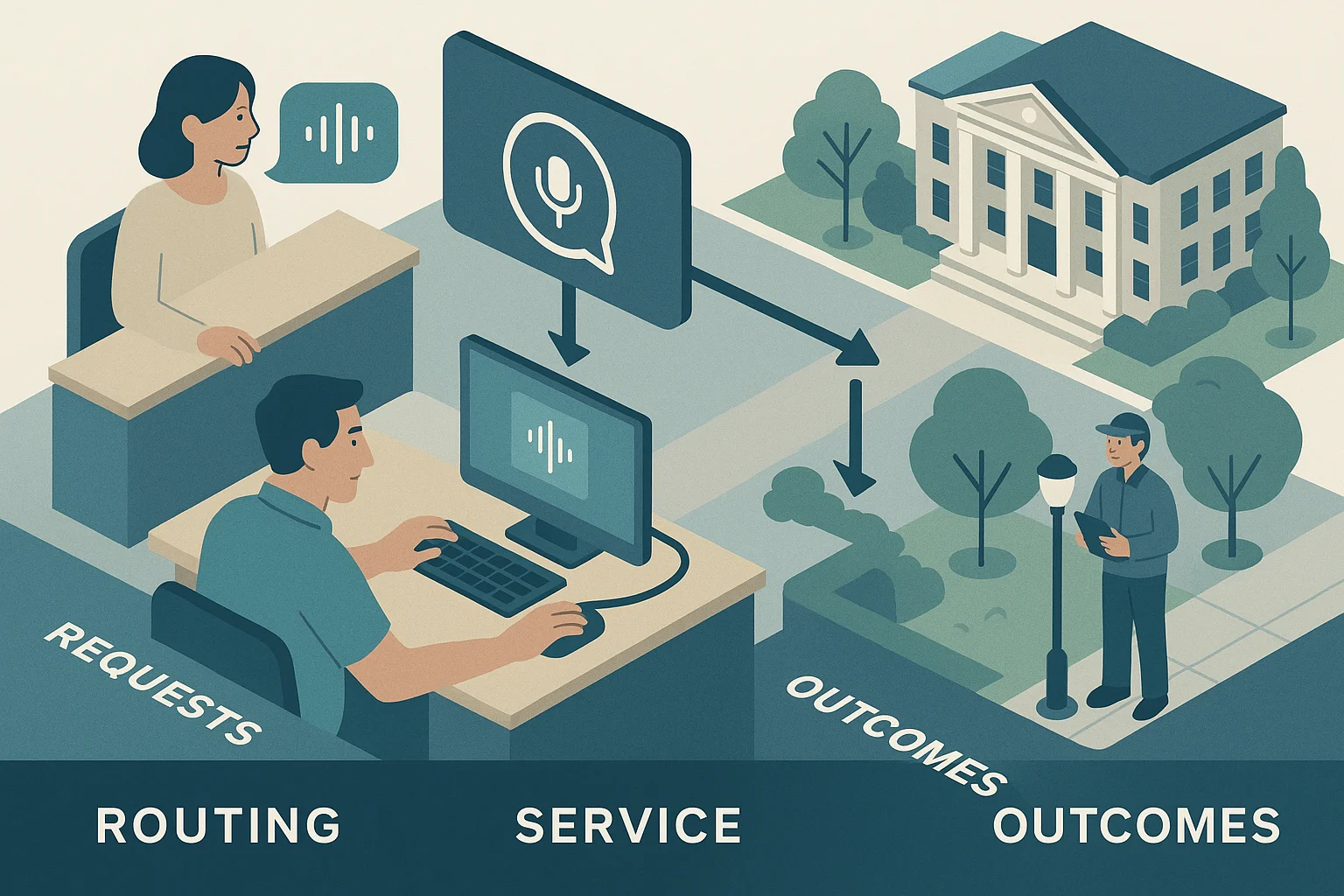
- Request an architecture showing the orchestration layer, API adapters and SoR write flow (no vendor proprietary black‑boxes for critical routing).
- Require evidence of operational runbooks, incident response, and a joint escalation model with the vendor.
Phased implementation and KPIs
Start with a controlled pilot that scopes low‑risk, high‑volume services (e.g., sanitation pickups, park maintenance reports). Measure: case acceptance accuracy (validation pass rate), duplicate reduction, first‑contact resolution where applicable, time to human handoff, predictive SLA accuracy, accessibility compliance checks, and audit completeness.
- Run a 90‑day pilot with continuous QA and an after‑action review tied to policy changes before scaling to other service lines.
- Use measurable outcomes—not vendor claims—to guide expansion decisions.
Managed services and operational ownership
Municipalities should clarify the split of responsibilities: who owns integrations, data pipelines, validation rules, and training data updates. Managed service offerings can accelerate deployment but contracts must specify handoff points, observability requirements, and vendor obligations for records and subprocessors.
- Insist on documented procedures for model updates, approval gates, and rollback mechanisms.
- Ensure the municipality retains the right to extract logs, transcripts and configuration data during and after contract termination.
Related Peak Demand resources
Industry and AI sources reviewed
- Artificial Intelligence Risk Management Framework (AI RMF 1.0)National Institute of Standards and Technology (NIST)
- Algorithmic Impact AssessmentGovernment of Canada
- Cross-Sector Cybersecurity Performance GoalsCybersecurity and Infrastructure Security Agency (CISA)
Public-sector procurement, privacy, accessibility, records, cybersecurity, and administrative-law obligations vary by jurisdiction. This article is operational guidance, not legal advice; organizations should confirm applicable requirements with qualified professionals.
Frequently asked questions
Suitable workflows include structured resident inquiries, service-request intake, permit or program information, appointment scheduling, department routing, status updates from approved systems, and after-hours overflow. Adjudication, enforcement discretion, emergency response, and binding eligibility decisions should remain with authorized staff.
Official reference: Artificial Intelligence Risk Management Framework (AI RMF 1.0)
Use a controlled service catalogue, required fields, department ownership rules, validation, duplicate checks, confirmation numbers, and documented handoff paths. The system should create an auditable record and avoid silently dropping requests when a downstream system is unavailable.
Official reference: Algorithmic Impact Assessment
Municipal deployments should document purpose, affected services, data use, human oversight, complaint and appeal paths, accessibility channels, records handling, monitoring, and the process for approving material changes.
Official reference: Algorithmic Impact Assessment
Require workflow demonstrations, integration and security architecture, testing evidence, auditability, data-location and subcontractor details, incident response, accessibility support, human escalation, exit planning, and clear ownership of ongoing updates.
Official reference: Artificial Intelligence Risk Management Framework (AI RMF 1.0)
Modernize public-service intake without losing control
Peak Demand helps municipal teams connect Voice AI to service requests, department routing, validation, escalation, records, and operational analytics.
Schedule a discovery call


