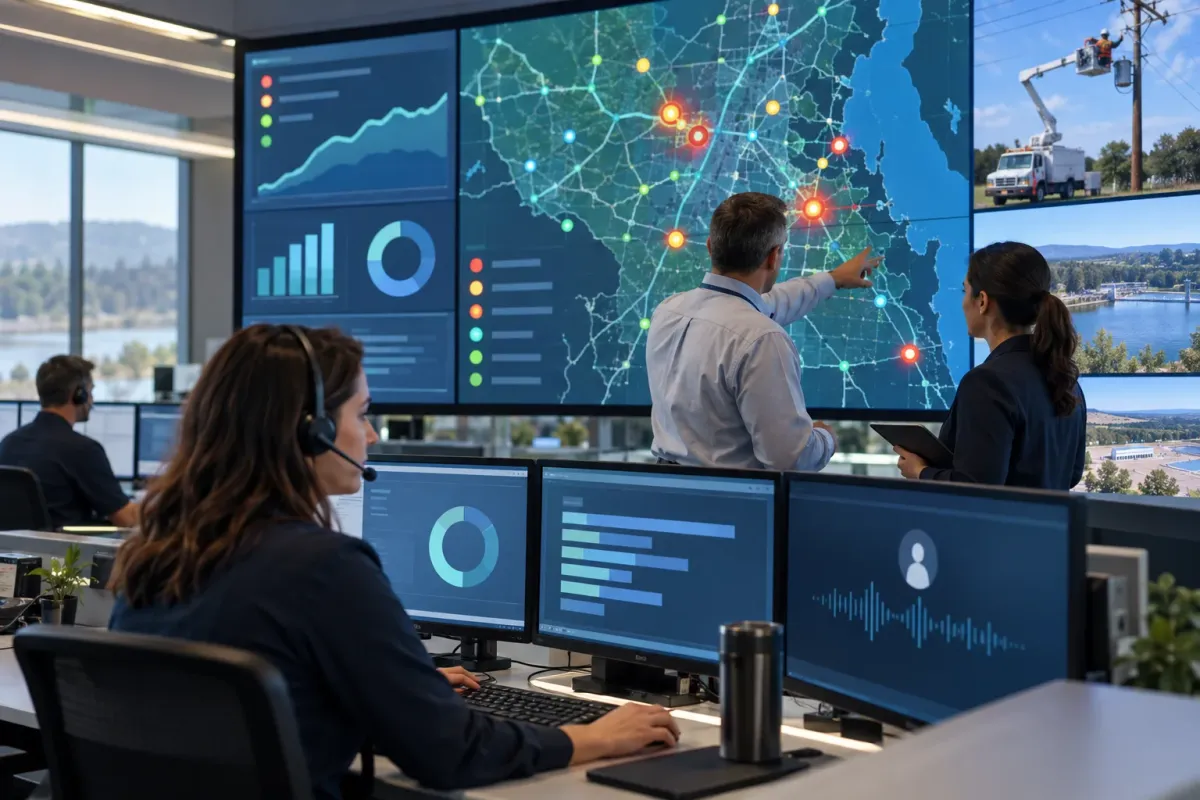
Migrating Legacy OMS, SCADA and CRM to Voice‑AI‑First Utility Operations
A practical operating framework for migrating outage management, SCADA-adjacent workflows, and CRM/CIS service‑request channels to a Voice‑AI‑first model with account-safe validation, robust integrations, and clear escalation boundaries.
1. Why Voice‑AI‑First, and what it changes
Voice AI can reshape customer-service and outage communications by increasing containment of routine contacts, improving consistency of information during incidents, and scaling surge handling. The migration is primarily an operational and controls exercise: map intent, verify identity, and route or write only under governed conditions.
Operational gains and non‑functional boundaries
Adopt Voice AI to reduce repeat inquiries, accelerate status distribution, and free specialist agents for complex work. Expect improvements in consistency, not instantaneous elimination of human roles: human escalation and auditability remain essential. Explicitly separate the Voice AI front end from operational control systems; Voice AI should never issue commands to field equipment or substitute emergency dispatch decisions.
- Containment of routine status requests and billing inquiries.
- Faster, consistent outage summaries tied to OMS events.
- Scalable surge handling during major events with controlled human handoffs.
Change in workflows — what to keep and what to refactor
Keep established safety workflows and field‑crew dispatch rules intact. Refactor contact-intake processes: move conversational intent detection and preliminary validation to Voice AI, while preserving authoritative data lookups and write approvals in OMS/CRM/CIS. That split reduces downstream operational risk and makes monitoring and rollback straightforward.
- Voice AI: caller intent, conversational context, preliminary validation
- Authoritative systems: confirmed account state, outage records, dispatch schedules
- Human agents: complex triage, safety confirmations, final write approvals where required
2. Reference architecture and approved call flow
Design the architecture around a simple, auditable call flow and defensible boundaries. Peak Demand recommends the canonical sequence below for most customer and outage workflows.
Canonical call flow
Customer call → Voice AI conversational layer → account or premise validation → read from approved utility API or knowledge store → determine intent outcome → either (a) provide status or information, (b) create a service request or ticket via approved write API with gating, or (c) escalate to a human agent. Log every decision and transaction with event IDs tied to the OMS/CRM record. This model preserves a single source of truth and makes rollback and audit straightforward.
- Initiation: telephony or contact platform hands audio to Voice AI with call metadata
- Validation: match caller signals (phone number, account token, service address) to a minimal validation policy before disclosing account details
- Lookup: perform read-only queries against OMS/CRM/CIS/knowledge systems through approved APIs
- Decision: map intent to action – status, request intake, schedule, or escalation
- Write: if required, post only through controlled write adapters with built-in confirmation steps and human approval thresholds
Integration adapters and separation of privileges
Use thin, auditable adapters between the Voice AI and utility systems. Adapters should translate Voice AI intents into API calls, enforce role-based credentials, and separate read-only access from write capabilities through distinct service accounts and logging. Implement retry and circuit‑breaker logic to prevent cascading failures during system outages.
- Read adapters: high‑availability caches, read-through to authoritative systems, rate limiting
- Write adapters: multi-step confirmation, thresholded for automation versus human approval
- Event bus: emit standard event contracts for downstream analytics and for OMS/SCADA correlation
3. Account‑safe validation, privacy and data‑handling controls
Validation and data handling are core to trust and regulatory compliance. Implement predictable, minimum‑viable validation patterns and clear rules for recording calls and storing derived data.
Minimum validation policy and disclosure rules
Adopt a validation policy that requires a configurable minimum of signals before disclosing account-specific or outage details. Signals can include caller phone match, one-time PIN, partial account number, or service-address confirmation. Never escalate or provide actionable infrastructure instructions based solely on an unvalidated interchange.
- Tier 1 (low-sensitivity): general outage information available without account verification
- Tier 2 (sensitive): account-balance, billing or repair history requires validation
- Tier 3 (write or safety-sensitive): work-order creation or schedule changes require multi-factor validation or human approval
Recording, retention, and cross‑border considerations
Define recording consent prompts, retention periods, and subprocessors in procurement documents. Distinguish processing locations (hosting region) from backup and subprocessor regions, and design the system to allow alternative hosting for jurisdictions with strict data‑locality preferences. Confirm specific obligations with qualified counsel and privacy professionals.
- Record consent and present it at call start where required
- Specify hosting region, backup region, and subprocessors in contracts
- Include mechanisms to restrict onward transfer and to purge recordings on request
Cybersecurity objectives and operational resilience
Define controls that limit attack surface and ensure rapid recovery. Use principles from cross‑sector cybersecurity goals and energy sector maturity models to build layered defenses: identity and access management for adapters, network segmentation, service‑account audits, and incident playbooks that cover integration failures and data incidents.
- Role-separated service accounts for read vs write adapters
- Network isolation between Voice AI services and SCADA/field-control networks
- Regular cyber tabletop exercises involving Voice AI integration failures

4. Migration sequencing and testability
A phased migration reduces risk and keeps outage and field operations running. Prioritize read-only capabilities and controlled escalation points before opening automated write paths.
Phase 1: Pilot status and FAQ containment
Start with inbound status queries and predefined FAQ responses tied to OMS event IDs. Validate intent handling and confirm that Voice AI responses align to authoritative OMS outputs. Measure containment and wrong‑answer rates and iterate.
- Pilot scope: outage status, estimated restoration times (EROs) read-only, and billing FAQs
- Success thresholds: containment rate, false-positive escalation rate
- Tools: synthetic test calls, recorded call QA, and parallel agent shadowing
Phase 2: Service‑request intake with gated writes
Introduce service-request creation with clear gating: automated creation for low-risk requests (meter reading, address update) and human approval for safety‑sensitive or dispatch-affecting requests. Ensure adapters enforce write policies and that every write includes caller validation metadata and an event correlation ID.
- Define a minimal set of auto-approvable request types
- Require confirmation prompts prior to creating a work order
- Instrument write adapters so every write can be rolled back or amended by agents
Phase 3: Scheduling and selective escalation automation
Enable scheduling and field-service routing for well-scoped requests where systems and SLAs are stable. Keep escalation to human schedulers during major incidents or when resource constraints are present.
- Allow Voice AI to propose time windows, but require human confirmation for high-risk tasks
- Integrate routing with field-service systems via read/write adapters that expose capacity and skill constraints
- Test scheduling under surge loads and confirm SLA adherence

5. Governance, measurement and continuous assurance
Governance must tie Voice AI performance to operational outcomes. Establish roles, dashboards, and QA regimes that keep the system safe, reliable, and auditable.
Governance model and accountability
Set a cross-functional governance body including customer service, operations, IT, cybersecurity, and legal. Assign clear responsibilities for intent taxonomy, validation rules, adapter access, and escalation policies. Maintain runbook ownership and change‑control procedures for conversational models and intent-to-action mappings.
- Owners for intent taxonomy, validation policies, and write approvals
- Change control for conversational model updates with staged rollout
- Regular audits of adapter service accounts and access logs
Key metrics and SLOs
Track containment rate, escalation rate, correct-answer rate, time-to-first-action for service requests, and closed-loop correlation between Voice AI interactions and OMS/field outcomes. Use event-level analytics to associate Voice AI interactions with downstream operational KPIs.
- Containment: percent of contacts resolved without human agent
- Escalation correctness: percent of escalations that required human intervention
- Action correlation: percent of Voice AI-created requests that result in a confirmed field action within SLA
Quality assurance and continuous testing
Run ongoing synthetic and live QA with clear pass/fail gates. Use shadow-routing where agent teams see Voice AI decisions without customer impact. Maintain an annotated sample of calls for model retraining and guard‑rail validation.
- Synthetic call generators for regression testing
- Shadow mode during major updates
- Post‑incident QA and model re‑labeling pipeline

6. Procurement, service model and operational support
Select vendors and structure contracts to reflect the operational responsibilities, data controls, and availability needs unique to regulated utilities.
Contract terms and evidence to request
Require clear statements of data hosting region, subprocessors, backup geography, remote support access, and incident notification duties. Request demonstration of high‑volume Voice AI handling, integration experience with OMS/CRM, documented escalation patterns, and evidence of event‑level analytics.
- Specify hosting region, backup region, and subprocessors in the contract
- Define incident notification timelines and contact paths
- Request runbooks for integration failure modes and recovery steps
Operational support model and Peak Demand differentiation
Favor suppliers that provide: high‑volume Voice AI operations, proven outage and service‑request integrations, account‑safe validation patterns, reliable workflow routing and human escalation, and event‑level analytics for operational governance. Peak Demand’s approach focuses on these exact capabilities and on building adapters and event contracts that integrate with existing OMS, CRM, and field‑service systems.
- 24/7 managed operations during high-event periods
- Prebuilt adapters for common OMS/CRM/CIS APIs and custom adapter development
- Operational analytics tied to event IDs and OMS correlation
SLA, observability and testing expectations
Define SLAs for availability, API latency, and time to restore. Include observability requirements—call traces, adapter telemetry, and end‑to‑end correlation of Voice AI events to OMS/field outcomes. Require pre‑production acceptance tests and runbook drills included in the procurement package.
- API latency and error-rate SLOs for critical read paths
- Runbook and tabletop drill obligations for major-event scenarios
- Evidence of load-testing at expected surge levels
Related Peak Demand resources
Industry and AI sources reviewed
- Cross-Sector Cybersecurity Performance GoalsCybersecurity and Infrastructure Security Agency (CISA)
- Cybersecurity Capability Maturity Model (C2M2)U.S. Department of Energy
- AI Risk Management Framework — Critical Infrastructure ProfileNational Institute of Standards and Technology (NIST)
Utility cybersecurity, critical-infrastructure, records, customer-protection, and emergency-communications obligations vary by jurisdiction and service type. This article is operational guidance, not legal advice; organizations should confirm applicable requirements with qualified professionals.
Frequently asked questions
Good starting points include billing and account questions, move-in or move-out intake, appointment scheduling, service-request capture, outage-status messaging from approved systems, payment-routing assistance, and structured escalation. Safety-critical and infrastructure-control decisions should remain with qualified utility teams.
Official reference: Cross-Sector Cybersecurity Performance Goals
Use the minimum approved identifiers needed for the workflow, validate them against the utility's system of record, limit data exposure, and provide a human-assisted path when verification fails. The Voice AI should not guess account, premise, or outage information.
Official reference: Cross-Sector Cybersecurity Performance Goals
Use controlled adapters, strict schemas, timeouts, retries, audit logs, safe failure states, and human escalation. The system should distinguish approved utility data from model-generated language and should never present stale or unverified operational information as fact.
Official reference: Cybersecurity Capability Maturity Model (C2M2)
Track containment by request type, successful validations, transfers, abandoned calls, integration errors, incorrect or stale responses, time to resolution, customer follow-up, and the percentage of cases completed safely without manual rework.
Official reference: Cybersecurity Capability Maturity Model (C2M2)
Build resilient utility customer-service automation
Peak Demand helps utilities connect Voice AI to approved customer-information, outage-communication, service-request, dispatch, escalation, and analytics workflows.
Schedule a discovery call


