
Measuring Voice AI Resolution Quality Across Municipal Departments
A practical, jurisdiction‑neutral operating model and measurement framework for municipal leaders to assess Voice AI resolution quality across 311, customer service, and departmental intake.
1. A municipal operating model for measuring Voice AI resolution
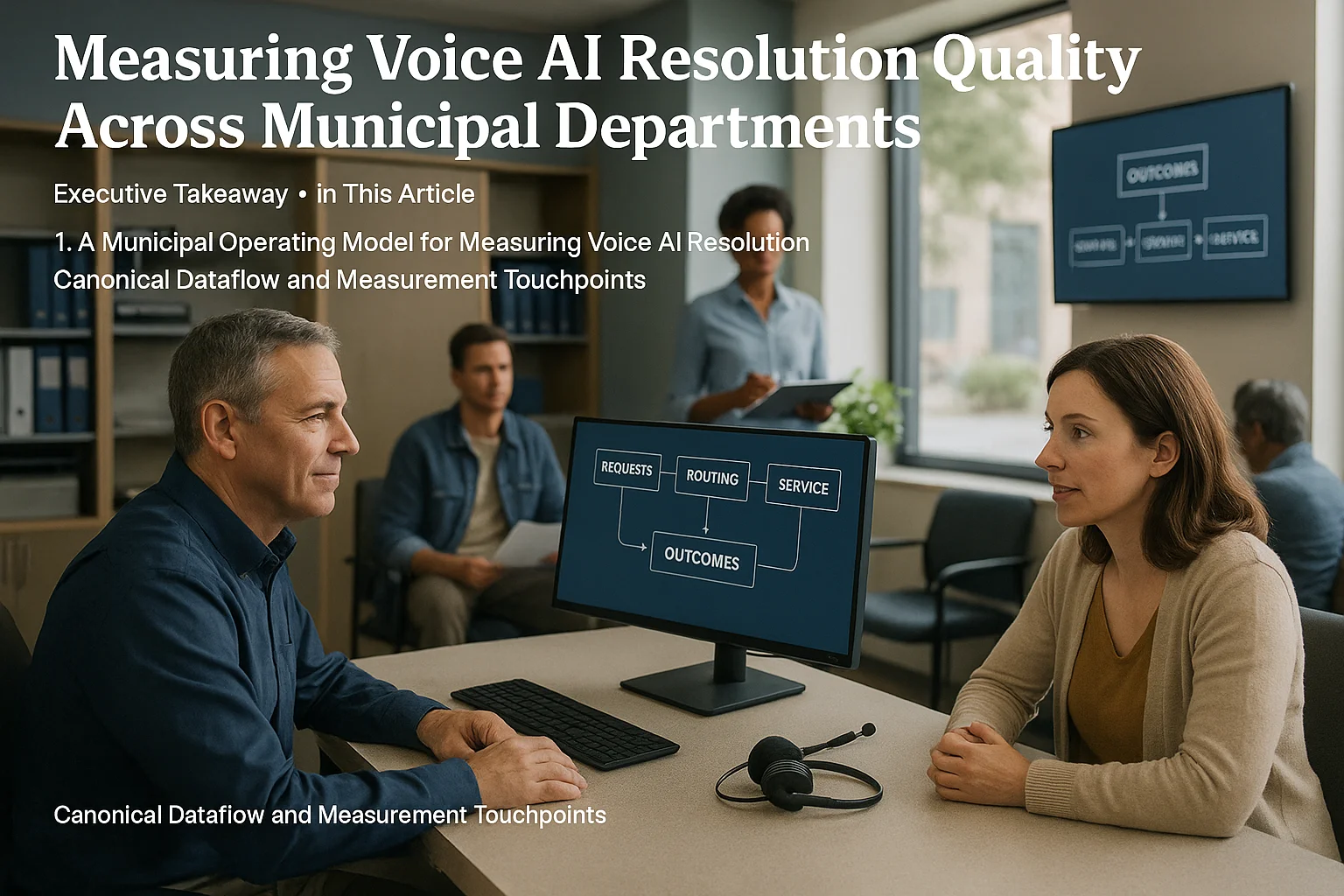
A practical operating model clarifies responsibilities, observability points, and decision boundaries. Use this as the canonical flow to design measurement and QA.
Canonical dataflow and measurement touchpoints
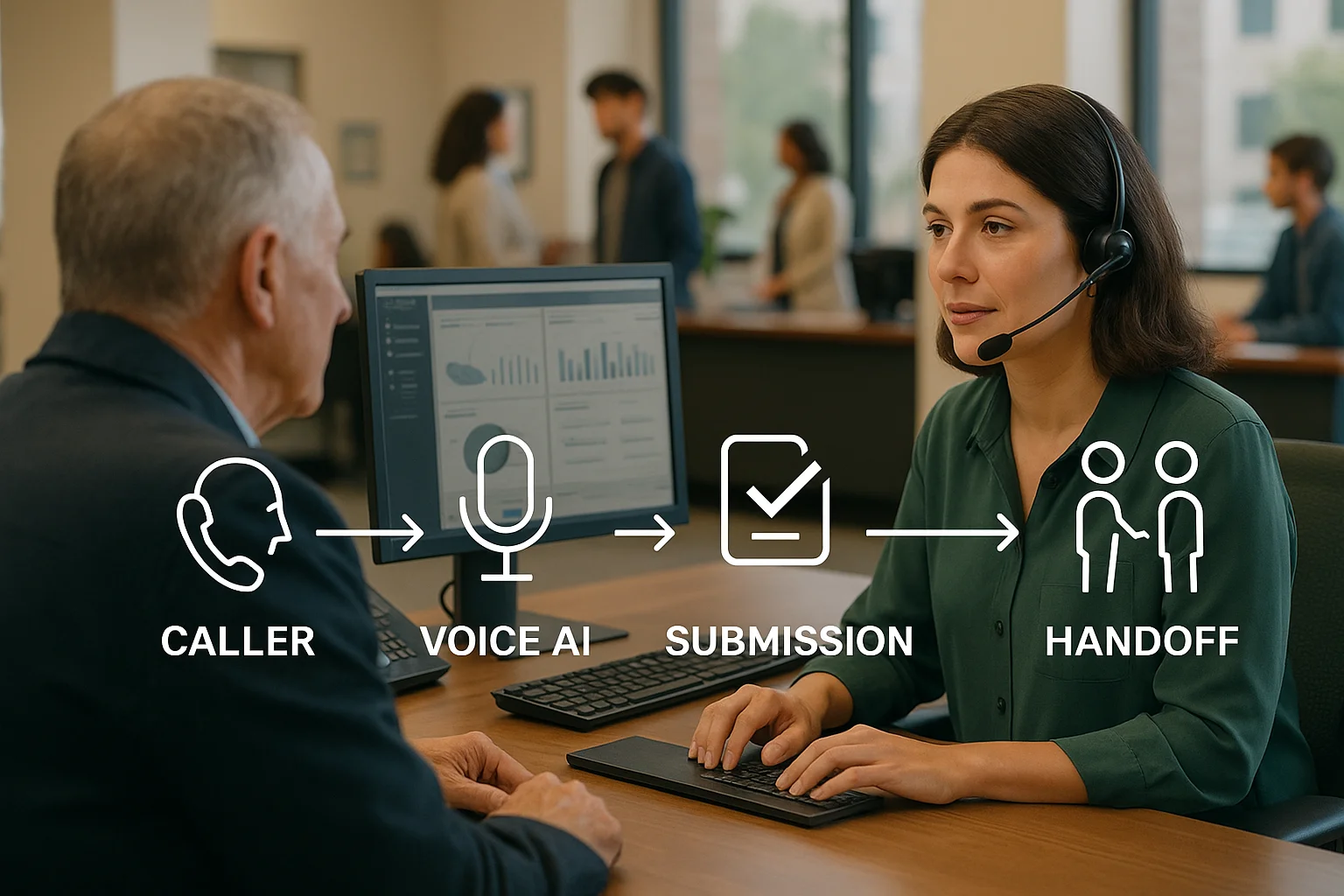
Design measurement around a simple, reproducible architecture that fits most municipal systems: Resident → Voice AI → logic bridge → form & field retrieval → validation → municipal case system → confirmation or human handoff. Instrument each handoff with an immutable transaction ID and a time-stamped event stream so you can trace whether resolution occurred in Voice AI or downstream human processes. Capture: intent classification outcome, slot/field values retrieved, validation checks passed, case ID submitted, confirmation number returned, and human-assignment metadata.
- Assign a single transaction ID upstream and propagate it through downstream systems for auditability.
- Log both verbatim resident transcript and the normalized fields saved to the case system.
- Emit a resolution outcome flag at finalization: contained (Voice AI), escalated (human), or deferred (requires follow-up).
Where to place controls and why they matter
Place validation and duplicate controls inside the logic bridge before case submission: dynamic form mapping, field-level validation, duplicate detection (by address, account, or unique identifiers), and confirmation-number generation. These controls reduce downstream rework, support audit trails for public records, and give measurable levers for containment and cost-to-serve.
- Dynamic forms: map intents to departmental forms and required fields so Voice AI only submits complete, validated cases.
- Field validation: run syntactic checks (address format, phone/email syntax), semantic checks (serviceable area), and cross-field checks (date consistency) before submission.
- Duplicate controls: check recent open cases by resident/premise and surface existing case IDs to avoid duplicate work.
2. Defining resolution outcomes and KPIs
Resolution quality is multi-dimensional. A short set of operational KPIs makes governance practical and auditable.
Outcome taxonomy (what you should measure)
Define outcomes that map to operational responsibilities and public accountabilities: containment (request fully handled in Voice AI), successful case submission (validated and accepted by the municipal case system), escalation accuracy (right department/person), human-handled resolution quality (closure and resident confirmation), and rework or duplication rates. Track resident confirmation as a separate metric—confirmation numbers and explicit verbal confirmation are the final assurance of intake.
- Containment — was the resident’s request resolved entirely by Voice AI without human intervention?
- Case submission success — did the municipal case system accept and record the case with required fields?
- Escalation accuracy — was the case routed to the correct department/team?
- Rework/duplicate rate — how often does the same issue require repeat contact or manual consolidation?
KPI measurement methods and expected rigour
Use event streams and sampled human review to validate automated indicators. Analytics should combine deterministic checks (case ID present, validation flags) with human QA for ambiguous outcomes (partial information, borderline jurisdictional issues). Maintain a register of measurement definitions so all stakeholders use consistent signals.
- Automated signals: transaction IDs, case acceptances, confirmation numbers, and error codes.
- Human QA signals: sample transcript reviews, resident surveys, and downstream resolution audits.
- Versioned KPI definitions: keep definitions under change control to preserve trend continuity.
3. Quality assurance: workflows, sampling, and controls
Production QA is a blended program: automated validation, risk-based sampling, and continuous feedback into models and prompts.
Production QA loop and governance
Operationalize QA as a closed loop: detect issues in analytics, triage by severity, assign remediation to product/voice-author teams, and redeploy. Use runbooks that define acceptable error boundaries, who may approve prompt or dialogue changes, and how to log change history for audit. Keep escalation rules simple: high-risk categories (emergency, legal, enforcement, eligibility) must be flagged for immediate human intervention and recorded separately.
- Issue triage: severity levels with distinct SLA and remediation workflows.
- Approved change control: versioned dialogue and validation updates with rollback capability.
- Auditing: immutable logs of who changed what and when, tied to the transaction ID.
Sampling strategy and review design
Adopt stratified sampling that covers high-volume intents, edge intents, new flows, and multilingual sessions. Combine random samples with targeted reviews triggered by analytics anomalies (sudden drop in containment, spike in rejections). Document sampling rules so reviews are reproducible and defensible.
- Stratify by intent, language, time-of-day, and outcome flags.
- Pair automated anomaly detection with immediate targeted sampling.
- Log reviewer decisions and tie outcomes back to prompts, NLU models, and validation rules.
4. Analytics, observability, and cost‑to‑serve
Analytics should answer operational questions: How many cases were contained? What’s the marginal cost to process a voice interaction? Where are the greatest failure modes?
Observability architecture and essential signals
Build a lightweight observability stack that captures event streams, transcripts, normalized fields, validation flags, case submission results, and cost counters. Use dashboards for near real-time alerts and periodic reports for governance committees. Ensure logs are queryable and linked to identity, timestamps, and processing nodes for incident investigation.
- Essential signals: containment flag, case-ID, validation errors, escalation reason, elapsed processing time, and confirmation issuance.
- Link analytics to billing or cost meters so interactions can be reconciled to vendor usage and infrastructure costs.
- Maintain exportable, auditable logs for FOI, oversight, and internal reviews.
Cost-to-serve: how to measure and use it
Compute cost-to-serve by combining marginal voice processing costs (vendor usage, telephony) with internal operational costs for human handling (average handle time, labour rates). Use containment and successful case-submission rates as levers: higher containment typically lowers human handling but must be weighed against rework risk. Use cost metrics to prioritize high‑volume, low‑complexity intents for containment optimization.
- Reconcile vendor billing with event logs to validate per-interaction costs.
- Monitor rework and duplication because these create hidden costs that inflate human-handling expenditure.
- Use cost metrics to build a prioritized backlog — optimize intents with the highest expected operational return.
5. Multisite and multilingual scale
Municipal services vary by locality and language. Measurement and controls must accommodate local policy, serviceability, and resident expectations.
Deployment topology and local variations
Support a federated topology where central voice infrastructure delegates local logic and validation rules to department-level adapters. Centralize shared components (speech transcription, logging, confirmation-number generation) and allow local adapters to supply jurisdictional rules, serviceability maps, and local forms. This reduces duplication while preserving local policy control.
- Central services: transcription, logging, event bus, confirmation-number generator.
- Local adapters: serviceability logic, department forms, local hours and closures, and routing preferences.
- Propagate local versioning metadata so analytics can filter by jurisdiction and change date.
Multilingual operations and measurement
Treat language as a first-class dimension in QA and analytics. Track containment and escalation rates by language and script, and maintain language-specific QA reviewers. Where automatic speech recognition or NLU is used, record confidence scores and surface low‑confidence calls for immediate human review or retry logic.
- Record ASR and NLU confidence alongside transcripts to prioritize QA.
- Measure outcome gaps by language and route remediation (prompt engineering, lexicon updates, human fallback).
- Ensure SLA and accessibility requirements are met for languages with high public need.
6. Escalation, safety boundaries, and human oversight
Define where human judgment is required and how to measure the quality of that handoff. Safety boundaries protect residents and the municipality from inappropriate automated decisions.
Clear failure boundaries and escalation protocols
Establish a policy that keeps sensitive domains with trained staff: emergencies, enforcement actions, eligibility assessments, legal advice, and discretionary decisions affecting rights or benefits. For all escalations, capture the reason code, transcript excerpt, and the handoff time. Measure handoff metrics: time to human response, first-contact resolution after handoff, and resident satisfaction following escalation.
- Predefine escalation reasons and require Voice AI to use explicit reason codes for every human handoff.
- Log the minimum context required for the human agent while protecting personally identifiable information.
- Measure and report on time-to-human and post-handoff resolution quality as separate KPIs.
Human-in-loop controls and auditability
When humans edit or correct Voice AI output, record both the original and modified values. Use these edit logs to inform root-cause analysis and model/prompt improvement. Maintain an audit trail that links each human action to the responsible staff identity and a documented justification when altering legal, enforcement, or eligibility outcomes.
- Persist original Voice AI fields and human edits together to support public-records and oversight requests.
- Require documented justification for edits that materially change resident outcomes.
- Use edit-rate analytics to prioritise improvements in dialogue flows and validation rules.
Related Peak Demand resources
Industry and AI sources reviewed
- Artificial Intelligence Risk Management Framework (AI RMF 1.0)National Institute of Standards and Technology (NIST)
- Cross-Sector Cybersecurity Performance GoalsCybersecurity and Infrastructure Security Agency (CISA)
- Algorithmic Impact AssessmentGovernment of Canada
Public-sector procurement, privacy, accessibility, records, cybersecurity, and administrative-law obligations vary by jurisdiction. This article is operational guidance, not legal advice; organizations should confirm applicable requirements with qualified professionals.
Frequently asked questions
Suitable workflows include structured resident inquiries, service-request intake, permit or program information, appointment scheduling, department routing, status updates from approved systems, and after-hours overflow. Adjudication, enforcement discretion, emergency response, and binding eligibility decisions should remain with authorized staff.
Official reference: Artificial Intelligence Risk Management Framework (AI RMF 1.0)
Use a controlled service catalogue, required fields, department ownership rules, validation, duplicate checks, confirmation numbers, and documented handoff paths. The system should create an auditable record and avoid silently dropping requests when a downstream system is unavailable.
Official reference: Algorithmic Impact Assessment
Municipal deployments should document purpose, affected services, data use, human oversight, complaint and appeal paths, accessibility channels, records handling, monitoring, and the process for approving material changes.
Official reference: Algorithmic Impact Assessment
Require workflow demonstrations, integration and security architecture, testing evidence, auditability, data-location and subcontractor details, incident response, accessibility support, human escalation, exit planning, and clear ownership of ongoing updates.
Official reference: Artificial Intelligence Risk Management Framework (AI RMF 1.0)
Modernize public-service intake without losing control
Peak Demand helps municipal teams connect Voice AI to service requests, department routing, validation, escalation, records, and operational analytics.
Schedule a discovery call


