
Manufacturing Voice AI Workflow Design at the Measurement, Optimization, and Scale Stage
Practical guidance for manufacturing leaders on measuring, optimizing, and scaling Voice AI for service, parts, and warranty intake—covering QA, containment, escalation, multi‑site scale, multilingual operations, and procurement evidence.
1. Stage context: What Measurement, Optimization, and Scale means for manufacturing Voice AI
This stage moves Voice AI beyond pilot scripts into measurable operational service. You’re no longer proving feasibility; you’re tuning pass rates, cost-to-serve, escalation quality, and replicable governance across lines, sites, and languages.
Objectives and success metrics
Operational leaders need a concise scorecard. Replace 'accuracy' as a lone metric with a small set of metrics that drive behavior and procurement decisions: containment quality (percent of calls fully handled without human handoff), escalation quality (percent of escalations that include correct context, validated product/serial, and routing), average time to resolution for automated cases, first‑contact containment cost, and handoff response SLA. Tie these metrics to business outcomes — mean time to part dispatch, field-tech idle reduction, and warranty triage velocity.
- Containment quality = correctly resolved calls / automated attempts
- Escalation quality = accurately routed escalations with validated context
- Automated resolution cycle time and its effect on parts-out times
- Cost-to-serve per call broken into automated, assisted, and fully human tiers
Decision thresholds that move a workflow from pilot to scale
Define quantitative and qualitative gates before broad rollout. Quantitative gates include containment quality exceeding baseline human-assisted containment by a defined margin (for example, improvement in throughput or a confirmed cost delta), escalation quality exceeding a minimum (often ≥95% validated context for warranty/parts intake), and uptime/latency thresholds compatible with field-service windows. Qualitative gates include repeatable QA processes, signed integration contracts with ERP/CRM, and documented incident playbooks that preserve human oversight for warranty and safety decisions.
- Containment quality stability over 30 days across representative call types
- Escalation format and data validation agreed with service teams (e.g., serial, warranty code)
- Integration health checks and test harness for ERP/CRM/warranty APIs
2. Operational architecture and safe boundaries
Designing for scale requires a clear architecture and explicit boundaries where Voice AI may and may not act—especially around warranty approvals, safety, and OT control functions.
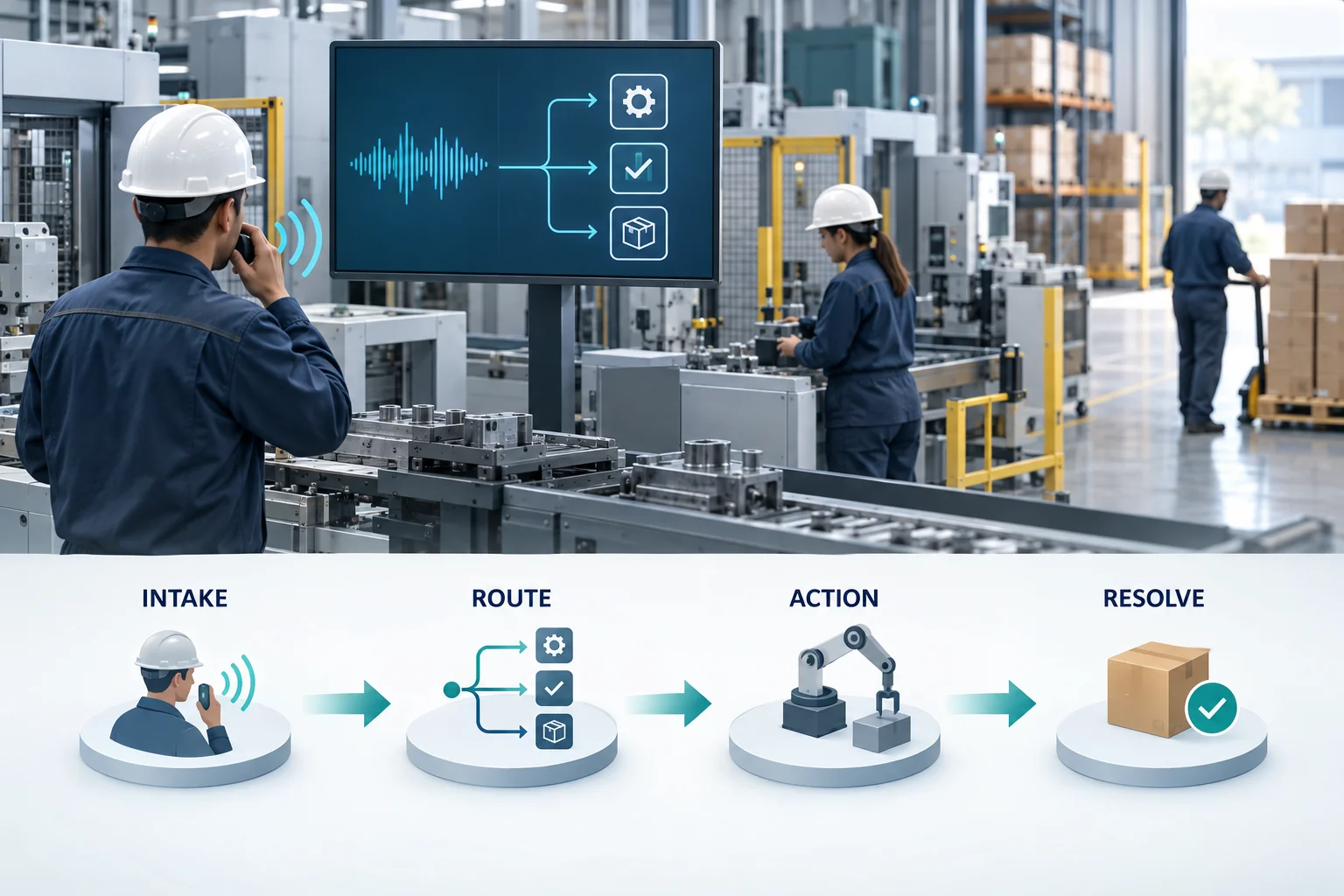
Canonical workflow: Caller → Voice AI → validation → back‑end systems → hand‑off
Treat Voice AI as the front of a workflow orchestration layer. Expected sequence: inbound call is processed by ASR and NLU to extract intent and entities (product, serial number, fault code); the orchestration layer performs product and warranty validation via ERP/CRM/service APIs; if validation succeeds and the task is within automation rules, the system completes the case or schedules a part/appointment; otherwise the system prepares an enhanced, structured hand‑off to a human specialist. This architecture reduces friction in parts and warranty intake while preserving human control for approvals.
- Caller interacts with Voice AI (ASR/intent extraction) → system populates structured case
- Validation call to ERP/CRM/warranty system to confirm product, ownership, and coverages
- Automated outcomes: order a replacement part, schedule a technician, or log a case
- Human outcomes: warm transfer with context payload (transcript, intent, product data)
OT/IT boundary and security controls
Do not allow Voice AI to issue commands or change operational state in OT systems. Where manufacturing data is needed for troubleshooting, use read-only, well-scoped adapters that are audited and throttled. Use network segmentation, application-layer controls, and role-based access to limit what the orchestration adapter can query. Instrument every automated call that touches asset data with audit trails and human approval gates for any action that could affect safety or production.
- Enforce read-only access to OT data; deny write/update actions without human sign-off
- Use controlled adapters or middleware for ERP/CRM and OT queries; log all requests and responses
- Implement least privilege, mutual TLS, and tokenized service accounts for integrations
- Maintain an auditable record of automated vs human actions for warranty and compliance reviews
3. Quality assurance and containment design
QA at scale is a process, not a one‑time test. Design an integrated QA program that treats containment and escalation quality as equally important and measurable.
Containment quality: definition, measurement, and tolerances
Containment quality measures whether an automated interaction both resolves the customer’s need and does so within policy constraints (e.g., does not approve a warranty that requires human review). Track containment at the intent level and at the outcome level. For parts/shipments, containment should be measured by the percent of automated orders that result in correct part fulfillment without human correction.
- Measure containment by call type (order status, parts intake, technical triage, warranty pre-check)
- Create ground-truth labels from human reviews and transactional confirmation (parts shipped, tech scheduled)
- Set stage-appropriate thresholds; require stronger containment before moving to site-wide scale
Escalation quality and warm‑handoff controls
Escalation quality focuses on the handoff. Even a low containment rate can be operationally acceptable if escalations are consistently complete, correctly routed, and fast. Design handoffs to include a structured payload: validated product and ownership data, summarized intent, key transcript snippets, confidence scores, and test harness links for human reviewers. Enforce SLAs for human pickup and create routing rules (by product line, warranty tier, or dealer) that reduce re-routes.
- Structured handoff payload with required fields (serial, purchase date, fault code, transcript snippet)
- Handoff confidence thresholds that trigger different routing (specialist vs. generalist)
- Monitor handoff latency and re-route rates as escalation quality metrics

4. Analytics, cost‑to‑serve, and measurable outcomes
Translate Voice AI performance into commercial terms your CFO and service ops teams can act on—cost per containment, avoided technician dispatches, and warranty leakage avoided.
Analytics model: what to measure and why
Combine per-call metrics (ASR confidence, intent confidence, latency), operational metrics (containment, escalation accuracy, transfer time), and back-end outcomes (parts ordered, appointments scheduled, warranty validated) into an attribution model. Store event-level telemetry in a time-series datastore for trend analysis and correlate AI performance with downstream KPIs such as field tech utilization, parts inventory turns, and customer NPS.
- Per-call telemetry tied to transaction IDs for cross-system correlation
- Daily/weekly dashboards for ops; drillable forensic views for QA and engineering
- Use cohort analysis to measure language/model shifts, product introduction effects, and seasonality
Calculating cost‑to‑serve and ROI defensibly
Break cost‑to‑serve into components: automated processing cost (cloud/ASR/LLM runtime), assisted cost (agent minutes for escalations), and human-only cost. Model avoided costs conservatively: count avoided technician dispatches only when containment results in successful remote resolution verified by downstream events (no re-dispatch within X days). Provide sensitivity analysis on model confidence thresholds and multi-site variability.
- Segment cost per call by outcome (automated resolved, assisted resolved, escalated)
- Conservatively attribute avoided dispatches only where transactional evidence exists
- Supply finance with scenario runs showing the impact of containment improvements on field costs

5. Multisite, multilingual, and scale operations
Scaling Voice AI across plants, dealers, and countries introduces variation—language, accent, regulatory requirements, and regional systems. Design for predictable fallbacks and centralized governance.
Language and localization strategy
Operational accuracy depends on both ASR/TTS quality and domain content. For each language or locale, collect representative voice samples and domain lexicons (model and part numbers, industry abbreviations). Use language-aware NLU tuning and localized prompts to reduce confusion. Maintain versioned prompt libraries and fallbacks: if confidence drops below a threshold, switch to a menu-based or agent-assisted flow.
- Collect and label domain-specific lexicons per locale (part numbers, model codes)
- Deploy locale-specific NLU configurations and prompt variants
- Fallback modes for low-confidence interactions: menu/agent/record-for-later
Scaling topology: regional hosting, redundancy and orchestration
Adopt a hybrid topology that balances latency, data residency, and availability. Use regional voice-processing endpoints close to call origination, central orchestration for business rules, and failover to a secondary region. For multinational operations, document hosting region, backup region, subprocessors, transfer mechanisms, and retention policies so procurement and legal teams can review trade-offs.
- Regional voice endpoints + centralized orchestration for consistent business rules
- Document hosting region, backup region, subprocessors, transfer and retention policies
- Orchestrate updates with canary rollouts and deterministic rollback plans
6. Continuous optimization, procurement, and governance
Sustained value requires experiments, procurement discipline, and clear integration ownership.
Continuous experiment and feedback loop
Embed experimentation into release cycles. Run A/B tests on prompts, confirmation strategies, and escalation triggers. Use the QA adjudication pipeline to close the loop: errors identified by auditors feed prompt tuning, model updates, or business-rule edits. Schedule regular cross-functional reviews (service ops, field, QA, IT, vendor) to evaluate KPI trends and approve model or prompt changes.
- A/B prompt and routing experiments with statistical significance criteria
- Closed-loop issue tracking: QA → engineering prompt changes → re‑audit
- Cross-functional change boards for production updates and rollback authority
Procurement evidence and vendor evaluation
For enterprise procurement, require operational evidence: integration adapters for ERP/CRM/warranty systems, demonstrable QA sampling methodology, SLA-backed handoff and latency SLAs, and an incident playbook. Require staging environments and test harnesses that simulate ERP and dealer responses. Insist on clarity of ownership: who owns ASR tuning, who owns orchestration rules, and who manages versioned prompts.
- Demand documentation: integration adapters, test harness, QA sampling plan, and SLA matrix
- Clarify integration ownership (vendor vs. in-house) for ERP/CRM/warranty connectors
- Require staging environment acceptance tests before production rollout
Related Peak Demand resources
Industry and AI sources reviewed
- Guide to Operational Technology SecurityNational Institute of Standards and Technology (NIST)
- Cross-Sector Cybersecurity Performance GoalsCybersecurity and Infrastructure Security Agency (CISA)
- Cybersecurity Resources for ManufacturersNIST Manufacturing Extension Partnership
Manufacturing cybersecurity, operational-technology, product, warranty, records, and workplace obligations vary by jurisdiction and operating environment. This article is operational guidance, not legal advice; organizations should confirm applicable requirements with qualified professionals.
Frequently asked questions
Strong starting points include parts and order-status requests, distributor or dealer support, warranty and service intake, appointment scheduling, case creation, basic product information, and routing to technical specialists. Keep engineering judgment, safety decisions, and operational-technology control outside the conversational layer.
Official reference: Cybersecurity Resources for Manufacturers
The workflow should collect structured identifiers such as model, serial number, part number, customer account, asset location, and symptoms, then validate them against ERP, CRM, catalogue, warranty, or service systems. The agent should escalate rather than invent a match when confidence is low.
Official reference: Cybersecurity Resources for Manufacturers
Not by default. Customer-service automation should normally use controlled business-system integrations and tightly governed adapters. Any connection near operational technology requires explicit security architecture, least privilege, monitoring, and separation from safety-critical control functions.
Official reference: Guide to Operational Technology Security
Require workflow mapping, integration ownership, test evidence, fallback behavior, auditability, security boundaries, change control, monitoring, human escalation, and a plan for maintaining product, parts, warranty, and service knowledge after launch.
Official reference: Cybersecurity Resources for Manufacturers
Connect Voice AI to real manufacturing service operations
Peak Demand helps manufacturers automate parts, order, warranty, dealer, distributor, and service requests through controlled integrations, validation, escalation, and reporting.
Schedule a discovery call


