
Manufacturing Voice AI Procurement & Rollout: Vendor Evaluation and Phased Deployment
A practical procurement and rollout guide for manufacturing leaders: how to evaluate Voice AI vendors, scope integrations with ERP/CRM and warranty systems, phase deployments, test readiness, and assign operational accountability.
1. Procurement priorities: what to test before you shortlist
Manufacturing buyers should treat Voice AI procurement as a systems integration procurement. Evaluate vendors on integration capability, call‑flow customization, parts and warranty validation, multilingual support, and operational controls rather than marketing model claims.
Integration depth over platform hype
Ask for documented, field‑tested adapters for your ERP, CRM, parts catalogue, and service management API. Request proof-of-function: sample call flows that validate a product/part number, check warranty eligibility, and create or update a service case with the correct routing metadata. Confirm how the vendor maps telephony identifiers to customer records, and how it handles out-of-band product lookups when catalog data is stale.
- Require end‑to‑end demo using your test data: caller → Voice AI → product validation → ERP/CRM lookup → case or order creation.
- Verify vendor supports both synchronous lookups (real‑time OData/REST) and queued orchestration for long-running queries.
- Validate multilingual UX and locale-aware parts nomenclature for dealer/distributor networks.
Custom call flows, parts and warranty intake
Prefer vendors that deliver editable call flows and confirmation screens for parts intake and warranty checks. Peak Demand differentiators to require in an RFQ include custom call flows that capture serial numbers, cross-reference warranty tables, and surface required evidence to a human specialist before approval.
- Request an editable call‑flow sandbox and versioning for call scripts.
- Confirm the vendor logs raw transcript excerpts and structured fields (part number, serial, complaint code) to your service system.
- Insist on documented handoff rules for escalation to technicians, distributors, or tier‑2 support.
2. Vendor evaluation checklist: architecture, security and governance
Beyond features, vendors must demonstrate secure, auditable operations and governance. Ask targeted questions about hosting regions, subprocessors, backups and remote support, and insist on observability and QA tooling.
Security, data residency and subprocessors
Include clear contractual obligations on hosting region, backup region, subprocessors, data retention and access controls. Confirm whether recordings are stored, how long structured call data is retained, and who may access raw audio. Require vendor disclosure of subprocessors and cross‑border transfer mechanisms. Buyers should confirm legal and regulatory obligations with counsel.
- Obtain a subprocessors list and data flow diagram (telephony provider, transcription service, analytics).
- Specify hosting region and backup region; require explicit controls for cross‑border transfers.
- Define retention windows for recordings, transcripts and PII, and the vendor’s breach notification timeline.
OT/ICS separation and operational technology safety
Voice AI must not introduce attack paths into OT/ICS. Require network isolation, firewalled APIs, and read‑only adapters where possible. Validate the vendor's approach against OT guidance and require controls that prevent automated changes to PLCs, MES or control systems.
- Mandate network segmentation and strictly scoped service accounts for any OT‑adjacent integration.
- Use API gateways and controlled adapters for read/write operations, with multi‑party approval for safety actions.
- Require vendor documentation of their OT risk posture and incident response commitments.
3. Contracting & procurement terms to include
RFIs and contracts must lock in responsibilities, acceptance tests, SLAs, pricing signals, and on‑ramps for integration work. Avoid vague feature language—define deliverables and exit criteria.
Deliverables, acceptance tests and KPIs
Make acceptance conditional on measurable outcomes: parts‑match accuracy in a defined test corpus, correct routing percentage to specialist queues, case creation parity with human baseline, and response times for human handoffs. Define test datasets and acceptance windows in the contract.
- Specify test scenarios (parts lookup, warranty check, order status) and expected pass rates during pilot.
- Include an acceptance period (e.g., 30–90 days) with explicit rollback terms.
- Tie a portion of payment or go/no‑go to acceptance criteria.
SLA, support & observability
Negotiate SLAs that matter operationally: platform availability, transcription latency, escalation latency, and a commitment on observability access (logs, dashboards, delivery pipelines). Require a documented change control process and timely notification of model or workflow changes.
- Ask for SLOs: uptime, average transcription latency, and time to respond to major incidents.
- Require read access to real‑time and historical dashboards for QA and operations.
- Include change control and emergency rollback rights in the contract.
Pricing, TCO and integration scope
Clarify what’s included: telephony costs, per‑minute AI processing, integration adapters, customization, and ongoing QA. Prefer transparent pricing for developer time, custom adapters, and change requests to avoid surprise professional‑services bills.
- Define scope lines: base product, integrations, custom call flows, and monthly QA/monitoring.
- Itemize costs for additional languages, geographies, or supplier/dealer connectors.
- Require a clear statement of work for integration milestones.
4. Implementation architecture and safe operating model
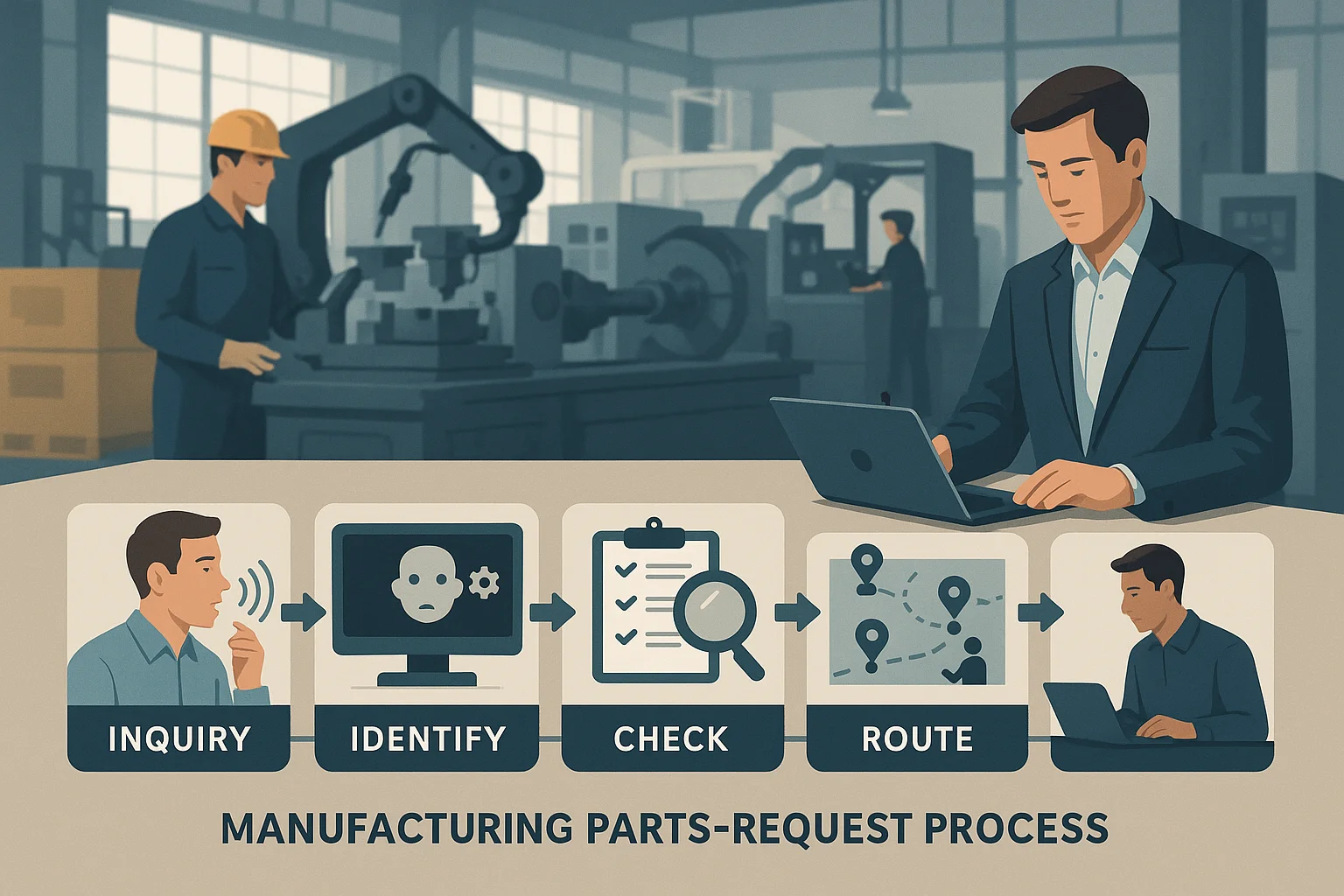
Design an architecture that enforces safety and auditability: caller → Voice AI → intent & product validation → ERP/CRM/warranty API → case/order or specialist handoff. Map responsibilities for adapters and error handling.
Reference operating flow
A simple operational diagram keeps responsibilities clear: Caller → Voice AI (ASR + intent classifier + confirmation UX) → product/serial validation against ERP/parts catalogue → warranty lookup → create/append service case or escalate to human. For long lookups, the system should queue and notify rather than timeout callers.
- Define synchronous lookups for short queries and queued handlers for multi‑step validations.
- Log each step (ASR output, intent, validation result, confidence score) for audit.
- Design UX that surfaces evidence before any warranty or safety‑adjacent action.
Human‑in‑the‑loop controls and approval gates
Enforce gates where warranty, quality, safety, or engineering outcomes are implied. Configure the system to collect required evidence and route to a specialist with a recommended action; allow specialists to approve, modify, or reject without automated binding approval.
- Implement queues for human review that include structured evidence and confidence indicators.
- Record decisions and operator identifiers to support dispute resolution.
- Avoid automated changes to warranties, returns, or safety procedures without documented multi‑party approval.
Resilience, backups and remote support
Specify hosting region and backup region, remote‑support access rules, and restoration SLAs. Control remote vendor access (jump hosts, audited sessions) and require a documented runbook for failover.
- Require explicit remote support controls and time‑boxed vendor access with session logging.
- Clarify how failover works across regions and how cached lookups behave under outage.
- Define RTO/RPO expectations for critical call handling and data recovery.

5. Phased rollout: pilot → hybrid → scale
A disciplined, measurable rollout reduces downstream risk. Use three gated phases: constrained pilot, hybrid production (human oversight), and governed scale. Each phase must have clear acceptance metrics and rollback criteria.
Phase 1 — Constrained pilot
Start with a limited caller population, a small set of use cases (e.g., order status, part number lookup), and a read‑only integration profile. Test call‑flow logic, transcription, and data mappings against a curated test set and live traffic at low volume.
- Run against a representative test corpus and live traffic with human monitoring.
- Require pass rates on acceptance tests: parts‑match, routing accuracy, and case creation fidelity.
- Keep the vendor in a supportive posture with on‑call engineering for quick fixes.
Phase 2 — Hybrid production with human oversight
Expand traffic and use cases, enable write operations to service systems under conditional rules, and keep human approvals for warranty and safety actions. Monitor KPIs and iterate on call flows and mappings.
- Allow conditional write‑backs (e.g., case creation) but require human confirmation for warranty adjustments.
- Instrument for observability: live dashboards for call outcomes, confidence distribution, and routing errors.
- Run weekly QA sessions to surface errors and update the training/test corpus.
Phase 3 — Governed scale
After meeting acceptance tests and governance checks, expand to full production with documented SLA enforcement, continuous QA, and scheduled model governance reviews. Retain human‑in‑the‑loop for risk areas and maintain the ability to revert to human handling for specific suppliers or geographies.
- Enforce periodic audits, model performance reviews, and security assessments.
- Ensure contractual SLAs and observability commitments are operationalized.
- Maintain fallback procedures and clear escalation chains.
6. Operational readiness, QA and measurable outcomes
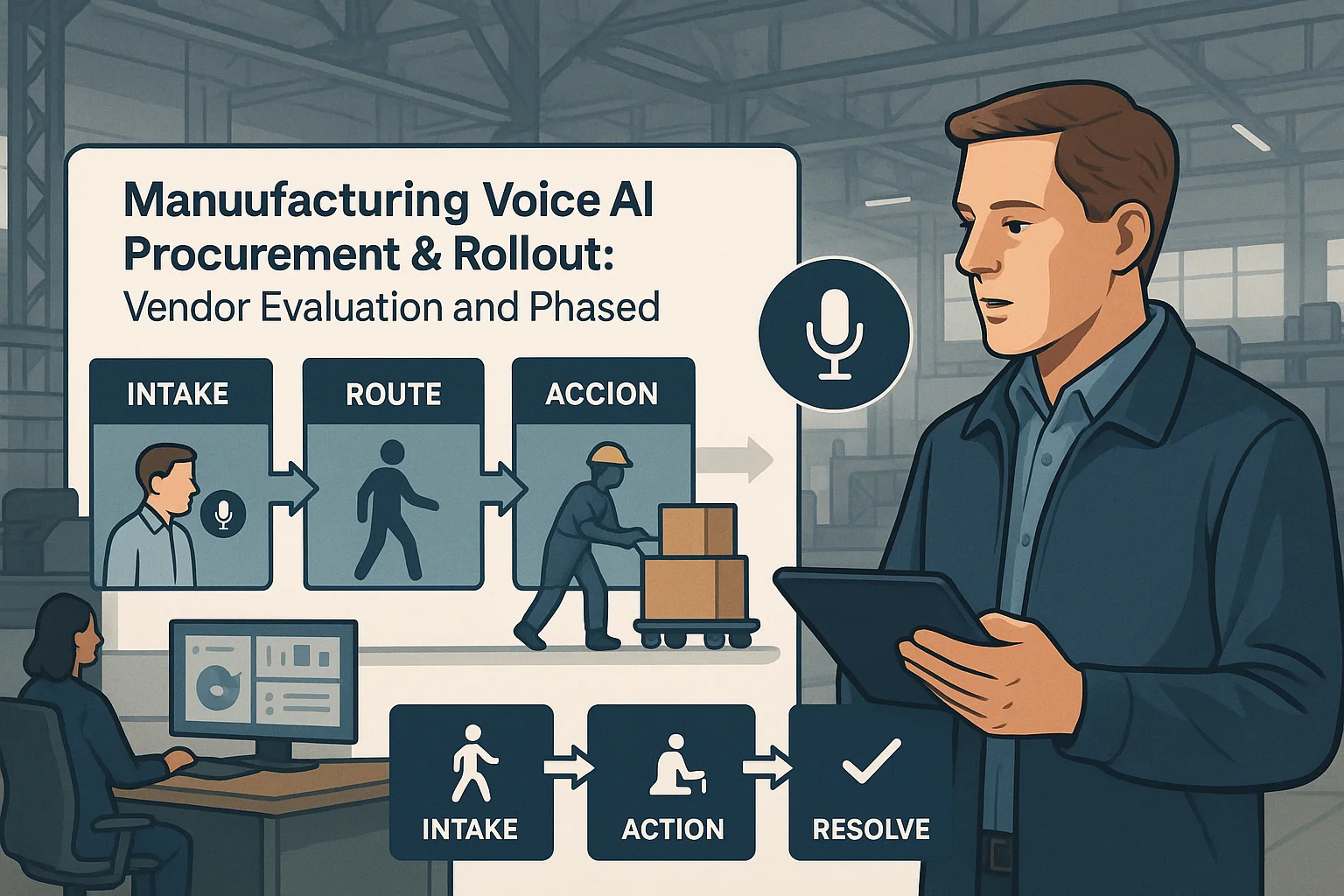
Prepare operations teams with QA tooling, dispute workflows, and KPIs. Define what success looks like in measurable terms and how teams will act on exceptions.
Key operational KPIs
Track measurable, controller‑level outcomes that connect Voice AI performance to business impact: parts‑match accuracy, first‑pass case creation accuracy, routing precision to specialist queues, human handoff time, and case resolution time once handled by the specialist.
- Report parts‑match and warranty lookup accuracy versus a human baseline.
- Monitor abandonment and misroute rates and the average time to escalate to an agent.
- Track reduction in agent average handle time and changes in case resolution time.
QA tooling and sample review
Require vendor QA tools that let operations sample calls by intent, filter by confidence score, and replay transcripts with links to validation lookups. Establish a QA cadence and a feedback loop for model and call‑flow improvements.
- Schedule weekly QA sampling for early rollout weeks, then move to a reduced cadence for steady state.
- Use stratified sampling (by intent, confidence, language, dealer) to find blind spots.
- Ensure QA artifacts feed back into both training datasets and call‑flow updates.
Dispute resolution and audit trails
Define how disputes are raised, evidence required, and how audit trails are used to resolve warranty or parts‑identification disagreements. Maintain immutable logs of inputs, model decisions, and human approvals.
- Create a documented dispute workflow owned by service leadership.
- Store evidence packages (audio, transcript, lookup results, operator decision) for a defined retention period.
- Require vendor support for forensic access during disputes.
Related Peak Demand resources
Industry and AI sources reviewed
- ISO/IEC 27701 Privacy Information ManagementInternational Organization for Standardization
- ISO/IEC 27001 Information Security Management SystemsInternational Organization for Standardization
- Guide to Operational Technology SecurityNational Institute of Standards and Technology (NIST)
- Cross-Sector Cybersecurity Performance GoalsCybersecurity and Infrastructure Security Agency (CISA)
- ISO/IEC 42001 Artificial Intelligence Management SystemInternational Organization for Standardization
- Cybersecurity Resources for ManufacturersNIST Manufacturing Extension Partnership
Manufacturing cybersecurity, operational-technology, product, warranty, records, and workplace obligations vary by jurisdiction and operating environment. This article is operational guidance, not legal advice; organizations should confirm applicable requirements with qualified professionals.
Frequently asked questions
Strong starting points include parts and order-status requests, distributor or dealer support, warranty and service intake, appointment scheduling, case creation, basic product information, and routing to technical specialists. Keep engineering judgment, safety decisions, and operational-technology control outside the conversational layer.
Official reference: Cybersecurity Resources for Manufacturers
The workflow should collect structured identifiers such as model, serial number, part number, customer account, asset location, and symptoms, then validate them against ERP, CRM, catalogue, warranty, or service systems. The agent should escalate rather than invent a match when confidence is low.
Official reference: Cybersecurity Resources for Manufacturers
Not by default. Customer-service automation should normally use controlled business-system integrations and tightly governed adapters. Any connection near operational technology requires explicit security architecture, least privilege, monitoring, and separation from safety-critical control functions.
Official reference: Guide to Operational Technology Security
Require workflow mapping, integration ownership, test evidence, fallback behavior, auditability, security boundaries, change control, monitoring, human escalation, and a plan for maintaining product, parts, warranty, and service knowledge after launch.
Official reference: Cybersecurity Resources for Manufacturers
Connect Voice AI to real manufacturing service operations
Peak Demand helps manufacturers automate parts, order, warranty, dealer, distributor, and service requests through controlled integrations, validation, escalation, and reporting.
Schedule a discovery call


