
Integrating Grid Telemetry, AMI & SCADA with Predictive Voice AI
A practical operational framework for utilities to integrate meter and SCADA telemetry with high-volume Voice AI for reliable outage communications, secure service-request intake, and controlled escalation.
1. Scope and operating model
This section defines what integrations and workflows belong inside a predictable, auditable Voice AI operating model for electric, water, gas, and municipal utilities. It sets clear role boundaries between customer communications and operational control systems.
Scope: what Voice AI should and should not do
Voice AI in utility customer operations should provide high-volume inbound and outbound customer interactions: outage notifications, estimated restoration-time status, service-request intake, appointment scheduling, and routine account queries. It must not make decisions that control grid devices, change SCADA setpoints, or substitute emergency dispatch decisions. Treat Voice AI as an information and workflow engine that references approved telemetry, issues service requests into OMS/CIS/CRM, and routes exceptions to humans.
- Accept, validate, and log customer reports and service requests.
- Read telemetry-derived state (outage flags, meter status) from approved APIs or event streams.
- Create or update tickets in OMS/CIS/CRM but do not issue control commands to distribution automation or SCADA.
Operating model: predictable event-driven call flow
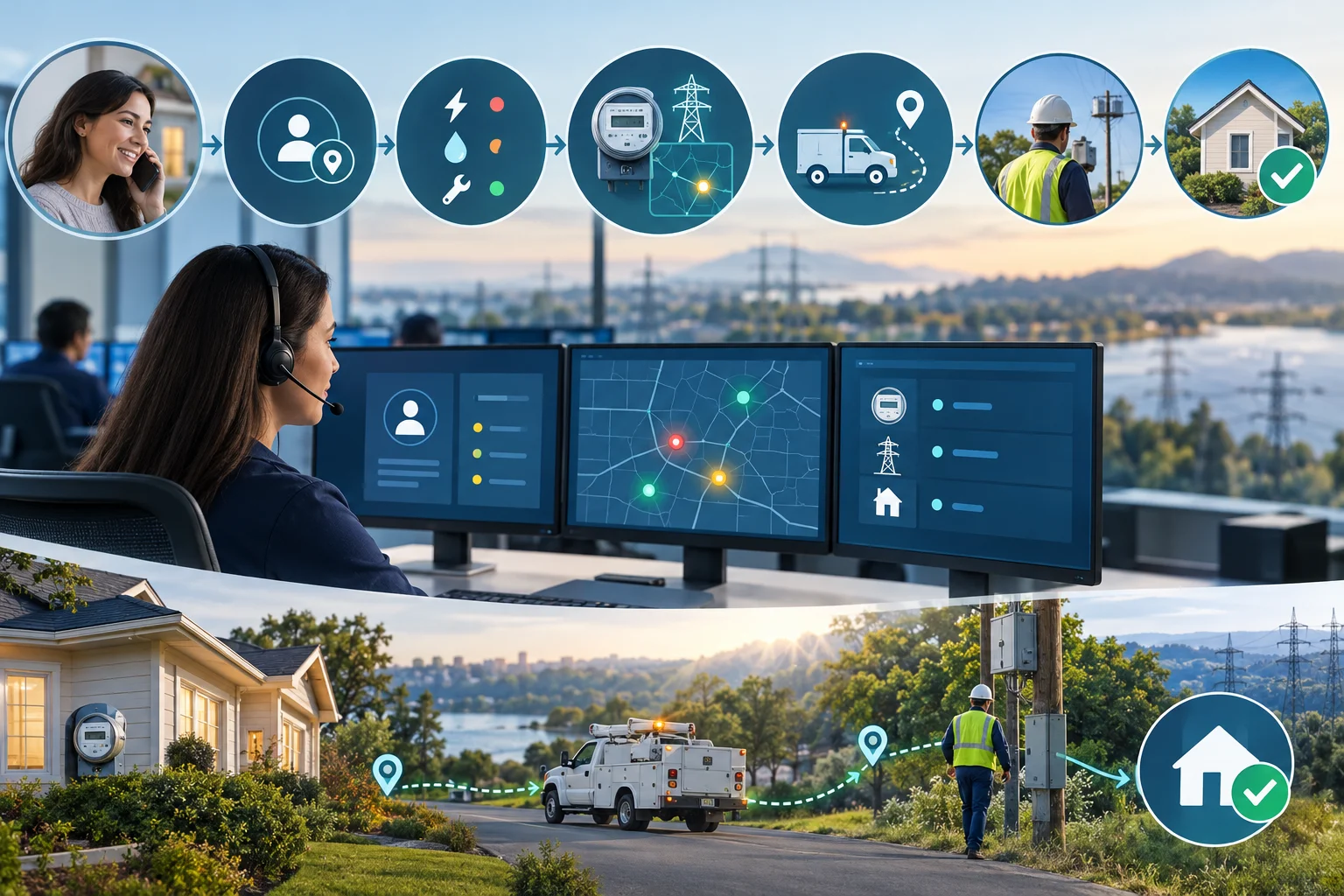
Implement a deterministic workflow: Customer call → Voice AI (IVR/ASR/NLU) → caller identity and premise validation → telemetry enrichment via approved utility APIs → deterministic routing to (a) automated status response, (b) create/annotate service request, or (c) human escalation. All handoffs must include a timestamped, tamper-evident event record.
- Pre-authenticate or validate account using multi-factor or tokenized callbacks where required.
- Enrich the call with premise-level telemetry (AMI outage flags, last-seen timestamps, SCADA event markers).
- Attach event-level trace IDs to OMS/CIS/CRM tickets for downstream reconciliation.
2. Core architecture and integration pattern
A resilient integration architecture balances telemetry fidelity, real-time responsiveness, and minimal blast radius for failures.
Event architecture and approved adapters
Ingest AMI and SCADA as event streams with clearly versioned data contracts. Do not permit direct Voice AI access to SCADA/ICS networks. Instead, deploy controlled adapters or middleware inside the utility boundary that expose only approved read-only APIs and normalized event messages to the Voice AI orchestration layer. This reduces attack surface and enforces business rules such as rate limits, caching, and redaction.
- Normalize events: outage-start, outage-end, last-seen, power-quality alerts, and confirmation flags.
- Use an adapter that enforces schema validation and maps telemetry to customer-facing states (e.g., confirmed outage vs. suspected).
- Cache recent telemetry snapshots with TTLs to avoid synchronous SCADA queries during surges.
Account and premise validation workflow
Account-safe validation is mandatory before any status disclosure or ticket action. Validation should combine phone-number tokenization, account lookup in CIS/CRM, premise location matching, and additional checks where needed (e.g., meter serial, last-bill amount). When callers cannot be validated to the required level, the Voice AI must deny sensitive actions and route to a verified human agent.
- Tokenized callback or one-time passcode for account-level operations.
- Premise match: caller-supplied address + AMI meter ID or transformer ID cross-check.
- Low-confidence cases: log the attempt, provide a generic status message, and escalate.
3. Outage communications and predictive operations
Use telemetry to transform reactive outage handling into timely, predictive communications. Prioritize accuracy, conservative messaging, and explicit uncertainty handling.
Telemetry signals to prioritize
When shaping customer messages, prioritize signals that reduce false positives: confirmed AMI loss-of-communication to a meter group, SCADA trip events mapped to feeders, outage confirmation from multiple telemetry sources, and field crew updates. Use cross-source corroboration before declaring confirmed outages.
- Combine AMI 'last-seen' with SCADA breaker status and feeder-level alarms to corroborate outages.
- Require at least two independent signals when issuing 'confirmed outage' status to customers.
- Timestamp accuracy: indicate when telemetry was last refreshed in customer messages.
Predictive notifications and conservative messaging
Predictive Voice AI can issue pre-emptive notifications when telemetry patterns indicate an increased outage probability (e.g., rising transformer temperature combined with feeder oscillations). However, messaging must be conservative: notify customers of increased risk and suggested safety steps without implying imminent or guaranteed events. Always offer an opt-in for escalated updates and present restoration estimates as ranges with confidence bands when possible.
- Use phrases like 'increased likelihood of service interruption' rather than definitive claims.
- Offer options: report outage, request status updates, or speak to an agent.
- Log customer consent for outbound follow-ups and respect recording and contact preferences.
4. Integration safeguards and failure boundaries
Design explicit safeguards so integration failures degrade safely and preserve human oversight and accountability.
Failure boundaries and graceful degradation
Define clear failure modes and automated fallback behaviour. If telemetry enrichment fails, the Voice AI must avoid creating presumptive outage tickets and instead capture a validated customer report and flag it for human triage. Use retry/backoff and circuit-breaker patterns on adapters to avoid cascading failures during storm-driven telemetry surges.
- Circuit breakers: open on repeated adapter failures, route calls to agents or a minimal scripted flow.
- If telemetry is stale or unavailable, present a standardized script: accept a report, generate a customer-initiated ticket, and escalate based on defined thresholds.
- Preserve all raw events and AI decisions in an auditable trace for post-incident QA.
Human escalation and controlled handoffs
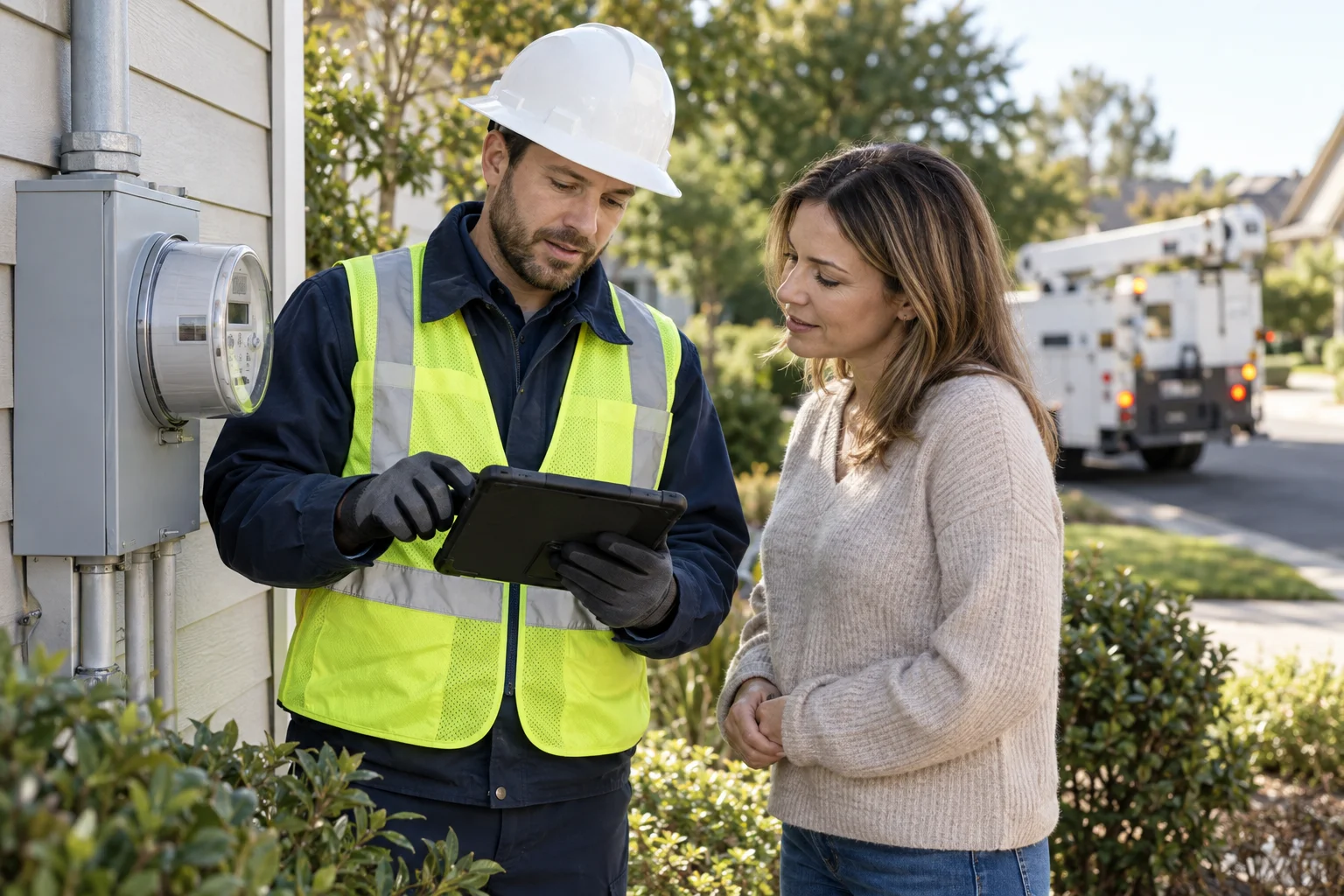
Escalation rules must be deterministic and auditable. Define routing by event severity, validation confidence, and customer sensitivity (critical services, medical dependencies). Handoffs include structured context: validation tokens, telemetry snapshot, N minutes of recent call transcript, and a recommended action. Humans should be able to override AI annotations and append structured remediation directives.
- Escalate automatically for low-confidence validation or high-severity telemetry (substation alarms).
- Provide agents with a single-pane-of-glass workflow that includes event trace IDs and suggested next steps.
- Require agent confirmation for ticket status transitions that affect restoration priorities.
5. Data governance, security, and observability
Operationalize governance: define who owns data, how it flows, and how to observe both telemetry and AI decisioning. Align with recognized frameworks for risk, cybersecurity, and maturity.
Data contracts, residency, and privacy controls
Establish data contracts for AMI/SCADA events: schemas, retention, allowable downstream uses, and redaction rules. Be explicit about hosting region, backup region, subprocessors, and any cross-border transfer mechanisms. For recordings and transcripts, implement consent capture workflows and retention policies consistent with local laws; confirm obligations with qualified privacy counsel.
- Define schema versions and backward-compatibility rules for telemetry adapters.
- Document hosting region, backup region, subprocessors, and transfer mechanisms in vendor SOWs.
- Treat recordings/transcripts as sensitive data: capture consent, define retention, and secure access controls.
Cybersecurity posture and AI risk governance
Align procurement and technical controls with cross-sector cybersecurity goals and AI risk management for critical infrastructure. Require risk assessments, documented controls for least-privilege access, segmentation of the Voice AI orchestration layer, and continuous observability for anomalous behaviour. Use maturity-model assessments to set remediation priorities and measurable improvement plans.
- Require vendors to demonstrate alignment with CISA Cross-Sector Cybersecurity Performance Goals for segmentation and identity controls.
- Apply the Cybersecurity Capability Maturity Model (C2M2) as a baseline to prioritize control improvements across telemetry-to-Voice-AI paths.
- Implement an AI risk-management playbook consistent with NIST's AI Risk Management Framework for critical infrastructure.

6. Procurement, deployment choices, and measurable outcomes
Procurement must demand clear integration ownership, SLAs, and evidence. Deployment is an iterative operational program with QA gates and measurable KPIs.
Procurement evidence and SOW checklist
Request explicit evidence in bids: event data contract schemas, adapter interface specifications, incident response and business-continuity plans, sample audit logs, and QA sampling plans. Define who maintains each adapter, who is responsible for API rate limits and error handling, and how vendor remote access will be controlled and logged.
- Require an incident response and business continuity plan that covers integration failures and erroneous automated actions.
- Ask for sample audit logs showing event trace IDs, timestamped AI decisions, and handoff metadata.
- Clarify maintenance ownership: vendor-managed adapter vs. utility-owned middleware.
KPIs and operating outcomes to measure
Track both operational and safety-adjacent KPIs: automated-intake accuracy, validation confidence distribution, outage-detection lead time, false-confirmation rate, escalation latency, and percentage of calls handled without human handoff. Maintain regular QA sampling of transcripts and telemetry alignment to measure drift.
- Measure automated-intake accuracy via sampled transcript-to-ticket reconciliation.
- Track outage-detection lead time: time between telemetry-confirmed outage and first customer notification.
- Report escalation latency and human-resolution times as part of service-level reviews.
7. Operational playbook and next steps
Turn architecture and procurement into operational reality with phased deployment, QA gates, and governance fora.
Phased rollout and QA gates
Begin with a well-scoped pilot: a single feeder or service area, controlled telemetry subset, and clear rejection criteria. Gate progression on measured KPIs and QA audits that include both telemetry-to-message correctness and human-agent satisfaction.
- Pilot → Controlled expansion → Storm-mode stress test → Full production.
- Require go/no-go reviews at each gate with documented acceptance criteria.
- Use synthetic and historical outage replay to test decision logic and message templates.
Governance forum and continuous improvement
Establish a standing governance committee that includes operations, IT, outage communications, field service, and regulatory representation. Review incidents, QA results, telemetry-contract changes, and vendor performance quarterly. Document remediation plans and timelines.
- Quarterly reviews of KPI trends, incident after-action items, and data-contract changes.
- Maintain a prioritized remediation backlog with owners and target dates.
- Ensure procurement clauses allow for technical reviews and security audits.
Related Peak Demand resources
Industry and AI sources reviewed
- Cross-Sector Cybersecurity Performance GoalsCybersecurity and Infrastructure Security Agency (CISA)
- Cybersecurity Capability Maturity Model (C2M2)U.S. Department of Energy
- AI Risk Management Framework — Critical Infrastructure ProfileNational Institute of Standards and Technology (NIST)
Utility cybersecurity, critical-infrastructure, records, customer-protection, and emergency-communications obligations vary by jurisdiction and service type. This article is operational guidance, not legal advice; organizations should confirm applicable requirements with qualified professionals.
Frequently asked questions
Good starting points include billing and account questions, move-in or move-out intake, appointment scheduling, service-request capture, outage-status messaging from approved systems, payment-routing assistance, and structured escalation. Safety-critical and infrastructure-control decisions should remain with qualified utility teams.
Official reference: Cross-Sector Cybersecurity Performance Goals
Use the minimum approved identifiers needed for the workflow, validate them against the utility's system of record, limit data exposure, and provide a human-assisted path when verification fails. The Voice AI should not guess account, premise, or outage information.
Official reference: Cross-Sector Cybersecurity Performance Goals
Use controlled adapters, strict schemas, timeouts, retries, audit logs, safe failure states, and human escalation. The system should distinguish approved utility data from model-generated language and should never present stale or unverified operational information as fact.
Official reference: Cybersecurity Capability Maturity Model (C2M2)
Track containment by request type, successful validations, transfers, abandoned calls, integration errors, incorrect or stale responses, time to resolution, customer follow-up, and the percentage of cases completed safely without manual rework.
Official reference: Cybersecurity Capability Maturity Model (C2M2)
Build resilient utility customer-service automation
Peak Demand helps utilities connect Voice AI to approved customer-information, outage-communication, service-request, dispatch, escalation, and analytics workflows.
Schedule a discovery call


