
Governed Predictive Orchestration for Utilities: SLOs, Economics & Escalation
A practical operating framework for utilities to deploy governed predictive orchestration across customer service, outage communications, service requests, and field escalation—covering SLOs, integrations, controls, procurement evidence and measurable outcomes.
1. Framing Governed Predictive Orchestration
Predictive orchestration coordinates customer-facing automation, data lookups, and human work to improve contact outcomes during normal operations and events. For utilities, the operable scope is customer communications, service-request intake, premise/account validation, field routing, and escalation — never direct operational control of network infrastructure.
What governed predictive orchestration covers
Operational scope includes inbound customer calls, high-volume Voice AI fronting, verification of account or premise, decisioning to provide status or create a service request, and routing to field crews or contact-centre agents when required. It also includes outbound outage notifications and request-status updates. The governance requirement is explicit: policies, SLOs, audit logs, and defined human fallbacks for every automatic decision.
- Inbound contact handling and triage for outages, safety reports, billing and service requests
- Account/premise validation using approved APIs or knowledge sources before disclosing account status
- Service-request creation in the authoritative system (OMS/CIS/CRM) only after validation
- Structured human escalation paths and documented runbooks
Canonical workflow (operational architecture)
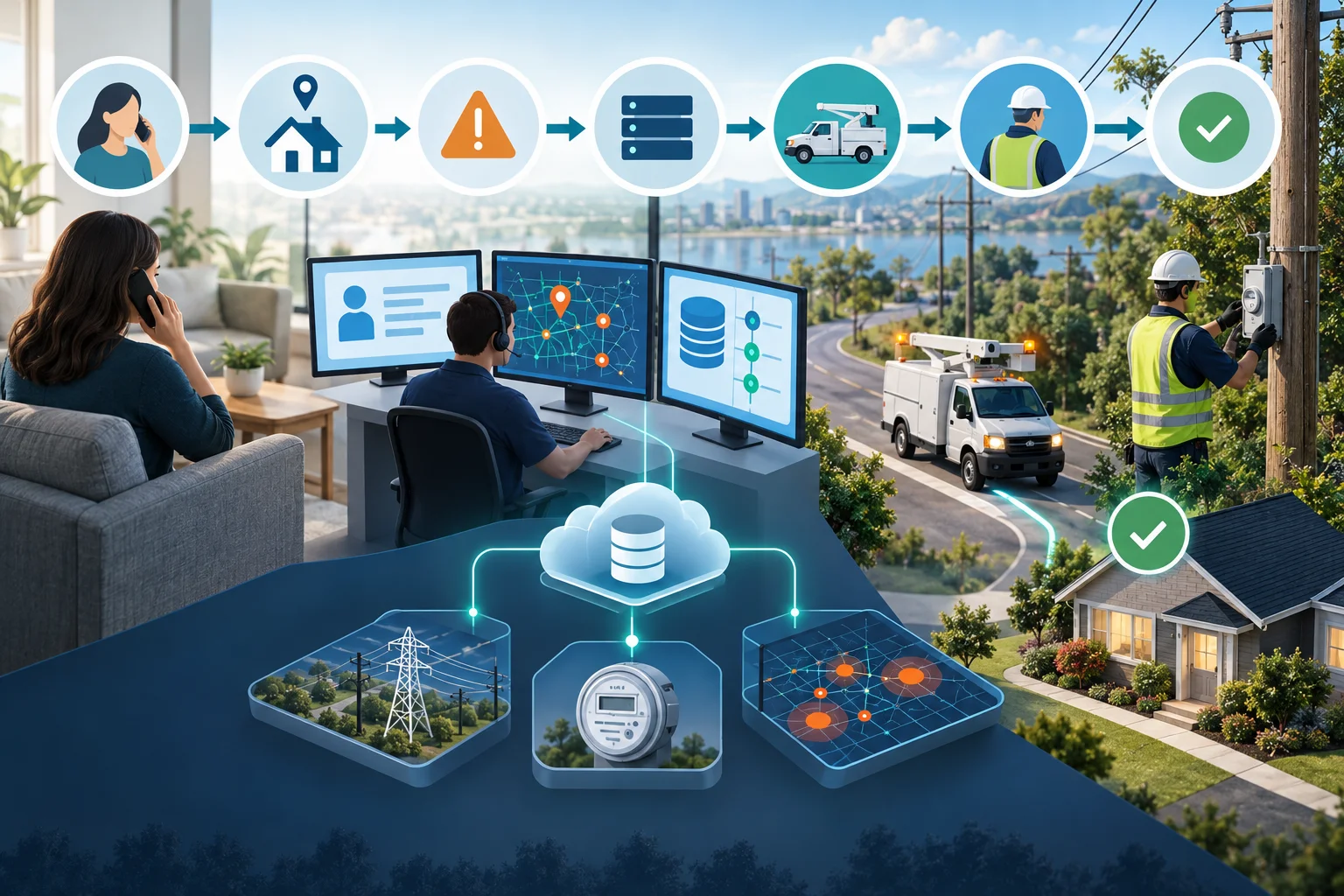
A deterministic, auditable workflow reduces risk and improves traceability. Standardize on this flow as the minimum architecture:
- Customer call → Voice AI session (IVR+NLP) for intent and context capture
- Account or location validation via approved APIs or knowledge sources (CIS/CRM, account index, meter or premise registry)
- Decision: provide status response (read-only), create a service request (write via approved adapter), or escalate to human
- If escalate: handoff with full context and recording reference; create provisional ticket in orchestration layer to avoid duplicate work
- Event-level analytics and audit trail stored in append-only logs for QA, dispute resolution and regulatory requests
2. SLOs, KPIs and measurable outcomes
Translate customer experience and operational risk into measurable SLOs. SLOs should be numeric, observable, and tied to remediation contracts with vendors and internal teams.
SLO taxonomy for customer-facing flows
Create SLOs across response, accuracy, escalation and integrity. Examples of SLO classes (do not treat these as mandatory regulatory levels):
- Contact response: percentage of inbound calls answered or acknowledged by Voice AI within target time
- Validation accuracy: proportion of sessions where account/premise verification succeeded without agent help
- Escalation reliability: mean time to connect to an agent (or on-call technician) and successful ticket transfer rate
- Service-request integrity: percentage of created requests that reach the authoritative OMS/CIS/CRM without manual correction
Measuring with event-level analytics
Event-level analytics capture each step and decision in the workflow so SLOs are verifiable and auditable. Store events with standard schema: session id, caller identifier (hashed where required), timestamp, validation steps, API responses, decision path and handoff metadata. Use these records for SLA verification, QA sampling and operational dashboards.
- Log raw and normalized events for cross-system reconciliation
- Correlate Voice AI session events with OMS/CIS ticket IDs for end-to-end KPIs
- Sample and review sessions for false positive/negative validation events and to tune intent models
3. Integration design and data contracts
Reliable orchestration depends on well-defined interfaces between the Voice AI layer and authoritative systems. Define explicit data contracts, error semantics, and retry behaviors.
Approved APIs, adapters and data contracts
Use controlled adapters to interface with CIS, OMS, CRM, meter registries and knowledge sources. Data contracts must specify required fields, validation logic, error codes, idempotency keys for writes, and permissible data retention. Make the orchestration layer write to the authoritative system only through these adapters to preserve accountability.
- Idempotent ticket creation with server-generated acknowledgement and authoritative ticket ID
- Explicit error classes: transient, permanent, validation-failure, authentication/authorization
- Retry and circuit-breaker policy per adapter to avoid cascading failures
Account-safe validation and privacy boundaries
Account validation should be the gating condition for information disclosure and write operations. Where regulatory or privacy rules apply, implement minimization and hashing of identifiers, consent capture for recordings, and geo-aware data residency controls. Distinguish verification that a caller is associated with a premise (sufficient to provide status) from authorization to perform sensitive changes (which should require elevated controls).
- Validation steps: caller identifier match, possession factors (last bill amount or PIN), premise index lookup
- Record the exact validation steps in the event log for dispute resolution
- Specify hosting region, backup region, subprocessors, and transfer mechanisms in procurement contracts
4. Escalation, human-in-loop and safety boundaries
Escalation design is a safety-critical element. Voice AI must be optimized to surface the right cases and provide agents or field staff with full context, not to make safety or operational-control decisions.
Escalation patterns and runbooks
Define deterministic rules that map intents, confidence thresholds, and validation failures to a small set of escalation paths: contact-centre agent, on-call technician, field dispatch, or emergency services. Each path requires a clear runbook with required context, acceptable handoff latency, and post-escalation reconciliation steps.
- Automated escalation triggers: high-severity outage report, safety risk keywords, failed validation on safety-critical inputs
- Handoff packet includes session transcript, validation evidence, API responses, tentative ticket and recommended priority
- After-action logging: record which runbook executed, decision rationale, and timestamps for audit
Safety boundaries and explicit non-control statements
Operational policy must prohibit Voice AI from performing any control actions on infrastructure (switching, remote isolation, recloser commands). The orchestration system may create dispatch orders or raise tickets, but responsibility for decisions that affect network state remains with qualified operations staff following approved procedures.
- Do not route actions that change network state through autonomous Voice AI decisions
- Label every automated response to callers that is read-only (status-only) versus actionable (request created)
- Include visible disclaimers in scripts where callers request operational intervention, clarifying escalation leads to human decision

5. Governance, security and resilience
Governance ties SLOs and integrations together with cybersecurity, AI risk controls and maturity planning. Use established frameworks to structure governance, while remaining jurisdiction-aware on compliance.
AI governance and risk management
Adopt an AI-specific risk profile and documentation for predictive orchestration: model behavior summaries, provenance of knowledge sources, and decision-logging. For critical infrastructure utilities, align governance controls with recommended practices in AI risk management to document operational boundaries and monitoring.
- Maintain model and prompt inventories tied to specific operational flows
- Document known failure modes and planned mitigations in the risk register
- Establish approval gates for production rollout and major model/prompt changes
Cybersecurity, maturity and contingency
Apply cross-sector cybersecurity goals and a maturity roadmap for orchestration and integration components. That includes identity and access control for adapters, hardened TLS and mutual auth for APIs, and incident-response playbooks that include Voice AI-specific scenarios. Use maturity measures to phase vendor responsibilities and in-scope subprocessors.
- Secure adapters with mutual TLS, short-lived credentials and granular RBAC
- Define backup regions and remote-support access rules in procurement language
- Test incident response and business continuity specifically for orchestration failures and integration outages

6. Procurement, QA and continuous improvement
Procurement should be evidence-based: require vendor performance data, explainability artifacts, and operational playbooks. QA is not a one-time activity; continuous sampling and analytics close the loop on model drift, integration errors and experience gaps.
Procurement evidence and contractual controls
Require vendors to provide event-level logs, integration test results, and runbooks for upgrades and incident response. Contract language must address data residency, subprocessors, retention and breach notification timelines. Build SLA credits around SLOs rather than vague uptime claims.
- Require proof-of-play: anonymized event logs demonstrating production-scale throughput and error handling
- Define retention and onward-transfer rules, including backup geography and subprocessors
- Include clear roles for who owns verification and remediation when tickets fail to reach the OMS/CIS
QA, observability and continuous tuning
Operationalize QA with automated sampling, human review of escalation cases, and dashboards that track SLO compliance. Use event-level analytics to identify pattern failures (e.g., validation failures by region or device) and to quantify the economics of automation versus agent handling.
- Automated alerts for rising validation-failure rates and end-to-end ticket reconciliation mismatches
- Monthly QA cycles combining random sampling and highest-severity session reviews
- Use analytics to set surge capacity SLOs and to reconcile volume-based pricing with actual event counts
7. Implementation checklist and practical next steps
A short, practical rollout plan for a production-ready predictive orchestration capability that balances governance and speed.
90-day pilot to production checklist
Run a scoped pilot limited by geography or call-type. The pilot should deliver measurable SLOs, integration verification and documented escalation runbooks.
- Define 3–5 SLOs and instrument event logging to measure them
- Build adapters to one authoritative system (CIS or OMS) with idempotent write flow
- Test end-to-end escalation to agents and on-call technicians with simulated failures
- Perform an AI-risk review and tabletop incident-response drill
KPIs to graduate from pilot
Use these KPIs to decide on production rollout:
- Sustained validation accuracy and a low rate of ticket reconciliation exceptions
- Escalation mean time to connect within agreed SLOs and documented human handoff quality
- Proven incident response and recovery times for integration failures
Related Peak Demand resources
Industry and AI sources reviewed
- AI Risk Management Framework — Critical Infrastructure ProfileNational Institute of Standards and Technology (NIST)
- Cross-Sector Cybersecurity Performance GoalsCybersecurity and Infrastructure Security Agency (CISA)
- Cybersecurity Capability Maturity Model (C2M2)U.S. Department of Energy
Utility cybersecurity, critical-infrastructure, records, customer-protection, and emergency-communications obligations vary by jurisdiction and service type. This article is operational guidance, not legal advice; organizations should confirm applicable requirements with qualified professionals.
Frequently asked questions
Good starting points include billing and account questions, move-in or move-out intake, appointment scheduling, service-request capture, outage-status messaging from approved systems, payment-routing assistance, and structured escalation. Safety-critical and infrastructure-control decisions should remain with qualified utility teams.
Official reference: Cross-Sector Cybersecurity Performance Goals
Use the minimum approved identifiers needed for the workflow, validate them against the utility's system of record, limit data exposure, and provide a human-assisted path when verification fails. The Voice AI should not guess account, premise, or outage information.
Official reference: Cross-Sector Cybersecurity Performance Goals
Use controlled adapters, strict schemas, timeouts, retries, audit logs, safe failure states, and human escalation. The system should distinguish approved utility data from model-generated language and should never present stale or unverified operational information as fact.
Official reference: Cybersecurity Capability Maturity Model (C2M2)
Track containment by request type, successful validations, transfers, abandoned calls, integration errors, incorrect or stale responses, time to resolution, customer follow-up, and the percentage of cases completed safely without manual rework.
Official reference: Cybersecurity Capability Maturity Model (C2M2)
Build resilient utility customer-service automation
Peak Demand helps utilities connect Voice AI to approved customer-information, outage-communication, service-request, dispatch, escalation, and analytics workflows.
Schedule a discovery call


