
Governance, Data Strategy & Accessibility for Municipal Voice AI at Enterprise Scale
A practical operating model and governance framework for deploying Voice AI across municipal 311 and customer‑service channels. Covers roles, data lifecycle design, accessibility and auditability, integrations, procurement, and measurable controls that keep sensitive decisions with trained staff.
1. Operating model: one clear resident interaction path
Begin with a single, auditable intake architecture that standardizes how resident interactions become municipal records. This reduces ambiguity, enforces validation, and defines human handoff points.
Core architecture and workflow
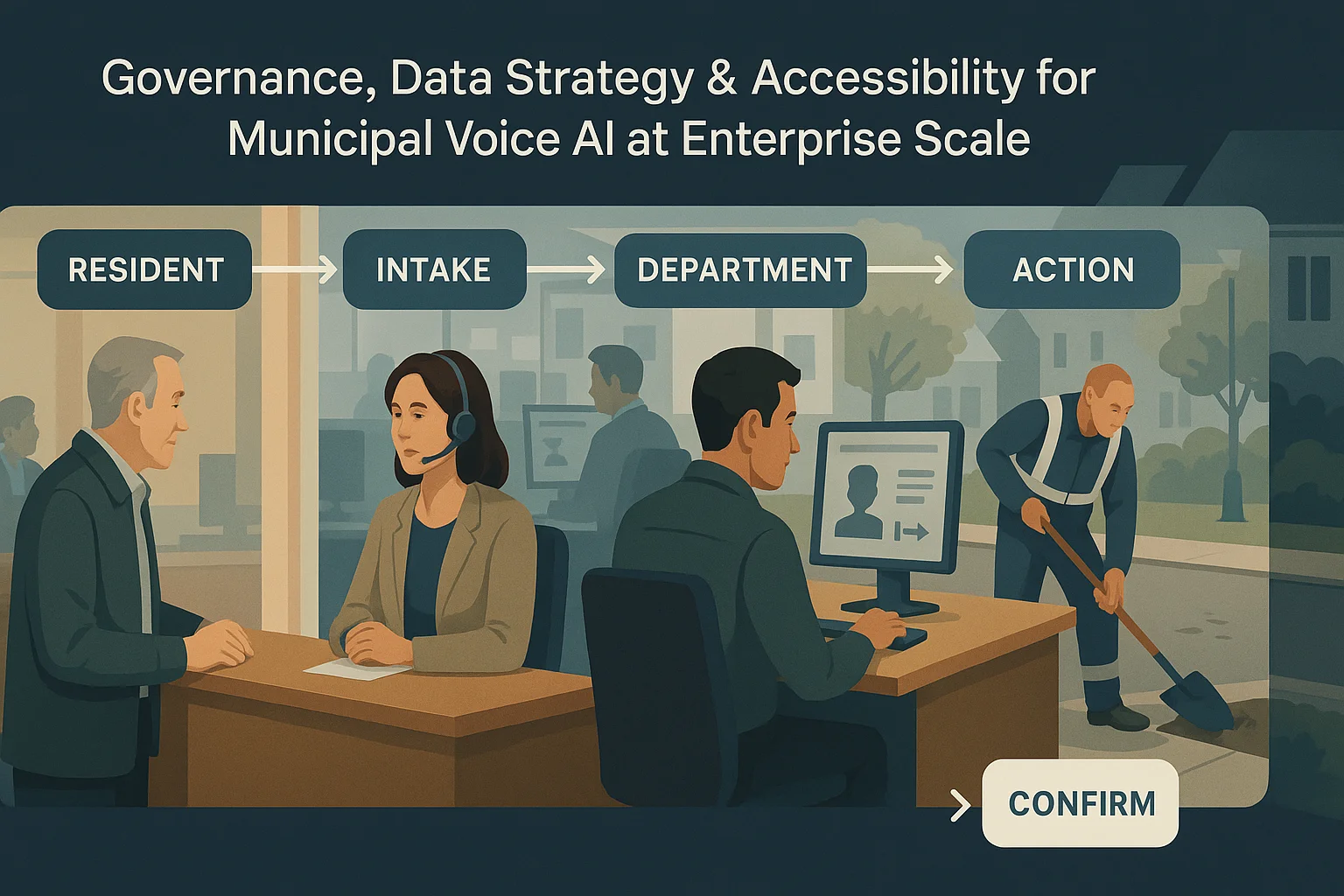
Standardize the operating path as: Resident → Voice AI front end → logic bridge (orchestration) → form and field retrieval → validation and duplicate checks → municipal case system → confirmation or human handoff. The logic bridge orchestrates business rules, lookup calls, and field‑level validation before a case record is created. Design each transition to emit structured events and immutable transcripts for audit and QA.
- Voice AI captures the resident’s intent and fields using dynamic forms and slot validation.
- Logic bridge performs identity/premise lookups, duplicate detection, and enrichment via approved APIs.
- Only validated submissions create case records in the municipal case system; otherwise escalate to human agents.
Why this path matters operationally
Concrete benefits flow from a single path: consistent records, measurable error rates, simplified QA, and auditable handoffs. By centralizing validation in the logic bridge, municipalities can change backend systems without reauthoring Voice AI flows, and maintain confirmation numbers for residents to reference.
- Confirmation numbers and read-back summaries establish public accountability.
- Dynamic forms let the system request only the fields needed for the service type, reducing resident burden.
- Duplicate controls and enrichment reduce downstream processing load for departments.
2. Governance & risk boundaries
Municipal programs must embed governance that translates policy into operational guardrails: who decides, who reviews, and what Voice AI can and cannot do.
Roles, responsibilities and escalation
Create a governance charter that lists stakeholders (service owners, IT, records/archives, legal/privacy, accessibility officers, operations, and frontline supervisors) and defines decision rights for model updates, script changes, and emergency overrides. Operationally assign daily stewardship to an owner who coordinates QA, incident response, and human escalation pathways.
- Service owners approve intents and success criteria; operations enforce SLA observability.
- Legal/privacy and records officers sign off on retention and recording consent policies.
- Supervisors own human-in-loop escalation procedures and training for edge cases.
Risk boundaries: safe‑lock list
Define an explicit 'do not automate' list: emergency reporting, enforcement notices, legal advice, eligibility decisions, and sensitive discretionary determinations must remain with trained staff. The charter should require that any case involving these categories triggers immediate transfer to a human and be flagged in audit logs.
- Implement intent filters that detect keywords indicating emergency or legal risks and force immediate handoff.
- Log all forced handoffs with transcript excerpts and reason codes for post‑incident review.
- Audit periodic false negative/false positive rates for the filters to maintain efficacy.
3. Data strategy: lifecycle, residency and records
A municipal data strategy must convert transient voice interactions into governed records. This section maps lifecycle choices and integration controls you must formalize.
Designing the data lifecycle
Define how data moves from raw audio to structured fields and to case records. Key stages: ephemeral audio capture, near‑real‑time transcription, validation controls, case creation, retention and archival or deletion. Require immutable audit logs that record who or what submitted a case, timestamps, confirmation numbers, and human escalations.
- Store raw audio and transcripts only when required for records, QA or legal hold; otherwise retain structured fields and verification artifacts.
- Record retention schedules should be aligned with municipal records policies and exportable for disclosure requests.
- Version control transcripts and form templates to support traceable changes to intake logic.
Residency, subprocessors and transfers
Document hosting region, backup region, subprocessors, remote support access, and transfer mechanisms for any vendor or cloud component. Ensure procurement contracts require notification of subprocessors and provide mechanisms to review transfer paths. Distinguish data residency (where data is hosted) from legal obligations in your jurisdiction and consult counsel on localization requirements.
- Specify hosting region(s) and backup geography in contract language; require notification of changes.
- Define allowed subprocessors and require a subprocessors’ list with change notices.
- Prescribe secure transfer mechanisms and logging for any cross‑border transfers.
4. Accessibility, inclusion and auditability
Accessibility and auditability are non‑negotiable for public services. Voice AI must be usable, testable, and auditable for compliance and public trust.
Operational accessibility controls
Design multimodal fallbacks: provide touch‑tone entry, web/TTY alternatives, and callback options. Use plain-language prompts, slow-speech modes, and repeat/confirm steps. Ensure that transcripts and confirmation numbers are available in accessible formats for residents requiring assistive technology.
- Always offer an immediate option to connect to a human or request a callback.
- Provide accessible transcripts and a case confirmation number suitable for screen‑reader workflows.
- Test flows with assistive-technology users before wide release.
Auditability: transcripts, confirmation and QA
Preserve structured transcripts and confirmation numbers as first-class records. Keep immutable event logs for each step: intent detection, slot capture, duplicate check result, enrichment calls, case submission, and escalation. Design QA sampling plans that pair transcripts with outcome labels so you can measure accuracy, failure modes, and model drift.
- Confirmation numbers should map to case IDs and be exposed in all outbound resident communications.
- Implement periodic transcript reviews and root-cause analysis for misrouted or failed cases.
- Maintain an audit trail that ties any changes in intake logic to an approval record.

5. Integration architecture and failure modes
Integration choices determine whether Voice AI improves throughput or multiplies operational risk. Specify adapters, APIs and failure behaviors up-front.
Approved integration patterns
Use controlled adapters and approved APIs to connect the logic bridge to municipal records systems, GIS, billing/citation systems, and identity services. Keep integration responsibilities explicit in contracts: who owns field mapping, who validates records, and who operates retries.
- Define a canonical field schema that adapters map to and validate before case creation.
- Housekeeping workflows should mark partially created records as 'pending validation' until human review completes.
- Use idempotent APIs and duplicate‑control keys to avoid double case creation.
Failure modes and safe fallback behaviors
Enumerate and test failure modes: transcription error, enrichment API failure, duplicate detection ambiguity, downstream case system failures, and human unavailability. For each failure mode, prescribe a deterministic fallback: queue with human review, prompt resident for clarification, schedule callback, or record an incident.
- If downstream case creation fails, log the failure, notify operations, and present the resident with an error confirmation and reference for follow-up.
- If identity/premise validation is inconclusive, mark the case for priority human review rather than creating potentially incorrect records.
- Measure mean time to repair (MTTR) for integration failures and include targets in SLAs.

6. Procurement, contracting and vendor evaluation
Procurement must move beyond feature lists. Prioritize measurable controls, observability, and the vendor’s ability to support public‑sector governance.
Contract must-haves
Include clauses for hosting region and backup geography, subprocessors, change‑notification, audit rights, and exit‑transfer of data. Require the vendor to provide runbooks for incident response, access controls, encryption, and remote support procedures. Make observability endpoints and logs part of the delivery scope.
- Explicitly require logging of every case submission, transcript, enrichment call and human handoff.
- Demand a clear subprocessors' list and notification timeline for changes.
- Include an exit plan for data export in machine‑readable formats.
Vendor evaluation and managed services
Evaluate vendors on operational maturity: evidence of dynamic form capabilities, API integration patterns, duplicate controls, validation engines, and audit features. Where appropriate, procure a managed service that includes observability and QA, but explicitly define the scope of system ownership and change control.
- Request runbooks showing how the vendor handles failed submissions, model updates, and human escalation.
- Assess the vendor's ability to deliver accessible transcripts and confirmation‑number mapping.
- For RFP readiness and compliance queries, consider providers that publish governance and privacy controls.
- See Peak Demand advisory material on what enterprise buyers should expect from managed Voice AI services.
7. Operational assurance, metrics and continuous improvement
Turn governance into measurable control. Define KPIs and QA plans that link resident experience to operational integrity.
Key metrics to track
Adopt an outcomes-driven metrics set that includes: successful case conversion rate, transcription error rate, duplicate detection rate, human escalation frequency, mean time to human handoff, and resident satisfaction for voice channels. Measure false acceptance of risk‑category intents separately and target continuous reduction.
- Track confirmation‑to‑case mapping success and time to confirmation.
- Monitor human escalation volumes and root causes to inform training and flow changes.
- Include observability metrics for API latency and downstream system errors.
QA, audits and model governance
Establish periodic QA cycles: daily for production‑critical flows, weekly sampling for lower volume services, and quarterly algorithmic impact assessments for new or changed models. Maintain a model-change log and require approval from the governance committee before deploy‑to‑production. For public transparency, publish a summary of the risk assessment and operational controls where permitted.
- Use sampled transcript-to-outcome reviews to label errors and feed back to model owners.
- Run algorithmic impact assessments when you change intent classifiers or introduce new decision logic.
- Maintain audit-ready documentation linking each intake flow to its approval record and retention schedule.
Related Peak Demand resources
Industry and AI sources reviewed
- Artificial Intelligence Risk Management Framework (AI RMF 1.0)National Institute of Standards and Technology (NIST)
- Cross-Sector Cybersecurity Performance GoalsCybersecurity and Infrastructure Security Agency (CISA)
- Algorithmic Impact AssessmentGovernment of Canada
Public-sector procurement, privacy, accessibility, records, cybersecurity, and administrative-law obligations vary by jurisdiction. This article is operational guidance, not legal advice; organizations should confirm applicable requirements with qualified professionals.
Frequently asked questions
Suitable workflows include structured resident inquiries, service-request intake, permit or program information, appointment scheduling, department routing, status updates from approved systems, and after-hours overflow. Adjudication, enforcement discretion, emergency response, and binding eligibility decisions should remain with authorized staff.
Official reference: Artificial Intelligence Risk Management Framework (AI RMF 1.0)
Use a controlled service catalogue, required fields, department ownership rules, validation, duplicate checks, confirmation numbers, and documented handoff paths. The system should create an auditable record and avoid silently dropping requests when a downstream system is unavailable.
Official reference: Algorithmic Impact Assessment
Municipal deployments should document purpose, affected services, data use, human oversight, complaint and appeal paths, accessibility channels, records handling, monitoring, and the process for approving material changes.
Official reference: Algorithmic Impact Assessment
Require workflow demonstrations, integration and security architecture, testing evidence, auditability, data-location and subcontractor details, incident response, accessibility support, human escalation, exit planning, and clear ownership of ongoing updates.
Official reference: Artificial Intelligence Risk Management Framework (AI RMF 1.0)
Modernize public-service intake without losing control
Peak Demand helps municipal teams connect Voice AI to service requests, department routing, validation, escalation, records, and operational analytics.
Schedule a discovery call


