
Experimentation & Safe Rollouts for Multisite Multilingual Enterprise Voice AI
A practical guide for enterprise buyers and architects to design experimentation, QA, observability, cost controls, containment, and governed rollouts across sites and languages for Voice AI.
1. Why experimentation and safe rollouts matter
Multisite, multilingual Voice AI touches sensitive customer interactions and enterprise systems. Poorly designed rollouts create wrong outcomes, customer friction, regulatory exposure, and unplanned costs. This section clarifies the decision points that should drive an experimentation and rollout program.
Complexity vectors and failure boundaries
Enterprises face three intersecting complexities: site operational differences (hours, routing), language and dialect coverage, and variation in legacy system integrations (CRM, billing, trouble‑ticket systems). Each axis multiplies test cases and failure modes. Define failure boundaries up front—e.g., what constitutes a containment drop that will trigger rollback, what percent of calls may be misrouted before human monitoring must intervene, and which intents are too high‑risk for automation. These boundaries form the basis for safe‑rollout gating and contractual service levels.
- Map high‑risk intents (billing disputes, safety reports) to human‑only or human‑review pipelines.
- Identify site‑specific system dependencies and their owner teams for operational runbooks.
- Define language/dialect coverage targets and minimum confidence thresholds per locale.
Decision checkpoints for buyers and operators
Turn complexity into milestones: pilot definition, integration readiness, QA gating, limited traffic canaries, progressive rollout, and steady‑state optimization. For procurement and operations, make these checkpoints contractually binding—each with acceptance criteria, observability requirements, and rollback clauses. Include clear ownership: vendor manages Voice AI and adapters; enterprise owns core business systems and final approval for transactions.
- Require delivery of test artifacts (synthetic call scripts, recorded call test sets) before pilot acceptance.
- Specify rollback criteria and automated cutover triggers in runbooks.
- Assign a single accountable owner for each integration and for vendor produced adapters.
2. Reference architecture and integration patterns
A consistent, modular reference architecture reduces risk during experimentation and scaling. Use clear adapter boundaries and minimize direct system coupling.
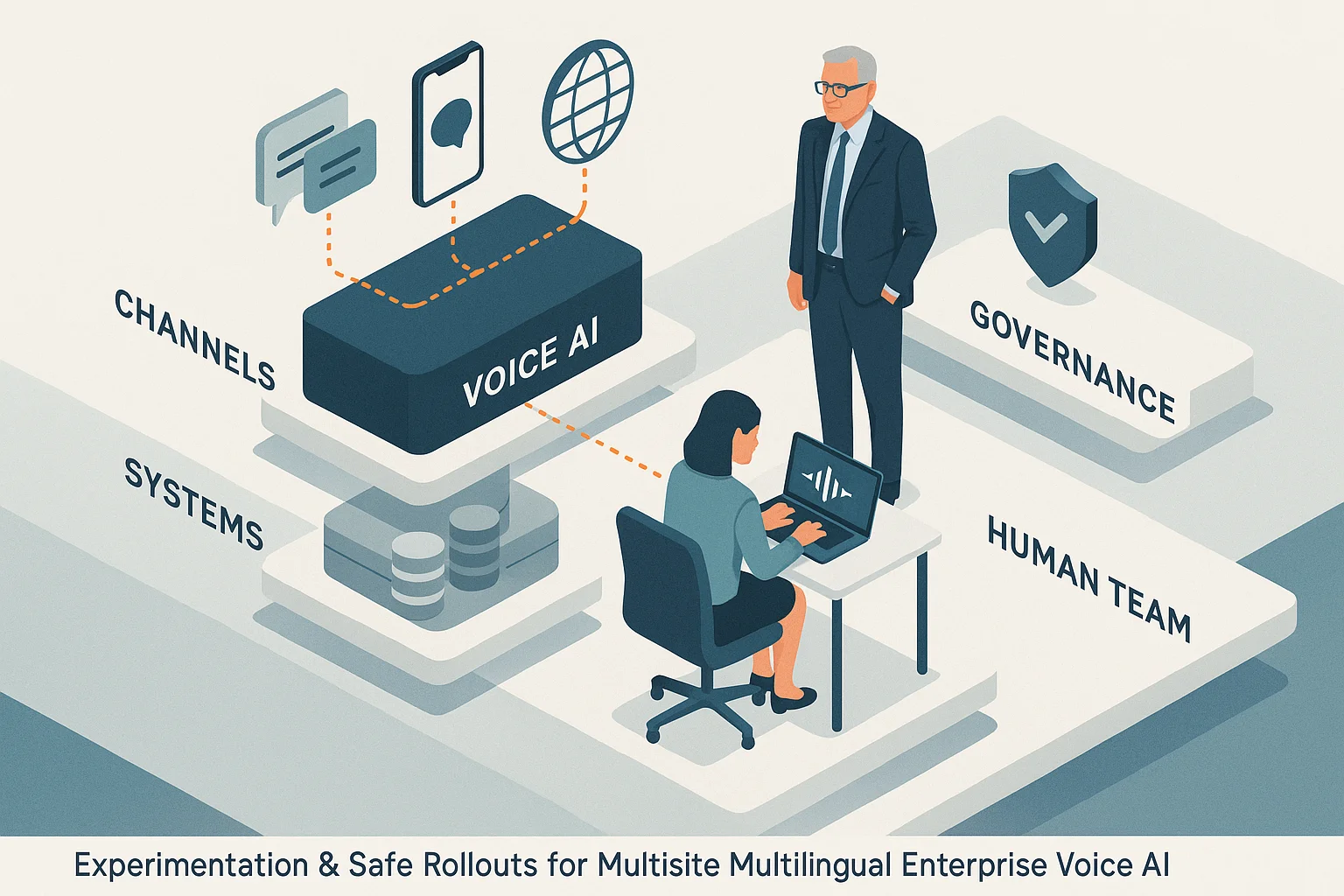
Modular reference: caller → Voice AI → business‑rules layer → enterprise systems → outcome
Adopt a simple, enforceable flow: Caller connects to a Voice AI engine that performs ASR/NLU plus dialog management. A business‑rules layer (policy and routing) enforces authorization, verification, and enterprise rules, calling approved enterprise systems via controlled adapters or orchestration. The final outcome is either automated fulfillment, an audited transaction, or a human handoff. This separation keeps decision logic auditable and lets teams swap models or vendors without reengineering enterprise integrations.
- Keep business rules out of model prompts—implement them in the rules layer.
- Ensure audio, transcripts, and structured events flow to QA and analytics pipelines in parallel to production flows.
- Treat human handoffs as first‑class responses with context bundles (caller state, confidence scores, recent transcript).
Integration ownership and controlled adapters
Contracts should mandate ownership of adapters: who builds and maintains connectors to CRM, billing, identity systems, or IVR? Prefer thin, enterprise‑approved adapters maintained in source control under change control. For managed services, require vendor to provide adapters but transfer operational control or co‑management to enterprise teams over time.
- Require adapter design reviews, unit tests, and CI/CD pipelines as part of acceptance.
- Specify supported API contracts and error‑handling semantics (timeouts, retries, idempotency).
- Document subprocessors, hosting regions, and access controls for each adapter.
3. Experimentation, QA pipelines, and observability
Controlled experimentation and auditable QA are the operational backbone of safe rollouts. Design experiments to validate multilingual coverage, containment, and escalation behavior before increasing live traffic.
Experimentation design: canary, A/B, and shadow modes
Start with shadowing and canaries: mirror production audio to Voice AI without affecting live routing to validate performance at scale. Use A/B tests for dialog variants and canaries to shift a small percentage of live traffic. For multilingual rollouts, prioritize per‑language canaries rather than global traffic changes—language behavior can diverge markedly.
- Shadow mode for 2–4 weeks across representative call types before any live automation.
- Canary to 1–5% of traffic with strict rollback triggers tied to containment and error budgets.
- A/B for content variants or prompt engineering limited to non‑critical intents.
QA pipelines, test suites and multilingual coverage
Build repeatable QA pipelines: synthetic tests, curated recorded test sets for each site/language, and regression suites that run on each change. Include end‑to‑end tests that exercise integrations (CRM lookups, transaction attempts) and human handoff flows. Track per‑intent confidence distributions and error classes (ASR error, intent mismatch, fulfillment failure). These pipelines are auditable inputs to your rollout gates.
- Maintain per‑language test corpora including short utterances, accented/dialectal variations, and noisy channels.
- Automate regression runs on every model or rules change with pass/fail thresholds.
- Log structured telemetry (timestamps, scores, adapter responses) to immutable audit logs.
4. Safe rollouts and human‑in‑the‑loop controls
Human oversight and well‑designed escalation are non‑negotiable. Keep high‑risk decisions behind explicit human controls and design seamless, auditable handoffs.
Phased rollout strategy
Adopt a four‑step rollout: pilot (few intents, shadowing), micro‑canary (small percent traffic, limited sites), phased expansion (site and language increments), steady state (full automation with continuous optimization). Attach acceptance criteria to each phase: minimum containment, maximum escalation error rate, and no regressions in customer satisfaction metrics.
- Pilot limited to low‑risk intents with automated fallback to humans.
- Micro‑canary with scripted rollback: immediate traffic reversion on breach of thresholds.
- Phased expansion by site and language, never by both simultaneously.
Escalation quality and human handoff workflows
Treat human handoffs as a measurable capability: require context bundles that include recent transcripts, confidence scores, verification status, and system attempts. Monitor transfer accuracy (was caller routed to correct queue/skill?), and time‑to‑accept by agent. Implement human review loops where agents flag recurring automation errors for model or rules updates.
- Automate packaging of conversational context for agents and retention for QA review.
- Define SLAs for transfer acceptance and agent response time during rollout phases.
- Use agent feedback as labeled data for retraining and content fixes.
Operationalizing human oversight and change control
Make oversight auditable: maintain changelogs for rules and prompts, require predeployment sign‑offs, and run post‑deployment retrospectives. Human oversight is an operational discipline—create rotas, escalation points, and playbooks for incidents such as mass fallbacks or API outages.
- Require vendor‑supplied change histories for model and rules updates.
- Document incident playbooks with clear responsibilities and communication templates.
- Run periodic audits of human overrides to detect automation drift.

5. Cost‑to‑serve, containment quality and measurable outcomes
Cost modeling and measurable outcomes turn experimentation into business decisions. Define how you will measure success and how costs will be tracked as rollouts scale.
Measuring containment and escalation quality
Containment rate (percentage of calls concluded without agent intervention) is a primary health metric, but it must be paired with quality measures: containment correctness (was issue truly resolved?), post‑interaction satisfaction, and repeat contact rates. Escalation quality measures the accuracy and efficiency of handoffs. Use a composite KPI that weights containment correctness and escalation accuracy for decisions about traffic shifts.
- Track containment correctness through sampled human QA and CSAT feedback.
- Measure repeat contacts within a window to detect false containment.
- Monitor escalation misroutes and their contribution to total handle time.
Cost‑to‑serve and billing models
Model cost‑to‑serve using per‑call processing costs, human agent cost offsets, and engineering/support overhead. Be cautious with vendor pricing that makes cost prediction opaque—require clear line items for model inference, adapter calls, recording storage, and human review credits. Include budgeted error‑handling costs (agent involvement for fallbacks) during rollouts.
- Require vendors to provide typical per‑containment and per‑escalation cost ranges under representative load.
- Build error budgets into financial models for early rollout phases.
- Specify audit rights to validate billing against telemetry.
KPIs, SLAs, and acceptance criteria
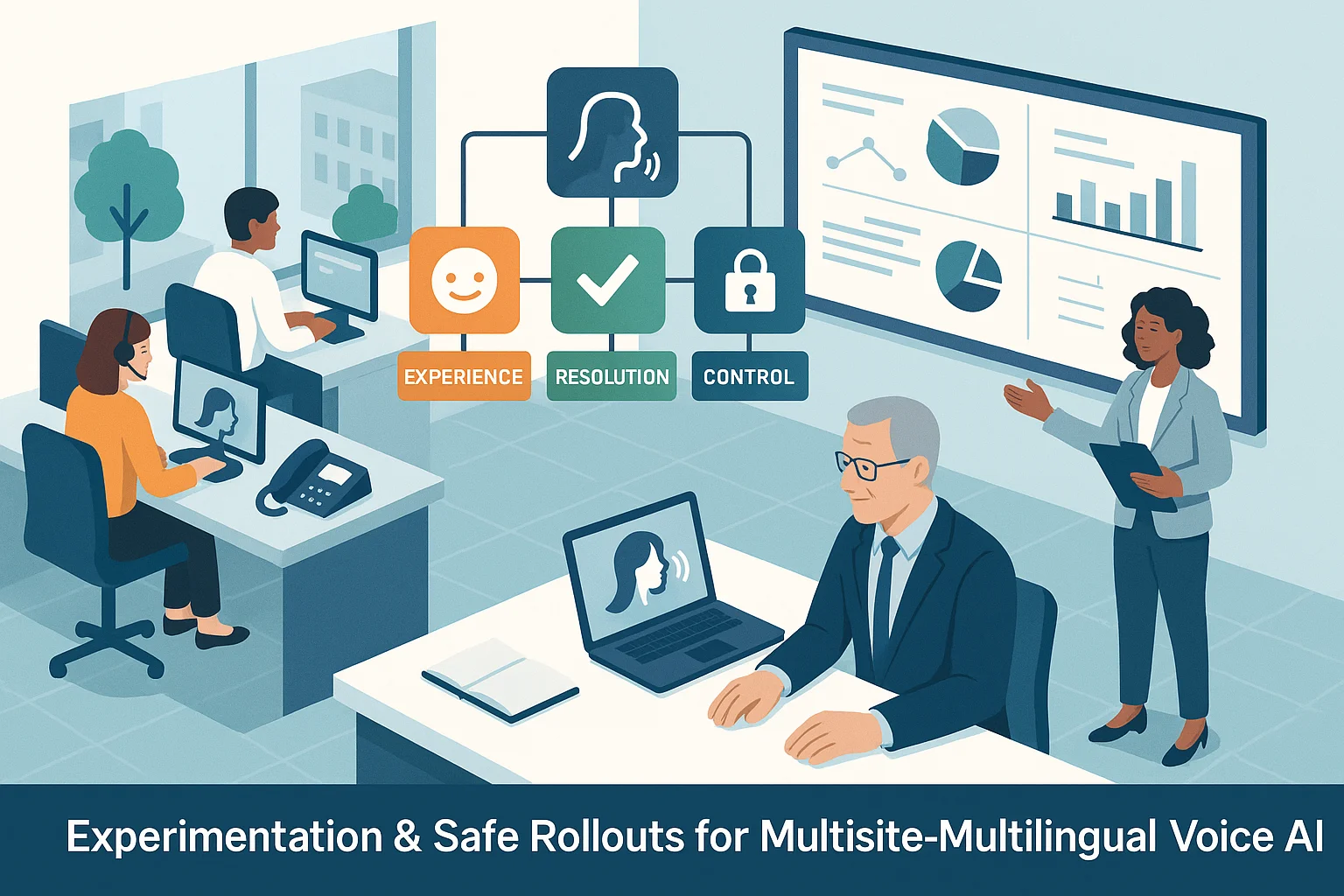
Translate operational goals into contractible KPIs and SLAs for pilots and steady state. Distinguish exploratory experiments (time‑boxed, observation focus) from production SLAs. Include metrics for availability, latency, containment, escalation accuracy, and observability completeness (logs, traces, retention).
- Pilot agreements should emphasize measurement and remediation over financial penalties.
- Production contracts should include clear SLA measurement methods and auditability.
- Include escalation SLAs and resolution timelines as part of contact‑centre routing obligations.
6. Multisite and multilingual scale operations
Scaling across sites and languages requires operational discipline: content versioning, localization controls, and regional hosting or failover that respects data residency constraints.
Localization, variant management and content governance
Treat language and site variants as first‑class artifacts. Maintain a content and rules registry with versioning and change control. Separate language models, prompts, and business rules so you can deploy updates per locale without unintended global effects.
- Use semantic versioning for rule sets and content bundles per language.
- Maintain translation and localization review processes tied to release gates.
- Audit content changes and link them to test runs and acceptance results.
Regional hosting, backups and remote support
Decide hosting region, backup region, and remote‑support access during procurement. Require vendors to disclose subprocessors, data flow maps, and the mechanisms used for cross‑border transfers. Ensure runbooks include failover plans if a regional endpoint is unavailable, and define constraints on remote access for troubleshooting.
- Specify primary and backup hosting regions and data residency obligations in SLAs.
- Require vendor disclosure of subprocessors and transfer mechanisms.
- Define remote support privileges and audit trails for production troubleshooting.
Operational scaling: staffing, training, and continuous optimization
Plan agent training and capacity changes to match phased automation. Use agent feedback and QA results as continuous inputs to model updates. Budget for ongoing optimization: language model maintenance, prompt tuning, and integration updates.
- Schedule regular agent training that demonstrates new automation capabilities and expected handoff behavior.
- Use a managed optimization cadence (weekly or biweekly) to incorporate labeled data into improvements.
- Ensure capacity planning accounts for burst traffic and cross‑site failovers.
Related Peak Demand resources
Industry and AI sources reviewed
- Artificial Intelligence Risk Management Framework (AI RMF 1.0)National Institute of Standards and Technology (NIST)
- AI Risk Management Framework: Generative AI ProfileNational Institute of Standards and Technology (NIST)
- OECD AI PrinciplesOrganisation for Economic Co-operation and Development
Privacy, telecommunications, recording-consent, cybersecurity, consumer-protection, employment, and records obligations vary by jurisdiction and use case. This article is operational guidance, not legal advice; organizations should confirm applicable requirements with qualified professionals.
Frequently asked questions
A serious managed service should include discovery, workflow design, telephony, integrations, validation rules, testing, monitoring, human escalation, incident handling, change control, analytics, and ongoing optimization. The value is the complete operating system around the model, not access to a model alone.
Official reference: Artificial Intelligence Risk Management Framework (AI RMF 1.0)
The operating model should assign clear owners for telephony, prompts, knowledge, APIs, credentials, incident response, analytics, approvals, and release management. Enterprise buyers should avoid deployments where those responsibilities are ambiguous or split across vendors without accountability.
Official reference: Artificial Intelligence Risk Management Framework (AI RMF 1.0)
Evaluate the complete workflow under realistic volume, latency, interruption, transfer, integration, and failure conditions. Measure task completion, escalation quality, unsupported responses, system errors, recovery behavior, and how quickly operators can detect and correct problems.
Official reference: Artificial Intelligence Risk Management Framework (AI RMF 1.0)
Ask for documented use-case boundaries, data handling, access controls, model and prompt change management, evaluation procedures, audit logs, human-oversight rules, incident response, subcontractor dependencies, and a process for reviewing material system changes.
Official reference: Artificial Intelligence Risk Management Framework (AI RMF 1.0)
Need deeper enterprise Voice AI integration?
For custom APIs, SIP and telephony architecture, multi-system workflows, QA, observability, and enterprise deployment, Peak Demand commonly evaluates platforms such as Retell AI as part of a managed architecture.
Explore Retell for Enterprise Voice AIPeak Demand may earn a commission from this link.


