
Experimentation & Causal Measurement for Multisite Municipal Voice AI
A practical operational framework for municipal leaders to run controlled experiments, measure containment and escalation quality, optimize cost‑to‑serve, and scale multilingual Voice AI across multiple sites with accountable QA, auditability, and safe failure boundaries.
1. Operating model & data flow
A consistent, auditable architecture reduces variance across sites and gives experiment designs a stable execution plane. Municipal deployments benefit from a single logical architecture that separates conversational logic, orchestration, validation, and municipal records.
Canonical operating flow
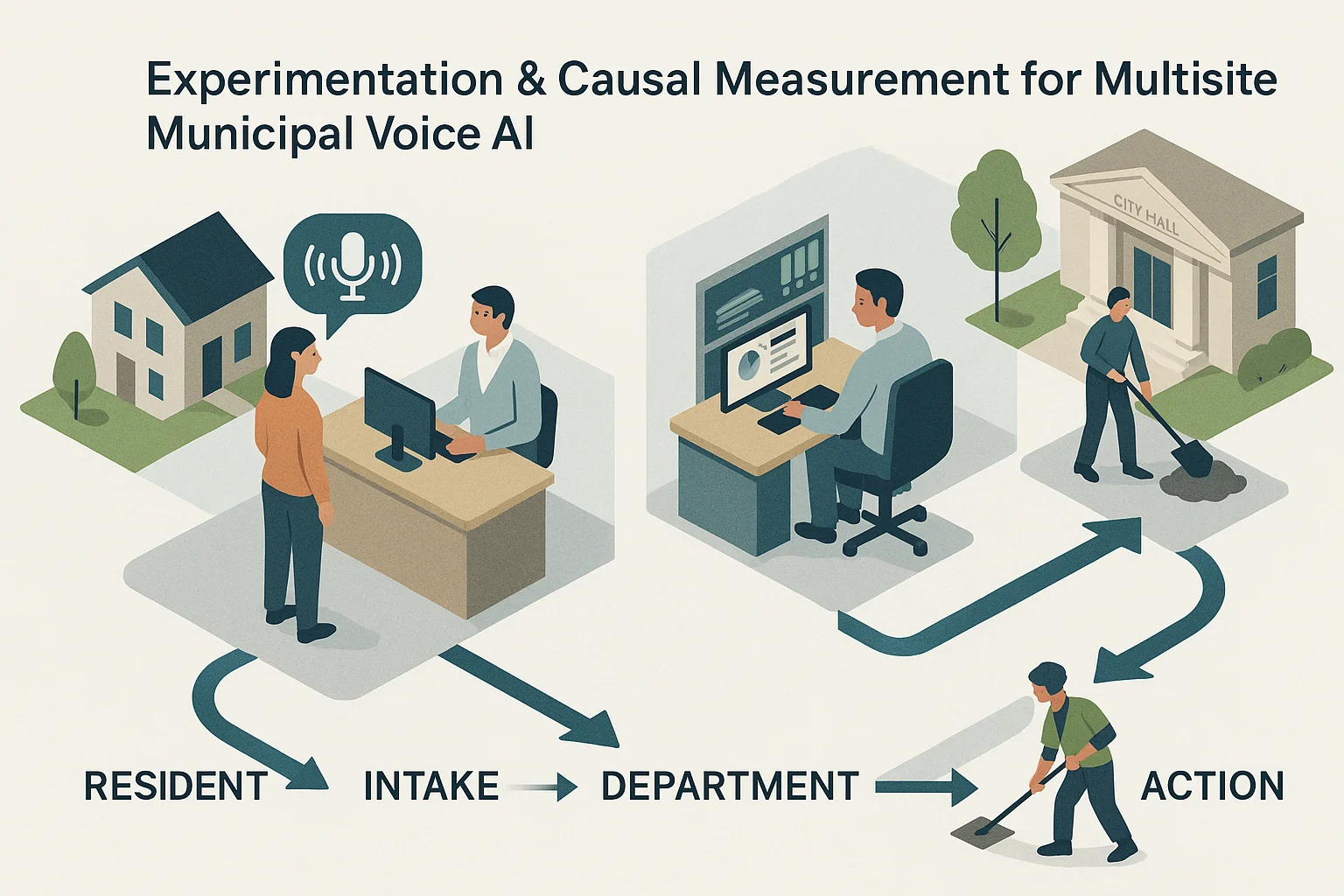
Adopt a single canonical flow to minimize integration variance and to instrument causal tests reliably. The recommended path is: Resident → Voice AI → logic bridge → form and field retrieval → validation → municipal case system → confirmation or human handoff. Keep each step observable and configurable so experiments change only one variable at a time.
- Resident: inbound call or callback request; consent and language selection recorded up front.
- Voice AI: conversation state, slot filling, partial transcripts, and containment attempts.
- Logic bridge: deterministic orchestration layer that applies policies, prioritizes handoff, and calls validation services.
- Form and field retrieval: retrieve the right form template and field definitions per site and service.
- Validation: automated field validation, duplicate detection, and identity/premise checks where permitted by policy and law. Store checks and results as structured events for measurement.
Peak Demand differentiation: dynamic forms and auditability
Make dynamic form retrieval and field‑level validation the locus of control. Dynamic forms ensure the Voice AI uses the same fields and validation rules as the municipal back office. Confirmed case submission should return a structured confirmation number and a minimal human‑readable receipt to the resident. Maintain searchable audit trails (transcripts, field events, validation passes/fails, duplicate detection flags) so supervisors can reproduce the decision path.
- Dynamic form templates per service and per site reduces mapping errors during scale.
- Case submission must include duplicate controls and confirmation numbers, and a confirmation record stored both in the municipal case system and the Voice AI.
- Accessibility and auditability are first‑class: provide both machine‑readable records and human transcripts with redaction tooling for sensitive fields.
2. Metrics, experimentation design, and causal measurement
Before changing the live agent, define the causal question and the primary metric. Municipal programs typically track containment quality, escalation quality, time‑to‑resolution, and cost‑to‑serve.
Define metrics unambiguously
Containment quality: percentage of contacts resolved without human handoff while meeting accuracy and service‑level criteria. Escalation quality: proportion of handoffs that contain complete, validated case data and required context (so human agents can action the request without re‑contact). Cost‑to‑serve: marginal operational cost per contact, including telephony, compute, and downstream human work.
- Use structured event logs to compute containment (resolved_without_handoff) and escalation_quality (handoff_complete_with_validated_fields).
- Record the time and number of human touches post‑handoff to estimate downstream cost‑to‑serve.
- Avoid conflating containment with customer satisfaction—use surveys or repeat contact measures to triangulate quality.
Experiment types and causal attribution
Choose the experiment design appropriate to the operational constraint: randomized controlled trials (preferred for causal identification), site‑level A/B rollouts, or stepped (phased) rollouts when randomization is impractical. For multisite programs, consider blocking by site to control site‑level heterogeneity.
- Randomized assignment at the call level yields the cleanest causal estimate of containment and cost effects.
- Stepped rollouts reduce political friction and enable difference‑in‑differences estimation when randomization is not possible.
- Always predefine the primary metric, analysis window, and minimum detectable effect to avoid post‑hoc interpretation errors.
3. QA, auditability and records
QA must be both operational (daily checks, sampling) and audit‑grade (immutable logs, redaction, retention policy). Municipal public accountability requires that records supporting an action are reproducible.
Operational QA workflows
Use a combination of automated checks and human review. Implement continuous sampling of contained calls, escalation handoffs, and duplicate‑detection failures; apply dual review for edge cases.
- Daily automated checks: containment rates, transcription confidence distributions, validation failure rates.
- Weekly human sampling: reviewers verify whether the contained resolution met policy and whether handoffs included complete validated data.
- Escalation audit: every missed‑field or validation error is a ticket for remediation and root‑cause analysis.
Audit trails and records governance
Store immutable, time‑stamped event logs that link transcripts to structured field events, validation checks, duplicate flags, and confirmation numbers. Retention, access, and redaction rules should be part of procurement documents and operations manuals.
- Log design: event_id, resident_id (pseudonymized where required), call_id, field_events, validation_results, submission_result, confirmation_number, transcript_ref.
- Access controls: role‑based logs for who viewed or exported records; maintain an export audit.
- Retention: define retention and deletion policies aligned with local records law; note that laws vary—confirm obligations with counsel.
4. Multisite and multilingual scale
Scaling across municipalities or departments introduces variability: service definitions, business rules, regional languages, and local exceptions. Design for configurability and a minimal shared logic surface.
Separation of logic and locale
Keep conversational policy and orchestration in a shared logic layer, and push site‑specific forms, lookup tables, and business rules into configurable data stores. This reduces experiment confounds and simplifies A/B blocking by site.
- Shared intents and slot definitions, site‑scoped form templates for mapping to case systems.
- Locale data includes default contact points, operating hours, fee schedules, and exemptions.
- Use feature flags to experiment at site level without changing shared logic.
Multilingual operations and quality control
Treat languages as separate test strata. Maintain separate containment and escalation baselines per language and calibrate confidence thresholds and prompts accordingly.
- Translate dynamic forms and validation rules; ensure field formats (addresses, postcodes) match locale expectations.
- Run language‑specific QA with native reviewers and incorporate pronunciation and recognition error rates into guardrails.
- Consider bilingual handoffs and human backstops for low‑confidence interactions.
Shared analytics but local accountability
Produce both consolidated dashboards for programme-level metrics and site‑level reports for local managers. Use shared metric definitions to avoid inconsistent reporting.
- Consolidated KPIs: containment, escalation quality, cost‑to‑serve, repeat contact rate.
- Site reports: individual case samples, local guardrail alerts, and escalation quality trends.
- Provide exportable evidence packages for audits and councillor inquiries.

5. Integrations, tooling and measurement stack
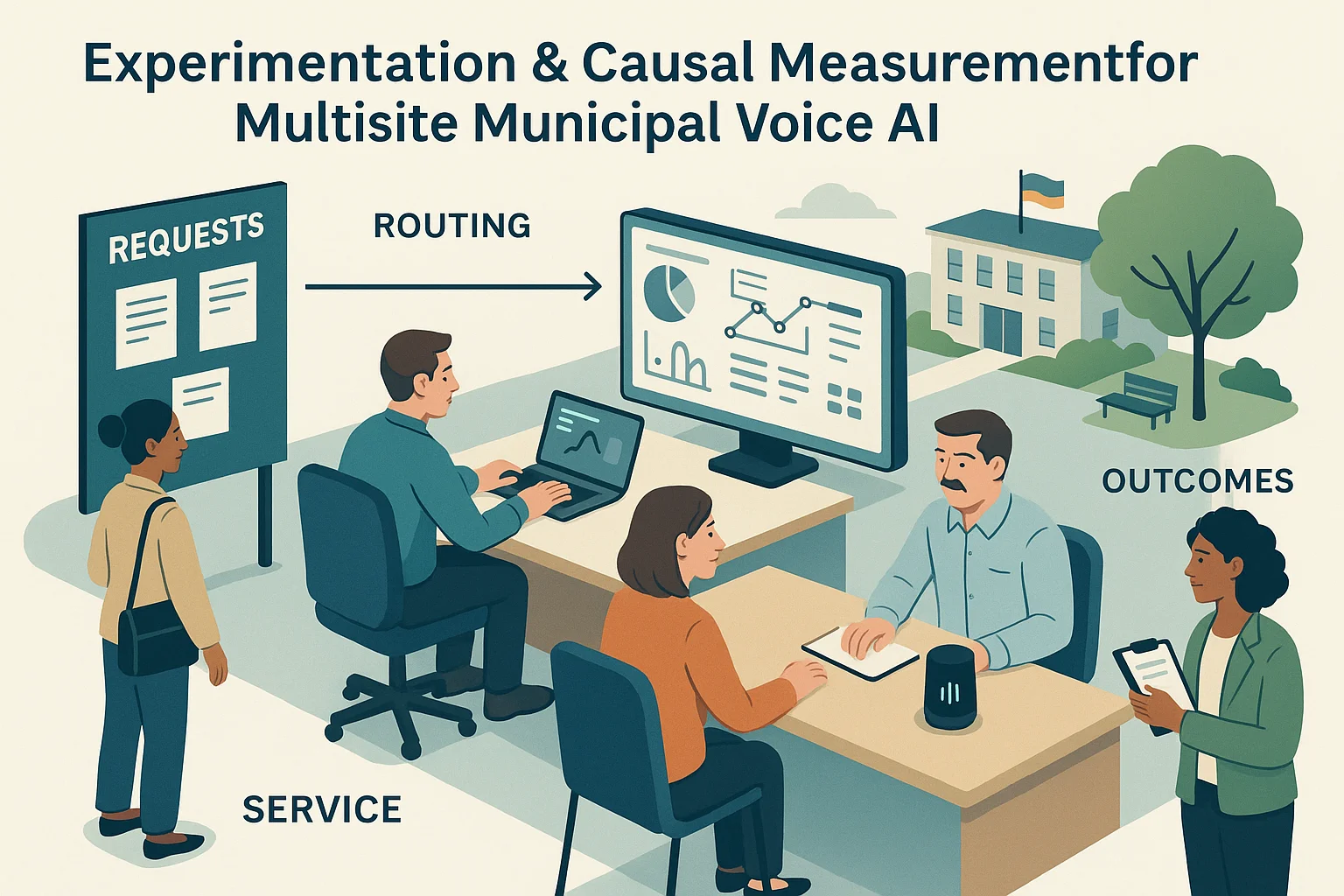
Measurement depends on a reliable stack: structured events, analytic warehouses, experiment assignment layers, and controlled adapters to municipal systems.
Instrumentation and event model
Design an event taxonomy before development. Each call should emit events for consent, language, intent, each field capture, validation result, duplicate check outcome, case submission attempt, case submission result, confirmation number, and handoff metadata.
- Events are the atomic units for causal analysis—keep schemas stable and versioned.
- Emit both raw transcripts and structured slot events, linking them with unique call and case IDs.
- Instrument telephony costs and compute usage at the call level to compute marginal cost‑to‑serve.
Controlled adapters and safe integrations
Integrate with municipal case systems through approved APIs or orchestration layers. Use adapters that implement retry logic, idempotency, duplicate controls, and confirmation receipts to ensure data integrity.
- Adapters should provide immediate submit/fail status and a later reconciliation path for soft failures.
- Enforce idempotency keys at the submission layer to avoid duplicate cases.
- Require a confirmation number before displaying containment success to the resident.
Analytics and experiment tooling
Use an analytics stack that can join event logs to case outcomes and to human agent records. Maintain an experiment assignment service that records treatment assignment to permit intent‑to‑treat analysis.
- Prefer an experiment service that writes immutable assignment records tied to call IDs.
- Join call events with downstream case closures, time to action, and cost records for causal cost‑to‑serve calculations.
- Use segmented dashboards for rapid detection of guardrail breaches and to monitor model drift metrics.
6. Procurement, safety boundaries, and governance
Procurement and governance documents should codify safety boundaries, recordkeeping obligations, failure modes, data residency needs, and vendor responsibilities for security and incident response.
Procurement checklist for Voice AI
Include explicit requirements for audit logs, redaction, accessibility features, dynamic form support, duplicate controls, confirmation numbers, and integration adapters. Require supplier documentation on subprocessors, hosting regions, backup regions, and defined remote support access.
- Demand event schema and export capability, and require role‑based access controls for record viewing.
- Define breach duties, notification timelines, and the supplier's subprocessors and locations for each service component.
- Ask for sample runbooks for common failures: telephony provider outage, adapter retry storm, and validation service downtime.
Failure boundaries and human oversight
Define which decisions must remain human: emergency calls, enforcement actions, eligibility, and discretionary legal choices. Design automatic fallbacks to human queues with prioritized context and verified fields.
- Policy‑driven handoffs: voice systems enact a deterministic rulebook for what is contained vs. what is handed off.
- Fallback paths: low‑confidence or validation failures immediately route to human agents with the partial transcript and field events.
- Escalation quality metric ensures human handlers receive validated data to reduce rework.
Risk assessments and compliance
Use algorithmic impact assessments and risk management frameworks appropriate to your jurisdiction to document anticipated benefits and harms, mitigation plans, and public transparency materials.
- Conduct an Algorithmic Impact Assessment where required and practical to document decision flows and mitigations.
- Map cybersecurity controls and supplier obligations against municipal risk appetite and the CISA Cross‑Sector Cybersecurity Performance Goals.
- Engage legal and records teams early to confirm retention, data residency, and disclosure obligations.
Related Peak Demand resources
Industry and AI sources reviewed
- Algorithmic Impact AssessmentGovernment of Canada
- Artificial Intelligence Risk Management Framework (AI RMF 1.0)National Institute of Standards and Technology (NIST)
- Cross-Sector Cybersecurity Performance GoalsCybersecurity and Infrastructure Security Agency (CISA)
Public-sector procurement, privacy, accessibility, records, cybersecurity, and administrative-law obligations vary by jurisdiction. This article is operational guidance, not legal advice; organizations should confirm applicable requirements with qualified professionals.
Frequently asked questions
Suitable workflows include structured resident inquiries, service-request intake, permit or program information, appointment scheduling, department routing, status updates from approved systems, and after-hours overflow. Adjudication, enforcement discretion, emergency response, and binding eligibility decisions should remain with authorized staff.
Official reference: Artificial Intelligence Risk Management Framework (AI RMF 1.0)
Use a controlled service catalogue, required fields, department ownership rules, validation, duplicate checks, confirmation numbers, and documented handoff paths. The system should create an auditable record and avoid silently dropping requests when a downstream system is unavailable.
Official reference: Algorithmic Impact Assessment
Municipal deployments should document purpose, affected services, data use, human oversight, complaint and appeal paths, accessibility channels, records handling, monitoring, and the process for approving material changes.
Official reference: Algorithmic Impact Assessment
Require workflow demonstrations, integration and security architecture, testing evidence, auditability, data-location and subcontractor details, incident response, accessibility support, human escalation, exit planning, and clear ownership of ongoing updates.
Official reference: Artificial Intelligence Risk Management Framework (AI RMF 1.0)
Modernize public-service intake without losing control
Peak Demand helps municipal teams connect Voice AI to service requests, department routing, validation, escalation, records, and operational analytics.
Schedule a discovery call


