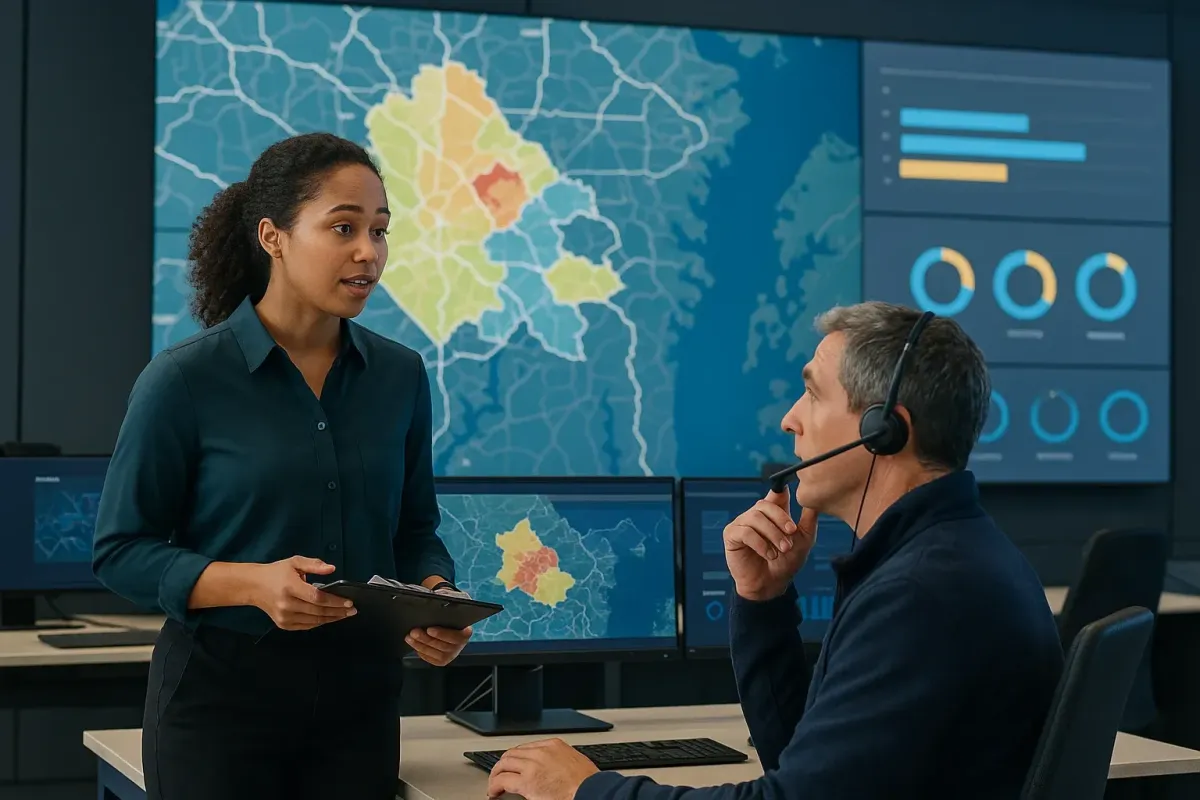
Enterprise Data Strategy for Predictive Operations in Utilities Voice AI
A practical, jurisdiction-neutral framework for utility leaders to design data strategy for high‑volume Voice AI that enables reliable outage communications, secure account validation, service‑request automation, and predictable field routing.
1. Why a utility-focused data strategy matters for Voice AI
Voice AI is a high‑throughput customer-facing layer that touches billing, outage communications, and field operations. The data strategy determines reliability, safety, and regulatory traceability in predictable operations.
Operational outcomes to design for
Prioritise outcomes that map to utility functions: accurate outage status for affected customers, correct service‑request intake (location, priority, safety flags), and reliable field scheduling data. These outcomes drive the data requirements: timeliness, validation, provenance, and retention windows aligned with operational SLAs.
- Timeliness: call-to-status latency targets for outage notifications and estimated restoration times.
- Provenance: source system and timestamp for every decision or response Voice AI provides.
- Retention: auditable recordings, event logs and metadata retained per policy for dispute resolution and regulatory review.
Failure boundaries and safety constraints
Design explicit failure modes: what Voice AI may do (provide status, capture requests, schedule callbacks) and what it must never do (initiate switching, issue safety advisories that replace emergency services). Map each capability to a fallback path—playback of latest verified data, immediate transfer to human agents, or read-only status response—so outages or degraded integrations do not create unsafe operations.
- Define a 'safe read-only' response when primary sources are unavailable.
- Automatically escalate calls with ambiguous or safety-critical content to human agents.
- Log and surface degraded-data indicators to downstream dispatch and field crews.
2. Core data architecture and canonical workflows
A compact, predictable architecture reduces integration friction and provides clear governance points. The canonical call flow enforces validation and uses only approved systems as sources of truth.
Canonical call flow (operational pattern)
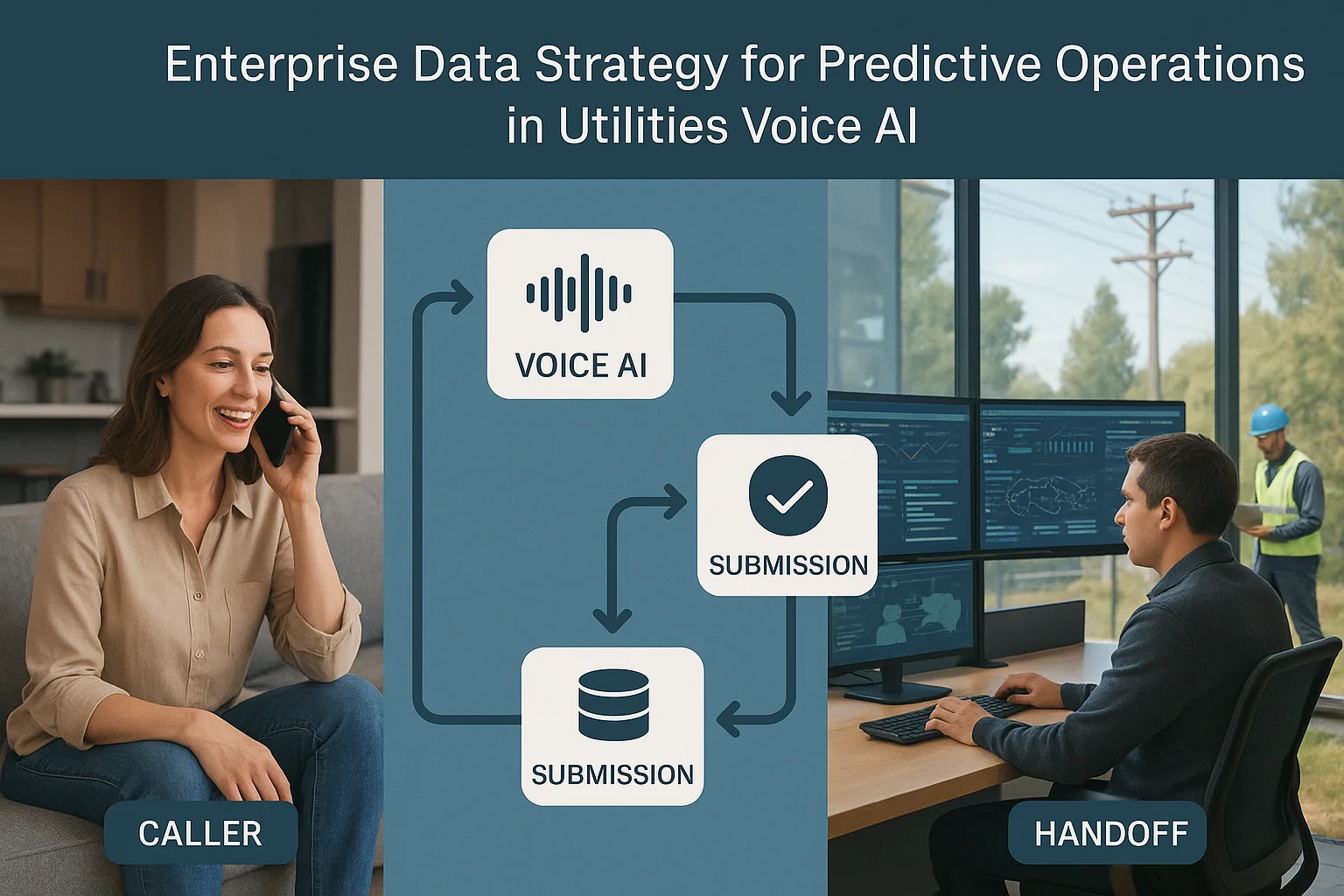
Standardize the call flow across channels so monitoring, QA, and auditing are consistent: Customer call → Voice AI intake → account or premise validation → query approved utility API or knowledge source → return status, create service request, or escalate to human. Keep Voice AI stateless outside ephemeral session data and store authoritative records in the utility’s CIS/OMS/CRM.
- Voice AI captures intent and minimal PII required for routing.
- Validation step queries CIS/CRM and geolocation services before any write operation.
- Service requests are created in the OMS or ticketing system using accepted data contracts.
Data layers and adapters
Segment data responsibilities: real-time status (OMS/SCADA/Network Data), customer identity (CIS/CRM), work management (OMS/WRMS), and analytics/event store. Use controlled adapters to translate between Voice AI session events and each canonical system. Adapters enforce contracts, throttle writes under surge, and present standardized error codes for deterministic fallback.
- Adapters implement input validation, rate limiting, retry semantics, and idempotency keys.
- Event store captures raw Voice AI transcripts, intent metadata, validation results, and API responses for diagnostics and analytics.
- A configuration layer maps intent versions to routing logic so operational teams can update flows without redeploying core models.
3. Account and premise validation: controls that prevent customer harm
Validation is the gatekeeper for any action that affects accounts, billing, field visits, or safety. Design multi-signal, risk-based validation that scales for high call volumes.
Risk-based validation pattern
Use a tiered validation approach: low-risk read-only queries (e.g., outage status) require minimal signals; medium/high-risk actions (service disconnects, access scheduling) require multi-factor signals: account number plus a time-limited token, geolocation confirmation, or callback verification. Log both the validation decision and the signals used.
- Define risk tiers in collaboration with legal, operations, and compliance.
- Require stronger validation when requests include sensitive operations or safety flags.
- Use ephemeral tokens tied to session and limited to a single transaction.
Account-safe implementation choices
Where possible, avoid storing full PII in the Voice AI session. Use tokenization and on-demand lookups to CIS/CRM through approved APIs. Implement fine-grained role-based access controls for adapters so Voice AI components have only the permissions required to perform declared actions.
- Tokenize account identifiers in-session; retain tokens with minimal metadata in the event store.
- Audit adapter credentials and rotate them regularly; require just-in-time elevated privileges for sensitive actions.
- Maintain a deny-list for operations that must always route to a human agent.
4. Integration, surge handling, and observability
Voice AI systems must survive surges—outages drive calling peaks—and provide operational visibility. Data contracts and event-level telemetry are the foundation for predictable behaviour.
Data contracts and event architecture
Define clear data contracts for each integration: required fields, acceptable value ranges, error semantics, and backpressure signals. Publish these contracts to both integration teams and vendors. Capture event-level detail (intent, confidence, validation result, API response code) to an immutable event store to enable post-incident analysis and SLA measurement.
- Contracts specify idempotency keys to avoid duplicate work-order creation.
- Include confidence scores and explicit thresholds that trigger human escalation.
- Ensure event logs include system-of-record pointers and full trace IDs for each call.
Surge strategies and graceful degradation
Implement pre-defined surge modes: (1) degraded read-only: only provide status from cached verified snapshots; (2) rate-limited write: accept requests but queue them to the OMS with explicit customer messaging; (3) full human-transfer: route calls to overflow centers. Make surge transitions observable, auditable, and reversible.
- Use cached, validated snapshot layers for outage status with clear TTLs.
- Expose surge mode in Voice AI prompts (e.g., ‘We are experiencing high volume; your request has been queued’).
- Prioritize safety-flagged calls for immediate human handoff regardless of surge mode.
Operational observability
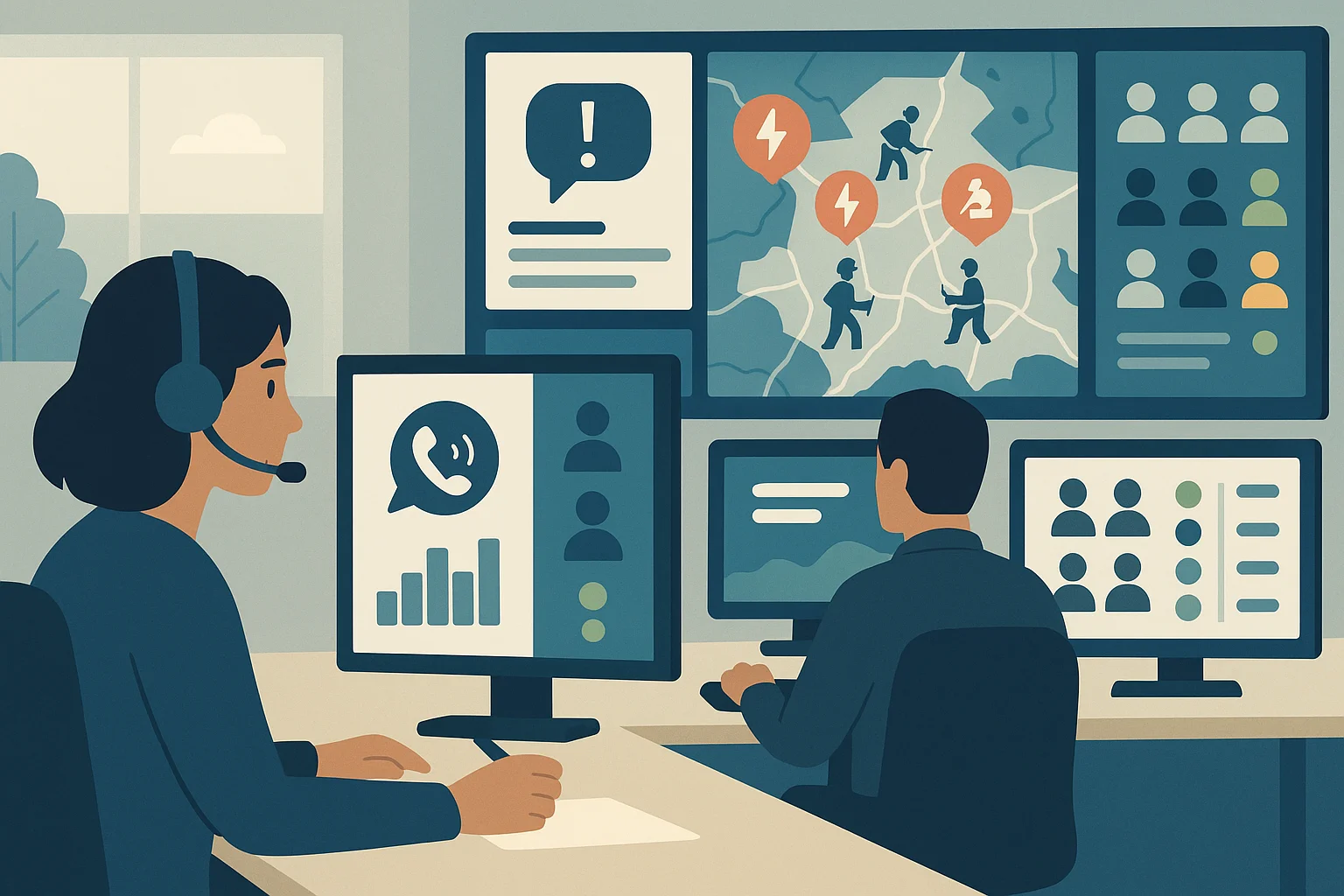
Measure call-level and event-level metrics: validation success rate, intent-to-action latency, escalations per thousand calls, duplicate work-order rates, and post-call field dispatch discrepancies. Correlate Voice AI events with OMS and field telemetry for closed-loop measurement of predictive operations.
- Dashboards must support drill-down from service-level KPIs to individual call traces.
- Alerting thresholds for validation failures and adapter error rates should trigger runbooked operator responses.
- Retain event data long enough to support regulatory inquiries and root-cause analysis.

5. Governance, risk, and resilience for critical operations
A governance framework ties the data architecture to enterprise risk management, cybersecurity, and continuity planning. Where claims intersect with critical infrastructure risk management they should follow recognized guidance.
Risk management and resilience controls
Map Voice AI capabilities to risk profiles and apply controls consistent with critical‑infrastructure guidance: identify high‑impact functions, implement defense-in-depth for integrations, and validate recovery objectives for Voice AI and adapters. Structured risk assessments and periodic tabletop exercises reduce unknown failure modes.
- Prioritize protections for identity, work-order creation, and outage messaging.
- Maintain documented recovery time objectives and validated failover paths for adapters and event stores.
- Run cross-team drills that include dispatch, field crews, and the Voice AI vendor to rehearse escalations.
Data residency, transfers, and third-party processors
Catalog where session data, recordings, and event logs reside, including backup geography and subprocessors. Document cross-border transfer mechanisms and retention policies. For any legal or regulatory obligations, confirm requirements with qualified counsel and local regulators before finalizing hosting and subprocessor arrangements.
- Maintain a register of subprocessors and access privileges for each environment.
- Define retention and deletion policies aligned to dispute resolution and regulatory needs.
- Limit remote-support access and document on-call procedures that involve third-party engineers.
6. Procurement, operational readiness, and measurable outcomes
Procurement should be framed as an operational contract: define integration ownership, SLAs for validations, testing responsibilities, and evidence required for acceptance.
Procurement checklist and evidence
Require vendors to provide integration runbooks, data-contract definitions, security architecture, and an observability plan. Ask for deterministic failure-mode documentation and proof of prior high-volume operations (references and operational metrics). Ensure contracts specify who owns adapters, error handling, and work-order reconciliation.
- Deliverables: adapter code or schema, test harness, and service-level definitions for validation and write operations.
- Specify acceptance tests: surge simulation, validation failure, and end‑to‑end ticket creation.
- Clarify ongoing responsibilities for adapter maintenance, rotation of credentials, and post-incident forensics.
Operational readiness and KPIs
Operationalize by running end‑to‑end scenarios with live data and field verification. Track KPIs tied to outcomes: percent of outage callers receiving accurate status, median time from call to ticket creation, percentage of escalated calls requiring human correction, and downstream field-dispatch accuracy. Use these KPIs in quarterly governance reviews.
- Run pre-launch shadow mode where Voice AI suggests actions but a human executes them.
- Set KPI targets with realistic baselines and include degradation thresholds that trigger remediation.
- Use event-level analytics to reconcile Voice AI actions with OMS and field outcomes.
Related Peak Demand resources
Industry and AI sources reviewed
- AI Risk Management Framework — Critical Infrastructure ProfileNational Institute of Standards and Technology (NIST)
- Cross-Sector Cybersecurity Performance GoalsCybersecurity and Infrastructure Security Agency (CISA)
- Cybersecurity Capability Maturity Model (C2M2)U.S. Department of Energy
Utility cybersecurity, critical-infrastructure, records, customer-protection, and emergency-communications obligations vary by jurisdiction and service type. This article is operational guidance, not legal advice; organizations should confirm applicable requirements with qualified professionals.
Frequently asked questions
Good starting points include billing and account questions, move-in or move-out intake, appointment scheduling, service-request capture, outage-status messaging from approved systems, payment-routing assistance, and structured escalation. Safety-critical and infrastructure-control decisions should remain with qualified utility teams.
Official reference: Cross-Sector Cybersecurity Performance Goals
Use the minimum approved identifiers needed for the workflow, validate them against the utility's system of record, limit data exposure, and provide a human-assisted path when verification fails. The Voice AI should not guess account, premise, or outage information.
Official reference: Cross-Sector Cybersecurity Performance Goals
Use controlled adapters, strict schemas, timeouts, retries, audit logs, safe failure states, and human escalation. The system should distinguish approved utility data from model-generated language and should never present stale or unverified operational information as fact.
Official reference: Cybersecurity Capability Maturity Model (C2M2)
Track containment by request type, successful validations, transfers, abandoned calls, integration errors, incorrect or stale responses, time to resolution, customer follow-up, and the percentage of cases completed safely without manual rework.
Official reference: Cybersecurity Capability Maturity Model (C2M2)
Build resilient utility customer-service automation
Peak Demand helps utilities connect Voice AI to approved customer-information, outage-communication, service-request, dispatch, escalation, and analytics workflows.
Schedule a discovery call


